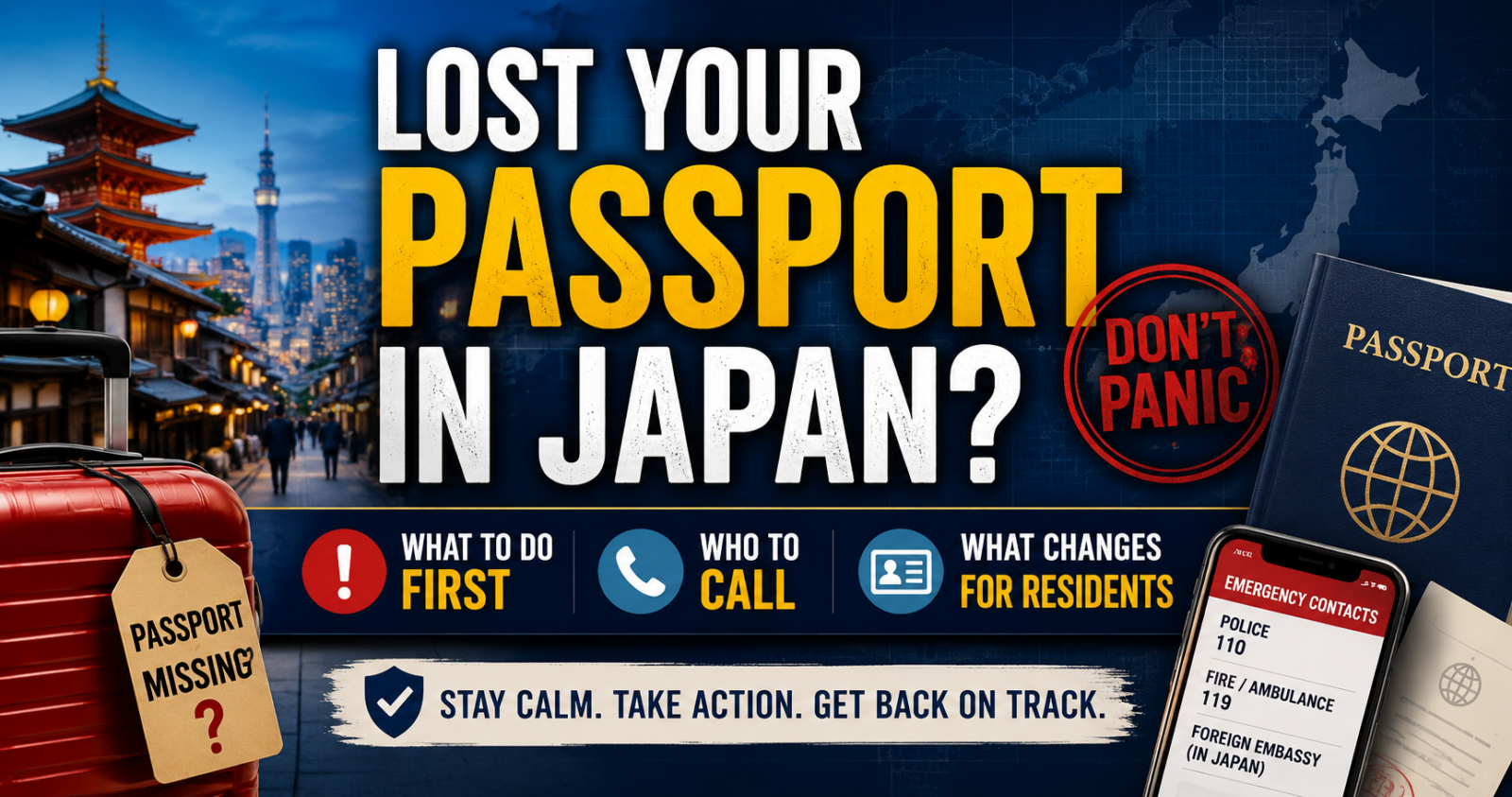
Lost Your Passport in Japan? What to Do First, Who to Call, and What Changes for Residents
If you lose your passport in Japan, do not wait for it to turn up on its own. The practical order is simple: check the last places you used it, file a lost-property report with police, contact your embassy or consulate, and ask whether you need a police certificate before they can issue a replacement or emergency document.
This guide is for tourists, students, workers, and long-term residents in Japan. It matters most when you need to catch a flight soon, prove your identity, or you lost other documents with the passport.
- Check the place you last used the passport first: hotel, airport, station, train, taxi, shop, or restaurant.
- File a police lost-property report at a police station or koban as soon as possible.
- Contact your embassy or consulate before assuming what documents they need.
- If your residence card was also lost, ask Japan immigration where to handle the next step.
What to do in the first few hours
Start with the simple places. In Japan, lost items are often kept by the business or transport operator for a short time before moving into the police lost-and-found system.
Check these places first:
- Your hotel front desk or luggage storage
- The station office for the line you used
- The airline counter or airport lost-and-found desk
- Taxi company dispatch if you took a taxi
- The store, restaurant, or attraction where you showed ID
If you were in Tokyo, the Metropolitan Police says railways, bus companies, airlines, and businesses may keep lost property for a few days before it reaches police records. That matters because a same-day call to the station or hotel can be faster than waiting for a police database match.
File a police report in Japan
After that first check, go to a police station or koban and file a lost-property report.
In Tokyo, the English guidance from the Metropolitan Police says you should submit a Lost Property Report in person. The same page also says reports cannot be accepted by email or other remote methods. It also notes that police can contact you if the item is found, but in practice you should give a Japanese phone number if you have one.
If the passport was stolen rather than simply lost, say that clearly when you report it. Some embassies ask for a police report or police report number when you apply for a replacement.
ここがポイント: The police report is not the same thing as a replacement passport application. You usually need both: one in Japan for the loss, and one with your own government for the new travel document.
Contact your embassy or consulate next
Do this even if you think the passport may still appear later.
The Tokyo police English page specifically tells people to contact their own embassy or consular office first to check whether a police certificate is required for reissue. That is important because replacement rules are set by your passport-issuing country, not by Japan.
Use Japan’s Ministry of Foreign Affairs directory of foreign missions to find the right embassy or consulate in Japan. If you are outside Tokyo, check whether your country has a consulate closer to Osaka, Nagoya, Fukuoka, Sapporo, Naha, or another city.
What your embassy may offer
The document you get depends on your nationality and your travel timing.
Examples from official government pages:
- The UK says you may be able to apply for an emergency travel document in Japan.
- The Australian Passport Office says people overseas with urgent travel needs can apply for an emergency passport at an embassy or consulate.
- US government guidance says people outside the United States should contact the nearest embassy or consulate, and in some cases may get a limited-validity passport if there is not enough time for a regular one.
That difference matters. An emergency document may get you home, but it may not work the same way as a full-validity passport for transit, visas, or future travel.
What to prepare before you go to the embassy
Requirements vary, but these are the items most often requested:
- Police report or report number
- Passport photos
- Another ID if you have it
- Copy or photo of the lost passport, if available
- Flight booking or urgent travel proof
- Payment method for fees
If you have scans saved in cloud storage or email, pull them up before your appointment. A passport copy, residence card copy, or old visa page can make the replacement process smoother.
If you live in Japan, not just visit
For residents, losing a passport is more than a travel problem.
It can affect:
- Re-entry plans if you were about to leave Japan
- Employer or university paperwork that needs passport details
- Banking or identity checks for some procedures
- Immigration-related procedures if your residence card was also lost
The Immigration Services Agency says entry and residence procedure questions should go to its Immigration Information Center. If your residence card was lost together with the passport, contact immigration promptly instead of waiting until your next trip.
If only the passport is gone
If your residence card is still with you, daily life is usually easier than if you lost both documents. You may still need the new passport for international travel, visa-related checks from your own government, and some contract or identity procedures.
If the passport and residence card were both lost
Treat that as a higher-priority case.
Do these in parallel:
- File the police report
- Contact your embassy or consulate
- Contact Japan immigration about residence procedures
- Tell your employer or school if upcoming paperwork or travel will be affected
Costs and timing
There is no single Japan-wide price for replacing a foreign passport. Fees, processing time, and emergency options depend on your nationality.
In real terms, expect variation in:
- Standard replacement passport fee
- Emergency document fee
- Passport photo cost
- Travel cost to the embassy or consulate
- Possible hotel or rebooking costs if your departure is delayed
Do not assume same-day issuance. Some embassies can move quickly in urgent cases, but others need appointments, identity checks, or approval from the home country.
Common mistakes to avoid
Waiting too long because Japan has a good lost-and-found system
Japan does have a strong lost-and-found culture, but that is not a reason to delay the formal steps. If you have a flight, hotel checkout, visa deadline, or school/work schedule, start the report and embassy contact process early.
Reporting only to the station or hotel
That helps, but it is not enough. You still need a police report if your embassy asks for it.
Canceling first and asking questions later
Some governments warn you to make sure the passport is really lost or stolen before formally reporting it, because once it is canceled, you usually cannot use it again even if it is found later.
Japan’s Ministry of Foreign Affairs says this clearly for Japanese passports: after a loss report, the passport becomes invalid and cannot be used even if found later. US and Australian government guidance says the same in their systems.
Forgetting transit rules
If you receive an emergency passport or travel document, check every country on your route, not only your final destination. Some transit points have separate document or visa rules.
Latest practical status as of May 8, 2026
A few current points are worth knowing:
- JNTO’s Japan Visitor Hotline is operating 24 hours a day, 365 days a year at
050-3816-2787inside Japan and+81-50-3816-2787from overseas. - JNTO also lists police emergency
110, ambulance/fire119, and a police lost-and-found number0570-550-142. - The Ministry of Foreign Affairs foreign missions directory is current and remains the fastest official starting point for finding embassies and consulates in Japan.
- Tokyo police continue to provide English guidance that tells people to file a Lost Property Report and to contact their embassy first if the item is a passport.
Bottom line
If you lose your passport in Japan, the fastest safe route is not complicated: search the last location quickly, file the police report, then move to your embassy without delay.
For tourists, the biggest risk is missing a flight because you waited too long.
For residents, the bigger risk is letting one missing document turn into a residence or re-entry problem when other paperwork is tied to it.
Before you travel again, check one last thing: whether the document you received is a full passport or only an emergency document, and whether your transit country accepts it.
参照リンク
- Tokyo Metropolitan Police: If you’ve lost something
- JNTO: Japan Visitor Hotline
- Ministry of Foreign Affairs of Japan: Foreign Missions in Japan
- GOV.UK: Passports and emergency travel documents in Japan
- USAGov: Lost or stolen passports
- Australian Passport Office: Lost and stolen passports
- Australian Passport Office: Emergency passport
- Immigration Services Agency of Japan: Feedback/request concerning policies geared towards harmonious coexistence with foreign nationals
- Ministry of Foreign Affairs of Japan: Passport procedures required in Japan and overseas