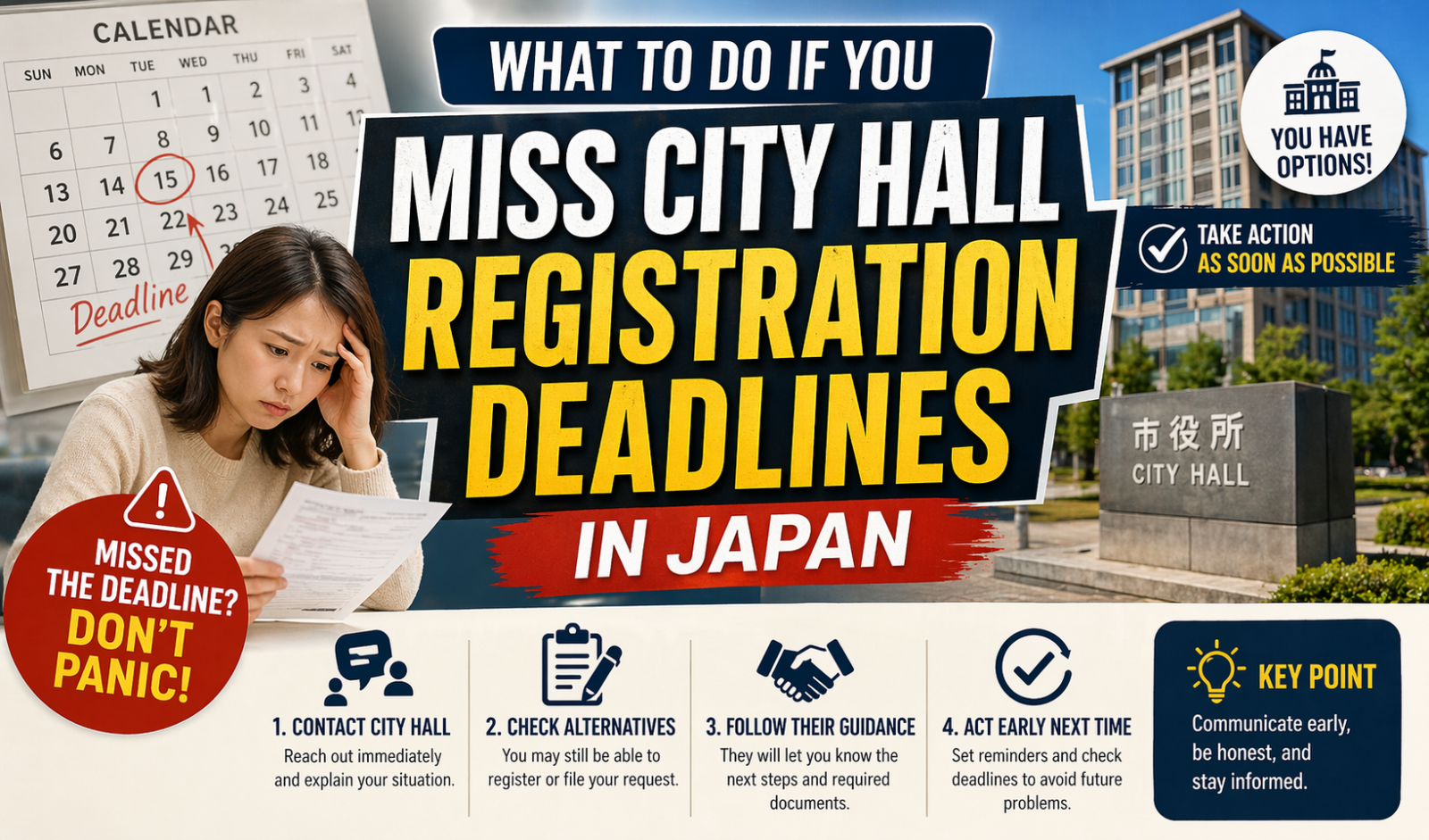
What to Do If You Miss City Hall Registration Deadlines in Japan
If you missed a city hall or ward office registration deadline in Japan, go and file the procedure as soon as possible. In many cases, the practical fix is simple: complete the late notification at the correct municipal office, bring your ID documents, and explain when you actually moved.
What matters is not trying to “reset” the date or waiting for the next convenient time. A late filing is usually much better than no filing, because your address registration affects your residence card record, My Number record, health insurance, pension, tax notices, and other basic services.
- Best next step: visit the municipal office that handles your current address as soon as you can
- Most common deadline: within 14 days after you move in or settle your address
- Main risk of waiting: paperwork problems can spread into insurance, tax, banking, school, and visa-related records
- Important line for foreign residents: a long delay can become more than a city hall problem if your residence card address stays outdated
Who This Guide Is For
This guide is for foreign residents in Japan who:
- just arrived and did not register their address in time
- moved to a new apartment and forgot the city hall procedure
- changed cities or wards and never completed the move-in paperwork
- are worried because their residence card still shows an old address
It matters most for students, workers, and long-term residents, because they usually need a current resident record for contracts, insurance, school paperwork, tax mail, and visa-related checks.
Which Deadline Did You Miss?
The first step is to identify which procedure you missed. The fix depends on the type of move.
1. You arrived in Japan and did not register your address
If you are a mid- to long-term resident who entered Japan with a residence card, or with a passport stating that a residence card will be issued later, you must notify your place of residence within 14 days after deciding where you live.
This is the basic “I now live here” registration. It is usually done at your city hall, ward office, town office, or village office.
2. You moved to a different municipality inside Japan
If you moved from one city, ward, town, or village to another, the normal flow is:
- file a move-out notification with the old municipality before moving
- file a move-in notification with the new municipality within 14 days after moving in
If you missed the deadline, the new municipality is still the place to fix the current address problem. In many cases, they will tell you what is missing and whether you also need a move-out certificate or extra explanation.
3. You moved within the same municipality
If you moved to a different address but stayed inside the same city or ward system, you usually need a relocation or change-of-address notification within 14 days after the move.
This is easy to overlook because people often think it only matters when they change cities. It still matters because your resident record and the address printed on related records need to match where you actually live.
ここがポイント: If you missed the 14-day deadline, the practical answer is usually to file now, not to wait. The longer the gap, the more likely the problem spreads into other records.
What You Should Do Now
Start with the office for your current address.
Go to the correct municipal office
Bring your case to the city hall or ward office that covers the place where you live now.
If you are not sure which counter handles it, ask for:
- resident registration
- moving-in notification
- change of address
- residence card address update
In many municipalities, the same visit can also update the address on your residence card when you file the resident registration procedure.
Bring the documents that usually matter
The exact checklist varies by municipality, but these are the documents most often needed:
- residence card, or special permanent resident certificate if that applies to you
- passport
- move-out certificate if you moved from another municipality and have one
- My Number Card if you have one
- National Health Insurance card or qualification document if you are enrolled
- pension booklet or pension number notice if you handle National Pension yourself
- a power of attorney if someone will act for you and the municipality allows it
A municipality such as Gifu City also lists these kinds of items in its English guidance, which is a good reminder that document requirements are not perfectly identical everywhere.
Explain the delay clearly
Do not invent a better story. Give the real move date and a short explanation.
Good examples are simple:
- you did not understand the procedure
- you moved during a busy school or work period
- you were still waiting to settle housing
- you were sick or had another reason you can explain briefly
A factual explanation is usually more useful than a long apology.
Ask what else must be fixed on the same day
This matters because the address registration itself is only one part of daily life in Japan.
Depending on your case, the same move can affect:
- National Health Insurance
- National Pension
- My Number Card information
- child-related benefits
- school enrollment records
- resident tax notices
If you are age 20 to 59 and you are not enrolled through an employer or spouse, National Pension enrollment and address handling may also matter at the municipal office.
What Can Happen If You Leave It Unfixed?
The most common problem is not a dramatic punishment on day one. It is that your basic records stop matching real life.
That can lead to practical trouble such as:
- mail from the city, tax office, school, or pension system going to the wrong address
- delays with health insurance or municipal procedures
- trouble proving your current address for a bank, phone contract, or apartment paperwork
- confusion when you renew or change other official records later
For mid- to long-term foreign residents, there is also an immigration angle.
Under the Immigration Control and Refugee Recognition Act, not reporting a new place of residence as required can lead to a fine of up to 200,000 yen. The law also allows status revocation issues in more serious cases, including when a person leaves a previously reported address and does not notify a new address within 90 days without a justifiable reason.
That does not mean every late filer faces the worst outcome. It means you should not treat an outdated address as a minor paperwork issue if weeks keep turning into months.
Common Mistakes After Missing the Deadline
Once people realize they are late, they often make a second mistake. These are the ones to avoid.
Waiting until visa renewal
This is risky. Your address record matters during daily life, not only at immigration time.
Using an address where you do not really live
Do not register a friend’s address, company address, or old share house just to make the paperwork easier. False notifications carry more serious legal risk than a late but truthful filing.
Forgetting the move-out side of the process
If you changed municipalities, the new office may ask about the old municipality’s move-out procedure. Even when late, ask how to clean up both sides properly.
Assuming online services finish everything
Japan’s moving procedure has become more digital, but it is not fully digital in the way many people expect.
Current Changes That Matter as of April 23, 2026
There is one update worth knowing if you are fixing a move late now.
Online move-out is wider, but move-in is still in person
The Digital Agency’s moving procedure service through Mynaportal is available nationwide for people moving within Japan who have a valid My Number Card with the needed electronic certificate. This can let you submit a move-out notification online in principle.
But the key limit remains the same: move-in notification itself still requires an in-person procedure at the municipality you move into. So if your deadline problem is on the move-in side, an online step alone will not solve it.
Municipal differences still matter
National rules set the main deadlines, but the desk flow, accepted proxy procedures, and supporting documents can differ by municipality. That is why it is smart to check your municipality’s website before you go, especially if you need English support or you are asking someone to file on your behalf.
A Practical Way to Handle This Week
If this is your situation now, keep it simple.
- Check which municipality controls your current address.
- Gather your residence card, passport, and any move-out paper you have.
- Visit the resident registration counter as soon as possible.
- Give the real move date and complete the late filing.
- Ask what linked procedures also need correction that day.
If your delay is already long, or if your residence card address has been wrong for a long time, confirm the next step directly with your municipality and, if needed, the Immigration Services Agency.
The practical takeaway is straightforward: do the registration now, while it is still mainly an administrative fix, not a bigger residency problem.
参照リンク
- Digital Agency: Online Service for Moving Procedures
- Digital Agency: FAQs on online move-out notifications and move-in appointments
- Immigration Services Agency: Notification of place of residence after new entry to Japan
- Immigration Services Agency: Notification of change of place of residence for mid- to long-term residents
- Japanese Law Translation: Immigration Control and Refugee Recognition Act
- Japan Pension Service: Enrollment in National Pension
- Digital Agency: FAQ about My Number
- Gifu City: Municipal Address Change Notifications