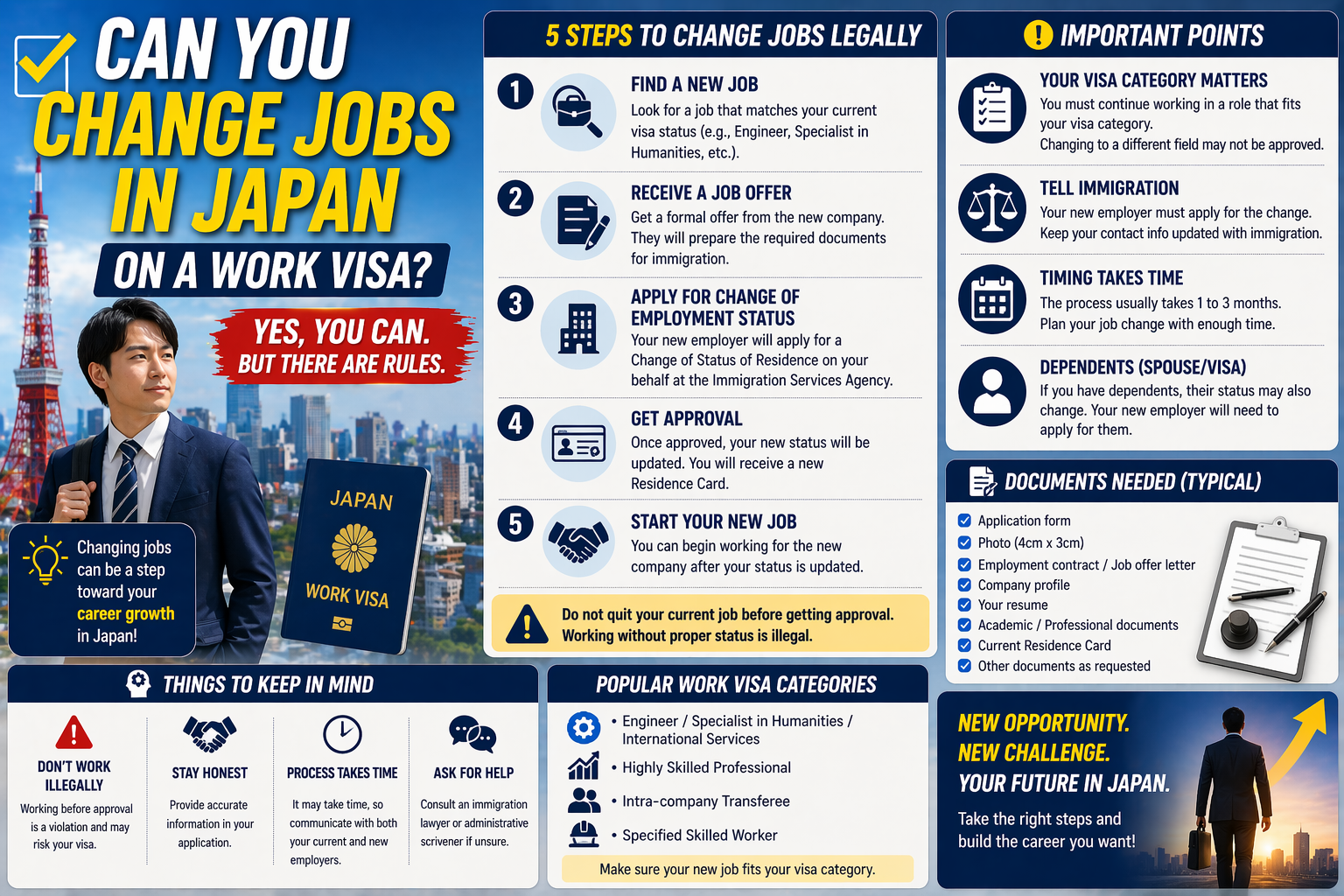
Can You Change Jobs in Japan on a Work Visa?
Yes, you often can change jobs in Japan without leaving the country, but only if your new work still fits your current status of residence.
The key point is simple: Japan does not decide this by the word “visa” alone. It decides it by your status of residence, the work category attached to your residence card and immigration record. If your next job falls inside that category, changing employers is usually possible. If it does not, you may need to apply for a change of status before you start the new role.
- Same work category: often possible with no new status application, but you still need to notify immigration.
- Different work category: usually requires a change of status of residence.
- Deadline that people miss: many workers must file an affiliated organization notification within 14 days after leaving a company or joining a new one.
- Big risk: staying unemployed for a long period without a valid reason can create trouble at renewal or even lead to revocation procedures.
This guide is for foreign workers in Japan, especially people on statuses such as Engineer/Specialist in Humanities/International Services, Skilled Labor, Research, or Highly Skilled Professional. It matters when you get a new offer, resign, move from teaching to office work, switch from one company to another, or spend time between jobs.
The short rule: when you can change jobs and when you cannot
Changing employers is not automatically a problem. Changing into work outside your current status is the real issue.
For example:
- If you are on
Engineer/Specialist in Humanities/International Servicesand move from one marketing job to another similar marketing role, that is often within the same status. - If you are on
Engineer/Specialist in Humanities/International Servicesand want to open and run your own company full-time, that may point towardBusiness Managerinstead. - If you are on
Intra-company Transfereeand leave the group company that transferred you, you usually cannot just move to any unrelated employer without checking whether you need a different status. - If you are on
Skilled Laboras a foreign cook, moving to office administration is not the same category of work.
ここがポイント: You can change jobs in Japan on a work visa if the new job matches the activities allowed under your current status of residence. If it does not, apply for a status change before doing that new work.
What “same status” means in real life
A lot of confusion comes from job titles. Immigration looks at the actual duties, your background, and the legal category of the work, not only the title shown in the offer letter.
A similar job at a new company
This is the easiest case.
If your new employer is giving you work that fits the same status you already have, you can usually move jobs without leaving Japan. In that case, your practical tasks are:
- resign properly under your employment contract
- update immigration through the required notification if your status is one of the covered work statuses
- prepare documents carefully for your next period-of-stay renewal
For many office workers, engineers, translators, designers, and private-sector language teachers on Engineer/Specialist in Humanities/International Services, this is the common path.
A job that changes your legal work category
If the new role belongs to another status of residence, you normally need to file a Change of Status of Residence application.
Common examples include:
- employee to full-time company manager
- intra-company transfer to an unrelated Japanese employer
- office work to specialized skilled work in another category
- student or dependent status holder moving into full-time professional work
As of April 23, 2026, the Immigration Services Agency lists the fee for a permitted change of status as 6,000 yen, or 5,500 yen for an online application. The standard processing period shown by ISA is one to two months.
Cases that need extra care
Some statuses are more employer- or activity-specific than people expect.
Highly Skilled Professional: changing jobs may affect the points basis that supported your status, so do not assume a simple employer switch is enough.Specified Skilled Worker: the rules are tied closely to the approved field and receiving organization, so job changes need much closer checking.Intra-company Transferee: this status is built around an internal transfer relationship, so moving outside that structure often changes the immigration analysis.
What you must do after you change jobs
The most missed step is the immigration notification.
For statuses such as Engineer/Specialist in Humanities/International Services, Research, Care Worker, Skilled Labor, Specified Skilled Worker, and some Highly Skilled Professional categories, ISA says you must notify immigration within 14 days when:
- your contract with the old company ends
- you sign a contract with a new company
- or both happen together
ISA allows this through its online notification system, by mail, or by filing the designated form.
This does not replace a change-of-status application when one is needed. It is a separate duty.
Do you need permission before starting the new job?
That depends on the new role.
- If the new job clearly fits your current status, people often start the new job without waiting for a new status decision because there is no status change to wait for.
- If the new job may fall outside your current status, do not assume it is safe to start first and fix it later.
If there is any doubt, a practical option is to apply for a Certificate of Authorized Employment. This document is not mandatory in every job change, but it can help confirm whether the work you plan to do matches your current status. That matters because the same question often comes back at renewal time.
Unemployment between jobs: how long is too long?
There is no simple official rule that says every work visa ends immediately when you resign. But there is a real risk if you remain in Japan for a long time without doing the activities tied to your status.
ISA explains that status revocation can apply where a person with a work-related status has stayed in Japan for three months or more without continuing the authorized activity, unless there is a justifiable reason.
That does not mean every three-month gap causes automatic cancellation. It does mean you should treat a long gap seriously.
Practical examples of factors that matter:
- you are actively job hunting and can show records
- you left because of layoff, illness, or another reason you can explain
- you are not working in an unauthorized job while waiting
- your current period of stay is close to expiry
A short gap between employers is common. A long unexplained gap is where problems start, especially at renewal.
Common mistakes foreign workers make
A job change becomes risky when the worker focuses only on the new offer and ignores the immigration side.
Mistake 1: Thinking any full-time job is fine
It is not. Full-time work is not the test. The test is whether the work fits your current status of residence.
Mistake 2: Forgetting the 14-day notification
This is one of the easiest errors to avoid, and one of the most common.
Mistake 3: Assuming the company handles everything
Your employer may handle labor and tax paperwork, but your immigration notification and status position are still your responsibility unless a formal representative handles the filing correctly.
Mistake 4: Working first and asking later
If the role may require a different status, this can create a direct immigration problem.
Mistake 5: Ignoring renewal risk
Even if the employer switch itself went smoothly, your next extension may be harder if your job duties, salary, or employment stability no longer support the status you hold.
A simple checklist before you resign
Use this before signing the next offer.
- Check the exact status of residence on your residence card.
- Compare your new duties with the activities allowed under that status.
- Confirm whether your status is one that requires a 14-day affiliated-organization notification.
- Ask whether a change of status is needed before the start date.
- Keep copies of your old resignation notice, new contract, job description, and pay details.
- If the case is unclear, confirm with ISA or a qualified immigration professional before you start work.
Current status and practical takeaway
As of April 23, 2026, the basic rule has not changed: Japan allows job changes on a work status, but only within the scope of the status you already have unless you obtain a change. Online immigration procedures remain available, and the current listed change-of-status fee is 6,000 yen, or 5,500 yen online.
For most workers, the safest way to think about it is this:
- changing employer is often possible
- changing the legal nature of your work is the real trigger
- the 14-day notification deadline is not optional
- a long gap without authorized activity is where renewal and revocation risk grows
If you are about to move jobs, the next thing to check is not only your new salary or contract date. Check whether your actual duties still match the status you already have. That is the point that decides whether the move stays simple or turns into an immigration application.
参照リンク
- Immigration Services Agency of Japan: Procedures by type
- Immigration Services Agency of Japan: Notification regarding the contracting organization
- Immigration Services Agency of Japan: Status of residence “Engineer / Specialist in Humanities / International Services”
- Immigration Services Agency of Japan: Change of status of residence
- Immigration Services Agency of Japan: Application for change of status of residence
- Immigration Services Agency of Japan: Application for certificate of authorized employment
- Immigration Services Agency of Japan: Revocation of status of residence
- Immigration Services Agency of Japan: Online applications
- Immigration Services Agency of Japan: Electronic notification system portal