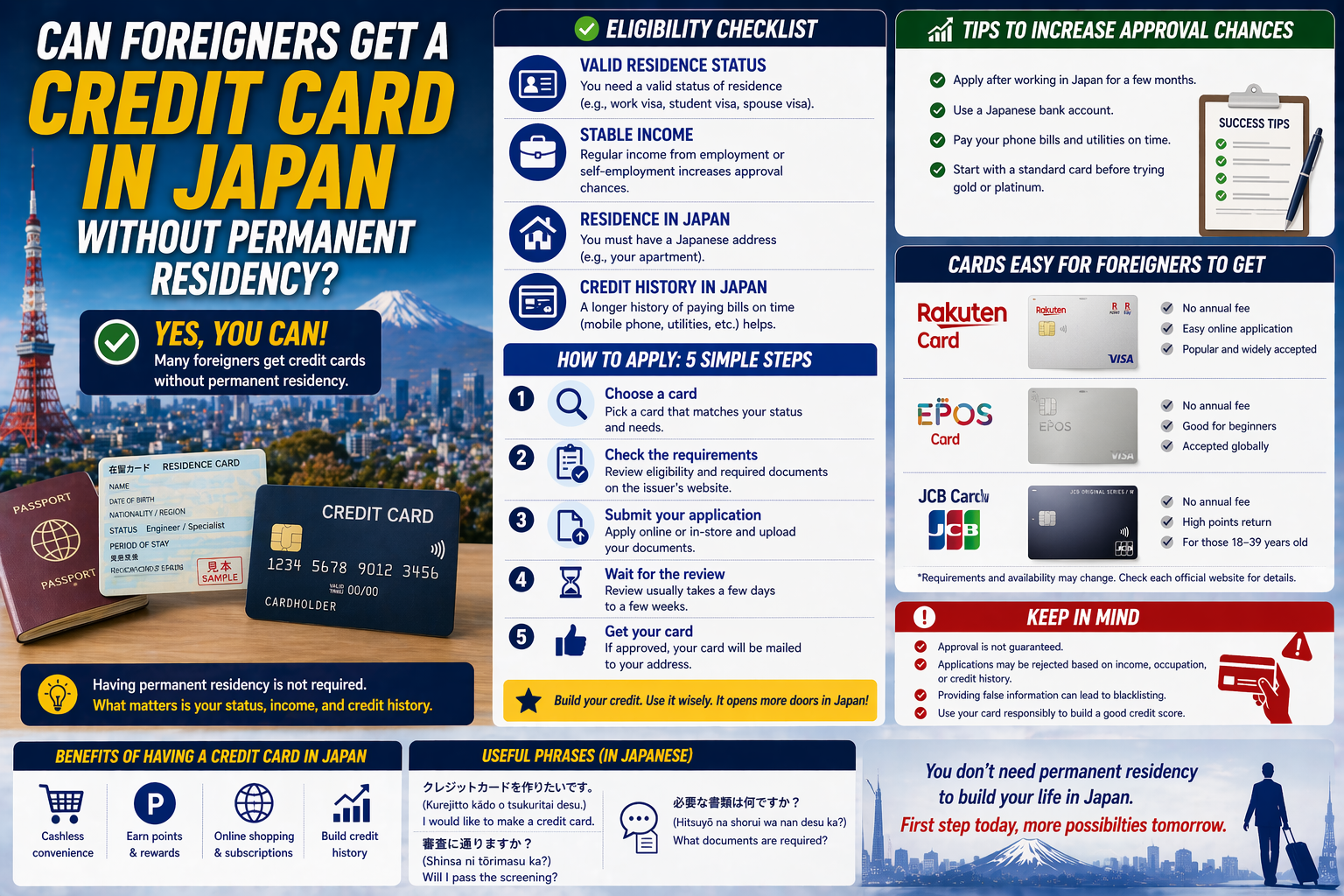
Can Foreigners Get a Credit Card in Japan Without Permanent Residency?
Yes, in many cases they can. Permanent residency is not usually the basic requirement. In practice, Japanese card issuers commonly focus on whether you have a valid mid-to-long-term status of residence, a registered address in Japan, a Japanese bank account, and enough income or payment ability to pass screening.
The important limit is this: if you are only in Japan short term, getting a normal Japanese credit card is usually not realistic. If you are a student, worker, dependent, or other mid-to-long-term resident, it can be possible even without permanent residency.
- Short answer: You do not usually need permanent residency itself.
- What you usually need: A residence card or special permanent resident certificate, a Japanese address, a Japanese bank account, and a phone number.
- Who this matters for: New workers, students, spouses, and long-term residents setting up daily life in Japan.
- What still decides approval: The card company’s own screening, including income, application details, and credit history.
Who This Guide Is For
This guide is for foreigners who already live in Japan, or will soon move in for more than a short visit, and want a local credit card for rent-related payments, phone bills, online shopping, travel bookings, or daily spending.
It matters most when you are doing the first wave of setup in Japan: opening a bank account, signing a mobile contract, paying utilities, or building a payment record that is easier to manage than cash-only life.
The Main Rule: Permanent Residency Is Not the Normal Starting Line
A lot of people assume “no permanent residency” means “no credit card.” That is too simple.
Official guidance from a major issuer, SMBC Card, says foreigners can apply if they meet the conditions, and it points to a different baseline: residence status for more than three months, required ID, a Japanese address, a Japanese bank account, and a Japanese phone number. That matters because it shows the practical gateway is not permanent residency itself.
This is best understood as an issuer rule, not a national law saying “foreigners without permanent residency cannot get cards.” Card approval is still private screening by each company.
ここがポイント: In Japan, the first question is usually not “Do you have permanent residency?” It is “Can you prove stable residence, identity, contact details, and ability to pay?”
What You Usually Need Before You Apply
Start with the basics. If these are missing, your application is weak before screening even begins.
1. A residence card for a stay over three months
Japan’s Immigration Services Agency explains that a residence card is issued to people who stay in Japan for more than three months. It is also used as ID for contracts and municipal procedures.
That means:
- Tourists and most short-term visitors are usually outside the normal credit-card path
- Mid-to-long-term residents are the main group who can apply
- Your status of residence and period of stay matter in real life, even if permanent residency does not
2. A registered address in Japan
The same immigration guidance says you must file your address within 14 days after your residence is decided. For card companies, this is not a small formality. Your card is normally mailed to your registered address, and address mismatches can delay or block approval.
3. A Japanese bank account
Most cards need a domestic bank account for automatic payment. If you do not have one yet, you usually need to solve that first.
4. A Japanese phone number
SMBC Card’s guidance for foreign applicants includes a mobile or landline number as part of the usual application setup. That matters because issuers may contact you during screening or use your phone number for account security.
What Card Companies Actually Check
After the basic documents, the next step is screening.
SMBC Card says the practical points include:
- whether you meet the card’s own application conditions
- whether you can submit ID and, if asked, income documents
- whether your name matches your official documents exactly
- whether you avoid asking for extra cash-advance features at the start
It also notes common rejection risks:
- mistakes or false information in the application
- applying for several cards in a short period
- late payments or other negative credit information
This matters for foreigners because a weak first application can close off easy options. If your residence card shows one spelling, your bank account uses another, and your application uses a nickname, the problem is not your nationality. The problem is inconsistent data.
Students, Workers, and Spouses: How the Reality Differs
Not every non-permanent resident looks the same to a card issuer.
Students
Students may be able to apply, but the bar is usually lower for entry-level cards than for premium cards. If you have allowed part-time income and your documents are clean, that can help. If you just arrived and have no bank account or stable contact information yet, approval is harder.
Workers
Workers with a steady job are usually in the strongest position among non-permanent residents. A full-time salary, clean application, and stable address make the file easier for the issuer to read.
Spouses and dependents
If you are in Japan as a spouse or dependent, approval is still possible, but the issuer will look closely at the total picture. Some people in this group may find a family card easier than a standalone new account, depending on household circumstances and the issuer’s rules.
Common Mistakes That Cause Trouble
These are the problems that matter most in everyday applications.
Applying too early
If you have just landed and still do not have your address registration, bank account, or phone number set up, waiting a little can be smarter than filing a weak application immediately.
Using a different name format
Use the same spelling and order as your residence card or passport. A small mismatch can become a manual review problem.
Applying for too many cards at once
This is a classic mistake. Issuers may read repeated applications as financial stress or risky behavior.
Asking for too much on the first card
An entry-level card with no cash-advance request is often the cleaner starting point. You can always upgrade later if your payment history is solid.
An Important 2026 Watchpoint: Residence Card Checks Do Not End After Approval
Getting approved is not the end of the compliance process.
EPOS Card says foreign customers may be asked to submit a residence card or special permanent resident certificate again so the company can keep confirming residency status and period of stay, in line with anti-money-laundering rules. In a February 16, 2026 FAQ update, EPOS also states that if a customer does not submit the updated residence card, or if the reported period of stay has expired, the company may restrict card use.
For foreigners living in Japan, this matters in very practical ways:
- renew your residence card on time
- update the issuer if your status or period of stay changes
- do not ignore follow-up emails or letters asking for document resubmission
- keep your address current with both the municipality and the card company
A card is not a one-time approval you can forget about. Your residency documents can continue to affect whether the account stays usable.
So, Can You Get One Without Permanent Residency?
For many foreigners already living in Japan, yes.
A more accurate answer is:
- Yes, if you are a mid-to-long-term resident with valid ID, a Japanese address, a Japanese bank account, and a realistic ability to pass screening
- Probably not, if you are only in Japan short term or you still lack the core setup documents
- Not guaranteed, even then, because each issuer applies its own screening rules
If you are preparing to apply, the next thing to check is not permanent residency alone. Check whether your residence card is current, your address is registered, your bank account is active, your name matches everywhere, and your application is modest enough to pass as a first card.