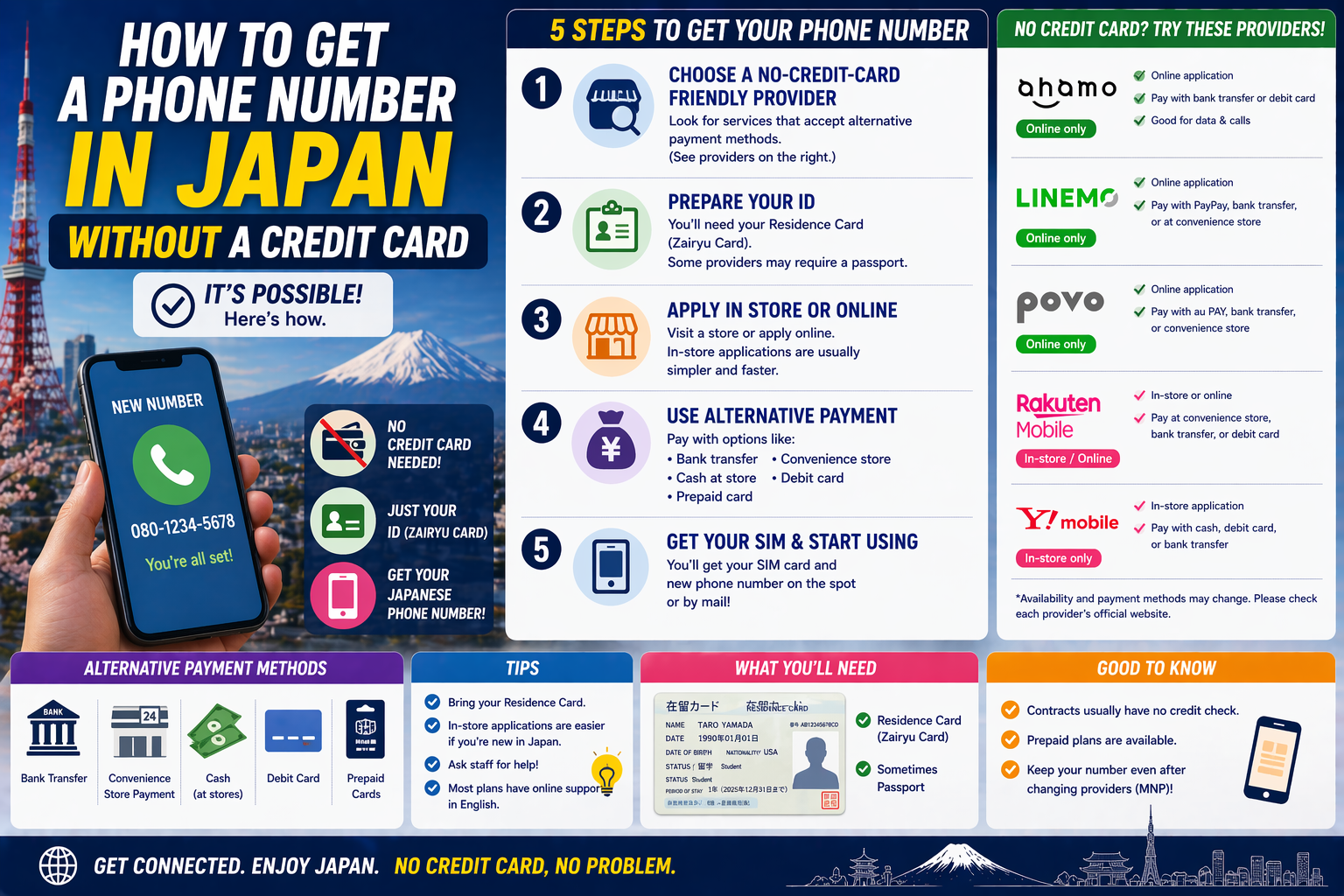
How to Get a Phone Number in Japan Without a Credit Card
Yes, you can get a Japanese phone number without a credit card.
The practical routes are debit card, bank account direct debit / bank transfer, or a provider that supports convenience-store or cash-linked payment. The harder part is not the phone number itself. It is choosing a plan that gives you a real Japanese mobile number and accepts your payment method.
This guide is for foreign residents, students, workers, and long-stay newcomers who need a number for job hunting, apartment paperwork, deliveries, school contact, or account verification.
- Fast answer: look for a voice SIM or eSIM, not a data-only travel SIM.
- Best no-credit-card paths: debit card, direct debit from a Japanese bank account, or convenience-store billing.
- Most common document: a valid residence card with your current address.
- Big mistake to avoid: applying before your address and ID details match.
Who this matters for
This matters most if you just arrived and have hit the usual loop:
- you need a phone number to live normally in Japan
- some carriers want a credit card or bank account
- some banks or services want SMS or a local contact number first
If that sounds familiar, the key is simple: do not start by comparing every carrier in Japan. Start by filtering for payment method and identity rules.
The main ways to get a number without a credit card
There are three realistic paths.
1. Use a debit card
Some providers accept debit cards, but not all debit cards work the same way.
For example:
- Rakuten Mobile says monthly charges can be paid by credit card, Rakuten Bank debit card, and some other debit cards.
- LINEMO says it accepts debit cards with the VISA, Mastercard, or JCB mark.
- Some carriers warn that even if a debit card can be registered, billing may still fail later depending on the card issuer.
What this means in practice:
- A debit card can be the easiest route if you do not yet have a Japanese credit card.
- It is still safer to keep a backup plan, because acceptance can depend on the card brand and issuer.
- If your debit card is foreign-issued, check carefully before assuming it will pass screening.
2. Pay from a Japanese bank account
If you already opened a Japanese bank account, this is usually the most stable non-credit-card route.
Examples:
- Rakuten Mobile supports bank transfer for monthly charges. It also notes a 110 yen monthly fee for bank transfer.
- LINEMO supports direct debit from a Japanese financial institution account in the subscriber’s name.
This route is usually better for long-term residents because:
- monthly payments are predictable
- failed payments are less likely than with some debit cards
- you do not need to wait for Japanese credit card approval
3. Use a provider built for foreigners or alternative billing
If you have no credit card and no Japanese bank account yet, a foreigner-focused provider can be the bridge.
Two useful examples:
- GTN Mobile lists convenience-store payment as an accepted payment method and supports customers in multiple languages.
- Mobal offers long-term SIM/eSIM plans with a real Japanese phone number and explains a cash route through its prepaid Mastercard service, which can be topped up at convenience stores if you live in Japan and have a residence card.
This route is not always the cheapest. But it can be the easiest when your priority is getting a usable number first.
ここがポイント: If you do not have a credit card, the question is not “Can I get a SIM?” It is “Which provider will give me a real Japanese number with a payment method I can actually use right now?”
What documents you usually need
For a normal Japanese voice plan, identity checks are strict.
Rakuten Mobile’s current guidance for foreign nationals centers on:
- residence card or special permanent resident certificate
- matching name, date of birth, and address
- a card that is still valid
Its identity-verification page also says the address must be listed, and if the address on your ID is outdated, you need supporting documents or an updated record.
That matters because many failed applications are not about nationality or language. They fail because:
- the address on the residence card is old
- the spelling of the name does not match
- the applicant enters a shortened middle name or different romaji form
- the payment method is in someone else’s name
Before you apply, check these four items
- Your residence card is valid and shows your current address.
- Your application name matches your ID exactly.
- Your payment method is accepted and, if required, in the same name as the subscriber.
- The plan clearly includes voice calls/SMS or says it provides a Japanese phone number.
The easiest order to try
If you want the shortest path, use this order.
Option A: You already have a Japanese bank account
Try a carrier that accepts direct debit or bank transfer.
A practical sequence is:
- Prepare your residence card and exact address.
- Choose a voice SIM or eSIM plan.
- Register a Japanese bank account for payment.
- Apply online if your phone supports eSIM, or order a SIM card if not.
This is the cleanest long-term setup.
Option B: You have a debit card but no Japanese credit card
Try a provider that clearly states debit card support.
Good cases to check first are Rakuten Mobile and LINEMO. But remember that debit-card behavior can vary by issuer, so approval today does not guarantee every foreign debit card will work the same way.
Option C: You have neither a usable debit card nor a Japanese bank account
Look first at providers with alternative billing.
This is where services like GTN Mobile or Mobal can make sense. You may pay a little more, but they can solve the immediate problem of getting a working number without waiting for a credit card.
eSIM can save you a day
If your phone supports eSIM, it can cut out delivery time.
Rakuten Mobile’s application guide and povo’s SIM/eSIM guidance both show why eSIM is useful: the line and number can be activated online once your application is approved and your device is compatible.
That matters if you need a number quickly for:
- apartment applications
- school registration
- employer contact
- deliveries
- account setup that sends SMS codes
If your phone does not support eSIM, a physical SIM is still fine. It just usually takes longer.
Common mistakes that slow people down
Applying with the wrong type of SIM
Many cheap travel SIMs and travel eSIMs focus on data. They are useful for internet access, but they are not the same as a long-term voice plan with a normal Japanese number.
When you compare plans, look for words like:
- voice
- SMS
- new number
- Japanese phone number
If the plan description only talks about data, assume you need to check again.
Using a payment method that is technically accepted but unstable
Debit cards can work, but some providers warn that final acceptance depends on the issuer. If your first priority is reliability, direct debit from a Japanese bank account is usually safer once you have that account.
Applying too early after moving
If you just moved, update your address first.
A provider may reject the application if:
- your residence card still shows an old address
- your supporting documents show a different room number or building name
- your registered details and ID use different spelling
Ignoring age restrictions
Extra checks apply for minors.
Examples from current provider guidance:
- Rakuten Mobile says applicants under 18 need additional consent from a legal representative.
- Mobal says voice SIM/eSIM plans with a Japanese phone number are only for customers aged 18 or over.
If you are under 18, confirm the exact rule before ordering.
Regional differences and provider differences
This topic is less about city rules and more about operator rules.
The national reality is the same across Japan: you need proper identity verification for a normal mobile contract.
What changes by operator is:
- whether debit cards are accepted
- whether direct debit is available
- whether convenience-store payment is possible
- whether English or multilingual support exists
- whether eSIM is offered
- how strict the online identity check is
So even if two plans look similar on price, the easier one for a foreign resident may be the one with better payment flexibility and clearer support.
Current status to check in 2026
As of April 23, 2026, the safe assumption is:
- credit card is not required in every case
- residence-card-based identity verification is still central
- payment rules differ sharply by provider
- online verification methods can change, so check the carrier’s latest application page before you submit
That last point matters. Several operators have been tightening or changing online ID procedures, and the details can move faster than older guide articles.
What to do first
If you need a Japanese number without a credit card, take these steps in order:
- Decide whether you need the number for long-term living, not just travel data.
- Check whether your phone supports eSIM.
- Confirm which payment method you can use today: debit card, Japanese bank account, or convenience-store/cash-linked route.
- Make sure your residence card and address are up to date.
- Apply to the provider that matches your payment situation, not the provider with the most ads.
The practical takeaway is simple: the easiest no-credit-card route in Japan is usually not “the cheapest SIM,” but the provider whose payment and ID rules match your current situation. Once you have that number, the rest of setup in Japan gets much easier.
参照リンク
- Rakuten Mobile: Payment methods
- Rakuten Mobile: Bank transfer payment
- Rakuten Mobile: Step-by-step application guide
- Rakuten Mobile: Identity verification documents
- LINEMO English guide: Payment by credit card or direct debit
- LINEMO FAQ: Payment methods and debit card support
- GTN Mobile: Payment methods
- GTN Mobile: Service overview
- Mobal: Japan SIMs and eSIMs
- Mobal FAQ: Cash payment route and age rule
- povo 2.0: SIM/eSIM activation procedure