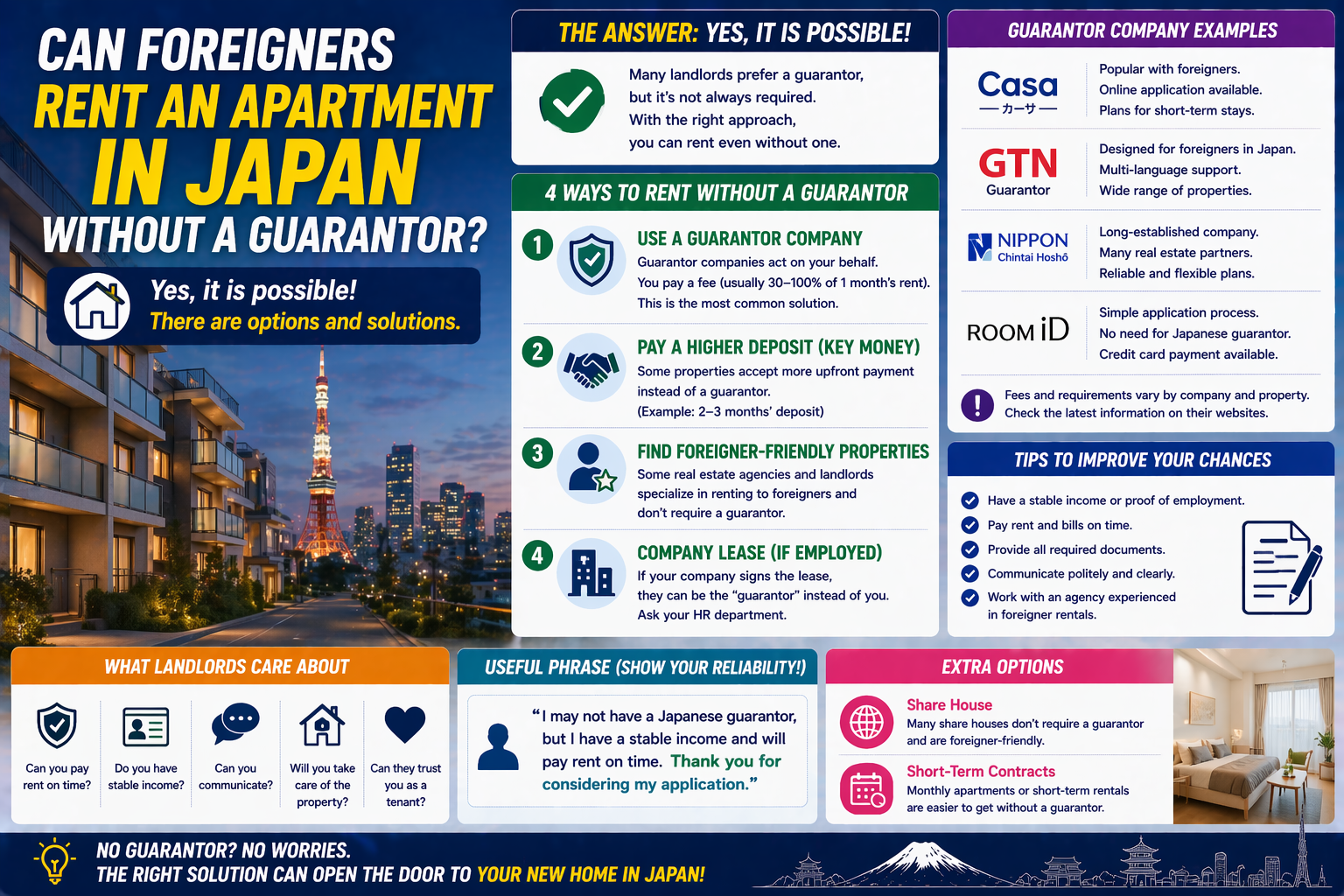
Can Foreigners Rent an Apartment in Japan Without a Guarantor?
Yes, often they can. In Japan, a foreign renter does not always need a personal guarantor if the property accepts a rent-guarantee company or offers a no-guarantor system such as UR rental housing.
The catch is practical, not theoretical: many private rentals still ask for either a personal guarantor or a guarantee company, and some landlords add their own screening rules. So the real question is not only “Is it allowed?” but which properties accept which backup method, and what extra cost or paperwork comes with it.
- Many private rentals require either a personal guarantor or a rent-guarantee company.
- Government guidance for foreign renters says a guarantor or guarantee company is often required at the application stage.
- Some housing, especially UR rentals, does not require a guarantor.
- Initial move-in costs can still be high even when you do not need a personal guarantor.
Who this guide is for
This is for foreign students, workers, and long-term residents who want a normal apartment in Japan and are worried because they do not have a Japanese relative, employer, or friend who can act as guarantor.
It matters most when you are:
- applying for a private apartment through a real estate agency
- moving to Japan for work or school
- changing jobs or cities and renting again
- trying to avoid being rejected late in the process
The short answer: what “without a guarantor” usually means in Japan
In practice, “without a guarantor” usually means without a personal guarantor.
For many apartments, the landlord or management company will still want protection if rent is unpaid or if there are contract-related costs after move-out. Instead of a family member or acquaintance signing as guarantor, they may require you to use a rent-guarantee company.
MLIT’s English Apartment Search Guidebook for foreign renters says a guarantor or use of a rental guarantee company is often required, and explains that Japanese rentals commonly use this system during screening and contract signing.
So there are three common patterns:
- You provide a personal guarantor.
- You use a rent-guarantee company.
- You choose housing that does not require either, such as some UR rentals.
Key point: No personal guarantor does not automatically mean no screening, no extra fee, or instant approval.
How the main options work
1. Private apartment with a rent-guarantee company
This is now one of the most common routes.
MLIT notes that use of guarantee companies has increased enough that standard rental contract forms include a guarantee-company type. For foreign renters, this matters because it creates a practical alternative when a landlord will not accept an overseas family member or when you do not know anyone in Japan.
What usually happens:
- the real estate agent checks whether the property accepts a guarantee company
- you submit ID, income or enrollment documents, and contact details
- the guarantee company runs its own screening
- you pay a guarantee fee in addition to normal move-in costs
MLIT’s foreign-renter guidebook gives a rough example: if you use a guarantee company, the fee is often around half a month’s rent for a two-year guarantee, though actual pricing varies by company and property.
2. Private apartment with a personal guarantor
Some landlords still prefer this route. The guarantor may need income proof and other documents, and the foreign-renter guidebook says agencies may ask whether you have one.
This is where many foreign renters run into trouble. A parent abroad may not be accepted. A friend in Japan may not meet the income standard. An employer may refuse to act as guarantor at all.
If a listing says a guarantor is required, ask one direct question before you spend time on the property:
“Can I use a rent-guarantee company instead of a personal guarantor?”
That one answer often decides whether the apartment is realistic for you.
3. No-guarantor housing such as UR
UR is the clearest official example of a no-guarantor option.
UR states that its rentals have no key money, no agency fee, no renewal fee, and no guarantor. For a foreign renter who has stable income and wants to avoid personal-guarantor problems, that can remove one of the biggest barriers.
But UR is not a free pass. UR also sets its own eligibility rules, including income standards or alternative financial qualification methods. Its current application rules say applicants must meet income conditions, and foreign nationals must have a qualifying status accepted by UR.
This means UR can be easier on the guarantor issue, but not necessarily easier on income proof.
Costs you should expect even if you do not need a personal guarantor
Skipping a personal guarantor does not mean cheap move-in.
MLIT’s guidebook says the total payment at contract signing often comes to about 4 to 7 months of rent, depending on region and property. That usually includes some combination of:
- security deposit
- key money
- agency fee
- fire or damage insurance premium
- first month of rent, usually paid in advance
- common service fee
- guarantee-company fee, if required
Quick example
If the monthly rent is JPY 80,000, the initial payment can still be large:
- 1 month deposit: JPY 80,000
- 1 month key money: JPY 80,000
- 1 month agency fee: about JPY 80,000 plus tax
- advance rent and building fee: around JPY 80,000 to JPY 90,000+
- guarantee-company fee: often an added amount
That is why the guarantor question should be checked together with the full move-in estimate, not by itself.
What foreign renters should ask before applying
A lot of rejections happen because the real issue was never clarified early.
Ask these points before you submit an application:
- Is a personal guarantor mandatory, or is a guarantee company acceptable?
- Which guarantee company is used, and how much is the initial fee?
- Is there a renewal fee for the guarantee contract?
- What documents are required for screening?
- Are overseas family members accepted as guarantors?
- Is an emergency contact also required?
- Can the agency explain the contract in English or another language you understand?
That last point matters. MLIT provides multilingual housing materials and sample contract documents precisely because rental procedures in Japan are different from many other countries.
Common mistakes
Assuming a foreign passport is the real problem
Sometimes the issue is not nationality by itself. It may be income level, contract length, visa period, language support, or the landlord’s preference for a guarantee company tied to that building.
You still need to watch for unfair treatment, but for day-to-day apartment hunting, the faster move is to ask which screening condition actually blocks the application.
Confusing a guarantor with an emergency contact
These are not the same.
A guarantee company or guarantor covers rent-related risk. An emergency contact is someone the landlord or manager can call if there is an urgent issue. You may still need an emergency contact even when no personal guarantor is required.
Focusing only on rent, not total contract cost
A cheaper apartment that demands key money, agency fees, and a guarantee-company fee may cost more upfront than a slightly more expensive place with simpler terms.
Signing the guarantee contract without reading the clauses
This matters more than many renters think.
As of April 23, 2026, MLIT’s rent-guarantee company registration system remains in place, and the registration rules were most recently revised effective October 1, 2025. MLIT also tells consumers to check guarantee contracts carefully in light of a Supreme Court ruling that stopped the use of certain unfair clauses, including terms that would let a guarantee company cancel a lease without proper limits or treat a property as vacated when the original lease had not actually ended.
That is a practical warning for renters: the guarantee contract is not just a formality.
Regional and property differences
There is no single nationwide market rule that every apartment follows in the same way.
What varies:
- whether key money is common
- how strict landlord screening is
- whether foreign-language support is available
- whether a building uses a designated guarantee company
- whether the agency will handle student, freelancer, or newly arrived applicants
Tokyo and other large cities often have more listings where a guarantee company is normal, but competition can also be stronger. In smaller markets, selection may be narrower, yet local agents may know landlords who are flexible if your paperwork is solid.
Best fallback options if you do not have a guarantor
If you are getting stuck, move in this order:
- Ask for listings that accept a guarantee company instead of a personal guarantor.
- Check UR rentals if your income and status fit their rules.
- If you are a student, ask your school housing office what partner agencies or support systems they use.
- Use MLIT’s foreign-renter materials to understand the contract terms before you apply.
- Ask the agent to narrow the search to “foreign-national acceptable” properties instead of broad city-wide listings.
This saves time and avoids applying for apartments that were unlikely to work from the start.
Final takeaway
Foreigners can rent in Japan without a personal guarantor, but usually not without some other risk-control step. In the private market, that step is often a rent-guarantee company. In some public or semi-public options such as UR, the no-guarantor route is clearer, but income and eligibility checks still matter.
If you are apartment hunting now, the next thing to check is simple: does the listing allow a guarantee company, and what is the full move-in cost after that fee is added? That answer is usually more important than the word “guarantor” by itself.
参照リンク / References
- MLIT: Support for Foreign Nationals in Looking for Rental Housing
- MLIT Apartment Search Guidebook (English PDF)
- MLIT: Rent Liability Guarantee Business Registration System
- UR Urban Renaissance Agency: Rental Housing Portal
- UR: Application Requirements
- Immigration Services Agency: Foreign Residents Support Portal Site