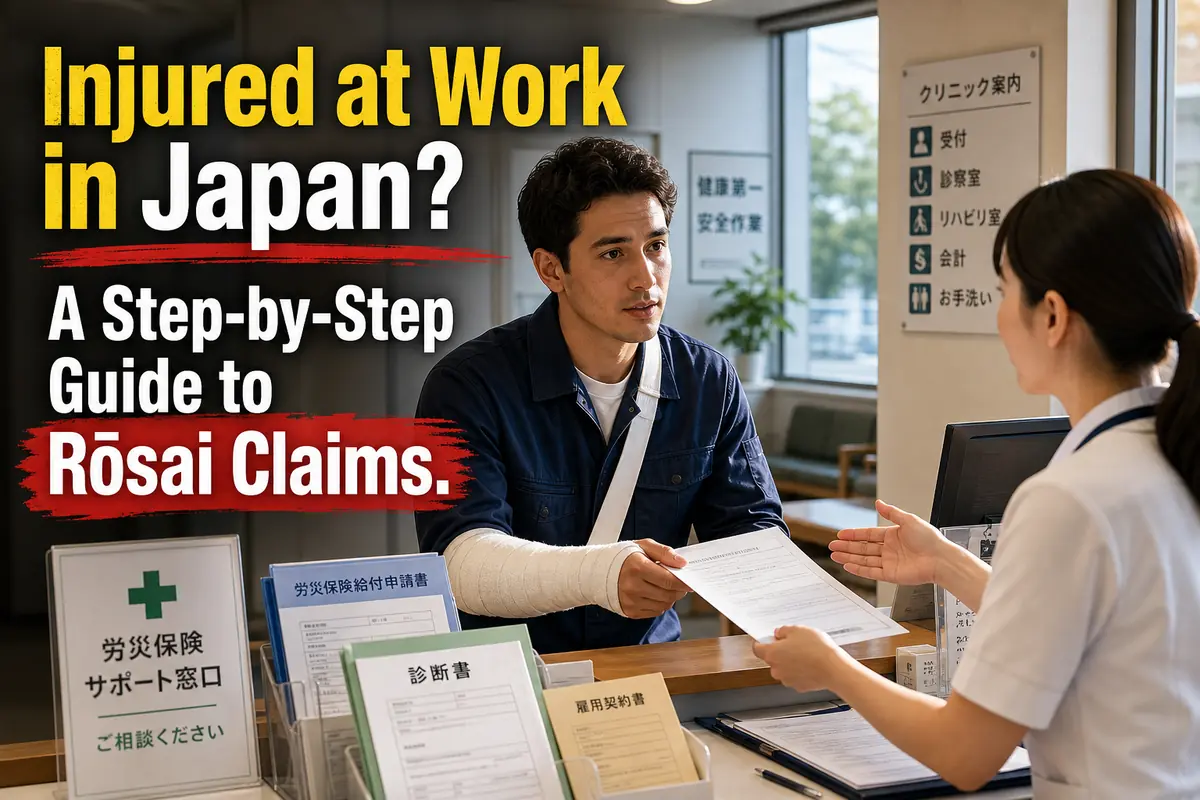
Injured at Work in Japan? A Step-by-Step Guide to Rōsai Claims
If you are injured while working in Japan, tell the medical provider that it may be a work accident and start a workers’ compensation claim—not an ordinary health insurance claim. Report the accident promptly, keep evidence, and contact the Labour Standards Inspection Office if your employer will not cooperate.
Japan’s workers’ accident compensation insurance is commonly called rōsai hoken (労災保険). It can cover medical treatment, part of your lost income, lasting disability, and certain commuting accidents.
This guide is for foreign employees, part-time workers, international students with jobs, and their families. The information reflects official sources available in August 2026, but the Labour Standards Inspection Office decides each claim individually.
The essentials:
- Employees are generally covered regardless of nationality or type of residence status.
- Part-time and casual workers can be covered; enrollment in employee health insurance is not required.
- Treatment at a designated rōsai medical provider is generally available without paying the covered treatment cost upfront.
- A worker can submit a claim even if the employer refuses to certify it.
- Different benefits have different filing deadlines, so do not wait for the company to “finish investigating.”
What should you do immediately after an injury?
Get necessary medical care first, then protect the records needed to connect the injury with your work. The first hours and days can affect both your health and the evidence available later.
1. Get emergency help when necessary
Call 119 for an ambulance or urgent medical assistance. Do not delay emergency care while trying to obtain permission from a manager.
Tell the hospital or clinic:
- that the injury happened at work or while commuting;
- your employer’s name and workplace address;
- when, where, and how the accident happened; and
- that you may use rōsai insurance.
If language is a problem, use a translation app or ask a trusted person to help. Keep your explanation factual and consistent.
2. Notify the employer as soon as possible
Report the accident to a supervisor, manager, or human resources department. A written message is useful even if you first report it verbally.
Include:
- the date and time;
- the exact location;
- the task you were performing;
- the equipment, vehicle, substance, or other person involved;
- the names of witnesses;
- the body part injured; and
- where you received treatment.
Ask the employer who handles rōsai paperwork. However, remember that the Labour Standards Inspection Office—not the employer—makes the final decision on whether an injury qualifies.
3. Preserve evidence
Save material that shows both the accident and your employment relationship:
- photographs of the location, equipment, or visible injury;
- messages sent to your supervisor;
- witness names and contact details;
- work schedules, timecards, and shift records;
- employment contracts and wage statements;
- medical records, prescriptions, and receipts;
- taxi, train, or bus receipts for hospital visits; and
- police documents for a traffic accident.
Write a short timeline while the details are fresh. For an occupational illness that developed over time, record your duties, hours, exposure, symptoms, and when you first sought treatment.
ここがポイント: Your company’s internal accident report is not the same as a rōsai benefit claim. Confirm which claim form will be filed, where it will be submitted, and keep a copy.
Who is covered by rōsai insurance?
Coverage usually follows the real working relationship, not the worker’s nationality. The Ministry of Health, Labour and Welfare states that foreign employees working in Japan are covered regardless of nationality. International students doing part-time work can also qualify.
Coverage generally includes people working for wages, such as:
- full-time employees;
- fixed-term and temporary employees;
- dispatched workers;
- part-time and casual workers; and
- students working paid shifts.
The employer normally pays the rōsai insurance premium. It is not deducted from the worker’s pay like an employee contribution.
What if the company says it is not enrolled?
A worker may still receive benefits when an employer failed to complete its insurance procedures. The employer’s failure does not automatically remove the worker’s protection.
Contact the Labour Standards Inspection Office rather than accepting “we have no insurance” as the final answer.
What if you are called a contractor?
A genuine freelancer, sole proprietor, company director, or self-employed worker is not automatically treated as an employee under the ordinary scheme. Some people can obtain special enrollment in rōsai insurance, but eligibility depends on their work category and enrollment arrangements.
A contract label is not always decisive. If the company controls your hours, work methods, location, and pay in a way that resembles employment, ask the Labour Standards Inspection Office to assess your actual situation.
Does residence status matter?
Rōsai coverage and immigration compliance are separate questions. A foreign employee’s nationality does not exclude the employee from workers’ compensation protection. If your work may have exceeded the activities permitted by your residence status, obtain separate advice from an appropriate immigration authority or qualified professional rather than abandoning the injury claim.
Which accidents can qualify?
Rōsai covers injuries and illnesses caused by work, plus commuting injuries that meet the statutory definition. It does not cover every accident that happens near a workplace.
Injuries and illnesses caused by work
A work-related case may include:
- a fall while carrying materials;
- a cut or crushing injury involving machinery;
- burns or chemical exposure;
- an injury caused by lifting or repetitive tasks;
- heat illness during work;
- certain occupational diseases; or
- a mental or physical illness linked to work when the official recognition requirements are met.
There must be a sufficient connection between the work and the injury or illness. Cases involving back pain, cumulative exposure, overwork, or mental health conditions often require more detailed medical and work records than a visible accident.
Injuries while commuting
A commuting injury can qualify when it occurs on a reasonable route and by a reasonable method between home and work. Travel between workplaces may also qualify in certain multiple-job situations.
Coverage can become complicated when the worker:
- makes a substantial private detour;
- interrupts the journey for a personal activity;
- uses an unusual route;
- stops for childcare, medical care, shopping, or another daily necessity; or
- is injured in a road accident involving another person.
Some necessary daily activities are treated differently from purely private detours. Do not assume that a stop automatically ends coverage; give the Labour Standards Inspection Office the complete route and purpose.
For traffic accidents, rōsai benefits may need to be coordinated with compulsory automobile liability insurance or other compensation. Report any payment from the other party or an insurer.
How medical treatment is paid
The payment route depends mainly on whether you use a medical provider designated for rōsai treatment. Ask before or at reception if the hospital or clinic is designated.
At a designated medical provider
For an injury caused by work, the usual claim for treatment is made with Form No. 5. A commuting injury generally uses Form No. 16-3, together with commuting information where required.
The form is submitted through the designated provider. Covered treatment is then generally provided without the worker paying the treatment charge upfront.
At a non-designated provider
You may need to pay first and request reimbursement later. A work injury generally uses Form No. 7, while a commuting injury generally uses Form No. 16-5.
Keep itemized receipts and proof of payment. The provider may also need to complete part of the form.
Do not automatically use ordinary health insurance
Japan’s public health insurance is generally not used for treatment of an injury caused by work or a qualifying commute. Tell the provider what happened instead of presenting the case as a private accident.
If ordinary health insurance was used before the work connection became clear, contact the insurer, medical provider, and Labour Standards Inspection Office. A correction and repayment process may be necessary.
Travel expenses for treatment
Necessary travel expenses for medical visits may be reimbursed when official conditions are met. The Ministry’s foreign-worker guide notes, among other requirements, a distance of at least two kilometers in principle and the use of an appropriate medical provider, subject to exceptions.
Keep receipts and a record of each journey. Confirm eligibility before assuming that taxis or long-distance travel will be paid.
What income support may be available?
A worker who cannot work during treatment and receives no wages may qualify for absence-from-work benefits beginning on the fourth day. The payment is generally 80% of the basic daily benefit amount: a 60% insurance benefit plus a 20% special allowance.
All three basic conditions must be met:
- the absence is necessary for treatment of a work or commuting injury or illness;
- the worker is unable to work; and
- wages are not being paid for that period.
The “basic daily benefit amount” is generally calculated from wages before the accident under statutory rules. It is not always identical to the worker’s normal take-home pay.
What happens during the first three days?
Rōsai absence benefits do not pay for days one through three. For an injury caused by work, the employer is generally responsible for compensation equal to 60% of average wages during this waiting period.
The treatment day can count as the first day when the worker is unable to work, although the exact calculation depends on timing and working arrangements. Commuting injuries are treated differently because the employer’s Labour Standards Act compensation duty does not apply in the same way.
Other possible benefits
Depending on the result of the injury, the system can also provide:
- disability benefits when lasting impairment remains after the condition stabilizes;
- an injury and disease pension for certain serious conditions continuing 18 months after treatment began;
- nursing-care benefits for eligible pension recipients;
- survivor benefits when a worker dies from a work or commuting accident; and
- funeral benefits.
These benefits have separate medical standards, forms, calculations, and deadlines. Ask the Labour Standards Inspection Office which claims may apply rather than relying on a single initial form.
How to file a claim
The worker is the claimant, although the employer and medical provider often certify parts of the paperwork. Forms and submission routes vary by benefit and by whether the case is a work injury or commuting injury.
Prepare the basic information
You will commonly need:
- your name, address, date of birth, and contact details;
- employer and workplace information;
- the employer’s workers’ compensation insurance number, if available;
- the accident date, place, and detailed circumstances;
- wage information;
- medical-provider certification;
- employer certification;
- bank account details for cash benefits; and
- supporting receipts or accident documents.
Use the name registered with your bank for payment details. Differences in Roman letters, spacing, or name order can delay a transfer.
Choose the correct form and destination
The most common routes are:
- designated provider treatment: submit the treatment claim through the provider;
- reimbursement after paying treatment costs: submit the expense claim to the competent Labour Standards Inspection Office;
- absence-from-work benefit: submit the relevant claim to the Labour Standards Inspection Office; and
- commuting traffic accident: submit the additional accident and third-party documents requested.
Official forms are available from the Ministry’s workers’ compensation forms page. The correct office is usually connected to the workplace handling the insurance, not necessarily the office nearest your home.
Keep a complete copy
Before submitting anything, copy or photograph:
- every completed page;
- medical and employer certifications;
- attached receipts;
- wage records; and
- the date and destination of submission.
The office may request an interview or more documents. A longer investigation does not necessarily mean rejection, particularly when the medical cause or commuting route needs examination.
What if the employer refuses to cooperate?
Employer refusal does not prevent a worker from starting a claim. Official guidance says a claim can be accepted without employer certification when the employer refuses to provide it.
Take these steps:
- Ask for the refusal or the company’s position in writing.
- Record the name and role of the person who refused.
- Gather independent evidence of the accident and your employment.
- Explain the missing certification to the Labour Standards Inspection Office.
- Submit the claim as directed by the office.
You can also claim after leaving the company or when the company no longer exists. In those cases, the office may ask for former managers’ or coworkers’ names and addresses.
Do not sign a statement saying that an accident was private, or that you waive a claim, unless you understand its meaning and have obtained appropriate advice.
Deadlines: why you should not wait
Many rōsai rights expire if the claim is filed too late. The deadline differs by benefit and may run separately for each day or expense.
Common examples include:
- treatment expenses already paid by the worker: generally two years from the day after payment;
- absence-from-work benefits: generally two years for each eligible day;
- nursing-care benefits: generally two years;
- disability benefits: generally five years after the condition is considered cured or stabilized;
- survivor benefits: generally five years from the day after death; and
- funeral benefits: generally two years from the day after death.
Treatment provided as a medical benefit through a designated provider is handled differently from reimbursement of expenses already paid. Occupational diseases can also raise difficult questions about when a right arose.
These are general time-limit examples, not a complete limitation analysis. Confirm the applicable date directly with the Labour Standards Inspection Office as soon as possible. An internal company investigation or negotiation does not necessarily stop the statutory clock.
Common mistakes that can weaken or delay a claim
Most avoidable problems come from using the wrong payment route, losing evidence, or waiting for employer approval.
Saying only “I hurt myself” at the hospital
Explain that the accident happened during work or commuting. The medical record should reflect the actual cause reported at the time.
Using a My Number health insurance card without explaining the accident
Ordinary public health insurance and rōsai follow different procedures. Tell reception before billing whenever possible.
Assuming part-time work is excluded
Part-time status, a short contract, or student status does not by itself remove employee coverage.
Letting the employer make the final decision
The employer can provide facts and certification, but the government office decides entitlement.
Throwing away receipts after visiting a non-designated clinic
Reimbursement requires evidence of the amount paid. Keep medical, pharmacy, transport, and related receipts separately.
Hiding a commuting detour
A detour does not always defeat a claim, but incomplete or inconsistent information can create credibility problems. Describe the route, stop, duration, and purpose accurately.
Waiting until you return home
Some claims can be handled from outside Japan, but certain support services are limited to Japan and overseas medical treatment requires verification. Before leaving, confirm forms, contact details, bank arrangements, medical records, and which benefits can continue.
Regional differences and practical limits
The national rōsai framework applies across Japan, but access and handling details vary locally. Each claim is processed through a Labour Standards Inspection Office, and designated medical providers differ by area.
Before taking action, confirm:
- which office has jurisdiction over the workplace;
- whether your hospital or clinic is designated for rōsai treatment;
- which documents that office wants for your type of accident;
- whether foreign-language consultation is available locally; and
- how to submit additional documents if you move or leave Japan.
Municipal offices do not normally decide rōsai claims. Your city’s National Health Insurance desk may become involved only if public health insurance was used incorrectly or needs billing adjustment.
Where foreign workers can get help in 2026
Official multilingual services can explain procedures when communication with the employer is difficult.
As of April 1, 2026, the Ministry’s Telephone Consultation Service for Foreign Workers lists English support at 0570-001-701, Monday to Friday, 10:00 a.m.–3:00 p.m., excluding noon–1:00 p.m. Call charges apply.
The free Labour Standards Advice Hotline lists English support at 0120-531-401:
- Monday–Friday: 5:00 p.m.–10:00 p.m.
- Saturdays, Sundays, and national holidays: 9:00 a.m.–9:00 p.m.
These services can provide general information and direct callers to the appropriate authority. Opening days and hours can change, so check the official multilingual consultation page before calling.
For an actual benefit claim, contact the Labour Standards Inspection Office responsible for the workplace. The Ministry’s foreign-worker brochure is available in English and several other languages.
Practical checklist before your next step
Act on the medical, evidence, and filing tracks at the same time. Do not wait for one to finish before starting the others.
- Tell the provider that the injury may be work-related.
- Notify the employer in writing.
- Save photographs, messages, work records, medical papers, and receipts.
- Check whether the provider is designated for rōsai treatment.
- Identify the correct claim form and Labour Standards Inspection Office.
- Request employer certification, but proceed to the office if it is refused.
- Check the deadline for every benefit you may need.
- Obtain advice before leaving Japan or accepting a settlement.
The next practical question is not simply whether your company calls the incident “rōsai.” It is whether you can document the link to work, use the correct treatment route, and submit each claim before its own deadline.
参照リンク
- Ministry of Health, Labour and Welfare: Workers’ compensation brochures for foreign workers
- Ministry of Health, Labour and Welfare: Industrial Accident Compensation Insurance Application Guidance for Foreign Workers, Volume 1
- Ministry of Health, Labour and Welfare: Main workers’ compensation claim forms
- Ministry of Health, Labour and Welfare: Workers’ Accident Compensation Insurance Act overview
- Ministry of Health, Labour and Welfare: Multilingual consultation services for foreign workers
- Ministry of Health, Labour and Welfare: Labour Standards Advice Hotline