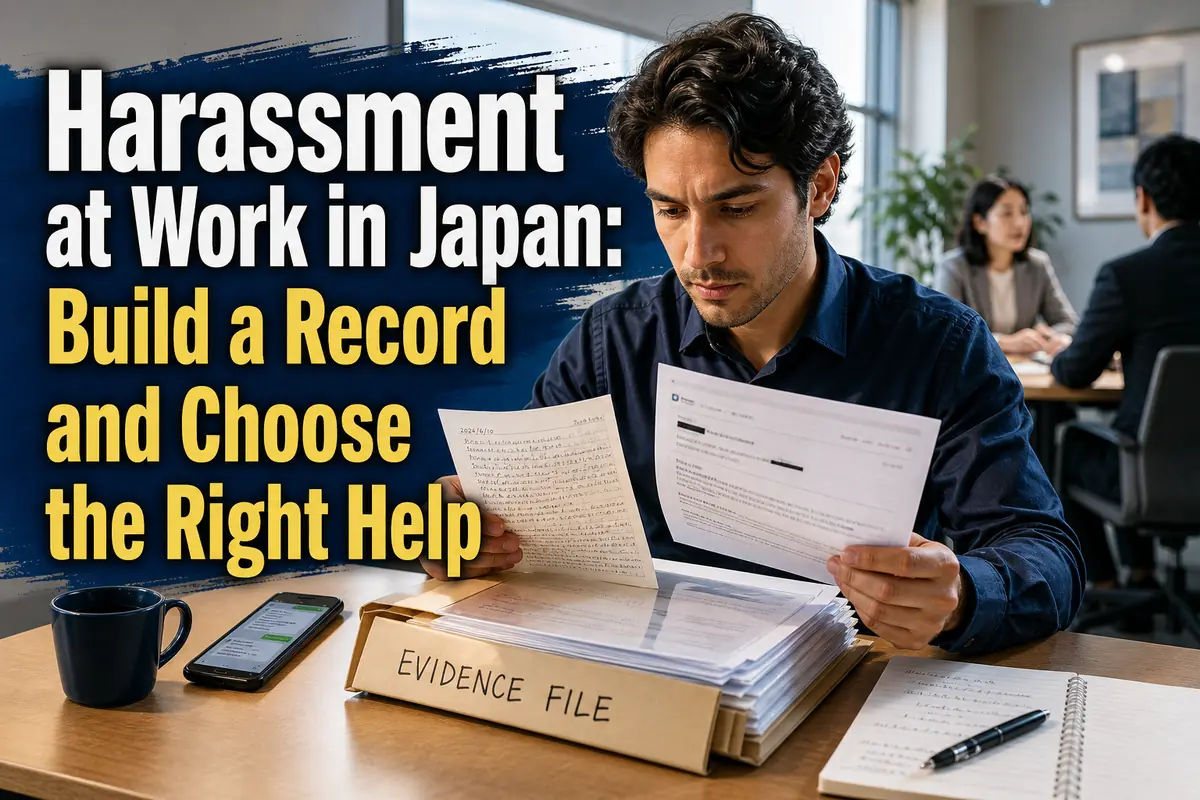
Harassment at Work in Japan: Build a Record and Choose the Right Help
If you are being harassed at work in Japan, write down each incident as soon as possible, preserve the original messages and work records, and ask for help through a channel that does not report to the alleged harasser. You do not need to wait until you have perfect evidence.
Japan requires employers to establish systems for preventing and handling several forms of workplace harassment. Workers must not be dismissed or otherwise treated disadvantageously simply because they consulted about power harassment or cooperated with an employer’s investigation.
This guide is for foreign employees, dispatched workers, part-time staff, fixed-term workers, interns who are legally treated as workers, and family members helping them. It explains practical first steps rather than giving a final legal judgment on an individual case.
Quick orientation
- Record the date, place, people, exact words or actions, witnesses, and effect on your work or health.
- Keep original emails, chat messages, schedules, evaluations, and medical documents somewhere you can lawfully access.
- Tell the company what happened, what protection you need, and how you want the matter handled.
- If the internal route is unsafe or ineffective, contact a Labour Bureau consultation service, a union, Houterasu, or another suitable public service.
First decide whether you need immediate protection
Personal safety comes before completing a complaint file. Documentation is valuable, but it should not keep you in a dangerous room or force you to confront the person alone.
Leave the immediate area and seek urgent help if there is violence, a threat of violence, stalking, confinement, sexual assault, or another danger. Call Japan’s emergency police number, 110, when immediate police assistance is required. For a medical emergency, call 119.
If the conduct is harming your physical or mental health, consider seeing a medical professional. Explain when the symptoms began and whether they appear connected to work. Medical records can help with treatment and may later establish a timeline, but getting care should not depend on whether you plan to file a claim.
Possible short-term requests to an employer include:
- no direct one-to-one contact with the person involved;
- a different reporting route;
- preservation of security-camera footage, access logs, or company messages;
- a temporary change of seat, shift, worksite, or remote-work arrangement;
- permission to bring a support person or interpreter to a meeting;
- written communication instead of an unrecorded private meeting.
Be careful about a transfer offered as “protection.” Ask whether your pay, duties, evaluation, promotion prospects, contract renewal, commute, or visa-related employment documents will change. A measure meant to separate people should not quietly become a penalty for the person who reported the problem.
What Japan recognizes as workplace harassment
“Harassment” is not one single legal category in Japan. The facts may involve power harassment, sexual harassment, pregnancy or leave-related harassment, discrimination, violence, unpaid wages, retaliation, or several issues at once.
Power harassment
The Ministry of Health, Labour and Welfare describes workplace power harassment through three connected elements:
- conduct based on a superior relationship;
- conduct exceeding what is necessary and reasonable for work; and
- harm to the worker’s working environment.
A “superior relationship” is broader than a manager-subordinate relationship. It may involve an experienced colleague whose cooperation is essential, a group acting against one worker, or even a subordinate who controls knowledge that a manager cannot easily replace.
Official guidance groups typical conduct into six patterns:
- physical abuse;
- psychological abuse, including intimidation, insults, or severe verbal attacks;
- isolation, exclusion, or deliberate neglect;
- excessive or clearly impossible demands;
- assigning work far below a person’s role or giving no work without a proper reason; and
- excessive intrusion into private matters.
Firm supervision, correction of an error, or a reasonable work instruction is not automatically harassment. The important questions are what was said or done, whether it was necessary for the job, whether the method was proportionate, and what effect it had on the working environment.
Sexual harassment
Sexual harassment can include unwanted sexual comments, questions, messages, touching, pressure to enter a relationship, or disadvantages imposed after a person refuses sexual conduct. It is not limited to conduct by a direct supervisor, and the people involved do not have to be of different sexes.
Record the conduct precisely. “My manager was inappropriate” gives an investigator little to test. “At approximately 18:10 after the team meeting, the manager asked whether I lived alone and invited me to a hotel after I said no twice” identifies the words, setting, response, and possible witnesses.
Pregnancy, childbirth, childcare, and family-care leave
Japanese law also requires employer measures against harassment connected with pregnancy, childbirth, childcare leave, and family-care leave. This can involve pressure not to apply, hostile comments after an application, or conduct that damages the person’s working environment because they used a protected system.
A necessary discussion about staffing or safety is not automatically harassment. The difference often depends on the language used, the available alternatives, and whether the employer is solving a real operational issue or pressuring the worker to surrender a right.
National obligations and company rules are different layers
National law sets employer obligations, including consultation systems, appropriate responses, privacy measures, fact-finding, and measures against disadvantageous treatment for consultation. A company’s handbook may add reporting routes and disciplinary rules.
Company policy cannot remove national protections. At the same time, a policy violation does not automatically decide whether a court would award compensation. Treat internal discipline, administrative consultation, and a legal claim as related but separate routes.
ここがポイント: You do not need to choose the perfect legal label before asking for help. Describe the conduct, dates, people, evidence, effect, and protection you need. The receiving organization can help identify the appropriate route.
Build a useful record, one incident at a time
The strongest record is usually a consistent timeline supported by original material. A short note made on the same day can be more useful than a polished summary written months later.
Use an incident log
Create one entry for each incident. Include:
- date and approximate start and end time;
- physical location or online channel;
- names and roles of the people involved;
- exact words or actions, as closely as you remember them;
- what happened immediately before and after;
- witnesses and where they were positioned;
- related emails, files, meeting invitations, or chat messages;
- how you responded;
- any effect on your duties, schedule, evaluation, pay, or health;
- who you later informed and what that person did.
Separate direct memory from interpretation. For example:
- Direct fact: “The supervisor said, ‘Foreign staff should not question Japanese managers,’ during the 3 p.m. meeting.”
- Context: “Four team members were present.”
- Effect: “My project questions were not accepted, and the deadline remained unchanged.”
- Interpretation to investigate: “I believe nationality influenced the treatment.”
This structure lets an adviser see both the event and why it matters without asking you to hide your concern.
Preserve original material
Useful records may include:
- emails and workplace chat messages;
- shift schedules, attendance records, and meeting invitations;
- instructions showing assigned deadlines or workload;
- performance reviews and earlier positive feedback;
- pay statements or notices of reduced hours;
- photographs of injuries or damaged property;
- consultation emails and the company’s replies;
- medical certificates, receipts, and appointment records;
- names of witnesses who directly saw or heard an incident.
Keep originals intact. If you create a translated copy, label it as a translation and retain the source-language version. Screenshots should show the sender, date, time, and surrounding conversation when possible.
Do not alter files to make them look clearer. Instead, create a separate index such as “Evidence 03 — team chat dated June 12” and explain what the item shows.
Protect the record without taking unrelated company data
A foreign worker may reasonably worry about losing access after suspension or dismissal. Preserve records early, but do so carefully.
Do not take customer lists, trade secrets, personal data about colleagues, or unrelated confidential files merely because they are available. Do not bypass passwords or security controls. If important evidence exists only in a company system, identify it precisely in your complaint and ask the employer to preserve it.
Audio recording raises fact-specific questions about privacy, workplace rules, admissibility, and how the recording was obtained or used. Before making, copying, or distributing a recording—especially one containing confidential information—get advice from a lawyer or qualified consultation service. Never place yourself in danger to obtain evidence.
Report the problem in a way that can be followed
A useful complaint asks for a documented response, not only an informal conversation. Check the work rules, employee handbook, intranet, employment contract, and posted notices for the harassment consultation desk.
The internal contact might be:
- human resources;
- a compliance or ethics desk;
- an external hotline contracted by the company;
- a manager above the person involved;
- a union representative;
- a headquarters contact if the local office is implicated.
If your direct manager is the alleged harasser, use another route. If HR reports to that manager or cannot provide a neutral process, move to an external consultation service.
What to put in the first written report
Keep the first report focused. Include:
- What happened: two or three representative incidents, with dates.
- Who was involved: names, roles, and reporting relationships.
- What evidence exists: messages, witnesses, schedules, or medical records.
- What is happening now: continued contact, lost shifts, health effects, or fear of retaliation.
- What you need immediately: separation, preservation of records, an interpreter, or another reporting manager.
- What response you request: confirmation of receipt, the investigator’s contact, expected steps, and a reasonable update date.
You can write:
I am requesting consultation under the company’s workplace harassment procedure. I have listed the main incidents and available records below. Please confirm receipt, explain who will handle the matter, preserve the identified records, and tell me what interim measures are available. I also request that information be shared only with people who need it for the response.
Do not send the complaint only from an account controlled by the alleged harasser. Retain a lawful copy or confirmation of submission.
Prepare for the interview
Bring a one-page chronology and an evidence index. If language is a barrier, request an interpreter and ask whether you may bring a union representative, colleague, lawyer, or other support person.
Ask practical questions:
- Who will investigate, and are they independent of the people involved?
- Who will receive my statement?
- How will witnesses be contacted?
- How will the company protect privacy?
- What interim protection is available?
- How can I report retaliation or new incidents?
- When should I expect the next update?
- Will I receive the result or at least a written explanation of the measures affecting me?
After the meeting, send a short factual follow-up: the date, attendees, key points, documents provided, requests made, and any deadlines discussed. This creates a shared record and gives the company an opportunity to correct misunderstandings.
Choose the external service that matches the problem
No single office handles every workplace dispute. The right contact depends on whether you need general labor guidance, administrative dispute resolution, enforcement of labor standards, human-rights support, union representation, or legal advice.
Comprehensive Labor Consultation Corners
The Ministry of Health, Labour and Welfare’s Comprehensive Labor Consultation Corners handle a wide range of employment problems, including bullying and power harassment. Workers, employers, students, and job seekers can consult. The service is free and does not require an appointment; consultation is available by telephone or in person, although language availability and opening hours differ by location.
These offices can provide information and may explain advice or guidance by the Prefectural Labour Bureau and conciliation for an individual labor dispute. Conciliation is different from a court judgment: it is a process intended to help the parties reach a voluntary resolution. Ask the adviser what the process can and cannot order before choosing it.
If the facts suggest a violation handled by an enforcement authority, the consultation corner may direct the matter to the appropriate department or Labour Standards Inspection Office. A Labour Standards Inspection Office is especially relevant to issues within its authority, such as unpaid wages, working hours, safety, or certain labor-standard violations; it is not a general court for every harassment claim.
Foreign-language labor hotlines
As of April 1, 2026, the MHLW’s foreign-language consultation information lists services in 13 languages.
For English:
- Telephone Consultation Service for Foreign Workers: 0570-001-701, Monday to Friday, 10:00–15:00, excluding 12:00–13:00. Call charges apply.
- Labour Standards Advice Hotline: 0120-531-401, Monday to Friday, 17:00–22:00; Saturdays, Sundays, and holidays, 9:00–21:00. The call is toll-free.
Year-end closures and temporary schedule changes may apply. Check the official page before calling. Other languages have different operating days.
Before the call, prepare your prefecture, employer’s legal name, worksite, employment type, main dates, and the result you need. Ask the adviser to repeat the name of any office they recommend and whether an appointment or interpreter is required.
A union
A labor union may help organize the facts, accompany a worker, communicate with the employer, or request collective bargaining when the legal conditions are met. Japan has enterprise unions as well as community or general unions that may accept individual workers.
Membership rules, fees, languages, and services vary. Ask what the union will do, what information it will share, how decisions are made, and whether it has experience with foreign workers and your type of employment.
Houterasu and legal advice
Houterasu’s Multilingual Information Service provides information about Japan’s legal system and refers callers to relevant services through an interpreter. The listed number is 0570-078377, Monday to Friday, 9:00–17:00; a separate number is available for VoIP and prepaid phones. The information service is free, but normal call charges apply.
A lawyer is particularly useful when there has been violence, serious health damage, dismissal, pressure to resign, a major loss of income, a proposed settlement, or concern about limitation periods. Ask about consultation fees, legal-aid eligibility, documents needed, and urgent deadlines before the meeting.
Human-rights counseling
The Ministry of Justice provides human-rights counseling for foreigners. Its foreign-language hotline, 0570-090-911, supports English and several other languages. This route may be relevant when the conduct involves discrimination, abuse, or another human-rights concern.
This service has a different role from a Labour Bureau, a Labour Standards Inspection Office, a union, or a court. Tell the counselor what outcome you need so they can explain whether their service fits the case.
Foreign-worker issues that need separate attention
Harassment and immigration status should be checked separately, even when the employer mixes them together. An employer does not personally “own” a worker’s status of residence, but a job change, loss of employment, or long period without authorized activity can create immigration reporting or status-related questions.
Do not assume that reporting harassment automatically cancels a visa. Also do not assume that resigning has no immigration consequences. Before leaving a job, ask the Immigration Services Agency or a qualified immigration professional about:
- whether the proposed new work fits your current status of residence;
- required notifications after leaving or joining an organization;
- the effect of unemployment or reduced activity;
- documents you should obtain from the employer;
- deadlines specific to your status and circumstances.
Keep immigration advice separate from pressure by a supervisor. Statements such as “Complain and your visa will be canceled” should be recorded exactly and checked with an independent official source.
Dispatched workers may have two relevant organizations: the dispatching agency that employs them and the client workplace where the conduct occurred. Report to the agency’s consultation contact and identify the client personnel involved. Ask both organizations which one will investigate, preserve records, arrange separation, and communicate the result.
Students and interns should contact their school or program office as well as an appropriate labor service. However, whether a particular intern is legally a “worker” depends on the actual arrangement, not simply the title. Obtain advice based on the contract, payment, supervision, and daily duties.
Common mistakes that weaken a complaint
Most mistakes come from waiting too long or making the record too broad. Avoid these patterns:
- Waiting for a dramatic final incident: repeated smaller events may show an important pattern.
- Keeping only screenshots: preserve original messages and surrounding context when lawfully possible.
- Using conclusions without facts: write the words, actions, dates, and consequences.
- Sending an emotional message to a large mailing list: use the designated channel and keep distribution controlled.
- Resigning or signing a settlement immediately: first check pay, unused leave, insurance, immigration, confidentiality, release clauses, and deadlines.
- Assuming HR is your private adviser: HR acts for the organization. Ask who will receive the information and seek independent advice when necessary.
- Secretly taking unrelated data: identify evidence without copying confidential material you have no right to keep.
- Treating every office as an enforcement agency: ask what the service can investigate, recommend, mediate, or order.
- Stopping the log after reporting: record retaliation, schedule changes, exclusion, poor evaluations, or new contact.
A complaint can be concise without being vague. Five well-documented incidents are more usable than twenty pages that mix rumors, assumptions, and unrelated workplace frustrations.
What is changing in October 2026
Two new employer duties are scheduled to take effect on October 1, 2026. According to the MHLW, employers will be required to take preventive measures concerning customer harassment and sexual harassment directed at job seekers and others engaged in recruitment-related activities.
Customer harassment matters to foreign workers in retail, hospitality, healthcare, transport, delivery, and other public-facing jobs. Abuse may come from a customer rather than a supervisor, but the employer’s response still affects whether the worker can perform the job safely.
Job-seeker sexual harassment can arise during recruitment, internships, workplace visits, or related contact before employment. Applicants should preserve invitations, messages, names, locations, and follow-up communication just as an employee would.
As of August 1, 2026, the effective date is still ahead. Workers and applicants should check the MHLW harassment-prevention page for the final guidance and current scope. Existing routes for consulting about sexual conduct, violence, discrimination, or other workplace problems may still be available before the new duties commence; the future effective date is not a reason to remain silent now.
A practical 48-hour action plan
The next useful step is to create a safe, reviewable record and contact one suitable person. You do not have to solve the whole case in one day.
Today
- Move away from immediate danger and seek medical or police help if necessary.
- Write the first incident entries while your memory is fresh.
- Preserve original messages and identify company-held records that may disappear.
- Read the company’s consultation policy and employment rules.
- Tell a trusted person where the record is stored.
Within the next working day
- Send a focused written consultation request through a safe channel.
- Request immediate protection and preservation of specific evidence.
- Contact a public labor consultation service or union if the internal route is unsafe.
- Check immigration implications independently before resigning or changing jobs.
Before signing or accepting anything
- Request time to review the document.
- Obtain a translation if you do not fully understand the Japanese text.
- Check resignation dates, money, confidentiality, waiver or release language, return of property, and future references.
- Seek independent legal advice when the consequences are serious or unclear.
The key watchpoint is not whether your first note uses the perfect Japanese legal term. It is whether you can show what happened, when it happened, who knew, what changed afterward, and what protection you requested. Start that record now, then use it to choose the next help channel deliberately.
参照リンク
- MHLW: Harassment measures for foreign workers
- MHLW: Power Harassment in the Workplace
- MHLW: Harassment related to pregnancy, childbirth, and childcare leave
- MHLW: Comprehensive Labor Consultation Corners
- MHLW: Foreign-language labor consultation services
- MHLW: Workplace harassment prevention and October 2026 changes
- Houterasu: Multilingual Information Service
- Houterasu: Workplace and Labor
- Ministry of Justice: Human Rights Counseling for Foreigners