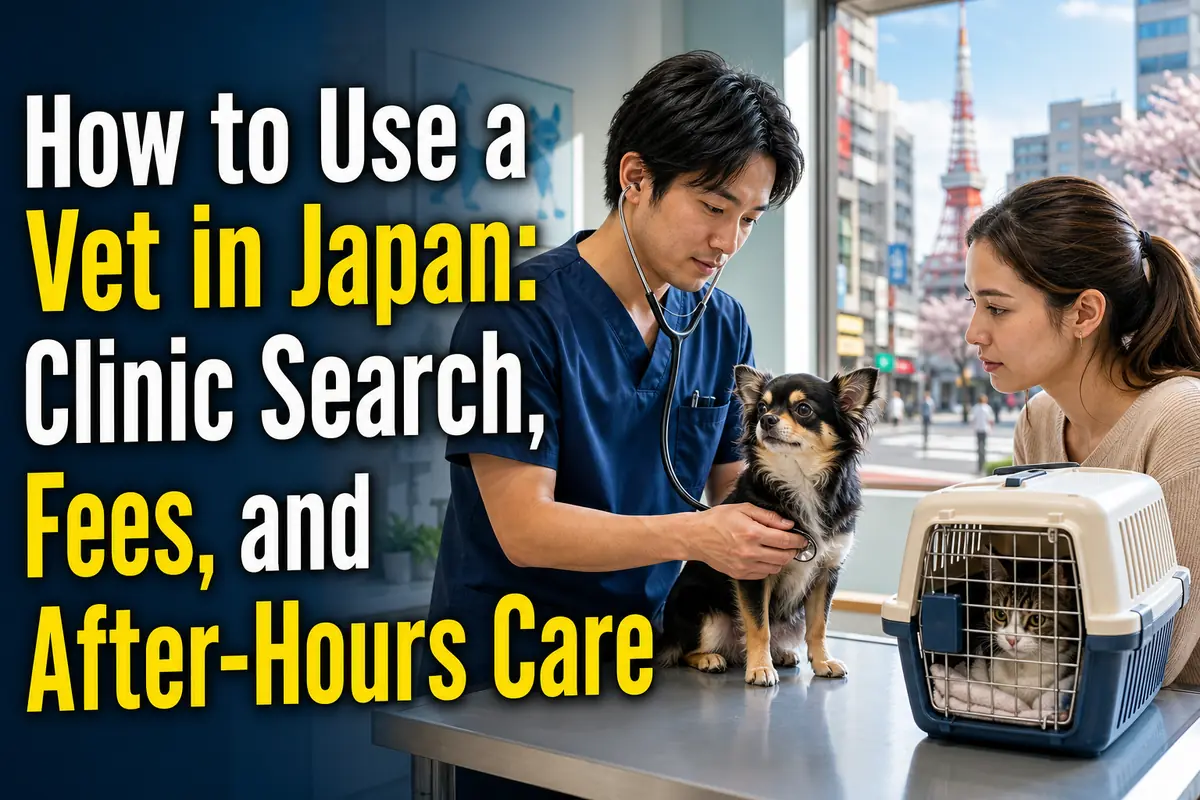
How to Use a Vet in Japan: Clinic Search, Fees, and After-Hours Care
Veterinary care in Japan is mainly provided by private animal hospitals, called dōbutsu byōin (動物病院, animal hospital). There is no public health insurance for pets, and clinics set their own prices. You should therefore find a regular clinic before your pet becomes ill, confirm which species it treats, and save a separate after-hours number.
This guide is for foreign residents who have brought a pet to Japan, adopted one locally, or need to arrange care without being fluent in Japanese.
The essentials:
- Find both a daytime clinic and an emergency option in advance.
- Call before visiting, especially at night or with an exotic pet.
- Expect to pay the full bill unless private pet insurance applies.
- Ask for an estimate before tests, admission, or surgery.
- Bring medical records, medication details, and your insurance card if you have one.
Choose a clinic before you need urgent care
The best clinic is one that can treat your animal, communicate clearly, and provide a realistic plan for emergencies. A nearby hospital is not necessarily suitable for every species or condition.
The Japan Veterinary Medical Association links to veterinary associations across Japan. The Japan Animal Hospital Association directory offers more detailed filters, including:
- Dogs and cats
- Rabbits, hamsters, ferrets, and other small mammals
- Birds
- Reptiles and amphibians
- Night consultations
- Emergency care
- CT or MRI equipment
- Pet insurance support
- Cashless payment methods
A directory is a starting point, not a guarantee that a clinic is open or able to accept your case. Check the hospital’s own website and telephone before leaving home.
Confirm the species first
Many Japanese clinics mainly treat dogs and cats. A sign saying dōbutsu byōin does not mean that the hospital sees every animal.
For a rabbit, bird, reptile, amphibian, ferret, or other less commonly treated pet, ask:
Kono dōbutsu o shinsatsu dekimasu ka?(この動物を診察できますか?)
Can you examine this kind of animal?
Also confirm whether the relevant veterinarian will be working that day. A hospital may normally list birds or reptiles but offer that service only during particular hours.
Check language support directly
Some clinics advertise English service, but the level may range from basic reception assistance to a full medical consultation in English. Ask before booking:
Eigo de sōdan dekimasu ka?(英語で相談できますか?)
Can I discuss the case in English?
If English support is limited, prepare a short written note containing:
- The main symptom
- When it began
- Changes in eating, drinking, urination, or bowel movements
- Current medicines and doses
- Known allergies or previous conditions
- Anything the animal may have swallowed
A translation app can help with routine questions, but complicated consent forms and treatment decisions may require an interpreter or a Japanese-speaking contact.
Understand how veterinary fees work
There is no national fee schedule for ordinary companion-animal treatment. Each clinic decides what to charge, so the same type of visit can cost different amounts in different cities—or even at neighboring hospitals.
The Japan Veterinary Medical Association explains that veterinary organizations cannot establish standard prices. Its nationwide fiscal 2021 survey, published in 2023 and based on responses from 1,096 small-animal veterinarians, reported these median charges:
- First consultation — shoshinryō (初診料): ¥1,500
- Follow-up consultation — saishinryō (再診料): ¥750
- Late-night surcharge — shinya jikan-gai shinryō (深夜時間外診療): ¥6,250
- One-day health examination — kenkō shindan (健康診断): ¥16,250
These figures are historical national medians, not current fixed prices. They also represent individual fee items rather than the final bill. A consultation may be followed by blood tests, imaging, injections, medicine, anesthesia, treatment, or hospitalization. The association’s fee guidance specifically warns that applicable items are added together.
What can make the bill larger?
The consultation charge is often only the first line on the invoice. Costs may rise because of:
- Blood, urine, stool, or allergy testing
- X-rays, ultrasound, CT, MRI, or endoscopy
- Sedation or general anesthesia
- Medicine dispensed by the hospital
- Surgery and operating-room charges
- Overnight monitoring or hospitalization
- An after-hours or emergency surcharge
- Referral to a specialist or advanced-care center
Exotic animals may require a hospital with specialist knowledge and suitable equipment. Availability is narrower, and travel or referral costs may become part of the practical expense.
ここがポイント: Do not treat ¥1,500 as the expected total for a first visit. It is a survey median for the initial consultation item; tests, treatment, medicine, tax, and emergency charges can be added separately.
Ask about price before agreeing to major treatment
Useful questions include:
Gaisan wa ikura desu ka?(概算はいくらですか?)
What is the estimated cost?Kensa no mae ni hiyō o oshiete kudasai.(検査の前に費用を教えてください。)
Please tell me the cost before the tests.Hoka no chiryo hōhō wa arimasu ka?(ほかの治療方法はありますか?)
Are there other treatment options?
An estimate may change when a test reveals a new problem. Still, asking for the proposed steps, likely price range, and decision points makes it easier to understand what you are authorizing.
Budget for care without relying on one “average”
A useful budget separates routine care from a larger emergency reserve. One national average cannot predict an individual animal’s needs because age, species, breed, chronic conditions, and the level of treatment all matter.
Anicom’s 2025 animal health data reported average annual treatment expenses of:
- Dogs aged 0–4: ¥52,613
- Dogs aged 5–9: ¥88,362
- Dogs aged 10 or older: ¥172,742
- Cats aged 0–4: ¥39,102
- Cats aged 5–9: ¥55,845
- Cats aged 10 or older: ¥106,158
The figures come from pet-insurance data and should not be treated as a quote for an uninsured animal. They matter because they show how sharply average treatment spending can increase with age. A healthy young pet may use little in one year, while an accident, surgery, or chronic illness can produce a much larger bill.
A practical plan can include:
- A monthly amount for checkups, vaccines, parasite prevention, and medicine
- A separate emergency fund that is immediately accessible
- A credit card or other payment method accepted by the chosen hospital
- Private pet insurance, if its limits and exclusions fit your situation
Know what pet insurance does—and does not do
Japanese public health insurance for people does not cover animals. Pet insurance is a private product, and its payment method depends on both the policy and the hospital.
Some participating clinics can reduce the amount paid at reception after checking an eligible insurance card. In other cases, the owner pays the full bill and files a reimbursement claim later.
Before depending on a policy, check:
- The reimbursement percentage
- The annual, daily, or per-visit limit
- Waiting periods
- Age limits for enrollment or renewal
- Coverage for chronic and pre-existing conditions
- Whether preventive care, dental work, pregnancy, or neutering is excluded
- Whether the emergency hospital accepts direct settlement
- What invoices, medical records, or claim forms you must keep
Insurance does not remove the need for accessible funds. A treatment may exceed the policy limit, fall under an exclusion, or require full payment before reimbursement.
What to bring to an ordinary appointment
A small medical file can save time when a new clinic has no history for your pet. Paper copies and phone photos are both useful.
Bring or prepare:
- Your name, address, telephone number, and identification
- The pet’s name, species, breed, sex, age, and weight if known
- Vaccination and microchip records
- Previous diagnoses and test results
- Current medicine, including the package or a clear photo of its label
- Details of allergies or adverse reactions
- Your pet-insurance card and policy information
- A secure carrier, crate, harness, or leash
- A fresh sample only if the clinic has asked for one
For a suspected poisoning or swallowed object, take the package, ingredient label, remaining material, or a photograph if it is safe to do so. Do not delay departure to collect nonessential items.
Describe symptoms with times and numbers
“Not well” gives the veterinarian little to work with. More useful information includes:
- Vomited three times since 7:00 a.m.
- Has not eaten since last night
- Drank much more water for four days
- Began limping after a fall
- May have swallowed part of a toy at about 2:00 p.m.
Videos can also help when coughing, seizures, limping, or unusual behavior has stopped by the time you reach the clinic. Record only when it is safe; urgent care comes first.
Build an emergency plan now
After-hours veterinary care is regional, and “night service” does not always mean walk-in treatment throughout the night. Some hospitals operate overnight emergency departments, while others respond only until a stated time, on selected days, or when staff are available.
The Osaka Prefecture Veterinary Medical Association’s night-service clinic list, for example, shows why advance checking matters: some entries require a reservation, a telephone call, or arrival before a particular time. Other prefectures and cities use their own directories and systems.
Save three contacts
Keep these in your phone and on paper:
- Your regular veterinarian
- The nearest hospital that confirms after-hours care for your species
- A second emergency option in case the first is full, closed, or too far away
Recheck the information after moving and periodically thereafter. Opening hours, staffing, accepted species, and emergency arrangements can change.
Call before traveling
Unless a hospital explicitly instructs otherwise, telephone first. An emergency team may need to confirm:
- Whether it can treat your animal
- Whether a veterinarian is available
- Whether your pet should come immediately
- How to transport the animal safely
- What records or materials to bring
- The after-hours surcharge and payment methods
A Tokyo hospital’s published emergency instructions illustrate common practice: callers are asked to contact the hospital before arrival, and patients may be seen according to medical urgency rather than arrival order. Its list for first-time patients includes owner identification and a pet-insurance card when applicable. Procedures vary, so follow the instructions of the hospital you are actually visiting.
Signs that warrant an immediate veterinary call
Contact a veterinarian or emergency hospital promptly for symptoms such as:
- Severe difficulty breathing
- Collapse, loss of consciousness, or inability to stand
- Repeated or prolonged seizures
- Heavy bleeding or major trauma
- Suspected poisoning
- A swallowed battery, sharp object, medicine, or other dangerous material
- A swollen abdomen with distress or repeated unproductive retching
- Inability to urinate, especially with repeated straining
- Heatstroke signs
- Complications during labor
- Sudden severe pain or rapidly worsening weakness
This list cannot diagnose an animal or cover every emergency. If you are unsure, call a veterinary professional and describe the symptoms. Do not wait for an English-speaking clinic if the delay could put the animal at greater risk.
Do not improvise treatment
Avoid giving human medicine unless a veterinarian has specifically prescribed it for that animal. Do not induce vomiting or use a home antidote without professional instructions. The correct response depends on the substance, dose, species, symptoms, and time since exposure; an unsuitable response can make the injury worse.
Referrals and second opinions
A general clinic may refer your pet when advanced equipment or specialist care is needed. This is common medical coordination, not necessarily a sign that the first clinic has failed.
Ask the referring veterinarian for:
- A shōkaijō (紹介状, referral letter)
- Test results and diagnostic images
- A current medicine list
- The reason for referral
- Whether the referral hospital requires an appointment
- What to do if the animal worsens before that appointment
University and specialist hospitals may accept referral cases rather than routine walk-ins. They can also have different fees, scheduling rules, and payment requirements.
For a non-emergency second opinion, request copies of the record and images before changing hospitals. Repeating tests because records are unavailable can add cost and delay.
Regional differences that change the practical plan
Veterinary medicine is available nationwide, but access is not uniform. Large urban areas are more likely to have overnight hospitals, advanced imaging, specialist departments, and clinics advertising foreign-language support.
In smaller cities, rural areas, and islands, you may need to:
- Travel farther for emergency or specialist treatment
- Use a local clinic for stabilization before referral
- Arrange a car or pet-friendly taxi in advance
- Confirm ferry, bridge, or winter road conditions
- Keep a larger supply of essential prescription medicine, with veterinary approval
Municipal offices manage some animal-related procedures, but they are not substitutes for a veterinary hospital. Registration, rabies administration, disaster planning, and local animal-welfare services can differ from clinical treatment. Contact your municipality for local administrative rules and a veterinarian for medical decisions.
Common mistakes to avoid
Most preventable problems come from waiting until the animal is sick to research access, cost, and transport. Watch for these mistakes:
- Assuming every clinic treats birds, reptiles, or rabbits
- Arriving at night without calling
- Expecting human national health insurance to apply
- Looking only at the consultation fee rather than the likely total
- Forgetting that emergency and late-night surcharges may be separate
- Leaving medical records or medicine names at home
- Assuming a clinic’s English-language webpage guarantees English support on every shift
- Depending on one emergency hospital without a backup
- Giving human medicine or inducing vomiting without veterinary instructions
- Waiting for a regular clinic to reopen despite severe or worsening symptoms
A practical setup checklist
Complete this checklist while your pet is well. It turns an unfamiliar system into a plan you can use quickly.
- [ ] Select a regular clinic that treats your pet’s species.
- [ ] Confirm its appointment system, languages, payment methods, and insurance process.
- [ ] Save two after-hours options and verify that they accept your species.
- [ ] Plan transport when trains and ordinary buses are unavailable.
- [ ] Keep identification, vaccination records, test results, and medicine details together.
- [ ] Ask the clinic how to request estimates and copies of records.
- [ ] Maintain an emergency fund even if the pet is insured.
- [ ] Review the contacts after moving or when clinic hours change.
Japan has no single nationwide veterinary price or emergency-access system. The most useful next step is therefore local and concrete: call one nearby daytime clinic and one after-hours hospital now, confirm that both accept your animal, and save their instructions before an emergency begins.
参照リンク
- Japan Veterinary Medical Association: Find an Animal Hospital
- Japan Animal Hospital Association: Hospital Search
- Japan Veterinary Medical Association: Small-Animal Veterinary Fees
- Japan Veterinary Medical Association: Fiscal 2021 Fee Survey
- Anicom: Pet Insurance and Veterinary Expenses
- Osaka Prefecture Veterinary Medical Association: Night-Service Clinics
- Daktari Animal Hospital: Emergency Visit Instructions