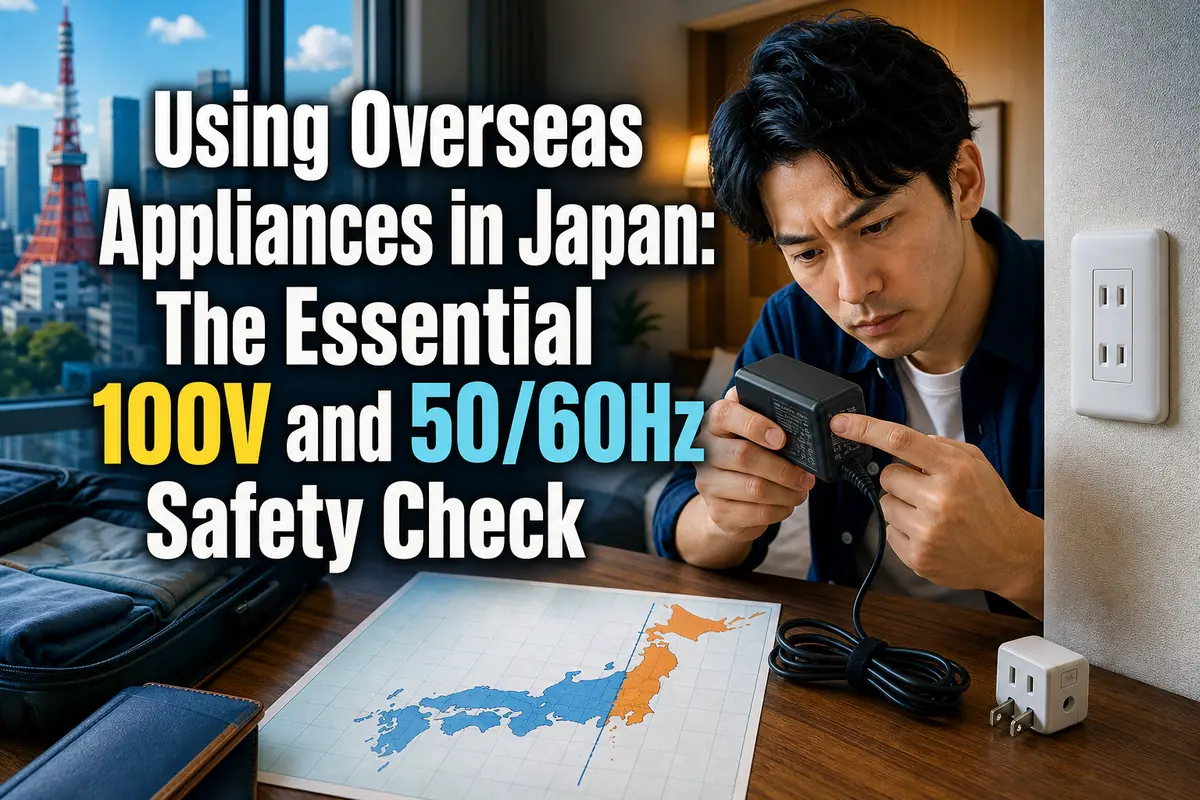
Can You Use Overseas Appliances in Japan? A 100V, Plug, and Frequency Guide
The short answer: many phone chargers and laptop adapters work in Japan, but only if their labels include 100V and the local frequency. A plug adapter changes the plug shape; it does not change voltage or frequency.
Before connecting any appliance, read the rating label on the appliance or its power supply. Look for a line such as INPUT: 100–240V~ 50/60Hz. If you cannot find the label or manual, do not assume the device is compatible.
This guide is for tourists, students, workers, and new residents bringing electrical equipment to Japan.
Quick checklist
- Japan supplies 100V AC, lower than the 110–120V used in some countries and much lower than 220–240V.
- Standard outlets use Type A, with two flat parallel slots.
- Eastern Japan generally uses 50Hz; western Japan generally uses 60Hz.
- A device marked
100–240V, 50/60Hznormally needs only the correct plug adapter. - High-power heating appliances are often safer and simpler to buy in Japan.
Three separate questions decide whether a device is safe
Plug shape, voltage, and frequency must all be checked separately. Passing one check does not mean the appliance passes the other two.
- Does the plug physically fit?
- Does the appliance accept 100V?
- Does it support the frequency used where you live?
A fourth question matters for three-prong appliances: does the installation provide the required protective earth connection?
Japan uses 100V, not 110V or 120V
Japan’s standard household supply is 100V AC nationwide. The Japan National Tourism Organization also identifies Type A as the standard outlet format.
This difference matters because equipment is designed to operate within a stated input range. The number to trust is the rating label—not the plug shape and not the country where you bought it.
How to read the label
Look near the power cord, battery compartment, underside of the appliance, or AC adapter. Useful Japanese terms include:
- teikaku den’atsu (定格電圧): rated voltage
- shūhasū (周波数): frequency
- shōhi denryoku (消費電力): power consumption
- nyūryoku (入力): input
- setsuchi (接地) or āsu (アース): grounding or earth connection
Here are common label patterns and what they mean:
INPUT: 100–240V~ 50/60Hz— normally usable across Japan with the correct plug connection.AC 100V 50/60Hz— designed for Japan and usable in both frequency regions.AC 100V 50Hz— intended only for a 50Hz supply unless the manufacturer says otherwise.120V 60Hz only— not confirmed for Japan; ask the manufacturer before use.220–240V 50Hz only— not directly compatible with a Japanese 100V outlet.
The tilde symbol ~ means alternating current. The output line on a charger, such as 5V DC, describes what the charger sends to the connected device. For wall compatibility, check the input line.
ここがポイント: If the label does not explicitly include 100V, treat the appliance as incompatible until its manufacturer confirms otherwise. A device turning on is not proof that it is operating safely or correctly.
What lower voltage does to overseas appliances
The result depends on the appliance’s design; there is no safe universal shortcut.
A modern switching power supply with a 100–240V input range adjusts automatically. This is common for phone chargers, laptop adapters, camera chargers, and some game-console power supplies.
A fixed-voltage appliance is different. Equipment designed only for 120V may run weakly, heat poorly, behave unpredictably, or fail to start at 100V. A 220–240V appliance will usually receive far too little voltage to work as intended.
Do not judge compatibility from a brief test. Motors and compressors can have demanding start-up conditions, while heating appliances may draw substantial power for long periods.
Devices that usually deserve extra caution
- Hair dryers, curling irons, and clothes irons
- Kettles, coffee makers, rice cookers, and toasters
- Microwave ovens
- Refrigerators, pumps, record players, and other motor-driven equipment
- Clocks that use the AC frequency for timing
- Medical or laboratory equipment
- Appliances with electronic temperature or speed controls
For a short visit, buying or borrowing a Japanese hair dryer or kettle is often more practical than carrying a large transformer.
A plug adapter is not a voltage converter
An adapter solves only a physical plug mismatch. It cannot turn Japan’s 100V supply into 120V or 230V, and it cannot change 50Hz into 60Hz.
Japan’s standard Type A outlet has two flat parallel slots. An ungrounded Type A plug from North America may fit physically, but that says nothing about the device’s electrical rating.
Travelers coming from countries that use Type C, G, I, or other plug formats normally need an adapter even when their charger supports 100–240V, 50/60Hz.
When a transformer may be needed
A transformer changes voltage. For example, equipment requiring 230V would need a transformer designed to accept 100V and produce the required output voltage.
Before buying one, verify all of the following:
- Input voltage: it must accept Japan’s 100V supply.
- Output voltage: it must match the appliance’s required input.
- Continuous wattage rating: it must exceed the appliance’s normal demand.
- Start-up capacity: motors and compressors may briefly require more power.
- Frequency: an ordinary transformer does not convert 50Hz to 60Hz.
- Grounding: the arrangement must preserve any protective earth required by the appliance.
The appliance manufacturer or a qualified electrical professional should determine the necessary capacity. Do not choose a transformer by voltage alone.
“Converter” can be an unclear product name
Some travel products marketed as converters are intended only for particular heating appliances and short periods of use. They may not provide clean, regulated power for electronics, motors, medical devices, or appliances with digital controls.
Read the converter’s permitted-device list and time limits. If the instructions do not clearly cover your appliance, do not use it.
Why Japan has both 50Hz and 60Hz
Your address determines the supply frequency, so check again whenever you move between regions.
Eastern Japan generally operates at 50Hz. Western Japan generally operates at 60Hz. Official travel guidance lists Tokyo in the 50Hz area and Nagoya, Kyoto, and Osaka in the 60Hz area.
TEPCO explains that frequency-conversion facilities are needed when electricity is transferred between the eastern and western systems. For a household user, however, the practical task is simply to match the appliance label to the local supply.
A useful regional guide
- 50Hz examples: Tokyo and much of eastern Japan
- 60Hz examples: Nagoya, Kyoto, Osaka, and much of western Japan
- Boundary or mixed areas: parts of central Japan require an address-specific check
Do not rely on a simplified map near the boundary. Ask the local transmission and distribution company, your landlord, accommodation provider, appliance manufacturer, or electronics retailer.
Which devices care about frequency?
A device marked 50/60Hz is designed for both systems. Many modern electronics and Japanese household appliances carry this marking.
Frequency can still matter for appliances containing motors, transformers, timers, or components designed around one supply frequency. Possible consequences include incorrect speed, inaccurate timing, extra heat, reduced output, or damage.
Panasonic’s Japanese refrigerator guidance illustrates why the exact model matters: it says its frequency-free refrigerators can be used in either region, while also noting an exception for one model and warning that appliances containing motors or transformers may be frequency-specific.
The safe rule is simple: check the complete rating, including Hz, rather than assuming that an appliance category is always compatible.
Grounding is easy to overlook in Japanese homes
A three-prong appliance should not lose its protective earth connection merely because the nearest outlet has two slots.
Two-slot outlets are common in Japan. Grounding connections may instead appear near washing machines, refrigerators, microwave ovens, air conditioners, or other designated appliance locations. Their form varies by building.
A three-to-two adapter with a loose earth wire is not automatically safe. The earth wire must connect to a proper grounding terminal according to the appliance and building instructions. Never attach it to a gas pipe, water pipe, screw, or other convenient-looking metal object.
If the required connection is unavailable:
- Ask the landlord or property manager before changing an outlet.
- Consult the appliance manufacturer or a qualified electrician.
- In a hotel or short-term rental, ask staff for an approved solution.
- Do not remove, bend, or defeat the grounding pin.
Stop using an outlet or appliance if you feel a shock, see repeated sparks, smell burning, notice discoloration, or find that a plug becomes unusually hot. Unplug it only if doing so is safe, keep people away, and contact the building manager, local power-network operator, or emergency services as appropriate.
What the PSE mark tells you—and what it does not
For products sold in Japan under the relevant law, the PSE mark is part of Japan’s electrical-product safety system.
The Ministry of Economy, Trade and Industry says the Electrical Appliances and Materials Safety Act covers 457 designated product items. Manufacturers and importers responsible for covered products must meet applicable technical and inspection requirements before applying the required PSE marking; covered products cannot be sold or displayed for sale in Japan without that marking.
This matters when buying extension cords, AC adapters, household appliances, or other covered electrical products in Japan. Purchase from a reputable seller, check the product instructions, and avoid suspicious products with missing manufacturer or importer information.
The PSE mark is not a substitute for reading the label. It does not mean that every appliance works on both frequencies, fits every outlet, or is appropriate for your room’s electrical capacity. Rules for commercial import or resale are also different from simply carrying personal belongings; businesses should check METI’s current requirements.
A safe arrival-day procedure
Check small chargers first and postpone uncertain, high-power appliances. This avoids turning unpacking day into an electrical emergency.
Step 1: Photograph every rating label
Take a clear photo before packing. Include the appliance model number and the label on any detachable charger or power brick.
Step 2: Sort equipment into three groups
- Directly compatible: label includes
100Vand the local frequency. - Compatible after a plug check: electrical rating is suitable, but the plug needs an adapter.
- Unconfirmed: 100V or the local frequency is missing from the label.
Keep the unconfirmed group unplugged.
Step 3: Check your destination’s frequency
Confirm whether the exact address uses 50Hz or 60Hz. This is especially important after moving across Japan or when staying near the east–west boundary.
Step 4: Inspect the outlet and grounding requirement
Check whether the plug fits securely and whether the appliance requires earth protection. Do not force a plug or create a chain of loose adapters.
Step 5: Check power and installation requirements
Large appliances may require a dedicated circuit, a particular outlet, or professional installation. Some Japanese homes also provide 200V circuits for equipment such as air conditioners, but a 200V outlet is not a general-purpose substitute for a foreign appliance. Its plug, circuit, frequency, grounding, and appliance rating must all match.
Step 6: Get a model-specific answer when uncertain
Send the manufacturer a photo of the rating label and provide:
- Exact model number
- Destination voltage: 100V AC
- Local frequency: 50Hz or 60Hz
- Intended transformer or adapter, if any
- Expected duration and type of use
A model-specific written answer is more useful than general advice about the brand.
Common mistakes to avoid
Most preventable problems begin with treating one electrical specification as if it answered every question.
- “The plug fits, so it is safe.” Physical fit does not prove voltage or frequency compatibility.
- “My adapter converts electricity.” A basic plug adapter changes only the connector shape.
- “120V is close enough to 100V.” The manufacturer’s permitted input range decides this.
- “A transformer fixes everything.” It usually changes voltage, not frequency, grounding, or circuit capacity.
- “All chargers are universal.” Many are, but the input label must say so.
- “East and west are the only possibilities.” Some boundary areas need an address-level check.
- “A power strip from home is fine.” Its plug, voltage, current rating, grounding, and local safety status all require review.
- “If it turns on once, it works.” Poor heating, timing errors, overheating, and motor stress may appear later.
FAQ
Can I charge my phone or laptop in Japan?
Usually, yes, if the charger says INPUT: 100–240V~ 50/60Hz. You may still need a Type A plug adapter. Check the charger rather than the phone or laptop battery label.
Can I use a US appliance rated only for 120V?
Do not assume so. Japan supplies 100V, and performance or safety can depend on the design. Ask the manufacturer whether that exact model supports 100V and the local frequency.
Can I use a European 230V hair dryer with a transformer?
It may be technically possible with correctly specified equipment, but hair dryers draw high power. A suitable transformer can be large, heavy, and expensive. A Japanese or verified dual-voltage dryer is usually the more practical option.
Will a 60Hz appliance work in Tokyo?
Tokyo uses 50Hz. Use the appliance only if its label or manufacturer confirms 50Hz operation. Changing voltage alone will not solve a frequency mismatch.
Will a Tokyo appliance work in Osaka?
Osaka uses 60Hz. An appliance marked 50/60Hz should be designed for either area, subject to its other installation requirements. A 50Hz-only model needs manufacturer confirmation before use.
Do hotels always provide adapters?
No. Some do, but availability and permitted use vary. Bring a suitable, reputable adapter or ask the property before arrival. Never assume a hotel outlet may be used for a high-power appliance.
What to check before your next trip or move
The rating label is the final practical checkpoint. Japan’s national voltage is consistent, but frequency, outlet grounding, building wiring, and appliance requirements can still differ.
Before plugging in:
- Confirm
100Vis within the input range. - Match
50Hz,60Hz, or50/60Hzto the address. - Use the correct plug connection without defeating grounding.
- Treat adapters and transformers as different products.
- Replace uncertain high-power travel appliances with Japanese-market models when practical.
- Ask the manufacturer or a qualified professional when the label leaves any doubt.
As of August 2026, Japan remains a 100V country with 50Hz and 60Hz regions. The next detail to verify is not a national policy update but the exact appliance model and the electricity supplied at the address where you will use it.
参照リンク
- Japan National Tourism Organization: Plugs & Electricity
- Japan National Tourism Organization: Japan Travel FAQ
- TEPCO: Frequently Asked Questions
- TEPCO Power Grid: Substations and East–West Frequency Conversion
- TEPCO Power Grid: Distribution Lines
- METI: Electrical Appliances and Materials Safety Act
- Panasonic Japan: Refrigerator Frequency Compatibility