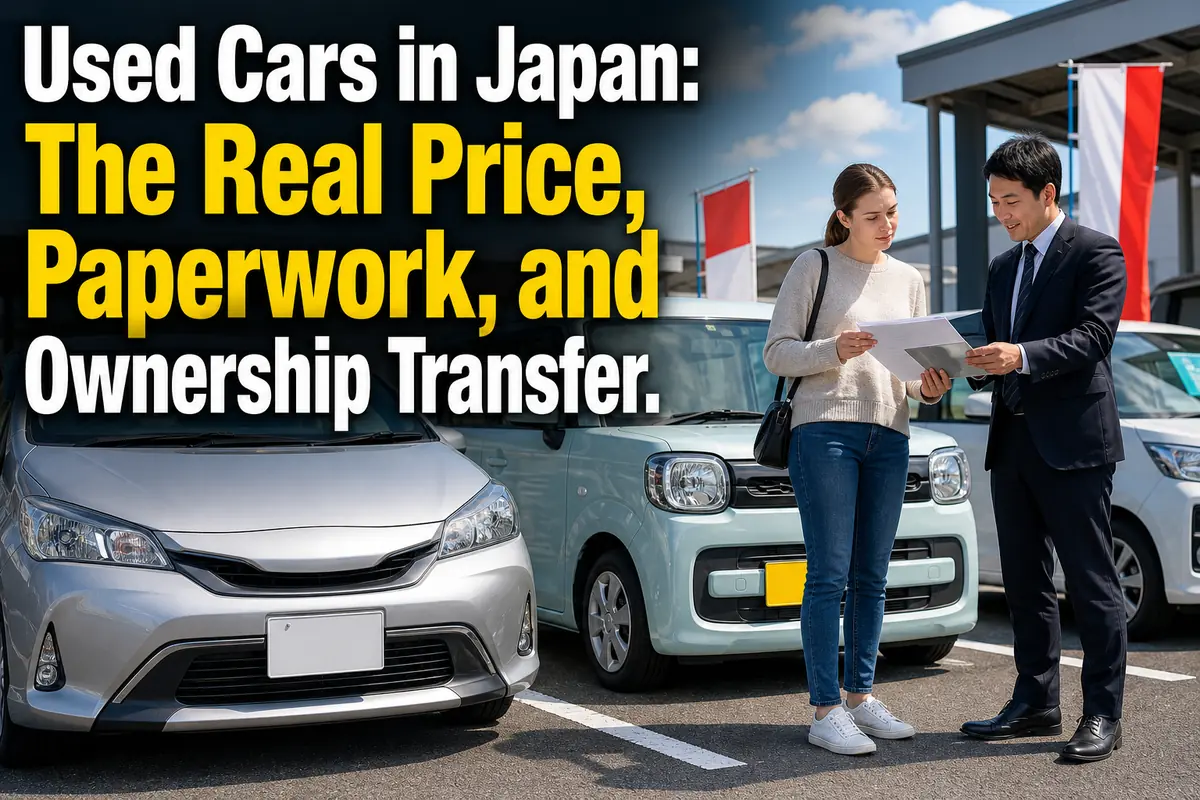
Used Cars in Japan: The Real Price, Paperwork, and Ownership Transfer
The safest way to budget for a used car in Japan is to start with the dealer’s 支払総額 (shiharai sōgaku), or total cash price, and then add the costs that depend on you: parking, optional insurance, delivery, requested accessories, and any maintenance due soon.
The number printed as 車両価格, meaning vehicle price, is not enough. A ¥700,000 car can require a much larger first-year budget once parking and future inspection costs enter the calculation.
This guide is for foreign residents and families buying from a dealer or private seller. It explains the process as of August 2026. Forms, fees, parking rules, and tax handling can vary by vehicle type and location, so confirm the final requirements with the office responsible for your address.
What you need to know first:
- Compare dealer cars by their total cash price, not only their vehicle price.
- Check whether the car is an ordinary registered vehicle or a kei car; the offices and paperwork differ.
- Arrange a legal parking space before registration when a garage certificate is required.
- Confirm the shaken expiry date, accident-repair history, warranty, and near-term maintenance before signing.
- Complete the ownership transfer promptly; the legal deadline is generally 15 days after the ownership change.
The purchase price is only one part of the budget
Your useful comparison figure is the amount needed to buy, register, park, insure, and operate the car—not the amount printed beside the vehicle alone.
Since October 2023, dealers covered by Japan’s automobile fair-competition rules have been required to present a used car’s selling price as 支払総額. This combines the vehicle price with the minimum insurance, taxes, recycling deposit equivalent, registration expenses, and administrative fees needed to buy that car under the stated conditions.
Those conditions matter. A displayed total may assume:
- registration within the dealer’s local area;
- collection from the dealership rather than home delivery;
- no optional accessories or extended warranty;
- a particular month of registration;
- the parking certificate being obtained under the quoted arrangement.
Ask for a written quotation using your address, expected registration month, delivery method, and chosen options. If a dealer says a mandatory preparation package must be added to the displayed total, ask why it was not included in the advertised price.
A practical first-year budget
The following is a planning model rather than a price list. Actual amounts depend heavily on the vehicle, prefecture, municipality, insurer, parking location, and dealer.
| Budget item | When it is paid | What to check |
|---|---|---|
| Dealer’s total cash price | At purchase | Registration area, tax, compulsory insurance, recycling deposit, dealer fees, and included maintenance |
| Parking contract | Before or around registration | Monthly rent, deposit, agency fee, renewal fee, and whether the space fits the car |
| Voluntary insurance | Before driving | Liability limits, vehicle coverage, driver restrictions, age conditions, and roadside assistance |
| Optional work | At purchase or later | Tyres, battery, dashcam, ETC setup, winter equipment, coating, or extended warranty |
| Fuel, tolls, and routine maintenance | Ongoing | Expected monthly distance and local use |
| Annual vehicle tax | Normally after the April 1 assessment date | Engine size or kei-car classification, vehicle age, and local notice |
| Next shaken | When the inspection expires | Inspection, compulsory insurance, weight tax, service, and repairs |
For example, if a dealer quotes a ¥900,000 total cash price, do not treat ¥900,000 as the complete first-year cost. Add your actual parking contract, voluntary insurance premium, and a maintenance reserve based on the inspection report and shaken expiry date. In a city where parking is expensive, the parking contract can affect the decision more than a small difference between two cars.
Understand the taxes and compulsory charges
Japan’s car charges are triggered at different times, so they should not be treated as one annual bill.
Consumption tax
A dealer’s vehicle price is normally shown with consumption tax included. A one-off sale of a personal car by an ordinary private owner is treated differently from a dealer’s business sale for consumption-tax purposes.
This distinction does not remove the need for transfer registration, insurance, or other applicable charges. It only explains why a private-sale quotation may look different from a dealer quotation.
Environmental performance levy
The automobile tax environmental performance levy may be charged when a vehicle is acquired. Its rate depends on factors such as the vehicle’s environmental performance and calculated acquisition value. The treatment can change with tax reforms, and kei cars are administered differently from ordinary vehicles.
Do not estimate this levy only from the price negotiated with the seller. Ask the dealer or prefectural tax office for the calculation that applies to the exact model and registration date.
Annual automobile tax or light motor vehicle tax
For an ordinary registered car, the annual automobile tax is generally based mainly on engine displacement, with possible differences related to registration date and environmental treatment. The person recorded as owner on April 1—or the user in certain ownership-retention arrangements—is normally assessed.
A kei car is subject to municipal light motor vehicle tax instead. The amount and billing authority therefore differ from an ordinary car.
A seller may ask the buyer to reimburse an amount corresponding to the unused portion of an already paid annual tax. The National Tax Agency explains that this reimbursement is part of the used car’s sale consideration; it is not a fresh tax payment from the buyer to the prefecture. Make sure the quotation labels it clearly.
Automobile weight tax
Weight tax is generally paid when the car undergoes shaken rather than every time ownership changes. The amount can depend on vehicle weight, environmental classification, and age.
From May 1, 2026, the applicable national tables distinguish qualifying vehicles and older vehicles, including higher treatment after age thresholds. Check the exact car through the electronic vehicle inspection certificate service or the current Ministry of Land, Infrastructure, Transport and Tourism tables. Two similarly priced cars can produce different inspection bills because of their weight, age, and emissions classification.
Compulsory automobile liability insurance
自賠責保険 (jibaiseki hoken), officially Compulsory Automobile Liability Insurance, is legally required. It mainly protects people injured in traffic accidents; it is not a replacement for broad voluntary insurance.
When ownership changes, the insurance subscriber information also needs to be transferred through the insurer or mutual-aid association. Driving without valid compulsory insurance can result in criminal penalties and licence consequences.
Recycling deposit
Japan’s recycling system attaches a prepaid recycling deposit to many vehicles. When a used car is sold, the buyer commonly pays the seller an amount corresponding to the deposit and receives the associated recycling entitlement.
Confirm whether the deposit equivalent is already included in the dealer’s total cash price. Also check whether the recycling fee has actually been deposited or will be due later.
ここがポイント: A car with valid shaken is not automatically cheaper to own, and a car without shaken is not automatically a bad purchase. Compare the full quotation, the remaining inspection period, weight tax, compulsory insurance, required repairs, and the date of the next major payment.
Choose between an ordinary car and a kei car before collecting documents
The category printed on the vehicle record determines where you apply and which documents you prepare.
An ordinary registered vehicle is handled through the transport branch office responsible for its main place of use. A kei car is handled by the Light Motor Vehicle Inspection Organization. A kei-car ownership change cannot be completed at an ordinary transport branch office.
Kei cars can offer lower taxes and may be easier to park because of their smaller dimensions. They are not automatically the best choice for every family, however. Passenger space, motorway use, luggage, safety equipment, engine performance, insurance, and local parking prices still need comparison.
Ordinary-car paperwork
The exact set changes according to whether the owner and user are the same person, whether a representative applies, and whether the registration area changes. A typical transfer involves:
- the application form;
- the current vehicle inspection certificate;
- a transfer certificate from the seller;
- the seller’s and buyer’s required seal-related documents;
- a recent seal registration certificate where required;
- a letter of attorney if a representative applies;
- a parking-space certificate where the law requires one;
- tax declarations and payment documents;
- the existing licence plates if the registration area changes.
The transport office may need the vehicle present when new plates are installed and the rear plate receives its official seal. Do not assume that documents alone will finish an out-of-area transfer.
Kei-car paperwork
A typical kei-car name change requires the original vehicle inspection certificate and, when the user or address changes, proof of the new user’s address. The Light Motor Vehicle Inspection Organization lists a residence certificate without an Individual Number or a seal registration certificate as common forms of address evidence; the document generally must have been issued within the previous three months.
Additional forms, plates, tax declarations, or a representative’s application request may be needed. If the registered owner differs from the user—often because a dealer or finance company retains ownership—obtain that owner’s consent before applying.
Some urban areas require a separate notification of the kei car’s parking location even though the process differs from an ordinary-car garage certificate. Check with the police station responsible for the parking address.
Secure the parking space before the transfer
For many buyers, parking paperwork—not payment—is the step that controls the registration schedule.
An ordinary car generally needs a 車庫証明 (shako shōmei), or parking-space certificate, when the relevant area and transaction require it. Applications go to the police station with jurisdiction over the parking location, not simply the station nearest the dealership.
You will commonly need:
- an application form;
- a map showing the parking location and its surroundings;
- a layout showing the space and access route;
- proof that you own the space, or the owner or manager’s permission to use it;
- the local application fee.
The space must be usable for the specific vehicle. Measure the width, length, entrance, turning room, and any height restriction before signing a parking contract.
Police fees and processing schedules vary by prefecture. Some procedures have also changed as prefectures digitize or simplify their systems. Use your prefectural police website for the current form, fee, collection date, and online availability.
Follow the purchase in the right order
Do not sign the final contract until the car, quotation, parking plan, and registration responsibility all agree.
1. Confirm that you can register and use the car
You need a usable address for the vehicle records and any supporting residence or seal documents required for the application. Your driving licence must also be valid for driving in Japan and for the vehicle concerned.
If you plan to finance the purchase, obtain approval before treating the car as secured. A lender may remain the registered owner until the loan is paid, which affects later sale, disposal, and document changes.
2. Inspect the documents and the car
Match the chassis number on the vehicle to the records. Then review:
- first registration date;
- shaken expiry date;
- recorded owner and user;
- mileage and available maintenance records;
- accident-repair or structural-repair disclosure;
- recall completion;
- number of keys;
- tyre age and tread;
- warning lights, battery condition, and fluid leaks;
- warranty period, distance limit, exclusions, and claim procedure.
Shaken confirms compliance at the time of inspection. It does not promise that the transmission, air conditioning, battery, tyres, or other components will remain trouble-free.
For a private sale, an independent inspection is especially valuable. There is no dealer package automatically handling registration, disclosure, warranty, or delivery.
3. Obtain an itemized quotation
The quotation should separate the vehicle price and other charges while showing the final amount payable. Ask which items are compulsory and which are optional.
Confirm in writing:
- the conditions behind the displayed total cash price;
- whether shaken is still valid or will be newly obtained;
- whether maintenance is included;
- whether the recycling deposit equivalent is included;
- whether compulsory insurance remains valid and will be transferred;
- whether plates, registration, parking paperwork, and delivery are included;
- whether a warranty is included in the vehicle price;
- the cancellation terms and deposit treatment.
4. Prepare the parking and identity documents
Document validity periods are short. Coordinate the parking certificate, residence certificate, seal registration certificate, seller’s papers, and planned registration date rather than collecting them months apart.
Names and addresses should match across the application documents. If your passport, residence card, residence record, seal certificate, and older vehicle records show different spellings or address histories, ask the registration office what connecting evidence it requires before the application day.
5. Complete the transfer and tax declarations
Ownership changes for ordinary cars use transfer registration. For kei cars, complete the corresponding name-change procedure with the Light Motor Vehicle Inspection Organization.
The Road Transport Vehicle Act generally requires an application within 15 days after the reason for the change occurs. A dealer often performs the procedure, but the buyer should still verify the completed vehicle record rather than assuming it was filed.
6. Fix the insurance before driving away
Confirm the compulsory insurance record and arrange voluntary insurance to begin no later than the handover time. Voluntary cover can include protection for damage or injury beyond the compulsory system, property damage, legal assistance, vehicle damage, and roadside service.
Check who is permitted to drive. Age limits, named-driver restrictions, household definitions, and business-use exclusions can materially change coverage.
7. Check the completed vehicle record
Electronic inspection certificates contain limited visible information, with additional details available through the official inspection-certificate viewing service. Check the registered owner, user, address or main place of use, plate number, and inspection expiry date.
Keep the certificate and other required records properly with the vehicle. Store copies of the contract, quotation, warranty, inspection report, insurance documents, and payment records separately.
Dealer purchase and private purchase are not the same transaction
A private sale can remove dealer fees, but it transfers more verification work and risk to the buyer.
With a dealer, registration support and a standardized total-price display can make comparison easier. The dealer may also provide maintenance and a written warranty. Those services have value only if their scope is clear.
In a private sale, decide in writing:
- the sale price and payment date;
- who pays transfer, plate, parking, and transport costs;
- the handover date and odometer reading;
- when risk passes to the buyer;
- who holds each original document;
- how remaining tax or insurance equivalents are handled;
- the deadline for ownership transfer;
- what happens if the transfer cannot be completed;
- whether the sale is as-is and what known defects have been disclosed.
Do not leave the car in the seller’s name. Tax notices, traffic matters, insurance questions, and disposal rights can become difficult when the registered records do not match the real owner and user.
Common mistakes that make a cheap car expensive
Most avoidable problems begin with comparing the wrong price or postponing paperwork.
- Comparing vehicle prices instead of payable totals: Use a written, address-specific total.
- Ignoring the next shaken date: A low price can be followed quickly by inspection, insurance, tax, service, and repair costs.
- Assuming shaken proves mechanical quality: Obtain maintenance records and consider an independent inspection.
- Renting a space that does not fit: Measure the car, entrance, ramps, and mechanical-parking limits.
- Buying before checking parking rules: The registration schedule may depend on police paperwork.
- Treating compulsory insurance as complete protection: Consider suitable voluntary cover before handover.
- Accepting unexplained mandatory packages: Ask the seller to identify the contractual and pricing basis for every required item.
- Missing name or address differences: Resolve spelling and address-history questions with the office before filing.
- Failing to verify the completed transfer: Read the updated vehicle record yourself.
What changed by August 2026
The most important current checks are the 2026 tax tables, electronic vehicle records, and local procedure updates.
From May 1, 2026, revised automobile weight-tax rules and tables apply to relevant inspections and used-vehicle registrations. The exact amount depends on the car, so an old blog post or a rough calculation based only on engine size is not reliable.
Electronic vehicle inspection certificates are now used for both ordinary and kei vehicles. Buyers should know how to read the certificate and use the official viewing service for the additional recorded information.
There was also a terminology change in Tokyo from April 1, 2026: the tax previously labelled 自動車税種別割 is shown as 自動車税 on current metropolitan guidance. Other authorities and older documents may still use the former wording. The practical step is to match the notice to the vehicle and assessment authority, not to assume that similarly named taxes are duplicate bills.
Final checklist before you pay
The best buying decision is the car whose documents, condition, and first-year cost all remain acceptable after the attractive headline price disappears.
Before transferring the balance, confirm:
- the final payable amount and every condition behind it;
- the car’s chassis number and registered owner;
- shaken expiry and likely next-inspection work;
- included maintenance and warranty terms;
- recycling-deposit status;
- the correct parking procedure for your address;
- who files the transfer and by what date;
- when compulsory and voluntary insurance begin;
- when you will receive the updated vehicle record, keys, and supporting documents.
If one figure deserves extra attention, it is not the discount. It is the amount you will spend between signing the contract and completing the next shaken. Ask the dealer to put that timeline on paper before you pay.
参照リンク
- Automobile Inspection and Registration System — MLIT
- Registration Procedure — MLIT
- Automobile Registration Procedures Portal — MLIT
- Electronic Vehicle Inspection Certificate Portal — MLIT
- 2026 Automobile Weight Tax Guidance — MLIT
- Compulsory Automobile Liability Insurance FAQs — MLIT
- Used-Car Total Price Display Rules — Automobile Fair Trade Council
- Used-Car Total Price Display FAQ — Automobile Fair Trade Council
- Consumption Tax Transactions — National Tax Agency
- Treatment of Remaining Automobile Tax in Used-Car Sales — National Tax Agency
- Automobile Tax — Tokyo Metropolitan Government
- Environmental Performance Levy — Tokyo Metropolitan Government
- Parking Place Certificate Procedure in English — Kanagawa Prefectural Police
- Light Motor Vehicle Name Change — Light Motor Vehicle Inspection Organization