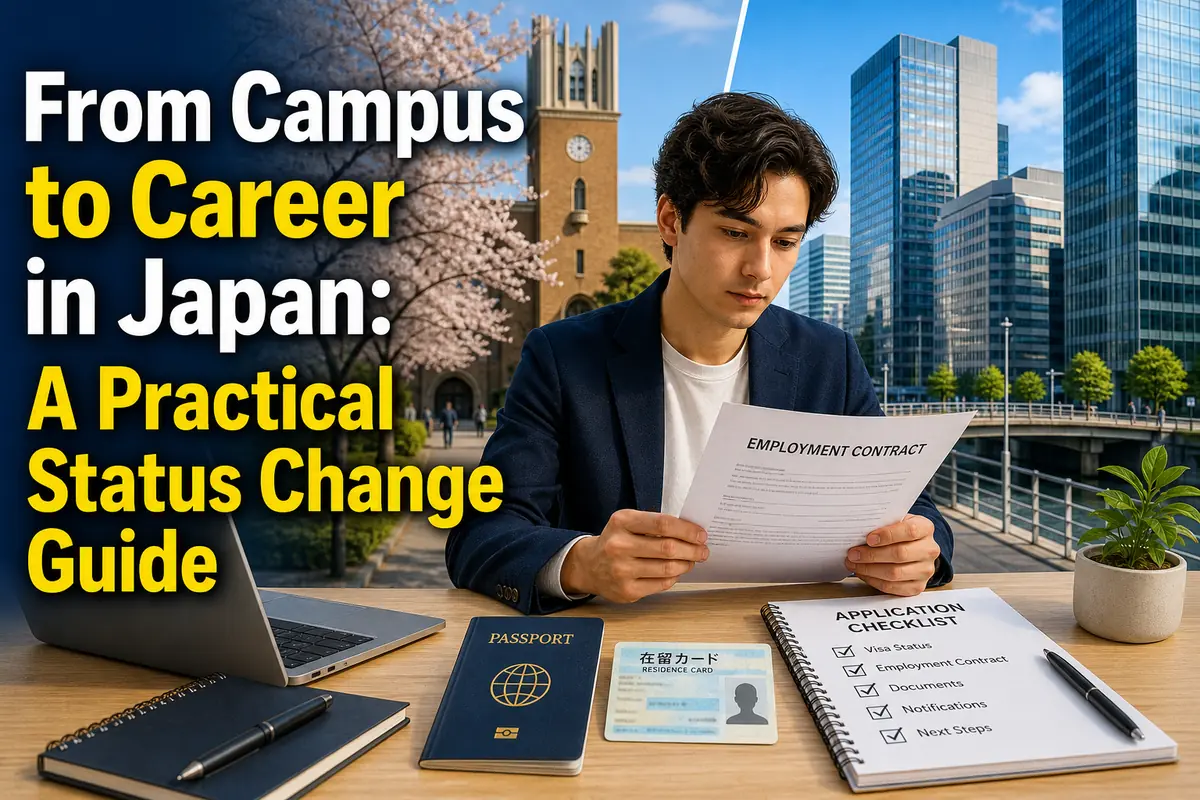
From Campus to Career in Japan: A Practical Status Change Guide
If you hold a Student status of residence and plan to begin a full-time job in Japan, you normally need permission to change to a work-authorized status before you start that job. A job offer alone does not change what work you may legally do.
For graduates starting work in April, the Immigration Services Agency (ISA) currently recommends applying between December 1 and the end of January. The correct status, evidence, and timing depend on the actual job—not simply on your degree or the fact that a company hired you.
This guide is for international students, recent graduates, and employers preparing for the move from study to full-time employment.
Quick guide
- Identify the status that matches your real duties before collecting documents.
- Ask your employer early because part of the evidence must come from the company.
- Do not begin unrestricted full-time work while you still hold Student status.
- As of August 2026, permission costs ¥6,000 for a counter application or ¥5,500 for an online application.
First, confirm which status matches the job
There is no single status officially called a “work visa” that covers every employee. Japan grants a status of residence according to the activities a person will perform.
A change from Student status is therefore not an automatic graduation procedure. The ISA examines whether the planned work falls within the requested status and whether the applicant and employer meet the relevant conditions.
Common possibilities include:
- Engineer/Specialist in Humanities/International Services: Often used for jobs involving engineering, IT, planning, accounting, marketing, translation, design, or other specialized work.
- Instructor: Generally relevant to teaching at elementary schools, junior high schools, high schools, and similar institutions.
- Professor: Used for research, teaching, or research guidance at universities and certain equivalent institutions.
- Researcher: Covers qualifying research work at public or private organizations outside the activities covered by Professor.
- Nursing Care: Relevant to qualifying care work by a certified care worker.
- Skilled Labor: Covers specified skilled occupations that require substantial experience, such as certain foreign-cuisine chefs.
- Specified Skilled Worker: A separate route for designated industrial fields, with its own tests, employment standards, and support requirements.
- Highly Skilled Professional: A points-based option for eligible advanced professional work.
The job title does not settle the question. An employee called a “sales associate,” for example, might mainly perform routine retail work or might manage overseas accounts using specialist language and business knowledge. Immigration examines the substance of the duties.
The link between education and work matters
For several professional statuses, the applicant usually needs relevant academic qualifications or qualifying work experience. The relationship does not always have to be a perfect match, but it must be credible under the rules for the requested status.
Prepare to explain:
- what you studied;
- what you will do each day;
- which knowledge or skills the position requires;
- why your education or experience prepares you for those duties;
- how much of the role consists of qualifying professional work.
This is especially important when a job description mixes specialist duties with customer service, factory work, food service, or other tasks that may not fit the requested status.
Salary and employment conditions also matter
The employment agreement should clearly state the position, duties, workplace, contract period, working hours, and pay. Depending on the status, remuneration generally must be comparable to that paid to a Japanese worker doing equivalent work.
A full-time permanent contract is not the only possible arrangement, but short contracts, dispatch work, multiple workplaces, or unclear duties can require more explanation and evidence.
When should you apply?
Apply as soon as the ISA accepts applications for your intended start date and your documents are complete. Waiting until March for an April job creates an avoidable risk.
For people scheduled to begin work on April 1, 2026, the ISA asked applicants to file between December 1, 2025, and the end of January 2026. This early window reflects the heavy volume of graduate applications from January through March.
Future graduating classes should check the ISA student-employment page for the dates that apply to them. A regional bureau may also publish local instructions or a reservation system.
Your current expiry date can change the plan
An early application window does not override the expiry date printed on your residence card. For the spring 2026 intake at the Tokyo Regional Immigration Services Bureau’s Shinagawa office, students whose existing period of stay expired before the bureau’s stated cutoff were instructed to seek an extension of Student status instead of using the ordinary early-change schedule.
Check these three dates together:
- the expiry date of your current period of stay;
- your graduation or course-completion date;
- the employment start date in your contract.
Ask your regional immigration office or school’s international-student office if those dates leave a gap.
Applying before expiry can protect your stay—but not expand your work rights
If an eligible application for a change or extension is filed before the current period expires and no decision has been made by the expiry date, a special-period rule may allow the applicant to remain under the existing status until a decision is made or until two months after expiry, whichever comes first.
That does not turn Student status into a work-authorized status. During that period, the permitted activities remain those of the previous status.
ここがポイント: Filing an application can preserve your lawful stay in qualifying cases, but it does not itself authorize the new full-time job. Wait for permission and confirm the effective date before beginning work.
Documents: divide the work between you and the employer
A successful application usually needs personal, academic, employment, and company evidence that tells one consistent story. The exact checklist depends on the requested status and the employer’s category.
Always download the current checklist for the specific status from the ISA website. Do not reuse a list prepared for a friend whose job or employer differs from yours.
Documents commonly prepared by the applicant
Depending on the route, these may include:
- the correct application form for a change of status;
- a photograph meeting the current specifications;
- passport and residence card;
- curriculum vitae or work-history documents;
- graduation certificate or expected-graduation certificate;
- academic transcript;
- evidence of relevant qualifications, tests, or professional experience;
- an explanation of the relationship between the course of study and the job, when useful;
- Japanese translations of documents written in other languages.
If you apply before graduation using an expected-graduation certificate, immigration may require the final graduation certificate before completing the case or issuing the new residence card.
Documents commonly supplied by the employer
The employer may need to prepare items such as:
- an employment contract or written notice of employment conditions;
- a detailed description of duties;
- company registration or organizational information;
- financial statements or tax-related company documents;
- brochures, website materials, or other evidence explaining the business;
- documents identifying the workplace, department, and reporting structure;
- an explanation of why the position requires the applicant’s specialist knowledge.
The exact company documents vary by the organization’s official category and the requested status. Large listed companies and smaller or newly established employers may face different evidence requirements.
A document-reduction rule introduced for some graduates
From December 1, 2025, the ISA expanded circumstances in which some documents may be omitted for changes from Student to Engineer/Specialist in Humanities/International Services or Researcher.
The additional cases include certain applicants who:
- graduated or expect to graduate from a Japanese university, graduate school, or junior college;
- graduated from an overseas university appearing in the top 300 in at least two of three designated world rankings; or
- will join an organization already employing a qualifying former student who changed to the same requested status and later received at least one extension there.
This reduction does not apply to dispatch-type employment, according to the ISA notice. It also does not remove the need to prove that the applicant and work qualify. Check the current official list before deciding that a document may be left out.
The application process, step by step
The safest process begins with job classification, not form filling. A complete but incorrectly classified application can still fail.
1. Review the real duties
Ask the employer for a detailed job description. Compare it with the ISA description and required documents for the proposed status.
If the position contains several types of work, estimate how much time each duty will take. Immigration may need to understand which activity is the main one.
2. Check your eligibility evidence
Match your degree, subjects, qualifications, or professional experience to the requirements. Obtain certificates and translations early; foreign universities and former employers may need time to issue them.
3. Coordinate with the employer
Give the employer the official checklist and agree on responsibility for each item. Confirm that names, dates, salary, work location, contract period, and duties agree across all documents.
4. Choose counter or online filing
Applications can be submitted to the immigration office with jurisdiction over the applicant’s residence. Eligible users can also use the online residence application system.
The online system was renewed on January 5, 2026. Online applicants can check statuses such as application completed, under examination, awaiting issuance, or completed in the system. Confirm the current registration, technical, and receipt requirements before choosing this route.
5. Keep proof of the application
For a counter application, the back of the residence card is normally marked to show that an application is pending. An online application does not receive that same notation, so keep the system confirmation available.
6. Respond promptly to requests
Immigration may ask for additional evidence or clarification. A request does not automatically mean refusal, but a slow or incomplete response can delay the decision.
7. Receive the result and new residence card
The ISA’s general procedural page gives a standard processing guide of approximately one to two months, but actual times vary with the case, season, office, and need for additional documents. Online applicants can view progress in the system; the ISA asks applicants to avoid calling merely to request individual progress reports.
The fee is paid when permission is granted:
- ¥6,000 for an application handled at the counter;
- ¥5,500 for an online application.
These amounts apply under the fee schedule introduced on April 1, 2025. A law promulgated in June 2026 raised statutory ceilings for certain immigration fees, so check the current procedural page again before paying in case the payable amount changes later.
What can you do while waiting?
Continue only activities permitted by your current Student status and any valid permission for activities outside that status. Do not treat the pending application as approval.
A student’s separate work permission may allow limited part-time work within its conditions, commonly up to 28 hours per week while classes are in session. It does not authorize an unrestricted full-time graduate position merely because the same company previously employed the student part-time.
Before the first day of the new job, the employee and employer should confirm:
- permission has actually been granted;
- the new residence card shows the expected status;
- the work falls within that status;
- the authorized period of stay covers the planned employment;
- any status-specific restrictions or conditions are understood.
If the decision is delayed beyond the expected start date, speak with the employer and immigration office. Postponing the start date may be necessary.
If you graduate without an immediate job start
Student status is tied to study, so graduation can create a separate immigration issue even when time remains on the residence card. Do not assume that the printed expiry date alone allows you to remain indefinitely without studying.
Continuing a job search
Eligible graduates of Japanese universities and certain other institutions may be able to change to Designated Activities for continued job hunting, generally with support or a recommendation from the school and other required evidence.
Eligibility differs by institution type. Japanese-language-school graduates, for example, are covered only in specified circumstances. Check the official category before relying on this route.
Waiting to join a company after receiving an offer
A person who has graduated and secured a job but has a long gap before the joining date may need a Designated Activities route for the waiting period. Required evidence can include details of the employer, contract, start date, and planned activities.
This is different from continued job hunting: one route is for searching for work, while the other addresses the period after an offer and before employment begins.
A job that does not fit the expected status
A degree and offer do not guarantee approval. If the main duties fall outside the proposed professional status, practical options may include:
- asking the employer to clarify or legitimately redesign the professional role;
- checking whether another status accurately covers the work;
- meeting the requirements for a separate route such as Specified Skilled Worker;
- choosing a different position that matches the applicant’s qualifications and an available status.
The documents must describe the genuine job. Changing only the wording while leaving the actual duties unchanged creates risk for both the worker and employer.
Common mistakes that delay or weaken an application
Most preventable problems come from late preparation or inconsistent evidence. Review the whole file as one package.
- Using “work visa” without identifying a category: The application must request a specific status based on activities.
- Assuming any degree permits any office job: The required relationship between qualifications and duties depends on the status and case.
- Submitting a vague job description: Generic phrases such as “general office work” do not show why a specialist status applies.
- Copying another graduate’s checklist: Employer category, contract type, occupation, and academic background can change the required evidence.
- Applying too late for an April start: The busiest season leaves less time to correct missing documents.
- Starting full-time work while permission is pending: A pending application does not expand Student activities.
- Ignoring graduation-to-employment gaps: A separate status or adjusted timeline may be necessary.
- Letting documents contradict each other: Different salaries, locations, duties, or start dates invite questions.
- Omitting translations: Foreign-language evidence may need Japanese translations, with the translator identified where required.
- Assuming an omission rule applies to dispatch employment: The expanded December 2025 document reduction expressly excludes dispatch arrangements.
What changed by August 2026?
The main recent changes affect timing, document preparation, online filing, and residence-card procedures—not the basic need to obtain permission before beginning the new activity.
Important developments include:
- The ISA now asks April starters to apply early, generally from December 1 through the end of January for the announced graduate cycle.
- From December 1, 2025, document omissions became available in additional qualifying Student-to-Engineer/Specialist in Humanities/International Services and Student-to-Researcher cases.
- A renewed online residence application system began operating on January 5, 2026.
- For residence cards issued from June 14, 2026, the photo exemption generally applies only to children under one year old; most applicants aged one or older need a compliant photograph.
- Current published change-of-status fees are ¥6,000 at the counter and ¥5,500 online, but a June 2026 legal amendment increased statutory fee ceilings. Applicants should recheck the payable fee at the time of permission.
National eligibility rules come from the ISA, but filing logistics can differ by regional office. School support procedures and employer document practices also vary. Use your local office’s instructions alongside the national checklist.
Final checklist before you apply
Your next action should be to test the job against the correct status and build a dated document plan with the employer. Do that before your final semester becomes busy.
- Confirm the exact proposed status and why the duties fit it.
- Check the expiry, graduation, application, and employment dates together.
- Download the current status-specific checklist.
- Assign applicant and employer documents to named people.
- Verify whether a document-reduction rule genuinely applies.
- File within the announced window and before your current stay expires.
- Keep evidence of submission and answer additional requests quickly.
- Do not start the new full-time role until permission is granted.
- Recheck the fee, photo rules, and regional-office instructions immediately before filing.
The most important unresolved point is usually not the application form. It is whether the actual first day’s duties match the requested status. Settle that question with the employer early; every other document should support the same answer.
参照リンク
- Immigration Services Agency: Employment of International Students
- Immigration Services Agency: Notice for Applicants Changing from Student to a Work-Authorized Status
- Immigration Services Agency: Status of Residence Index and Document Lists
- Immigration Services Agency: Application for Change of Status of Residence
- Immigration Services Agency: Change-of-Status Application Forms
- Immigration Services Agency: Guidelines for Change of Status and Extension
- Immigration Services Agency: Special Period While an Application Is Pending
- Immigration Services Agency: Online Residence Application Procedures
- Immigration Services Agency: Checking Application Progress
- Immigration Services Agency: 2025 Immigration Fee Revision
- Immigration Services Agency: Engineer/Specialist in Humanities/International Services Clarifications
- Immigration Services Agency: Designated Activities for Continued Job Hunting
- Immigration Services Agency: 2026 Immigration Act Amendments