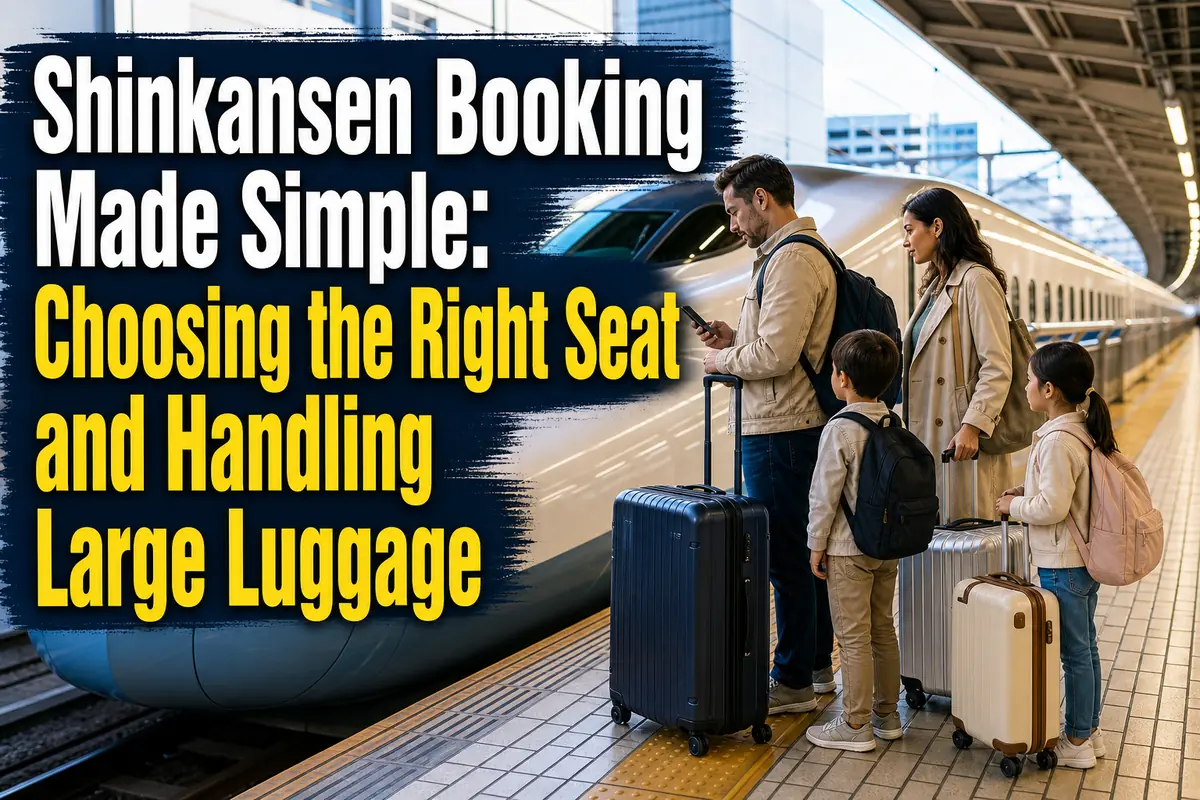
Shinkansen Booking Made Simple: Choosing the Right Seat and Handling Large Luggage
For most trips between Tokyo, Kyoto, Osaka, Hiroshima, Fukuoka, and Kagoshima, the simplest option is to book a reserved seat through SmartEX and board with a QR ticket or registered transit IC card. If your suitcase measures more than 160 cm when its three sides are added together, reserve a seat with an oversized baggage area at the same time.
This guide is for foreign residents, visiting relatives, students, workers, and families who need to buy their own Shinkansen tickets. The information is current as of August 1, 2026.
The essentials
- SmartEX covers the Tokaido, Sanyo, and Kyushu Shinkansen—not every bullet train in the country.
- A reserved seat guarantees your seat on a specific train; a non-reserved ticket usually does not.
- Each traveler needs a separate QR ticket, assigned IC card, or paper ticket.
- Luggage whose three dimensions total more than 160 cm requires a suitable reserved seat on the covered routes.
First check whether SmartEX covers your journey
SmartEX is the right service for the main Shinkansen corridor from Tokyo to Kagoshima-Chuo. It is not a nationwide booking system.
You can use it for journeys on these connected lines:
- Tokaido Shinkansen: Tokyo–Shin-Osaka
- Sanyo Shinkansen: Shin-Osaka–Hakata
- Kyushu Shinkansen: Hakata–Kagoshima-Chuo
Covered train types include Nozomi, Hikari, Kodama, Mizuho, Sakura, and Tsubame. A single booking can include connections within the covered network, subject to the service conditions.
Do not assume that SmartEX can book a train simply because it is called a Shinkansen. Routes operated north or northwest from Tokyo—including the Tohoku, Hokkaido, Joetsu, and Hokuriku Shinkansen—use other JR booking services. Check the operator before creating an account or entering payment details.
SmartEX is separate from local train travel
A SmartEX fare combines the basic fare and limited-express fare for the Shinkansen section. It does not automatically include the local train ride to or from the Shinkansen station.
For example, if you travel from a neighborhood station to Tokyo Station and then take the Shinkansen to Kyoto, the local journey to Tokyo Station is normally charged separately. You may pay it with an IC card such as Suica or PASMO.
This difference matters when comparing prices. SmartEX can be convenient without always being the cheapest total option once connecting local fares or other discounts are considered.
Reserved or non-reserved: which ticket should you choose?
A reserved seat is the safer default for families, groups, long journeys, and anyone carrying substantial luggage. Non-reserved seating is most useful when flexibility matters more than having a guaranteed place to sit.
Reserved seat
A reserved ticket gives you a specific train, car, and seat. It is usually the better choice when:
- you need to sit with a partner or child;
- you are traveling during a weekend, holiday, or morning or evening rush;
- you have a fixed appointment after arrival;
- you want a window or aisle seat;
- you need an oversized baggage area;
- standing for part of the journey would be difficult.
SmartEX reserved-seat prices vary by train type and season. Ordinary reserved seats can cost more during peak and top-season periods and less during off-peak periods. Check the displayed total before paying rather than relying on an old fare example.
Non-reserved seat
A non-reserved ticket lets you use an eligible non-reserved car on the specified date and route. You choose an open seat after boarding. If every seat is occupied, you may need to stand or wait for another train.
In SmartEX, the booking screen may ask you to select a train before it displays the non-reserved fare. That train is part of the search process; the official instructions state that a non-reserved fare can be used in a non-reserved seat on the booked date and route.
Non-reserved seating is a poor match for oversized luggage because the designated baggage spaces are connected to particular reserved seats.
Nozomi changes during major holidays
During designated peak travel periods—including parts of Golden Week, Obon, and the year-end/New Year holidays—Nozomi trains on the Tokaido and Sanyo lines operate with reserved seats only. A non-reserved ticket does not provide a seat on those Nozomi services.
Hikari, Kodama, Mizuho, Sakura, and Tsubame may continue to offer non-reserved cars, but those cars can be crowded. JR announces the applicable dates, so check the official Nozomi peak-period page before holiday travel.
ここがポイント: If you know your travel date and need to sit, reserve a seat. The small saving or extra flexibility of a non-reserved ticket is rarely worth the risk for a family trip or a busy holiday departure.
How to make a SmartEX reservation
Booking is straightforward once you have confirmed the route, passenger count, and luggage size. Prepare those details before opening the seat map.
What to prepare
You will generally need:
- a SmartEX account;
- a compatible credit card in the account holder’s name;
- the travel date and approximate departure time;
- the correct departure and arrival stations;
- the number of adults and children;
- the size of each large suitcase;
- an IC card for each passenger if you plan to board that way.
SmartEX has no annual membership fee, although your card issuer may charge a foreign transaction fee. Card compatibility and authentication can differ by issuer, so register before the day of travel. If registration or payment fails, buy through a JR ticket machine, ticket office, or another official service instead of repeatedly trying at the gate.
Booking steps
- Sign in to the SmartEX website or app.
- Enter the date, time, departure station, destination, and number of passengers.
- Select a train after checking both its departure and arrival times.
- Choose Ordinary reserved, Green Car, or non-reserved seating.
- If required, select “Seat with oversized baggage area.”
- Use the seat map or choose a window or aisle preference when available.
- Confirm every passenger, train, station, and fare.
- Pay and open the reservation details to set up the boarding method.
Basic SmartEX tickets can be purchased from 5:30 a.m. one year before travel until four minutes before the scheduled departure, apart from maintenance periods and other restrictions. Reservations made more than one month ahead use a tentative timetable; SmartEX confirms the train details and seats after 8:00 a.m. one month before departure.
Seat maps may be unavailable overnight or when few seats remain. If several people must sit together, book early and check that the final screen shows the intended seats.
Choose one boarding method before reaching the gate
A completed payment is not the last step: every passenger must have a usable way through the gate. SmartEX supports QR tickets, designated IC cards, and collected paper tickets.
Option 1: QR ticket
Open the reservation in “My Trips,” display the QR ticket, and scan it at a Shinkansen gate marked for QR use. Keep the small “Seat Information” slip issued by the gate until the end of the journey.
For a group, each seat has a different QR ticket. Send the correct QR ticket to each traveler or print them before departure. If you change the date, route, or passenger arrangement, distribute the updated tickets again.
When transferring from a local train paid with an IC card, scan the SmartEX QR ticket first and then touch the IC card at the Shinkansen transfer gate. This allows the local fare and Shinkansen booking to be handled separately.
A screenshot or paper copy can be a useful backup if a phone battery, mobile connection, protective screen cover, or display problem prevents scanning.
Option 2: Registered transit IC card
You can designate a supported IC card—such as a physical or mobile transit card—to each passenger in the reservation. The traveler then touches that card at the Shinkansen gate and collects the Seat Information slip.
Remember these points:
- One IC card cannot be assigned to several seats in the same reservation.
- Each companion needs a different card.
- Round-trip journeys require card designation for both directions.
- Confirm the displayed card number in “My Trips” before leaving home.
- If the same card also pays for a connecting local train, it must have enough stored value for that local segment.
The Shinkansen fare itself was already paid by credit card. Touching the designated IC card identifies the SmartEX reservation; it does not pay the Shinkansen fare from the card’s stored balance.
Option 3: Paper tickets
If QR or IC boarding is unsuitable, collect paper tickets from a compatible machine or counter before boarding. You will need the pickup code and your SmartEX login password. Some locations may also ask to see the payment card.
Collection is not available from every JR machine or counter. Look for the EX pickup symbol and check the official ticket-pickup locations in advance, especially if your trip begins at a station operated by another JR company.
Once paper tickets have been collected, online changes become more restricted. Do not collect them days early unless you need to.
Measure large luggage before booking
On the Tokaido, Sanyo, and Kyushu Shinkansen, a suitcase is “oversized” when its length, width, and height add up to more than 160 cm. Baggage above this limit needs a seat linked to an oversized baggage area.
Measure the outside of the bag, including wheels and handles:
length + width + height
Examples:
- 75 + 50 + 30 = 155 cm: not oversized under this rule
- 80 + 55 + 30 = 165 cm: oversized; reserve the appropriate seat
- A total above 250 cm: not permitted as ordinary carry-on baggage
The standard carry-on allowance generally permits up to two items per passenger, each weighing no more than 30 kg, totaling no more than 250 cm across three dimensions, and measuring no more than 200 cm on its longest side. Smaller personal items such as handbags and umbrellas are treated separately.
What the baggage reservation provides
Select “Seat with oversized baggage area” during the search. These are usually seats in the last row of certain cars, with a shared storage area behind them.
There is no extra charge beyond the relevant reserved-seat fare for selecting this option. Availability is limited, however, and the space is shared with other passengers who booked the corresponding seats.
The luggage remains your responsibility. Secure it against rolling, keep valuables with you, and leave enough room for other users.
Some reserved cars also have separate baggage storage facilities. Their availability and reservation conditions can differ, so follow the option shown for the particular train rather than assuming every car has the same layout.
What happens without the correct reservation?
A passenger who brings oversized baggage without the required reservation may be charged ¥1,000 including tax and directed by train staff to move the bag to a designated place. More importantly, the train may not have convenient space available.
Do not place a large suitcase behind the last row simply because the area looks empty. On applicable trains, that space belongs to passengers holding seats with the corresponding baggage-area reservation.
Strollers, sports equipment, and musical instruments
The oversized-baggage reservation requirement does not apply in exactly the same way to certain items, including strollers, sports equipment, and musical instruments. However, you still need the appropriate reservation if you want to use the designated oversized baggage area.
Rules also differ outside the Tokaido, Sanyo, Kyushu, and Nishi Kyushu Shinkansen. Confirm the operator’s policy when your journey uses another route.
Costs, changes, and missed trains
Flexibility depends on the fare product, the departure time, and whether you have already entered the gate or collected tickets. Read the conditions before choosing a discounted fare.
Changes before departure
The basic SmartEX service normally allows repeated changes without a change fee if all applicable conditions are met. You must act before:
- the reserved train departs;
- entering through the gate with the QR ticket or IC card; and
- collecting paper tickets.
A train change can generally be made until four minutes before departure and must remain within three months of the original purchase date. A fare difference may still be charged or refunded.
Discounted Hayatoku products have tighter conditions. A lower price can mean restrictions on trains, dates, changes, or what happens after a missed departure.
If you miss a reserved train
With an eligible standard reserved-seat fare, you may generally use an ordinary non-reserved seat on a later train covering the same section on the same day. You lose the original reserved seat, and this protection does not apply to every discounted product.
During a period when Nozomi has no non-reserved seats, holding a ticket that permits non-reserved travel does not give you a place to sit on Nozomi. Ask station staff which later service you may use.
Refunds
For the basic service, the published refund fee before departure is ¥320. Different deductions can apply after departure or to special products. Cancel through SmartEX while you are still eligible rather than allowing the train to leave and expecting a full automatic refund.
Important 2026 booking changes
The most relevant current change is that the old SmartEX round-trip discount ended for journeys from April 1, 2026. The booking interface can still let you search or arrange outbound and return travel, but travelers should not expect the former “smartEX-round trip” discounted product.
Compare the actual total shown for each direction. Advance-purchase products may still offer savings when their deadlines and restrictions fit your plans.
Other points to watch in 2026 include:
- Nozomi continues to use all-reserved seating during designated major peak periods.
- Ordinary reserved-seat prices still change according to seasonal fare periods.
- One-year-ahead SmartEX reservations are available only under specified conditions and use a tentative timetable until one month before travel.
- Train layouts and baggage facilities can vary, particularly outside the standard 16-car Tokaido Shinkansen sets.
Always recheck the reservation shortly before travel. A booking made months ahead should not be treated as a substitute for confirming the final train number, time, seat, and boarding method.
Common booking mistakes
Most problems come from mixing up the route, ticket type, or gate method—not from the train journey itself. A two-minute check prevents many station-day surprises.
Avoid these errors:
- Using SmartEX for an uncovered line: Confirm the Shinkansen operator first.
- Assuming the local train fare is included: Budget and pay separately for travel to and from the Shinkansen station.
- Choosing non-reserved seating with a large suitcase: Oversized baggage normally requires a linked reserved seat.
- Assigning one IC card to several people: Every passenger needs an individual boarding credential.
- Scanning in the wrong order at a transfer gate: With QR plus IC, scan the QR ticket and then touch the IC card.
- Forgetting the Seat Information slip: Take it from the gate and keep it during the journey.
- Collecting paper tickets too early: Doing so can limit easy online changes.
- Relying on an old round-trip discount: That SmartEX product ended for travel from April 1, 2026.
- Arriving with an uncharged phone: Save or print the QR ticket and reservation details.
A practical checklist for travel day
Leave home with the reservation details available offline and the luggage rule already settled. Do not wait until the platform to measure a suitcase or assign a companion’s IC card.
Before departure, check:
- the station name, including distinctions such as Osaka versus Shin-Osaka;
- the train name and number;
- departure time and platform information;
- car and seat numbers;
- one boarding method for every passenger;
- each large bag’s three-side total;
- enough IC-card balance for connecting local trains;
- the latest disruption and peak-period notices.
Arrive earlier if you need to collect tickets, have children or several suitcases, or are unfamiliar with the station. Large stations can require a long walk between local lines and the Shinkansen gates.
The final decision is simple: reserve a seat when your schedule matters, reserve the correct baggage area before bringing a suitcase over 160 cm, and confirm how every member of your group will pass through the gate. Those three choices remove the most common sources of Shinkansen stress.