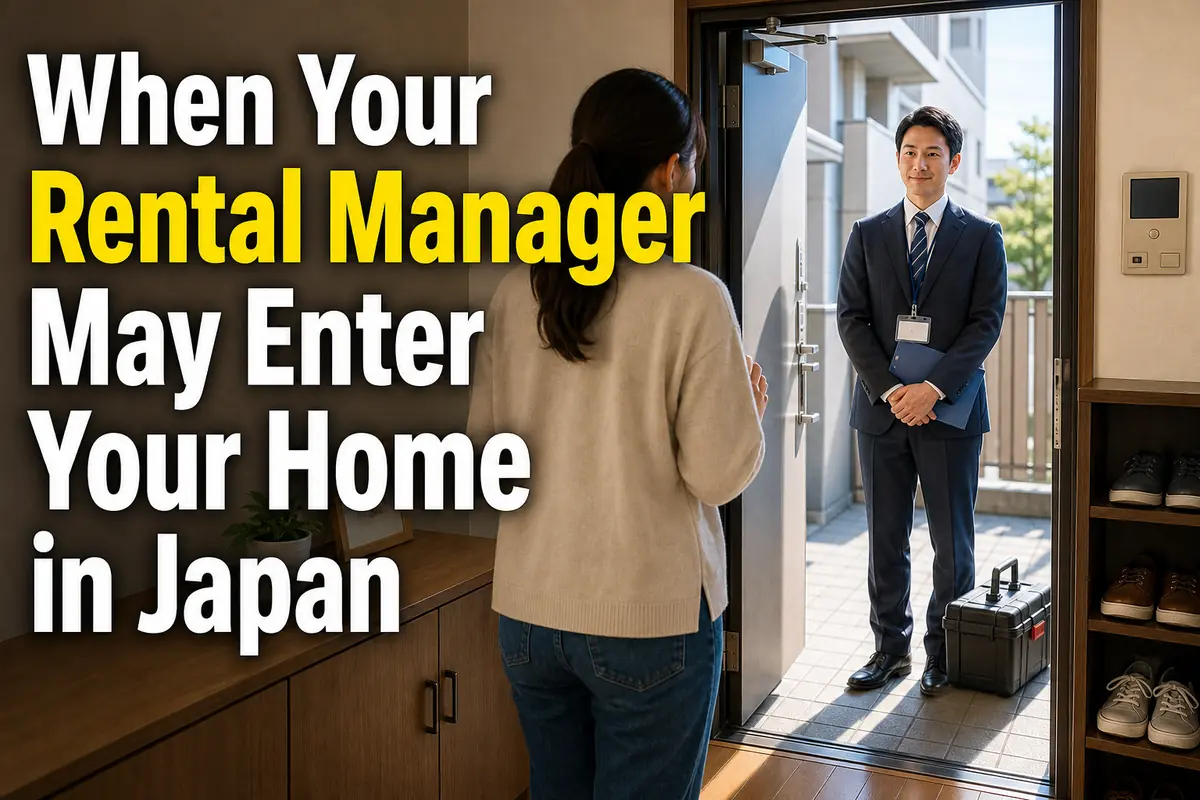
When Your Rental Manager May Enter Your Home in Japan
A landlord or property manager in Japan generally cannot enter your rented home whenever they wish. For ordinary inspections, repairs, or viewings, they should explain the purpose and obtain your consent in advance. A genuine emergency—such as a fire spreading or water pouring into another unit—can justify entry without prior consent.
This distinction matters to foreign tenants who receive an unexpected inspection notice, discover that someone entered while they were away, or are asked to leave a spare key with the management company.
The short version
- Holding a duplicate key does not by itself give a landlord unlimited permission to enter.
- Planned entry normally requires a specific reason, advance contact, and the tenant’s consent.
- A tenant should cooperate with genuinely necessary preservation work but can ask to change an unreasonable date or conditions.
- Prior consent may be skipped when immediate action is needed to prevent serious harm.
- Your signed lease may contain more detail, so check the clauses marked tachiiri (立入り, entry) and shūzen (修繕, repairs).
This guide explains the national legal framework and the Ministry of Land, Infrastructure, Transport and Tourism’s model lease as of August 2026. It provides general information, not a legal judgment about an individual dispute.
Ownership does not cancel the tenant’s control of the home
Once an apartment is rented out, ownership is not a standing invitation to enter the occupied unit. The tenant possesses and uses it as a home during the lease.
Japan’s Penal Code also recognizes unlawful entry into another person’s residence as a potential offense when it occurs without justifiable grounds. Whether a particular incident meets that legal standard depends on its facts, so tenants should not assume that every disagreement over access is automatically a criminal case. Still, the provision shows why “I own the building” is not a complete answer to a privacy complaint.
The Ministry of Land, Infrastructure, Transport and Tourism—often shortened to MLIT—publishes a model residential lease called the chintai jūtaku hyōjun keiyakusho (賃貸住宅標準契約書, Standard Residential Lease Contract). The model is not compulsory law, and your actual contract may use different wording. It is nevertheless a useful benchmark because it separates normal access from emergency access.
Under its entry clause:
- Entry for fire prevention, structural preservation, or another particularly necessary management purpose requires the tenant’s advance consent.
- The tenant should not refuse such necessary entry without a valid reason.
- A prospective tenant or buyer viewing the unit after the lease has ended also needs advance consent.
- In an emergency, the landlord may enter without advance consent. If entry occurs while the tenant is absent, the model clause requires notice afterward.
ここがポイント: The practical rule is not “the landlord may never enter” or “the owner may always enter.” Ordinary access requires consent; urgent access may proceed without it when delay would create a real danger.
Planned inspections and repairs normally require an arrangement
For non-emergency work, expect the landlord or management company to contact you before anyone crosses the apartment door. A useful notice should identify who wants access, why, and when.
Common legitimate reasons include:
- tracing a leak that is not currently causing immediate damage;
- checking a smoke detector or other building equipment;
- inspecting structural damage after an earthquake;
- repairing plumbing, wiring, an air conditioner supplied with the unit, or another landlord-maintained fixture;
- completing legally or contractually required safety work;
- showing the home near the end of the tenancy, if the lease permits this and you agree to the visit.
There is no single national notice period that automatically applies to every ordinary visit. Your lease may state a period or procedure. In practice, the parties should arrange a reasonable time based on the urgency of the problem, the work required, and the tenant’s availability.
What you may reasonably ask before agreeing
A message saying only “inspection tomorrow” leaves important questions unanswered. Ask for:
- the purpose of entry;
- the proposed date and time window;
- the names or company roles of the people attending;
- the expected duration;
- the rooms or equipment they need to access;
- whether photographs will be taken and what they will show;
- whether you or a representative may be present;
- alternative dates if the first time is difficult.
You do not need difficult Japanese. A short written response creates a useful record:
Please tell me the reason for entry, who will enter, and the expected time. I can provide access on [date/time]. Please do not enter before I confirm.
A simple Japanese version is:
立入りの目的、入室する方、予定時間を教えてください。[date/time]であれば対応できます。私が承諾する前に入室しないでください。
The key term is shōdaku (承諾, consent). If you agree only to a plumber entering the kitchen between 10:00 and 11:00, that is not the same as unrestricted access to every room for the whole day.
Tenants cannot block essential preservation work indefinitely
Privacy does not allow a tenant to prevent genuinely necessary repairs or preservation work without a valid reason. Article 606 of Japan’s Civil Code says that the lessor must make repairs necessary for use of the leased property, except where the need arose for a reason attributable to the tenant. It also says the tenant may not refuse an act necessary to preserve the leased property.
That rule matters when a leaking pipe, unsafe wiring, damaged exterior wall, or similar defect could worsen if nobody can inspect or repair it.
A scheduling conflict is different from refusing forever. If the proposed visit is unreasonable, reply promptly and offer workable alternatives. For example:
- “I cannot be present tomorrow, but I am available Thursday morning or Friday after 15:00.”
- “Please arrange for the management company to attend with the contractor.”
- “Only the kitchen is relevant to the leak; please explain why access to the bedroom is needed.”
Silence is risky. It may delay repairs, increase damage, and make it harder to show that you were trying to cooperate.
When a request deserves closer scrutiny
Ask for clarification when the stated purpose and requested access do not match. Examples include:
- a routine inspection with no explanation of what will be checked;
- repeated visits without a new maintenance reason;
- a request to photograph private belongings unrelated to the defect;
- entry by an unknown person with no identification;
- a viewing for a future renter before the current lease has ended, without your agreement;
- a claim that unpaid rent alone allows immediate entry into the occupied home.
Do not physically confront a worker or manager. Keep the door closed if there is no emergency, communicate in writing, and contact the management company through the telephone number shown in your lease—not a number supplied only in an unexpected message.
Emergency entry is a narrow but important exception
Prior permission may be impractical when waiting could endanger people or cause serious property damage. The MLIT model lease specifically gives preventing the spread of fire as an example and also covers other urgent necessity.
Situations that may require immediate access include:
- smoke, flames, or a fire alarm indicating danger inside the unit;
- water actively escaping from the apartment and flooding another unit;
- a suspected gas leak;
- signs that a person inside needs immediate rescue;
- serious damage that creates an immediate risk to the building or its occupants.
The label “emergency” is not enough by itself. The circumstances should explain why the landlord could not wait for a reply or arrange a normal appointment.
After entry during your absence, ask for a written account containing:
- the time and reason for entry;
- who entered;
- what rooms were accessed;
- what emergency work was performed;
- whether anything was moved, damaged, photographed, or left unsecured;
- what follow-up repair is required.
If there is an active fire, medical emergency, or dangerous leak, call 119 for fire or ambulance help as appropriate. Do not delay an emergency response merely to settle the wording of the lease.
A master key does not equal continuing consent
Many rental buildings have key arrangements for emergencies or management, but possession of a key does not erase the access rules. Check what your contract and key-related documents actually say.
Look for these Japanese terms:
- kagi (鍵): key;
- aikagi (合鍵): duplicate or spare key;
- kanri gaisha (管理会社): property management company;
- tachiiri (立入り): entry;
- kinkyūji (緊急時): in an emergency;
- tenken (点検): inspection;
- shūzen (修繕): repair;
- jizen renraku (事前連絡): advance notice.
Ask who stores any duplicate, why it is held, how access is recorded, and whom you should contact after an emergency. Building practices vary, and a management company’s internal policy cannot be assumed to match every lease.
Changing the lock without permission may violate the contract or interfere with emergency access. If you have a security concern, request a lock change through the landlord or manager and confirm who pays before work begins.
What to do after an unexplained entry
Preserve facts first; arguments about motives can wait. A clear timeline is more useful than an angry telephone call with no record.
1. Check for immediate danger
If someone may still be inside, you feel threatened, or property appears to have been stolen or damaged, move to a safe place and contact the police. For an immediate police emergency in Japan, call 110.
2. Record what you can verify
Write down the date and approximate time. Save entry notices, emails, chat messages, intercom history, and photographs of disturbed or damaged items. Do not claim that a particular person entered unless you have evidence.
3. Read the relevant clauses
Search the lease and any building rules for tachiiri, kinkyūji, tenken, and shūzen. Check whether the contract describes notice, consent, emergency access, inspections, or viewings.
4. Ask for a written explanation
Send the landlord and management company a calm request:
I found evidence that the apartment may have been entered on [date]. I did not give consent for a scheduled visit. Please confirm whether anyone entered, the reason, the names or roles of those involved, the time, and any work performed. Please arrange all non-emergency access with me in advance.
Avoid immediately changing locks, withholding rent, or ending the lease on your own. Those steps can create separate contractual problems and may weaken your position.
5. Escalate through an appropriate service
If the explanation does not resolve the problem, possible contacts include:
- the landlord’s head office or the management company’s formal complaint desk;
- your local shōhi seikatsu sentā (消費生活センター, consumer affairs center);
- Consumer Hotline 188, which connects callers to a nearby consumer consultation service but operates in Japanese;
- the Japan Legal Support Center, known as Houterasu, for information about the legal system and suitable consultation services.
Houterasu’s Multilingual Information Service is available at 0570-078377 on weekdays from 9:00 to 17:00. Its official page also lists 050-3754-5430 for VoIP and prepaid phones. The service provides general information or referrals; an individual legal assessment requires appropriate professional advice.
Common mistakes that make access disputes harder
Most avoidable problems come from treating every request as either harmless or illegal. Use the purpose, urgency, contract, and communication record together.
- Assuming a notice is the same as consent: “We will enter Tuesday” does not necessarily show that you agreed.
- Refusing all repairs: A tenant generally must allow necessary preservation work, even if the first proposed time is inconvenient.
- Agreeing only by telephone: Confirm the purpose and time afterward by email or message.
- Leaving scope unclear: State which worker, room, task, and time you approve.
- Withholding rent in protest: An access dispute does not automatically suspend the duty to pay rent.
- Changing the lock secretly: The lease may restrict alterations or require the manager to retain emergency access.
- Calling every visit an emergency: A routine inspection does not become urgent merely because the manager prefers a quick appointment.
- Assuming one building’s custom is a national rule: Contract wording and management arrangements differ.
Questions renters often ask
Can the manager enter while I am at work?
For an ordinary inspection or repair, absence does not remove the need to arrange access. You can agree in writing to entry while you are away, ask to be present, or propose another time. A genuine emergency may justify entry without advance consent.
Can I refuse a viewing for the next tenant?
The MLIT model lease requires advance consent for a prospective tenant or buyer to view the unit after the lease has ended. Your contract and the timing of the proposed viewing matter. Ask for the contractual basis, attendees, and appointment time rather than accepting open-ended access.
How much advance notice must the landlord give?
There is no universal number of hours or days for every ordinary entry. Check your lease. The notice should be reasonable for the purpose and urgency, and the visit should still be agreed rather than simply announced.
May maintenance staff take photographs?
Photographs of a leak, meter, appliance, or damaged surface may be useful for repairs. Ask what will be photographed and how the images will be used. Personal papers, computer screens, and unrelated belongings should not need to appear in routine maintenance records.
What if I will be outside Japan for several weeks?
Follow any lease requirement to notify the manager of a long absence and provide an emergency contact. State in writing how non-emergency access should be arranged. Being away does not by itself turn routine work into an emergency.
A practical access checklist
The safest approach is to make each visit specific, documented, and proportionate to the problem. Before giving permission, confirm:
- [ ] Why is entry necessary?
- [ ] Is this planned work or a genuine emergency?
- [ ] What does the lease say?
- [ ] Who will enter?
- [ ] On what date and during what time window?
- [ ] Which rooms or equipment will they access?
- [ ] Will photographs be taken?
- [ ] May I or my representative attend?
- [ ] How will completion or emergency entry be reported?
Keep the management company’s emergency number with your lease documents. If a dispute develops, preserve the messages and request a written account before taking steps such as replacing locks, withholding payment, or terminating the contract. The next fact to establish is always the same: was the visit agreed in advance, or was there a real emergency that could not wait?
参照リンク
- Ministry of Land, Infrastructure, Transport and Tourism: Standard Residential Lease Contract
- MLIT: Standard Residential Lease Contract PDF
- Japanese Law Translation: Civil Code
- Japanese Law Translation: Penal Code
- Consumer Affairs Agency: Consumer Hotline 188
- Japan Legal Support Center: Multilingual Information Service
- Fire and Disaster Management Agency: 119 Emergency Calls