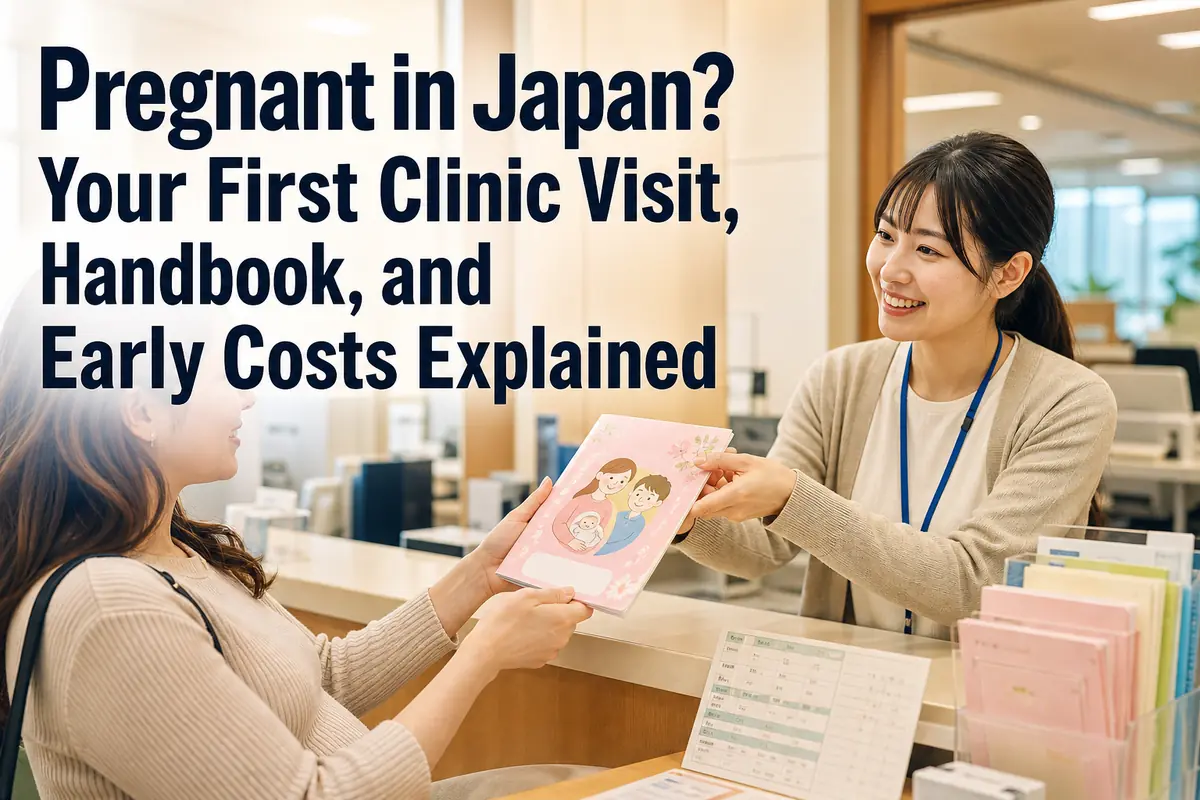
Pregnant in Japan? Your First Clinic Visit, Handbook, and Early Costs Explained
If you think you are pregnant in Japan, book an obstetrics and gynecology clinic first. After a doctor confirms the pregnancy, notify the municipality where you live and collect the Maternal and Child Health Handbook and prenatal checkup vouchers.
The first clinic visit is often paid out of pocket because confirming a normal pregnancy is generally not treated as insured medical care. Municipal vouchers usually become available only after pregnancy notification, and they reduce later checkup costs rather than making every visit completely free.
This guide is for foreign residents and their families who need to understand what to do during the first weeks of pregnancy.
The basic route is:
- Take a home pregnancy test if your period is late.
- Contact an obstetrics and gynecology clinic and ask when to visit.
- Attend the clinic for medical confirmation.
- Submit a pregnancy notification to your city, ward, town, or village.
- Receive the Maternal and Child Health Handbook and prenatal checkup vouchers.
- Confirm where you will receive ongoing care and whether the facility can handle delivery.
Medical fees, required documents, available languages, and subsidy amounts vary. Check both the clinic and your registered municipality before relying on a general estimate.
Step 1: Choose a Clinic and Call Before You Go
Your first practical task is to find a clinic that accepts new maternity patients and can communicate with you. A positive home test does not automatically reserve a place for prenatal care or delivery.
Search for an obstetrics and gynecology department, usually shown as sanka-fujinka (産科婦人科) or fujinka (婦人科). A small gynecology clinic may confirm the pregnancy but may not provide delivery services.
Before booking, ask:
- Do you accept first-time pregnancy appointments?
- When should I come based on the first day of my last menstrual period?
- Is an appointment required?
- Do you offer care in English or allow an interpreter?
- How much should I expect to pay at the first visit?
- Can I pay by card, or should I bring cash?
- Does the facility provide prenatal care and delivery, or only early examinations?
- If I hope to give birth there, when must I reserve a delivery place?
Some hospitals require a referral letter and may charge an additional fee when a patient arrives without one. A local clinic can often perform the first examination and provide a referral if hospital care is needed.
Why the timing of the visit matters
A clinic may advise you to wait until a certain stage unless you have symptoms requiring urgent assessment. If you visit very early, an ultrasound may not yet show enough to confirm the pregnancy’s location or estimate the due date. The clinic may ask you to return after several days or weeks, creating another self-paid visit.
Do not delay care merely to avoid that possibility. Contact a medical professional promptly if you have bleeding, strong or one-sided abdominal pain, fainting, fever, severe vomiting, or another worrying symptom. The Ministry of Health, Labour and Welfare also advises pregnant people to seek early medical advice for symptoms such as genital bleeding, abdominal pain, severe headache, fever, serious weakness from morning sickness, or the loss of previously felt fetal movement.
What Happens at the First Pregnancy Appointment?
The main purpose is to confirm whether you are pregnant, check the pregnancy’s location and progress, and decide when you should return. The exact examinations depend on the stage of pregnancy and the clinic.
A first appointment may include:
- A medical interview about your last period, symptoms, previous pregnancies, illnesses, medication, allergies, and family history
- A urine pregnancy test
- An ultrasound, which may be transvaginal in early pregnancy
- Measurement of weight and blood pressure
- Advice about medication, supplements, alcohol, smoking, work, and warning symptoms
- An estimated due date, either at this visit or after a later scan
Bring any information that helps the clinician understand your health. Useful items include:
- Residence card or another form of identification
- My Number health insurance card or other current proof of insurance eligibility
- Medication notebook, called an okusuri techo (お薬手帳), or a written medication list
- Records of previous pregnancies or treatment when relevant
- The date of the first day of your last menstrual period
- A list of allergies and existing conditions
- Cash as a backup payment method
If you do not speak enough Japanese for medical explanations, ask about interpretation before the appointment. Machine translation can help with reception questions, but decisions involving symptoms, test results, consent, or medication deserve reliable interpretation.
How Much Does the First Visit Cost?
There is no single national price for an initial pregnancy-confirmation visit. Normal pregnancy and routine prenatal examinations are generally outside ordinary health insurance coverage, so clinics set their own charges and patients may initially pay the full amount.
The bill can vary because of:
- Whether an ultrasound or laboratory test is performed
- Whether the pregnancy is too early to confirm and a repeat visit is needed
- The clinic’s initial consultation and documentation fees
- Whether an uninsured service or optional test is added
- Whether a hospital charges an extra fee for attending without a referral
Ask the clinic for an estimate when making the appointment. Also ask whether the estimate includes ultrasound and testing.
When health insurance may apply
Pregnancy itself is not an illness, but medical treatment for a complication may be covered by public health insurance when it meets insurance rules. Examples can include treatment for an ectopic pregnancy, severe pregnancy-related illness, or a medically necessary procedure. Coverage depends on the diagnosis and service, so confirm the billing details with the medical institution and your insurer.
Prenatal checkup vouchers are different from health insurance. They are municipal subsidies for specified examinations. A voucher may cover all or part of an eligible checkup, but you can still owe money if the clinic’s charge exceeds the subsidy or if a test is outside the voucher’s scope.
ここがポイント: The first clinic visit, public health insurance, and municipal prenatal vouchers are three different systems. Ask which one applies to each charge instead of assuming that showing an insurance card or voucher makes the entire visit free.
Step 2: Submit Your Pregnancy Notification
After a medical institution confirms the pregnancy, notify the municipality where you are registered as a resident as soon as practical. This procedure is called ninshin todoke (妊娠届), or pregnancy notification.
The responsible counter may be located at a city or ward office, public health center, health and welfare center, or child and family support office. The name differs by municipality.
You will normally receive:
- A Maternal and Child Health Handbook
- Prenatal health checkup vouchers or examination slips
- Information about local pregnancy, birth, and parenting services
- Details of consultations with a public health nurse or midwife
- Information about parent classes and financial support
The national government advises residents to submit the notification promptly after learning of the pregnancy. However, the exact form, accepted locations, appointment system, and required identification are set locally.
Documents to check before visiting the municipal office
Requirements vary, but a municipality may ask for:
- A completed pregnancy notification form
- Identification such as a residence card
- My Number documentation
- Information provided by the clinic, including the expected due date
- Bank account information for a local or national pregnancy-support application
- A letter of authorization if another person submits documents for you
Do not assume that a medical certificate is universally required. Check your municipality’s current instructions or call the maternal and child health section.
Resident registration affects access to local vouchers
Municipal support is tied to your registered address. For example, Shinjuku City states that its package containing prenatal examination slips is provided to people registered as residents.
This matters if you:
- Recently moved but have not completed your address registration
- Plan to move during pregnancy
- Live temporarily in one municipality while registered in another
- Plan a satogaeri shussan (里帰り出産), meaning you will stay and give birth near relatives elsewhere
- Expect to receive care or give birth outside Japan
Contact both the municipality that issued your vouchers and the place where you will receive care. You may need replacement vouchers after moving or may have to pay first and apply for reimbursement when using an out-of-area facility. Keep every receipt and itemized statement until the municipality confirms what can be reimbursed.
What Is the Maternal and Child Health Handbook?
The Maternal and Child Health Handbook is a long-term paper health record, not merely proof of pregnancy. Its Japanese name is Boshi Kenko Techo (母子健康手帳).
Healthcare professionals use it to record information from pregnancy through childbirth and the child’s early years. It can include:
- Prenatal checkup results
- Pregnancy weight and health records
- Delivery information
- The baby’s growth and development
- Infant health examinations
- Vaccination records
- Guidance for pregnancy and parenting
Bring it to prenatal appointments, the delivery facility, infant checkups, and vaccinations. Keep it even after the child grows older because it may become the clearest record of early health care and immunizations.
Ask specifically for a language version
Foreign-language editions are available in some municipalities, but the languages and distribution points differ. Shinjuku, for example, lists editions including English, Chinese, Korean, Spanish, Tagalog, Portuguese, Thai, Indonesian, Vietnamese, and Nepali. Yokohama lists a different local selection.
Ask these questions at the counter:
- Is the complete handbook available in English or my preferred language?
- Are the checkup vouchers separate from the translated handbook?
- Are local guidance sheets available in translation?
- Can the municipality arrange interpretation for consultations?
A translated handbook does not mean that every clinic or municipal form will be available in the same language.
How Prenatal Checkup Vouchers Work
Vouchers reduce eligible prenatal checkup costs, but their value and use are controlled locally. They are not a nationwide unlimited pass for pregnancy care.
According to the Ministry of Health, Labour and Welfare, municipalities issue checkup tickets or subsidy vouchers when residents submit a pregnancy notification. The ministry’s published survey covering all 1,741 municipalities found an average public contribution of ¥107,792 as of April 2022. That figure describes average municipal support at that time; it is not a guaranteed amount for an individual in 2026.
Your actual out-of-pocket cost depends on:
- Your municipality’s current voucher package
- The tests scheduled at each stage
- The prices charged by your clinic or hospital
- Optional screening and services
- Whether the provider accepts your municipality’s vouchers
- Whether you receive care outside the municipality or prefecture
At each visit, bring both the handbook and the relevant vouchers. Reception staff may tell you which slip to use, but check before handing anything over because vouchers can be assigned to particular examinations.
A checkup subsidy is not the childbirth payment
Do not confuse prenatal vouchers with the Lump-Sum Allowance for Childbirth and Childcare. For eligible members, Japan Health Insurance Association materials state a standard childbirth lump sum of ¥500,000 per child, with different amounts applying in some circumstances. A direct-payment arrangement may allow the insurer to pay the delivery facility rather than requiring the family to advance the full eligible amount.
That allowance is mainly connected to childbirth expenses, not the ordinary bill for your first pregnancy-confirmation visit. Eligibility, the applicable amount, and the application route depend on your insurance and the delivery circumstances. Confirm them with your employer’s insurer, Japan Health Insurance Association branch, health insurance society, or municipal National Health Insurance counter.
A Current Benefit to Ask About in 2026
People who notify their municipality of a pregnancy should also ask about the Support Benefit for Pregnant Women. This is separate from clinic billing, prenatal vouchers, and the childbirth lump sum.
The Ministry of Health, Labour and Welfare’s Birth Navi explains that the statutory program began in April 2025. It provides:
- ¥50,000 after pregnancy notification
- A further ¥50,000 for each expected child after notification of the number of fetuses, generally from 32 weeks of pregnancy
The benefit is administered by municipalities and is combined with consultation support. A fetal heartbeat must have been medically confirmed, and the national guidance includes pregnancies that later end in miscarriage, stillbirth, or abortion.
Application procedures, interview arrangements, identity checks, payment dates, and handling after a move are local. Receiving the handbook does not necessarily complete every benefit application, so ask the municipal officer what remains to be filed.
Choosing Ongoing Care and a Delivery Facility
Confirm your long-term care plan early because not every clinic delivers babies and popular facilities may limit reservations. This is a separate decision from obtaining the handbook.
Possible arrangements include:
- One hospital provides both prenatal care and delivery.
- A local clinic provides routine checkups and refers you to a hospital for delivery.
- You transfer to another region for a planned stay near family.
- A specialist center manages the pregnancy because of a medical risk.
When comparing facilities, ask about:
- Whether delivery reservations are available for your due month
- Referral requirements
- Emergency care outside normal hours
- Language and interpretation support
- Estimated delivery charges and deposit deadlines
- Private-room, epidural, meal, and family-visit policies
- Care available for higher-risk pregnancies or newborn complications
- Rules for transferring records if you move
Prices and services can differ substantially even within one city. Request a written estimate and ask which items are optional, which are medically necessary, and which may be covered by insurance.
Common Mistakes and How to Avoid Them
Most early problems come from treating separate systems as if they were one automatic process. A clinic, municipality, and health insurer each handle different parts.
Waiting for the handbook before calling a clinic
The normal sequence is medical assessment first, then municipal notification. If you have symptoms, seek medical advice without waiting for paperwork.
Assuming every maternity facility provides delivery
Confirm whether the clinic handles births and whether a reservation is necessary. Early confirmation matters in areas where capacity is limited.
Expecting health insurance to pay for every visit
Routine pregnancy care is generally outside normal insurance coverage. Complication-related treatment and municipal subsidies follow different rules.
Treating vouchers as cash
Vouchers usually apply only to named examinations and participating providers. They may not be refundable, transferable, or usable outside the issuing area without prior arrangements.
Forgetting to update support after moving
Old vouchers may stop being usable after an address change. Contact the new municipality promptly and ask how to exchange them.
Losing receipts from out-of-area care
Reimbursement procedures often require original receipts and detailed statements. Keep them until the issuing municipality has made a decision.
Assuming English support is automatic
A municipality may issue an English handbook while the clinic operates mainly in Japanese. Arrange language support separately for both settings.
Practical Checklist for the First Two Weeks
Your immediate goal is to establish medical care, complete the municipal procedure, and understand what you must pay next. Use this checklist in order.
- Record the first day of your last menstrual period and your symptoms.
- Call an obstetrics and gynecology clinic for timing, fees, language support, and payment methods.
- Prepare identification, proof of insurance eligibility, medication information, and medical records.
- Attend the examination and ask when the pregnancy can be formally documented.
- Ask whether the clinic offers ongoing prenatal care and delivery.
- Check your municipality’s pregnancy-notification page for documents and office hours.
- Submit the notification and request a handbook in your preferred language.
- Collect and read the prenatal voucher instructions.
- Ask separately about the Support Benefit for Pregnant Women.
- Contact your insurer about childbirth benefits and direct payment.
- Save receipts, test results, estimates, and contact details in one folder.
The most important next move is simple: call a clinic before visiting, then contact the maternal and child health office registered to your address as soon as the pregnancy is confirmed. Those two calls will reveal the local fees, paperwork, language support, and deadlines that a nationwide guide cannot determine for you.
参照リンク
- Ministry of Health, Labour and Welfare: For Your Well-being During Pregnancy and Delivery
- Ministry of Health, Labour and Welfare: Early-Pregnancy Support and Services
- Ministry of Health, Labour and Welfare: Survey of Public Funding for Prenatal Health Checkups
- Shinjuku City: Pregnancy Notification and Mother and Child Health Handbook
- City of Yokohama: From Pregnancy to Childbirth
- Japan Health Insurance Association: Benefits Guidebook