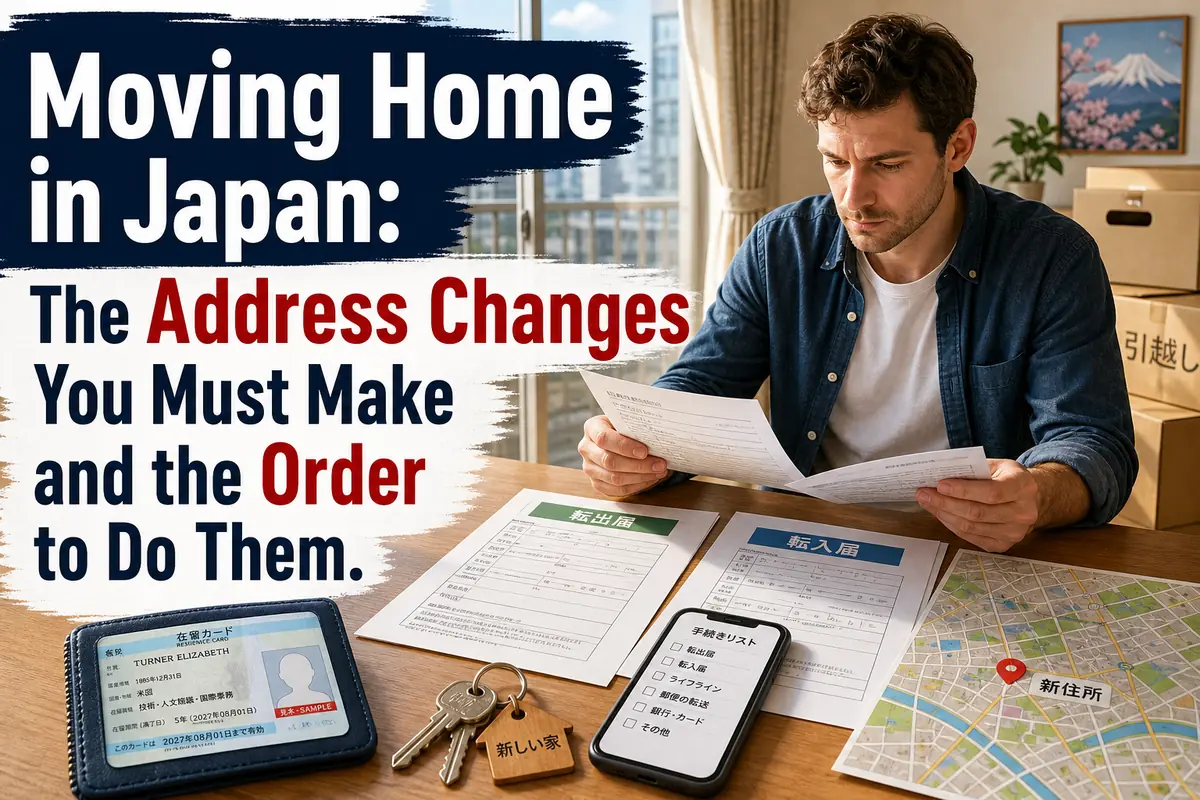
Moving Home in Japan: The Address Changes You Must Make and the Order to Do Them
When you move within Japan, update your resident registration at the municipal office within 14 days of actually moving into the new home. If you have a residence card, take it with you so the new address can be recorded and your immigration address notification can be completed through the same municipal procedure.
Moving to another municipality requires two stages: notify the municipality you are leaving, then file a moving-in notification at the new one. If you stay in the same municipality, you normally file only a change-of-address notification.
This guide is for foreign residents and their families moving between homes in Japan. The information is current as of August 1, 2026, but documents, counters, and related services vary by municipality.
Quick checklist
- Different municipality: submit a moving-out notification, then register at the new municipal office.
- Same municipality: submit a change-of-address notification after the move.
- Bring each foreign resident’s residence card or special permanent resident certificate.
- Update your My Number Card, health insurance, utilities, employer, bank, and other services separately where necessary.
First decide which moving procedure applies
The correct form depends on whether your new home is inside or outside your current municipality. A municipality may be a city, ward, town, or village; large designated cities can have special rules for moves between wards.
Moving within the same municipality
File a tenkyo todoke, usually translated as a change-of-address or relocation notification. Submit it after you begin living at the new address and within 14 days of the move.
You do not normally need a moving-out certificate. The municipal office updates your resident record, residence card address, and other eligible municipal records.
Moving to another municipality
The usual sequence is:
- Submit a tenshutsu todoke, or moving-out notification, to your current municipality.
- Receive a moving-out certificate, unless the information is transferred through the eligible My Number Card procedure.
- Move into the new home.
- Submit a tennyū todoke, or moving-in notification, at the new municipal office within 14 days of the actual move.
- Present your residence card and update your My Number Card if you have one.
Do not file a moving-in notification before you actually live at the address. Resident registration is based on where you live, not merely on a signed lease or a future moving date.
Moving between wards in a designated city
Cities such as Yokohama, Osaka, and Nagoya are divided into administrative wards. A move between their wards may not be handled exactly like a move between two independent municipalities.
Check the city’s official moving page before choosing a form. Mynaportal also warns that procedures within designated cities can differ from its general descriptions.
The municipal-office deadline that matters most
The practical deadline is 14 days after you start living at the new address. This applies to the moving-in notification after an inter-municipal move and the change-of-address notification after a move within one municipality.
For a mid- to long-term foreign resident, presenting the residence card when filing the municipal notification is especially important. The Immigration Services Agency states that the municipal filing is treated as the required notification of the new place of residence when the card is presented.
If the municipal resident-registration procedure is accepted without your residence card, that treatment may not apply. You could then need an additional address notification. Bring the card rather than assuming the databases will update automatically.
ここがポイント: A municipal address update is not just a mailing-address change. It updates the official resident record and, when the required residence document is presented, fulfills the address-notification step for covered foreign residents.
The Immigration Services Agency also explains that an address change does not produce a new residence card. The municipal office normally writes or prints the new address on the existing card.
What to prepare before visiting the counter
Take original identity and residence documents for everyone covered by the notification. Exact requirements vary, so check the new municipality’s website or call its resident-registration section before visiting.
A practical document pack includes:
- Residence card for each mid- to long-term resident
- Special permanent resident certificate, where applicable
- My Number Card for each holder
- Moving-out certificate when moving from another municipality, unless an eligible electronic transfer replaces it
- Passport if requested for your circumstances
- National Health Insurance eligibility document if enrolled
- Documents for municipal medical subsidies, child benefits, long-term care, or other local programs
- Personal seal registration card if relevant to the municipality you are leaving
- Authorization form if a representative will file for you
Families may need proof of relationships
A municipality may request an original document showing the relationship between family members and the head of household. This can matter when the relationship is not confirmed through a Japanese family register.
If the document is not in Japanese, the municipality may require a Japanese translation. Shinjuku City, for example, instructs applicants to include the translator’s name and contact details. Other municipalities may set different requirements, so confirm whether a self-prepared translation is accepted.
A representative may need extra documents
Another household member or authorized representative may sometimes submit the notification. The office may ask for a power of attorney and the representative’s identification.
Rules can differ according to the notification, the person’s age, and whether the representative belongs to the same household. Do not assume that one family member can complete every card-related procedure for everyone.
Can you complete the move online?
Mynaportal can remove the trip to your old municipal office in many inter-municipal moves, but it does not normally make the entire move online.
As of August 1, 2026, the Digital Agency’s moving service allows eligible My Number Card users to:
- submit a moving-out notification through Mynaportal;
- send moving information to the destination municipality; and
- notify the destination office of a planned visit.
You must still go to the new municipal office to submit the moving-in notification and complete related card procedures. A planned-visit notice is not itself a moving-in notification.
What the online route requires
Prepare the following before starting:
- A valid My Number Card or supported smartphone electronic certificate
- The necessary PINs and digital-signature password
- A compatible smartphone, or a computer with a card reader
- The Mynaportal app
- Your new address and planned moving date
- A daytime telephone number
Check the application status before visiting the destination office. Submitting data late at night, on a holiday, or immediately before your visit may not give the old municipality enough processing time.
When the paper route may be simpler
Use the counter or postal option provided by your municipality if your card or electronic certificate is unavailable, a PIN is locked, the household details are complicated, or the online service tells you that it cannot process the case.
Municipal rules determine whether a moving-out notification can be mailed and what identification copies must accompany it. Moving-in and same-municipality address notifications generally require a counter visit.
Update the My Number Card at the same visit
Resident registration and the physical My Number Card are connected, but the card still needs its own address and continued-use processing. Bring it to the new municipal office.
For a move to another municipality, file the moving-in notification within 14 days. Mynaportal’s official procedure list warns that missing this deadline can invalidate the card. It also states that continued-use processing must be completed within 90 days after the moving-in notification.
An additional limit can apply if the moving-in notification is not filed within 30 days of the planned moving-out date recorded in the earlier notification. Moving dates sometimes change, so contact both municipalities promptly if the delay becomes long.
Your signature certificate may stop working
The electronic certificate used for digital signatures contains address information. It becomes invalid when that address changes. For an inter-municipal move, the official procedure list says it expires on the planned moving-out date; after a same-municipality move, the old certificate also becomes invalid because the address has changed.
Ask the new municipal office to issue a new signature certificate if you use the card for electronic applications. Merely having the new address written on the card does not restore the expired certificate.
This can affect online procedures that require a digital signature, so avoid scheduling a time-sensitive application for the middle of your move if possible.
Residence-card and immigration points for foreign residents
An ordinary address move is reported at the municipal office, not at a regional immigration bureau. Bring the residence card and complete the municipal notification within the required period.
Keep these separate situations in mind:
- Address only: notify the municipality where you live.
- Name, nationality or region, date of birth, or sex changes: separate residence-card procedures may be required through the Immigration Services Agency.
- Employer or school changes: certain residence statuses require a notification about the affiliated or contracting organization, generally within 14 days.
- Divorce or death of a spouse: some spouse-based residence statuses have a separate notification requirement.
Moving because you changed jobs or schools may therefore trigger two different duties: an address procedure at the municipality and an affiliation-related procedure with immigration. Completing one does not necessarily complete the other.
Special permanent residents follow municipal procedures using their special permanent resident certificates. People outside the mid- to long-term resident system may have different requirements and should confirm their position with the municipality or Immigration Services Agency.
Fees and other possible costs
The standard moving notification and address entry on a residence card are generally free. The move can still create small administrative costs.
Possible expenses include:
- Postage for a mailed moving-out notification
- Fees for residence certificates or other copies requested for banks, schools, or employers
- Translation costs for family-relationship documents
- Replacement costs for lost documents
- Utility connection, disconnection, or contract-related charges
- Local fees for bulky-waste collection or disposal
Do not buy certificates before asking whether they are needed. Many organizations accept an updated residence card, My Number Card, or online submission instead.
Municipal services that may need separate action
Updating the resident record does not automatically settle every local benefit, insurance record, or household service. Ask the municipal counter for a personalized list.
National Health Insurance and pension
If you are enrolled in National Health Insurance, the municipality handles your participation and local records. An inter-municipal move may involve ending the old municipality’s coverage and completing procedures at the new one. A move within the same municipality may still require an address update.
People insured through an employer should report the new address to the employer or its designated benefits system. Do not join National Health Insurance simply because you moved if your employee coverage continues.
National Pension records may also need attention, depending on your enrollment and how your information is linked. Ask the pension or insurance counter when you file the move.
Children, education, and local benefits
Families should check procedures for:
- child allowance;
- children’s medical-cost subsidies;
- nursery school or certified childcare enrollment;
- public elementary or junior-high school transfer;
- pregnancy and infant-health services; and
- single-parent or disability-related programs.
Eligibility, application forms, and income-review schedules can differ by municipality. A benefit received in the old city does not guarantee automatic enrollment in the new one.
Seal registration and other local records
A registered personal seal may be automatically deregistered when you leave a municipality. If you need seal-registration certificates after moving, you may have to register again under the new municipality’s rules.
Pet registration, long-term-care insurance, municipal parking, bicycle registration-related matters, and local transport passes may also require separate checks.
Notify services outside the municipal office
The government filing changes your official resident record, not every private contract attached to the old address. Work through the following list according to urgency.
Before or around moving day
- Arrange electricity, gas, and water closure or transfer.
- Update internet and mobile-phone contracts.
- Tell the landlord or property manager where final documents and refunds should be sent.
- Arrange Japan Post mail forwarding.
- Update fire, earthquake, and household-insurance policies.
Japan Post’s relocation service forwards eligible mail from the old domestic address to the new one free of charge for one year. The one-year period runs from the date the relocation form is submitted, not from the requested forwarding start date. Registration can take several business days, so apply early.
Mail forwarding is only a safety net. Some restricted-delivery items are not forwarded, and mail is returned to the sender after the forwarding period ends. Notify important senders directly.
Soon after municipal registration
- Employer, school, university, or scholarship organization
- Bank, credit-card company, and securities provider
- Life, medical, vehicle, and other insurers
- Japanese driver’s-license and vehicle-registration authorities
- Subscription, delivery, and online-shopping accounts
- Clinics, pharmacies, and other services that use your address
- Embassy or consulate registration where relevant
Drivers should check the police authority for their prefecture. Procedures, required proof of address, locations, reservations, and whether a fee applies can vary. Holders of a Myna Driver’s License may have different options depending on the services they activated.
Resident tax does not simply move with you
A change of address does not erase tax already assessed by the municipality where you were registered on January 1. You may continue receiving payment slips or notices from the previous municipality after moving.
If resident tax is withheld from salary, give the new address to your employer promptly. If you pay it yourself, make sure notices from the former municipality can reach you and contact its tax office if anything is unclear.
This is also why postal forwarding matters. A bill carrying the old municipality’s name is not automatically a duplicate or a mistake.
For individual tax treatment, consult the relevant municipal tax office or a qualified professional rather than relying only on a general moving checklist.
Common mistakes and how to avoid them
Most problems come from treating the move as one automatic update. It is a chain of related but separate procedures.
Mistake: Visiting immigration for an address-only change
For covered foreign residents, the new residential address is normally reported at the municipal office. Take the residence card so the address can be recorded correctly.
Mistake: Forgetting the residence card
A resident-registration filing without the residence card may not count as the immigration address notification. Bring the original card for every person whose address is changing.
Mistake: Assuming the Mynaportal application finishes everything
The online service can handle the moving-out submission and the destination visit notice. You still need to complete the moving-in or change-of-address procedure as instructed by the municipality.
Mistake: Leaving the My Number Card procedure unfinished
Ask the counter to confirm all three points:
- the new address is shown on the card;
- continued-use processing is complete after an inter-municipal move; and
- a new signature certificate has been issued if you need one.
Mistake: Updating only the head of household
Each foreign resident has an individual residence document. Bring all relevant cards and confirm whether every family member must attend or whether a representative can act for them.
Mistake: Relying only on mail forwarding
Japan Post forwards eligible mail temporarily; it does not update banks, insurers, government agencies, or service contracts. Change the registered address directly with each important sender.
A practical timeline
Do the move in three rounds: preparation, municipal registration, and account cleanup. This keeps urgent legal deadlines separate from lower-priority subscriptions.
One to two weeks before moving
- Confirm whether the move crosses a municipal boundary.
- Check both municipal websites for documents, office hours, and language support.
- Submit the moving-out notification if required.
- Use Mynaportal if eligible and practical.
- Arrange utilities and Japan Post forwarding.
- Prepare family-relationship documents and translations if needed.
On moving day
- Record meter readings and keep final utility information.
- Keep residence cards, My Number Cards, passports, and the moving-out certificate with you rather than packing them in a moving truck.
- Confirm the date you actually began living at the new address.
Within 14 days after moving in
- File the moving-in or change-of-address notification.
- Present the residence card or special permanent resident certificate.
- Update the My Number Card and request a new signature certificate if needed.
- Complete National Health Insurance and other municipal procedures.
- Ask about benefits, school matters, seal registration, and local programs.
During the following days
- Notify your employer or school.
- Update banks, cards, insurance, driver’s-license records, and vehicle documents.
- Confirm that utilities and communications work at the new home.
- Watch both physical and electronic mail for requests from either municipality.
Final check before considering the move complete
Your move is not finished administratively until your identity documents, municipal services, and essential contracts all show usable information.
Confirm these points:
- The new address appears on each relevant residence card.
- The moving-in or change-of-address notification was accepted within 14 days.
- Each My Number Card remains valid and its required procedures are complete.
- Health insurance and family benefits work at the new address.
- Your employer or school has the correct information.
- Banks and important service providers can contact you.
- Japan Post forwarding is active, but direct address changes are continuing.
If the actual moving date changes, a document is missing, or the 14-day deadline has passed, contact the municipal office immediately. The next useful step is not to wait for every document to become perfect; it is to ask the resident-registration counter how to correct the specific delay.
参照リンク
- Immigration Services Agency: Notification of a change in place of residence
- Immigration Services Agency: Residency Management System Q&A
- Immigration Services Agency: Guidebook on Living and Working
- Digital Agency: Online Service for Moving Procedures
- Digital Agency: Moving-service FAQs
- Mynaportal: List of moving-related procedures
- My Number Card official site: Frequently Asked Questions
- Shinjuku City: Notification Procedures for a Change of Address
- Yokohama City: Procedures for when moving house
- Yokohama City: Joining and leaving National Health Insurance
- Japan Post: Relocation and forwarding service
- National Police Agency: Driver’s-license procedures