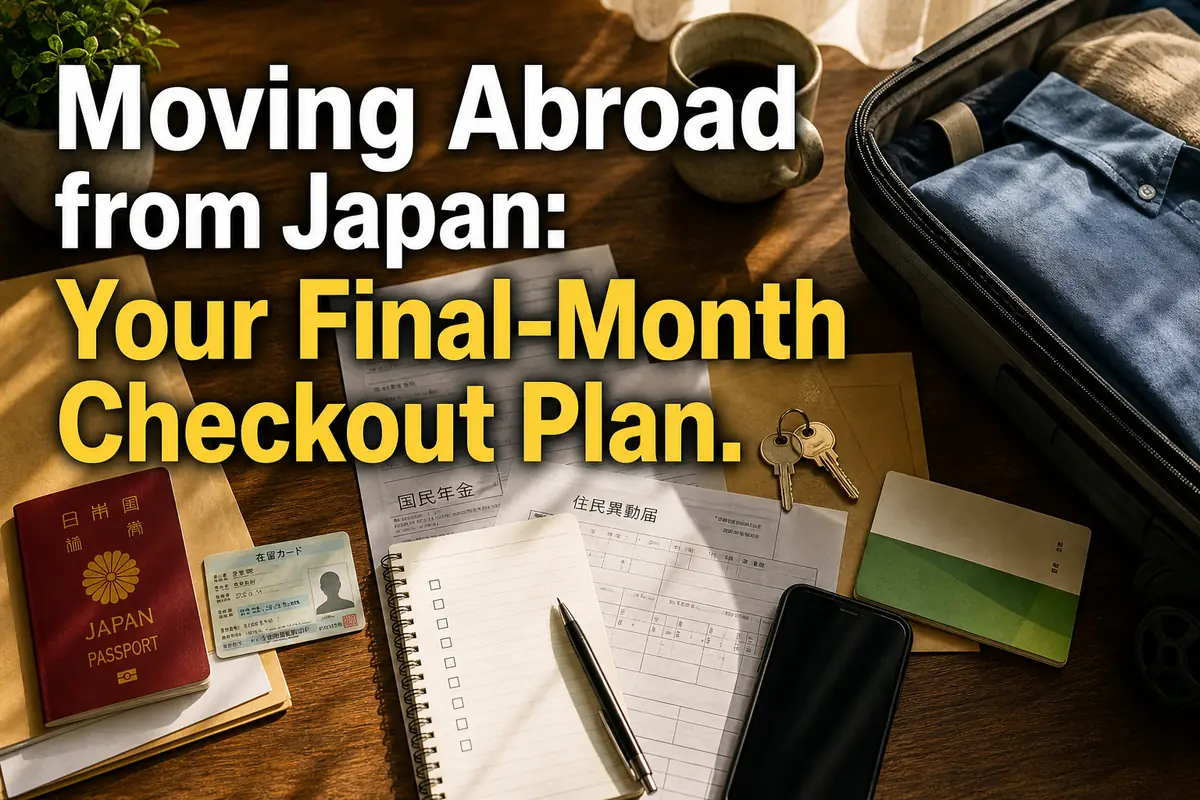
The Final Month in Japan: A Departure Checklist for Foreign Residents
If you are leaving Japan permanently, start at your municipal office and employer before closing your Japanese bank account. File your overseas moving-out notice, settle health insurance and taxes, decide what to do with your pension record, and arrange a reliable way to receive mail after departure.
The order matters. A pension refund may require proof that you no longer have a Japanese address, while later tax bills or refund documents may still need a bank account, a tax representative, or a contact address in Japan.
This guide is for foreign workers, students, dependents, and long-term residents ending their residence in Japan. Procedures differ by municipality, employer, insurance system, residence status, and departure date, so confirm the final requirements with the offices responsible for your case.
Quick departure plan:
- Several weeks before departure: contact your employer, municipal office, tax office if necessary, pension office, bank, landlord, and service providers.
- Before closing accounts: confirm how final salary, tax refunds, pension-related payments, utility charges, and deposits will be paid.
- At city hall: submit an overseas moving-out notification and complete National Health Insurance procedures if enrolled.
- Before flying: keep copies of tax, pension, insurance, employment, and address records in a form you can access overseas.
Begin with the dates that control your procedures
Your last working day, moving-out date, and flight date may trigger different procedures. Write all three down before contacting any office.
For example, employer-sponsored health insurance normally ends in connection with the end of employment, while municipal National Health Insurance is linked to your residence and eligibility. Your municipal moving-out date also matters when the Japan Pension Service checks whether you still have an address in Japan.
Prepare a simple departure file containing:
- Passport and residence card
- My Number card or documents showing your My Number
- Planned moving-out and flight dates
- Last working day and employer contact details
- Health insurance eligibility document or card, if one was issued
- Basic Pension Number Notice or pension book
- Recent payslips and withholding tax certificate
- Municipal tax and insurance payment notices
- Japanese bank details and an overseas account certificate
- New overseas address, phone number, and email address
- Contact details for any representative remaining in Japan
Do not pack these records in checked luggage or ship them ahead. You may need them during your last visits to city hall, the tax office, or the airport.
File your overseas moving-out notice at city hall
The municipal moving-out notification is the administrative starting point for a permanent departure. Ask the city, ward, town, or village where your resident record is registered how early it accepts the notice and which documents it requires.
Tell the counter staff that you are moving overseas permanently. This is different from taking a short trip or temporarily visiting your home country while keeping your main residence in Japan.
Typical items include:
- Identification, such as a residence card
- My Number card, if applicable
- National Health Insurance eligibility document or card, if enrolled
- The departure date and overseas destination
- Documents requested for other household members leaving with you
- Authorization documents if another person files on your behalf
Municipal rules and counter arrangements vary. Some procedures may be combined at one counter; elsewhere, you may need to visit separate resident registration, insurance, pension, and tax desks.
Ask for proof before leaving the counter
Confirm whether you can obtain a certificate or other record showing that your resident registration will be removed. You may need municipal records later for pension, tax, banking, or administrative purposes.
Also ask whether certificates you may need overseas—such as residence, tax, or payment certificates—will still be available by mail after departure. Municipal convenience-store certificate services may stop working after your move-out is recorded.
ここがポイント: Filing a moving-out notice does not automatically settle every tax, insurance, pension, banking, or postal matter. Treat it as the step that allows the other procedures to be completed correctly.
Separate resident tax from national income tax
Leaving Japan does not erase tax already due, and two different tax systems may require separate action. Resident tax is handled by your municipality; national income tax is handled by the National Tax Agency and your competent tax office.
Resident tax: January 1 is the key date
Individual resident tax is generally imposed by the municipality where you were registered on January 1, based mainly on income from the previous year. Moving overseas after January 1 does not by itself cancel that year’s liability.
This creates a common problem for people departing early in the year. A bill based on the previous year’s income may be issued after they have already left Japan.
Ask your municipal tax desk:
- Whether you have unpaid installments from an existing resident-tax bill
- Whether your employer will deduct the remaining amount from your final salary
- Whether another bill is expected after departure
- Whether you must appoint a local tax representative, often called a nozei kanrinin
- Whether bank transfer, advance payment, or another overseas payment method is available
If your tax has been deducted from salary, do not assume the final balance will automatically be collected. A job ending can change the payment method from payroll withholding to direct payment.
National income tax: decide who will file
If you are required to file a Japanese income tax return for the departure year, the National Tax Agency describes two main routes:
- Appoint a tax agent in Japan before departure and have that person handle later procedures.
- If you leave without appointing one, complete the required return and payment before departure.
Whether you must file depends on your income and circumstances. Year-end adjustment by an employer may complete the process for some employees, but it may not cover cases involving multiple jobs, self-employment, property, investments, deductions, or Japanese-source income received after departure.
A tax agent can be an individual resident in Japan or a Japanese corporation. The agent receives documents and handles tax procedures; appointing one does not transfer your tax liability to that person.
Keep these documents:
- Final payslips
- Withholding tax certificate, or gensen chōshūhyō
- Copies of filed returns and tax-agent notifications
- Receipts or online payment records
- Records of Japanese property, investments, or other continuing income
- Your municipality’s contact details and taxpayer reference numbers
For a final decision, consult the relevant municipal tax office, national tax office, or a qualified Japanese tax professional.
End health insurance without creating a coverage gap
First identify whether you have employer insurance or municipal National Health Insurance. They end through different channels.
If you have employer-sponsored health insurance
Ask the employer or insurer for the exact last day of coverage and how to return any issued eligibility document. Also confirm coverage for dependents.
If your employment ends before your departure date, you may have a period with no employer coverage. Depending on your situation, you may need to join National Health Insurance or consider another permitted option for that interval. Do not assume you remain insured until your flight simply because you still possess a card or eligibility document.
Request and retain:
- Proof showing the date your employer insurance ended
- Instructions for returning eligibility documents
- Information about any final premium deduction
- Separate confirmation for covered family members
If you have National Health Insurance
Complete the withdrawal and premium adjustment with your municipality when reporting the overseas move. Minato City, for example, tells residents moving abroad to adjust their National Health Insurance premiums during the moving-out process.
Bring the insurance document requested by your municipality. Ask:
- What date your eligibility ends
- Whether a final premium remains payable
- Whether an overpayment will be refunded
- Which account will receive a refund
- Where a later bill or notice will be sent
Do not use municipal insurance after eligibility ends, even if a document still appears valid. The municipality may later seek repayment of medical costs it covered after your eligibility ended.
Arrange insurance for the journey and your destination separately. Japanese public health insurance is not a substitute for long-term coverage after you cease residing in Japan.
Make a pension decision instead of automatically claiming a refund
A lump-sum withdrawal payment can provide cash after departure, but it may remove the Japanese contribution periods used to calculate it. Compare the refund with preserving your pension record before applying.
The Japan Pension Service states that eligible non-Japanese people with short coverage periods under National Pension or Employees’ Pension Insurance may apply after leaving Japan. The claim must generally be filed within two years from the date they no longer have an address in Japan.
Eligibility is not based only on nationality or departure. Review the official claim form for all current conditions. In practical terms, you should confirm that you:
- Are not a Japanese national
- Are no longer covered by the relevant Japanese pension system
- No longer have an address in Japan when the claim is received
- Have the minimum qualifying contribution period stated in the current rules
- Have not already acquired a right to a Japanese pension benefit
- File within the applicable two-year period
Typical supporting records include proof of identity, evidence of an overseas bank account held in your name, and a document showing your Basic Pension Number. If your overseas moving-out notice has been properly recorded, the Japan Pension Service may be able to confirm electronically that you no longer have a Japanese address.
Why waiting may be better
A refund is not always the best choice. Before claiming, check whether:
- You may return to work in Japan
- Your total Japanese coverage could eventually reach the period needed for an old-age pension
- A social security agreement with another country allows coverage periods to be combined for eligibility
- You already have a pension entitlement or another benefit that could be affected
The Japan Pension Service explains that an Old-age Basic Pension may be available when the required coverage period—currently generally 10 years—is met. Social security agreements can also change how periods are counted, depending on the country and benefit.
Once a lump-sum payment is granted, the Japanese coverage periods used in its calculation no longer count toward future Japanese pension benefits. That consequence can be more valuable than the immediate payment for someone likely to return or build a longer international career.
Employees’ Pension withholding requires extra planning
A lump-sum withdrawal payment from Employees’ Pension Insurance may have Japanese income tax withheld. An eligible claimant may be able to seek a refund through a tax representative, which is another reason to arrange tax matters before departure.
Confirm the current withholding and refund procedure with the Japan Pension Service and National Tax Agency. Keep your pension decision separate from your city-hall checkout: the municipal procedure ends your resident registration, but it does not automatically submit a lump-sum claim.
Do not close your bank account too early
Keep a usable payment route until every final charge and refund has been identified. Closing an account immediately after receiving your final salary can disrupt several later transactions.
Possible incoming or outgoing payments include:
- Final salary and expense reimbursement
- Rental deposit refund
- Utility and mobile-phone charges
- National Health Insurance adjustment
- Resident-tax payments
- National income-tax refund
- Pension-related payment
- Credit-card settlement
Ask your bank whether you may legally and contractually keep the account after becoming a nonresident. Banks have different identity, address, and residency requirements, and some services may be restricted after an overseas move.
Never leave a false Japanese address on the account. Give the bank accurate information and follow its instructions. If the account must be closed, arrange alternative payment methods with each organization before departure.
Build a mail plan that works outside Japan
Do not assume Japan Post’s standard relocation service will send ordinary domestic mail to your overseas home. Its regular forwarding service redirects mail from an old Japanese address to a new address for one year, and Japan Post’s guidance for international students says overseas forwarding is not available under that service.
A safer departure plan is to:
- Change your address directly with the tax office, municipality, pension service, bank, insurer, employer, landlord, school, and other senders.
- Ask a trusted person or authorized professional in Japan whether they can receive specific documents for you.
- Use a tax representative where the law or procedure calls for one.
- Switch bills and statements to electronic delivery where available.
- Confirm which items require personal delivery and cannot simply be received by someone else.
Postal forwarding does not update your address with government offices or companies. Conversely, filing a moving-out notice at city hall does not notify Japan Post, your bank, or private service providers.
If you are shipping belongings overseas, check destination availability and prohibited items shortly before posting. Japan Post service availability and restrictions can change by country, route, and item type.
Complete the private contracts around your departure
Government procedures are only half of the work; contracts can continue charging you after your flight. Contact each provider and obtain a cancellation date or final-billing explanation.
Home and utilities
Check your lease for the notice period and inspection procedure. Arrange meter readings or final access as required for:
- Electricity
- Gas
- Water
- Internet
- Mobile phone
- Rental equipment
Keep dated photos and documents related to the final inspection, but do not treat them as a substitute for the landlord’s required handover process.
Employer or school
Request documents you may need overseas, including employment, income, graduation, or enrollment records. Confirm the final salary date, company property return, insurance end date, and who will issue any later tax document.
If your residence status, sponsored activity, or a pending immigration application is affected by leaving a job or school, check directly with the Immigration Services Agency before departure.
Vehicle, bicycle, and subscriptions
Cancel or transfer registrations and contracts where necessary. Depending on what you own, this may include:
- Car, motorcycle, or moped registration and tax matters
- Bicycle anti-theft registration
- Parking contract
- Gym, delivery, and membership subscriptions
- Credit cards and automatic payments
Simply removing an app or discarding a card does not cancel a contract.
Handle residence documents at departure
Make your intention clear during departure inspection: you are leaving permanently, not using a re-entry arrangement. Carry your passport and residence card, and follow the immigration officer’s instructions.
Residence-card handling depends on why and when the card becomes invalid. The Immigration Services Agency states that an invalid residence card must generally be returned within 14 days in situations where it was not collected during departure or otherwise returned. If you are uncertain about re-entry permission, permanent residence, a pending application, or family members with different statuses, contact immigration before your flight.
Do not destroy the residence card in advance. Keep digital copies of both sides and of important immigration records, but present the original when required.
Common mistakes that create problems after departure
Most departure problems come from assuming that one notification updates every organization. It does not.
Avoid these mistakes:
- Closing the bank account before final charges and refunds are settled
- Believing resident tax ends on the flight date
- Leaving between January and June without asking whether a new resident-tax bill will arrive later
- Assuming an employer will complete every national and municipal tax procedure
- Using health insurance after eligibility has ended
- Claiming a pension refund without considering future Japanese coverage or a social security agreement
- Expecting standard domestic mail forwarding to reach an overseas address
- Packing the Basic Pension Number, tax documents, or residence card in shipped luggage
- Keeping an inaccurate Japanese address with a bank or service provider
- Treating a permanent departure as a temporary absence to avoid administrative work
A practical schedule for the final month
Work backward from the flight date and leave time for corrections. A national checklist is useful, but your municipality and organizations decide their own counter hours, documents, and processing times.
Four to six weeks before departure
- Give notice to the landlord and service providers.
- Ask your employer about final salary, insurance, resident-tax withholding, and tax documents.
- Contact city hall about the overseas moving-out procedure.
- Review pension options and social security agreements.
- Ask the bank what happens when you become a nonresident.
- Choose any tax or administrative representative you may need.
One to three weeks before departure
- Submit the moving-out notice during the period allowed by your municipality.
- Complete National Health Insurance withdrawal or confirm employer-insurance termination.
- Arrange resident-tax payment and any municipal tax representative.
- File a national tax-agent notification or settle required income-tax procedures.
- Collect pension, employment, residence, and tax records.
- Change addresses directly with important senders.
During the final days
- Complete the property inspection and return keys.
- Record final utility arrangements and payment methods.
- Confirm that salary, refunds, and automatic payments have valid accounts.
- Back up documents to secure storage accessible overseas.
- Carry your passport, residence card, and essential records to the airport.
After departure
- Check for final tax, insurance, utility, and housing notices.
- File a pension claim only after confirming that it is the right option and that all conditions are met.
- Follow up on any Employees’ Pension tax refund through the appointed representative where applicable.
- Keep contact details current with the Japan Pension Service if you receive a Japanese pension overseas.
Final check before you board
The most important task is not collecting a large pile of forms. It is making sure every later bill, refund, and official notice has a valid route to reach you.
Before leaving, verify these five points:
- City hall has your permanent overseas move recorded.
- Both municipal and national tax responsibilities have a payment or representative plan.
- Health insurance has a confirmed end date for every family member.
- You have made an informed pension decision rather than assuming a refund is automatic.
- Your bank and mail arrangements can handle transactions and notices after departure.
Keep this file for several years. The first document you need after leaving Japan may arrive months later—and by then, returning to a municipal counter will no longer be an easy option.
参照リンク
- National Tax Agency: Income tax information for an individual who will leave Japan
- Japan Pension Service: Leave Japan
- Japan Pension Service: Lump-sum Withdrawal Payments
- Japan Pension Service: English Lump-sum Withdrawal Payment Claim Form and guidance
- Japan Pension Service: Old-age Basic Pension
- Japan Pension Service: Systems for people working in a social security agreement country
- Minato City: National Health Insurance System
- Setagaya City: Resident tax after moving out
- Japan Post: Relocation and forwarding service
- Japan Post: Practical Guide for International Students
- Japan Post: International mail service availability
- Immigration Services Agency: Returning an invalid residence card