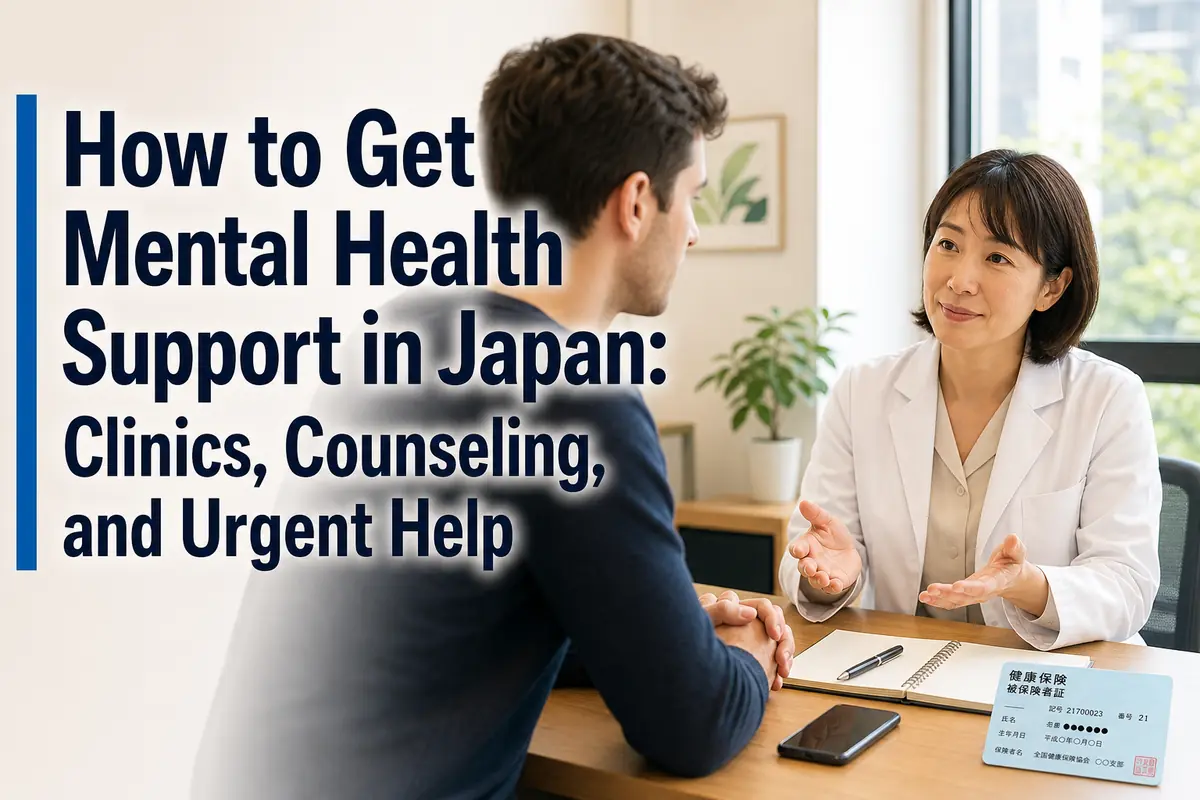
How to Get Mental Health Support in Japan: A Practical Route from First Call to Ongoing Care
If you need mental health support in Japan, choose the service by what you need right now: call 119 if you cannot stay safe, contact a helpline if you need immediate emotional support, book a psychiatric or psychosomatic clinic for medical assessment, or use counseling when you mainly want structured talk therapy.
These services are not interchangeable. A counselor generally cannot prescribe medicine, while a medical clinic may not provide long counseling sessions. Checking the service type, language, insurance status, and appointment rules before you go can prevent delays and unexpected bills.
This guide is for foreign residents, students, workers, and family members. The information and links were checked on August 1, 2026, but telephone hours, supported languages, fees, and local programs can change.
Quick guide:
- Immediate danger or a medical emergency: Call an ambulance on 119. Call police on 110 if police assistance is needed.
- You need someone to talk to now: Try a crisis or emotional-support helpline and check its current operating hours.
- Symptoms affect sleep, work, study, or daily life: Contact a psychiatry or psychosomatic medicine clinic.
- You want regular talk therapy: Look for a qualified counselor or psychologist and confirm the private fee in advance.
Start with the level of urgency
Your first decision is whether you can remain safe while arranging ordinary care. Do not wait for a clinic appointment if there is an immediate risk of suicide, serious self-harm, violence, overdose, or another medical emergency.
When to call 119
Call 119 for an ambulance if you or the person you are helping has already taken steps to cause serious harm, has taken an overdose, is unconscious, has severe physical symptoms, or cannot stay safe.
The emergency operator will normally ask for:
- Whether you need an ambulance or the fire service
- The address or a nearby landmark
- What happened and the person’s current condition
- The person’s approximate age
- Your name and telephone number
Say “kyūkyū desu” (救急です, “medical emergency”) and give the city, ward, town, or village first when stating the address. The Fire and Disaster Management Agency advises callers to speak slowly and answer the operator’s questions; an ambulance may be dispatched before every question is complete in a high-priority case.
If police assistance is necessary—for example, because someone is in immediate danger from another person—call 110. TELL also directs people who are unable to stay safe to 119 or 110 rather than treating its Lifeline as a replacement for emergency services.
If it is urgent but not an immediate emergency
A helpline can provide a human connection while you decide what to do next. It cannot diagnose an illness, issue a prescription, or guarantee admission to a hospital.
Useful options include:
- TELL Lifeline: English-language telephone and chat support for Japan’s international community. The toll-free number is 0800-300-8355. Its service schedule can change, so check the official hours page before relying on a particular time.
- Yorisoi Hotline: Call 0120-279-338 and press 2 after the Japanese recording for foreign-language support. Languages and availability vary by time; some languages may require advance arrangements.
- Kokoro no Kenkō Sōdan Tōitsu Dial: Japan’s national unified mental-health consultation number connects a caller to a participating public service in the caller’s area. Service hours are set locally, and foreign-language availability is not guaranteed.
Keep at least two options in your phone. A line may be busy or closed, especially during periods of high demand.
ここがポイント: A helpline helps you through the present moment; a clinic assesses and treats health conditions; a counselor provides talk-based support. If safety is at risk, use 119 or 110 instead of waiting for any of them.
Choose between psychiatry, psychosomatic medicine, and counseling
The right door depends on whether you need medical treatment, talk therapy, or help deciding. Japanese service names can be confusing, and English descriptions do not always match the care offered.
Psychiatry: seishinka
A psychiatry department or clinic may appear as 精神科 (seishinka). A psychiatrist is a medical doctor who can assess mental-health symptoms, make a medical diagnosis, prescribe medicine, prepare medical documents when appropriate, and arrange further treatment.
Psychiatry is usually the clearer starting point when symptoms include:
- Thoughts of suicide or self-harm
- Severe or persistent depression or anxiety
- Panic attacks
- Hallucinations, delusions, or extreme changes in mood
- Symptoms that significantly interfere with eating, sleeping, work, school, or personal care
- A need to review or continue psychiatric medication
Some clinics use 心療内科 (shinryō naika) in their name, translated as “psychosomatic medicine.” This field commonly treats physical symptoms connected with psychological stress, such as headaches, stomach problems, fatigue, or sleep disturbance. In everyday practice, the boundary between psychosomatic medicine and psychiatry is not always obvious from a clinic’s website.
Ask directly whether the doctor treats your main concern. A clinic carrying the right-looking label may focus on a narrower group of conditions.
Counseling and psychology
Counseling usually focuses on conversation, coping strategies, relationships, grief, adjustment, trauma, or behavior patterns. Counselors and psychologists do not generally prescribe medicine.
Japan has nationally recognized qualifications such as Certified Public Psychologist (公認心理師, kōnin shinrishi), but providers may also advertise under broader English titles. Before paying for private counseling, ask:
- What professional qualification does the provider hold?
- Is that qualification recognized in Japan or another country?
- Do they have experience with your concern and age group?
- What is their policy for emergencies and referrals?
- How are records and personal information handled?
- What happens if you miss or cancel a session?
The main practical difference is billing. A medical consultation that qualifies for Japanese public health insurance may be insured, while stand-alone private counseling is often self-pay. Do not assume that counseling becomes insured simply because it takes place in or near a clinic.
Public consultation services
If you do not know whether medical care is necessary, contact your local:
- Public health center or health center
- Mental Health and Welfare Center
- Municipal foreign-resident consultation desk
- International association
- University student-support office
- Employer’s occupational health service or employee assistance program
The Ministry of Health, Labour and Welfare explains that local public consultation offices can help residents discuss mental-health concerns and identify appropriate services. These consultations may be free, but language support and appointment procedures differ by municipality.
Understand insurance and likely costs
Confirm whether each part of the service is insured before the first appointment. A clinic can offer insured medical care and private-pay counseling under the same roof.
Medical care under public health insurance
For residents enrolled in National Health Insurance or employee health insurance, covered medical treatment generally follows the same public-insurance rules as other covered outpatient care. Working-age patients commonly pay 30% of the approved medical fee, although age, income, benefit status, and the exact service can change the amount.
Possible charges include:
- The first or follow-up medical consultation
- Covered tests
- Prescription charges at the pharmacy
- Medical certificates, which may be outside insurance
- Translation or language-support fees where applicable
- A hospital surcharge if you attend certain large hospitals without a referral
Ask the clinic, “Do you accept Japanese public health insurance for this appointment?” Also ask whether every planned service is covered. Showing a My Number Card registered for use as a health-insurance certificate, or another currently accepted proof of coverage, does not make a private service insured.
Private counseling
Private English-language counseling is commonly billed per session. A practical guide published by the UK government gives a broad example of ¥5,000 to ¥10,000 or more for about 50 minutes, but this is not an official Japanese fee schedule. Actual fees may be lower or substantially higher depending on the provider, location, session length, specialization, and cancellation policy.
Request the full price before booking, including:
- Intake or registration fees
- Ordinary session fees and session length
- Online-platform or interpretation fees
- Charges for reports or letters
- Late-cancellation and missed-session charges
- Whether tax is included
Students should check their school first. Universities may provide free or lower-cost counseling, although English availability, eligibility, session limits, and waiting times vary. Workers can ask HR or an occupational health office whether an employee assistance program is available, but should also ask who receives usage information and what confidentiality rules apply.
Support for continuing outpatient psychiatric treatment
Japan’s Self-Support Medical Care for Mental Outpatient Services, called jiritsu shien iryō (自立支援医療), may reduce eligible outpatient psychiatric costs for people who need continuing treatment. Under the national framework, the basic patient share for eligible care is generally 10%, with monthly limits linked to factors such as household income and condition.
This is not an automatic discount on every mental-health expense. Important limits include:
- You must apply through the municipality where you live.
- A doctor’s certificate and other documents are normally required.
- Only approved treatment and designated providers are covered.
- Stand-alone private counseling may remain outside the program.
- Renewal procedures and document requirements apply.
Ask your municipal disability-welfare or health counter for the current application form and document list. Do this early if a doctor expects long-term outpatient treatment; approval and effective-date rules should be confirmed locally.
Find a suitable clinic without wasting appointments
Search nationally, then verify details with the clinic itself. A directory entry showing “English available” does not prove that the relevant doctor speaks English on your appointment day.
Step 1: Search official directories
The Ministry of Health, Labour and Welfare’s Medical Information Net (NAVII) covers medical institutions and pharmacies across Japan. It allows searches by location, department, opening time, and supported language.
Search terms that may help are:
- 精神科 — psychiatry
- 心療内科 — psychosomatic medicine
- メンタルクリニック — mental clinic
- 児童精神科 — child and adolescent psychiatry
Tokyo residents can also use the Tokyo medical-information service HIMAWARI at 03-5285-8181. It provides information in English, Chinese, Korean, Thai, and Spanish every day from 9:00 a.m. to 8:00 p.m., according to the current official page. The service can help identify foreign-language medical institutions, but it does not choose a doctor for you.
Outside Tokyo, the Ministry maintains a prefecture-by-prefecture list of local call centers. Municipal foreign-resident desks and regional international associations may also help make an inquiry, but interpretation support varies.
Step 2: Call before booking
Confirm the following points:
- Is the clinic accepting new patients?
- Is a referral required?
- Does a psychiatrist who treats your concern work there?
- Can the full consultation be conducted in your preferred language?
- Is an interpreter allowed, and who arranges or pays for one?
- Is the visit covered by Japanese public health insurance?
- Are counseling, testing, certificates, or online visits billed separately?
- How soon is the first available appointment?
- What should you do if symptoms become urgent before that date?
Ask specifically whether language support applies to the doctor’s consultation, not only reception. Mental-health care depends heavily on precise descriptions, and reception-level English alone may not be enough.
Step 3: Prepare a short health summary
Write a one-page summary in simple English and, if possible, Japanese. Include:
- Main symptoms and when they began
- Changes in sleep, appetite, energy, concentration, and daily functioning
- Current and previous medicines, including doses
- Allergies and important physical conditions
- Previous diagnoses, hospital treatment, or serious reactions to medicine
- Alcohol, non-prescribed drug, and supplement use when relevant
- Any current risk of self-harm or harm from others
- What you want from the appointment
Bring your insurance information, residence details if requested, medication notebook (okusuri techō), referral letter if required, and relevant medical records. Do not stop or change prescribed medicine solely because an appointment is delayed; contact the prescriber or another qualified medical service for individual advice.
What usually happens at the first visit
The first appointment is mainly an assessment, not a promise that every problem will be resolved that day. The doctor may ask detailed questions before discussing treatment.
Topics commonly covered include:
- Present symptoms and their effect on daily life
- Physical health and current medicines
- Previous mental-health treatment
- Family medical history
- Work, study, housing, and support at home
- Alcohol or other substance use
- Immediate safety concerns
Treatment may involve follow-up visits, medication, a referral for counseling, further testing, or referral to a hospital or specialist. The exact plan depends on the person and provider.
Before leaving, make sure you understand:
- The next appointment date
- How and when to take prescribed medicine
- Important side effects that require prompt contact
- Whom to call if symptoms worsen
- Whether counseling is part of the clinic’s service
- Which costs are insured and which are private
If communication is unclear, ask the doctor to write down the treatment name, medicine name, and next step. You can also ask whether a professional interpreter may attend future visits.
Regional and personal circumstances can change the route
Japan has a national medical-insurance framework, but access is strongly shaped by location and affiliation. English-language care is more concentrated in large cities, while rural areas may require travel, remote consultations, or interpreter arrangements.
Municipality
Local governments determine the desks, languages, hours, and reservation systems for their public consultations. Applications for jiritsu shien iryō are also handled locally even though the program has a national legal framework.
School or employer
A university may have its own counseling center or referral network. An employer may provide occupational health consultations or an employee assistance program. These can be useful entry points, but they do not necessarily replace independent medical care.
Ask what information is confidential and whether the institution receives identifiable usage or clinical information.
Residence status
Using ordinary mental-health services does not itself create one universal immigration procedure. However, individual questions involving public benefits, ability to work or study, sponsorship, leave, or a future application can be fact-specific. Obtain current advice from the relevant public authority or a qualified professional instead of relying on assumptions about visa consequences.
Children and teenagers
Child and adolescent services may have different referral routes and long waiting lists. Parents can ask a pediatrician, school counselor, board of education, child-guidance office, or child psychiatry service where to begin. In an immediate safety emergency, use 119 or 110 regardless of age.
Common mistakes that delay support
Most avoidable problems come from assuming that similar-looking services provide the same care. Check the role, price, and urgency level explicitly.
- Waiting for an English-speaking specialist during a crisis: Use emergency or crisis support first, then arrange preferred-language ongoing care.
- Expecting a counselor to prescribe medicine: Only an appropriately licensed medical professional can prescribe.
- Assuming every “mental clinic” offers long talk therapy: Ask what a standard appointment includes.
- Assuming all counseling is covered by insurance: Confirm each service and fee separately.
- Trusting an online language label without calling: Verify which staff member speaks the language and on which day.
- Arriving at a large hospital without checking referral rules: Some hospitals require a referral or charge an additional fee.
- Leaving medication details at home: Bring the packages, a medication notebook, or a complete list.
- Relying on one hotline: Save alternatives because availability and languages change.
- Choosing a private provider only by an English title: Check qualifications, scope of practice, fees, and emergency procedures.
A practical action plan
You do not need to understand the entire Japanese system before taking the next useful step. Use the route that matches the situation today.
If you need help today
- Decide whether you can remain safe.
- Call 119 or 110 if there is immediate danger.
- Otherwise, contact TELL, Yorisoi, or a local public consultation line.
- Tell a trusted person where you are if doing so is safe.
- Arrange medical assessment when symptoms are severe, persistent, or disrupting daily life.
If you are arranging ongoing care
- Decide whether you need medical assessment, counseling, or both.
- Search NAVII and local official resources.
- Call two or three providers and compare language, waiting time, insurance, and fees.
- Prepare your symptom and medication summary.
- After the first visit, confirm the treatment plan and emergency contact route.
- If continuing psychiatric treatment is expected, ask your municipality about jiritsu shien iryō.
The most important practical step is to separate immediate safety from long-term provider choice. In an emergency, use 119 or 110. For ongoing care, verify the clinic’s language support and billing before the first visit—and keep a second contact ready in case the preferred service is unavailable.
参照リンク
- Fire and Disaster Management Agency: Guide for Ambulance Services
- Fire and Disaster Management Agency: How to Call an Ambulance
- TELL Japan: Lifeline
- TELL Japan: Phone and Chat Hours
- Hyogo International Association: Yorisoi Hotline and Foreign-Resident Services
- Ministry of Health, Labour and Welfare: Unified Mental Health Consultation Dial
- Ministry of Health, Labour and Welfare: Local Mental Health Consultation Offices
- Ministry of Health, Labour and Welfare: Medical Information Net (NAVII) Guide
- Ministry of Health, Labour and Welfare: Local Call Centers
- Tokyo Metropolitan Government: HIMAWARI Medical Information Service
- Ministry of Health, Labour and Welfare: Self-Support Medical Care Overview
- UK Government: Mental Health Support for British Nationals in Japan