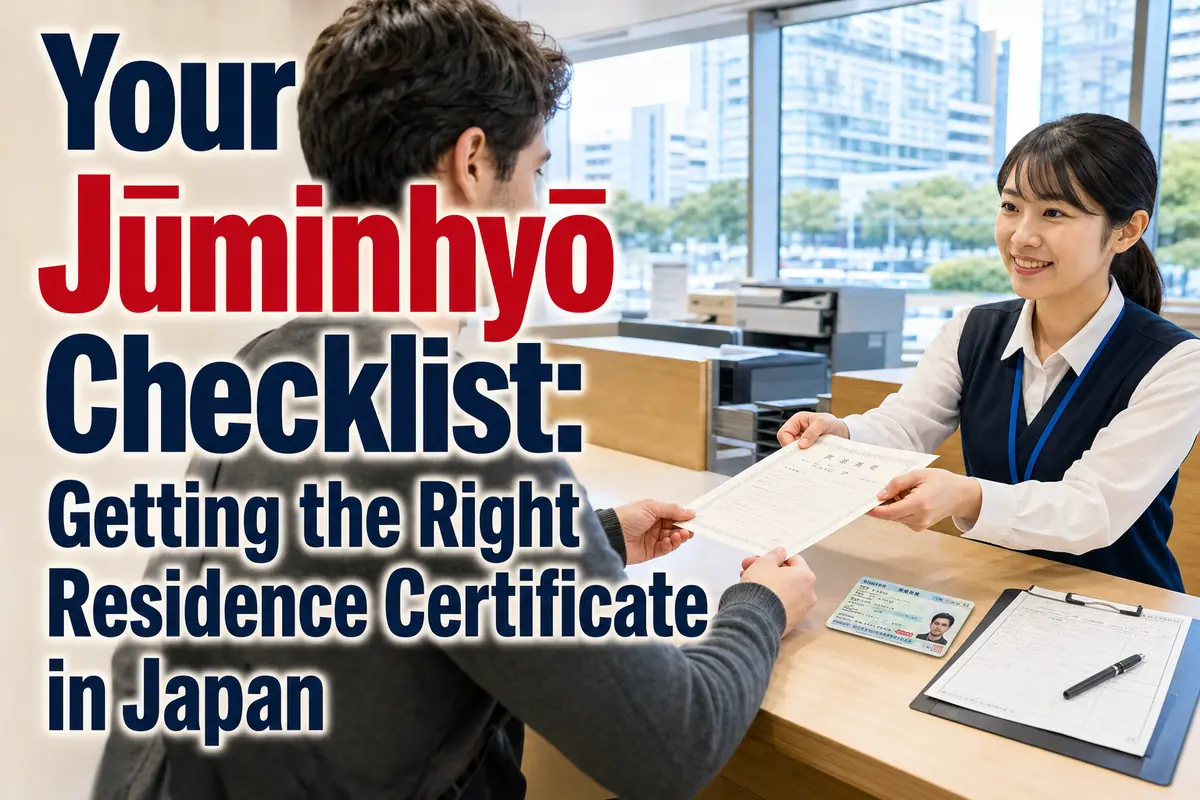
Getting a Japanese Residence Certificate: A Practical Jūminhyō Guide
A jūminhyō (住民票) is an official copy of the residence record kept by the municipality where you are registered. Foreign residents commonly need one when an employer, school, bank, housing office, or public authority asks for proof of their registered address or household details.
You can usually request it from your city or ward office. Depending on your municipality, you may also be able to obtain it by mail, online, or from a convenience-store kiosk using a My Number Card.
Before ordering one, ask the organization receiving it exactly which people and fields must appear. That small check can prevent a rejected application—and avoids disclosing your My Number when it is unnecessary.
Quick guide:
- Typical counter fee: around ¥300 per copy, but local fees vary.
- Bring government-issued identification, such as your residence card.
- Decide whether you need only yourself or everyone in your household shown.
- Include My Number, residence status details, or other optional fields only when specifically requested.
- A representative may need a signed letter of attorney.
This guide is for foreign residents and their families who have completed resident registration in Japan. Procedures and available certificate details can differ by municipality, so use your local government’s current instructions for the final check.
What a jūminhyō is—and what it is not
A jūminhyō proves information in Japan’s Basic Resident Register; it is not an immigration permit or a family-register certificate.
The register connects an individual to a registered address and household. Municipal services involving health insurance, local taxes and other resident procedures may use this record. Shinjuku City, for example, explains that residence records retain address, household and head-of-household information.
The document you receive is normally called a copy of the residence record—jūminhyō no utsushi (住民票の写し). Despite the word “copy,” it is an official certificate printed or issued by the municipality. You should not photocopy an old certificate and assume it will serve the same purpose.
Jūminhyō versus residence card
These documents answer different questions:
- A residence card mainly shows immigration-related identity and status information for eligible foreign nationals.
- A jūminhyō certifies the information currently recorded by your municipality, including your registered address and selected household details.
An organization may request one, the other, or both. Showing a residence card does not automatically replace a requested jūminhyō.
Jūminhyō versus koseki
A koseki (戸籍) is Japan’s family-register system. Foreign nationals do not normally have their own Japanese koseki, although events involving a Japanese spouse or child may appear in that Japanese person’s register.
A jūminhyō is therefore the more relevant municipal certificate when a foreign resident needs to prove a registered Japanese address or household composition. It does not prove every family relationship recognized under another country’s law.
Who can have a residence record
Nationality alone does not decide eligibility; the person must fall within a category covered by Japan’s resident-registration system.
Official municipal guidance lists the main eligible groups as:
- Medium- to long-term residents who have, or are eligible for, a residence card
- Special permanent residents
- People granted permission for temporary refuge or provisional stay
- Certain people temporarily remaining in Japan because of birth or loss of Japanese nationality
Short-term visitors and other foreign nationals outside these categories do not normally receive a residence record. A tourist cannot obtain a jūminhyō simply by staying at a hotel or private address.
New residents must first complete the applicable address-registration procedure. If your move-in notification has not been processed, the municipality may not yet be able to issue a certificate showing the new address.
What information can appear on the certificate
The correct certificate is not always the one with the most information. It is the one containing the fields the receiving organization actually requires.
Basic entries generally include information such as:
- Name
- Address
- Date of birth
- Sex as recorded
- Household information
- Head of household and relationship to that person, when requested or applicable
For a foreign resident, additional entries may include:
- Nationality or region
- The applicable foreign-resident category
- Status of residence
- Period of stay and expiration date
- Residence card number
Available wording and selection options can differ between municipal forms and issuing methods. At a counter, show the clerk the request from your employer, school or other receiving organization if you are unsure which boxes to select.
My Number is not printed automatically in every case
A jūminhyō may be issued with your 12-digit My Number when you specifically request it and the intended use permits it. The Digital Agency identifies a residence certificate carrying My Number as one way to confirm that number.
That does not mean you should include it on every certificate. My Number is regulated personal information, and many address-verification procedures do not need it. Ask the recipient before requesting a version that displays it, then handle the document carefully.
Choose between an individual and household certificate
Application forms commonly let you request:
- A certificate for one person
- A certificate covering all eligible members of the household
“Household” has a specific meaning in resident registration. People sharing an address are not necessarily recorded as one household, while family members may have separate household records depending on how they registered.
If a school needs proof for one child, an individual certificate may be enough. If a housing or benefit procedure requires household composition, the full-household version may be necessary.
ここがポイント: Ask the recipient three questions before applying: whose names must appear, which optional fields are required, and how recently the certificate must have been issued.
When you may need a jūminhyō
You need one when a procedure requires municipal proof of your registered address or household data—not merely because you live in Japan.
Possible situations include:
- Employment or payroll procedures
- School enrollment or scholarship paperwork
- Housing applications
- Banking or financial verification
- Vehicle-related procedures
- Applications for municipal services or benefits
- A procedure requiring confirmation of My Number
These are examples, not universal rules. A bank might accept another identification document for one service but request a jūminhyō for another. An employer needing My Number confirmation may specify a certificate with My Number, while an ordinary proof-of-address request may not.
Check whether the recipient requires:
- An original rather than a scan
- Issue within the last three or six months
- The entire household or one individual
- Head-of-household relationships
- Nationality or residence-status entries
- My Number
- An official translation or additional document
The issuing office determines what it can print. The receiving organization determines what it will accept.
How to obtain one at a municipal counter
The counter is usually the safest option when you need unusual fields, are applying through a representative, or are unsure what to request.
1. Find the correct office
Start with the municipality where your current address is registered. Depending on the city or ward, certificates may be available at:
- The main city or ward office
- Branch offices
- Administrative service counters
- Dedicated certificate counters
Opening hours vary. Some offices offer extended hours on selected days, while others close on weekends and national holidays.
2. Prepare identification and request details
Bring official identification. A residence card or special permanent resident certificate is commonly accepted for foreign residents; your municipality may list other acceptable documents.
Also prepare:
- The name and address recorded in the resident register
- The number of copies needed
- Whether the request covers one person or the household
- The exact optional entries required
- The reason for requesting sensitive entries, if the office asks
- The handling fee
If a Japanese form is difficult, write down “住民票の写し” and the required fields, or bring the receiving organization’s instructions.
3. Complete the application
Mark only the items you need. Before submitting the form, check names carefully, especially if your registered name uses an alphabetic spelling, kanji, kana or an alias recorded under applicable rules.
4. Pay and inspect the certificate
Fees are set locally. Yokohama currently lists ¥300 per copy at its counters, illustrating a common amount rather than a nationwide fixed price.
Before leaving, confirm:
- The correct person or household appears
- The address is current
- Every required optional field is present
- My Number is absent unless intentionally requested
- The number of copies is correct
Using a representative
Another person may be able to apply for you, but being a friend or relative does not automatically give that person authority.
A member of the same registered household may be treated differently from someone outside it. A representative outside the household commonly needs:
- A signed letter of attorney or proxy form
- Their own identification
- Accurate information about the person whose certificate is requested
- The required fee
Municipalities may apply additional checks, particularly when sensitive information such as My Number is requested. Some certificates may be mailed directly to the person concerned instead of being handed to the representative.
Download your municipality’s own proxy template when available. A self-written letter may be accepted in some places, but missing wording or a signature can delay the request.
Getting a jūminhyō at a convenience store
Convenience-store issuance is fast, but it only works when your municipality and the certificate you need are supported.
The national convenience-store certificate service uses compatible kiosk terminals. The Digital Agency says the service generally operates from 6:30 a.m. to 11:00 p.m., including weekends and public holidays, but municipalities may restrict hours or suspend service for maintenance.
You normally need:
- A valid My Number Card with the required electronic certificate
- The four-digit PIN used for user authentication
- A municipality participating in the service
- A compatible kiosk terminal
- The certificate fee
The basic process is:
- Select the government or administrative services menu.
- Choose certificate issuance.
- Place or scan your My Number Card as instructed.
- Select your municipality and enter the PIN.
- Choose the certificate type and requested details.
- Check the preview carefully.
- Pay the fee and collect every printed page.
- Take your card and receipt before leaving.
A participating municipality’s certificates can generally be obtained from a compatible kiosk outside that municipality. However, the issuing municipality still controls available certificate types, fees, hours and fields.
The national guide notes that a convenience-store residence certificate does not include the resident-record code. Other restrictions may also apply. If the kiosk cannot provide a required item, use the municipal counter or another method approved by your municipality.
Avoid repeated PIN mistakes
Do not guess the PIN repeatedly. Incorrect entries can lock the electronic certificate, requiring a reset procedure. If you are unsure of the number, check your municipality’s reset options before trying again.
Mail and online applications
These options can save a trip, but they are not standardized across Japan.
Some municipalities accept postal requests. Common requirements include an application form, a copy of identification, the fee in an accepted form, and a stamped self-addressed return envelope. The certificate may be sent only to the registered address unless a permitted exception applies.
Some cities also offer online requests using a My Number Card and smartphone. Authentication method, payment options, delivery address, fees and processing times vary.
Yokohama, for example, lists counter, mail and online routes for residence certificates, with My Number Card requirements for its online process. Treat this as a local example—not a national promise that every municipality offers the same service.
Costs, timing and validity
There is no single nationwide price or universal expiration date for a jūminhyō.
Typical practical points are:
- Counter fees are often around ¥300 per copy.
- Convenience-store fees may be lower, equal or otherwise set by the municipality.
- Postal requests add postage and may take several working days.
- Online requests may still involve postal delivery.
- Counter issuance is often completed during the visit if no special review is needed.
A jūminhyō does not automatically become legally invalid after three months. Instead, the receiving organization often sets a freshness requirement—commonly an issue date within a specified number of months. Confirm that requirement before paying for several copies.
Regional differences that matter
The Basic Resident Register is a national system, but certificate services are operated locally.
Differences may include:
- Fee per copy
- Counter locations and opening hours
- Languages available at the office
- Accepted identification
- Postal and online application rules
- Convenience-store participation and service hours
- Optional fields available through each issuing channel
- Treatment of representatives
- Payment methods
For example, Yokohama lists ¥300 for a counter-issued residence certificate and, following a certificate-format change introduced in January 2026, ¥250 for applicable convenience-store issuance. Another municipality may use different prices or formats.
Always search your city or ward website for “jūminhyō,” “copy of residence record,” or “certificate of residence.” If an English page is incomplete, compare it with the current Japanese page or ask the resident-services counter.
Common mistakes and how to avoid them
Most problems come from ordering the wrong version, using an old address, or assuming every issuer follows the same rules.
Requesting unnecessary My Number information
Do not select My Number “just in case.” Confirm that the recipient needs it and can lawfully handle it.
Choosing the wrong household scope
“One person” and “entire household” are not interchangeable. Ask whose names must appear.
Omitting a required foreign-resident field
An immigration-related or employment procedure may ask for status of residence, period of stay or nationality. Ordinary proof of address may not. Follow the recipient’s checklist.
Applying before an address update is complete
A certificate reflects the municipal record. After moving, complete the required notification first and verify that the new address has been registered.
Assuming a residence card is enough
The residence card and jūminhyō serve different purposes. Submit the document named in the instructions or ask whether an alternative is accepted.
Using a certificate that is too old
The recipient—not the municipality—often sets the acceptable issue-date window. Check it before reusing a certificate kept at home.
Expecting every certificate from a kiosk
Convenience-store service has local and document-specific limits. Use the counter when you need a field the kiosk cannot issue.
Current status as of August 2026
Convenience-store access continues to expand, but municipal support remains the deciding factor.
The Digital Agency confirms that My Number Cards can be used for residence-certificate issuance at participating convenience-store kiosks. It also demonstrated iPhone-based My Number Card use for certificate issuance in June 2025. Device support does not remove local eligibility requirements: the municipality, available electronic certificate and kiosk still determine whether the transaction can be completed.
Certificate layouts may also change as municipal systems are updated. Yokohama introduced new residence-certificate formats in January 2026, including different availability for household-style and individual formats. Readers should therefore rely on current municipal instructions rather than an old sample certificate.
FAQ
Can a tourist get a jūminhyō?
Normally no. Short-term visitors are not usually entered in the Basic Resident Register. Eligibility depends on falling within a covered resident category and completing resident registration.
Can I get one immediately after arriving in Japan?
Only after the municipality has processed the applicable resident and address registration. Ask the counter when the record will become available if you need the certificate urgently.
Can my spouse collect it for me?
Possibly. The answer depends on whether your spouse is recorded in the same household and on local rules. Otherwise, a letter of attorney and identification will commonly be required.
Can I get an English-language jūminhyō?
The official certificate is generally issued in Japanese. Some municipalities provide multilingual guidance, but that does not mean the certificate itself will be translated. Ask the receiving organization whether you must arrange a translation.
Does it always show my status of residence?
Not necessarily. Foreign-resident details may be optional or depend on the issuing method. Request the exact fields required for your procedure.
Is a jūminhyō the same as proof of residence for immigration overseas?
Not automatically. A foreign authority decides which documents it accepts and whether translation, notarization or authentication is required.
Your practical checklist
The safest approach is to work backward from the receiving organization’s requirements.
Before applying, confirm:
- Who must appear on the certificate
- Which optional fields must be included
- Whether My Number is required
- How recent the certificate must be
- Whether an original or translation is needed
- Which application route can issue that exact version
- Your municipality’s current fee and required identification
If any point is unclear, take the recipient’s written instructions to the municipal counter. The next decision is not simply where to print the certificate; it is whether the version you order contains exactly what the procedure requires—and nothing sensitive that it does not.
参照リンク
- Shinjuku City: Residence Records (Juminhyo)
- Yokohama City: Family Register and Residence Certificates
- Yokohama City: Residence Certificate Format Changes from January 5, 2026
- Digital Agency: How to Obtain Certificates at Convenience Stores
- Digital Agency: FAQ on My Number
- Digital Agency: iPhone-Based My Number Card Certificate Issuance Demonstration