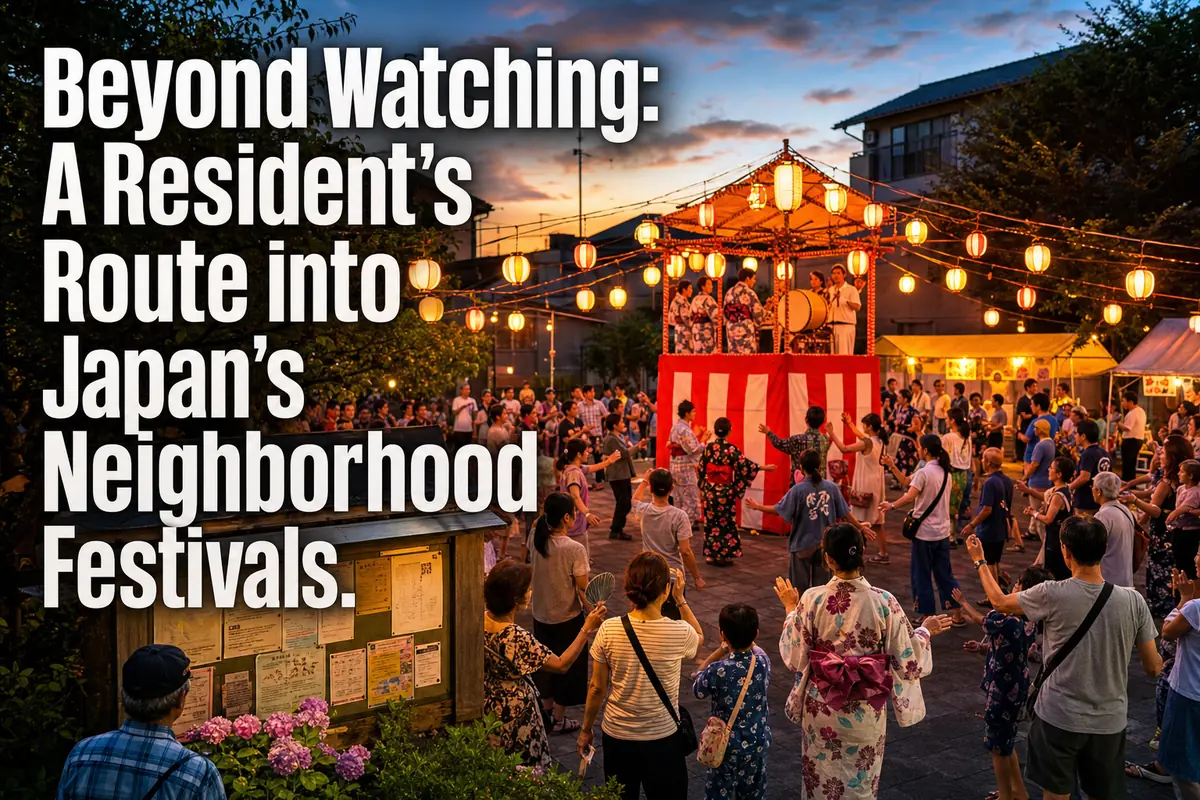
Beyond Watching: A Resident’s Route into Japan’s Neighborhood Festivals
The easiest way to join a local festival in Japan is to first identify what kind of participation is open: watching, joining a public dance, registering for an activity, or helping the organizers. These are not the same, and only the first is automatically open at most public events.
Foreign residents and their families are often welcome, but there is no single national registration system. The organizer—such as a shrine, municipality, shopping street, school, or neighborhood association—sets the rules.
The quick answer
- To attend: usually arrive during the public hours; advance registration is uncommon.
- To dance: public bon odori circles often allow anyone to follow along.
- To carry a mikoshi or pull a float: ask first; registration, suitable clothing, age limits, or a local connection may be required.
- To volunteer: contact the organizer early, because meetings and preparation may begin weeks before the event.
This guide is for foreign residents, including workers, students, long-term residents, and families who want to move from simply watching to taking part.
First decide how you want to participate
Your next step depends more on your role than on the size of the festival. A visitor at a food-stall area faces very different requirements from someone entering a religious procession.
1. Attend as a spectator
Public street festivals, municipal events, fireworks displays, and many shrine festivals normally have areas that anyone can enter. Admission may be free even when food, games, reserved seating, or workshops cost money.
Check the event notice for:
- Public opening and closing times
- Parade routes and traffic restrictions
- Paid or ticketed areas
- Rules for bicycles, pets, alcohol, and photography
- Cancellation notices for rain, heat, or severe weather
Do not assume every part of a public-looking event is open. Ceremonies inside a shrine building, school events, rehearsals, and spaces behind barriers may be restricted.
2. Join an open dance or activity
A public bon odori is often the simplest active role. Dancers move in a circle around a raised platform called a yagura. Beginners can usually stand near the outer part of the circle, watch the people ahead, and copy the movements.
The Japan National Tourism Organization notes that bon odori dancing is generally open to everyone. Individual organizers can still set local conditions, so read signs and follow staff directions.
Other open activities may include:
- Stamp rallies
- Children’s games
- Festival workshops
- Public tug-of-war or dance sessions
- Community sports activities
- Cleanup sessions after an event
Some are free; others require a small ticket or advance booking.
3. Enter a procession or performance
Carrying a mikoshi—a portable sacred shrine—is not simply an extension of watching the parade. The route may be physically demanding, and the organizer must manage safety, clothing, numbers, and the religious character of the event.
Possible conditions include:
- Advance registration
- Residence in the neighborhood or membership in a participating group
- A minimum age or restrictions for children
- Attendance at a briefing or rehearsal
- A specified happi coat, footwear, or other clothing
- A participation fee, deposit, or equipment charge
- Agreement to follow the procession leader’s instructions
The same caution applies to pulling a dashi float, performing on stage, playing music, or operating a stall. Never step into a procession because other people appear to be joining. Ask an organizer first.
Where residents can find reliable event information
The most useful notices are often local and may appear only shortly before the event. Large tourism websites help with famous festivals, but neighborhood events are more likely to appear in municipal newsletters, association notices, or posters near where you live.
Check these sources in order:
- Your city or ward website
- The printed municipal newsletter delivered to homes
- Community-center and ward-office noticeboards
- Your neighborhood association, called chōnaikai or jichikai
- The local international association or multilingual information center
- The organizer’s official website or social account
- Posters at stations, shopping streets, shrines, schools, and supermarkets
Tokyo’s Intercultural Portal Site, for example, maintains notices for events, classes, volunteer opportunities, and organizations involved in intercultural activities. The details come from individual organizations, so readers must contact the named organizer for final confirmation.
Search terms that can help include:
[city or ward name] matsuri[neighborhood name] bon odori[event name] sanka boshu— participant recruitment[event name] volunteer boshu— volunteer recruitment[event name] moushikomi— application[event name] uchikiri— applications closed
Adding the current year is important. Old festival pages often remain visible in search results.
Neighborhood associations: useful, but not mandatory everywhere
Joining a neighborhood association can create a direct route into small events, but membership is voluntary and local arrangements differ. These resident-run groups often organize summer festivals, children’s activities, sports days, disaster drills, crime-prevention patrols, and neighborhood cleaning.
Yokohama City explicitly states that non-Japanese residents are welcome to join its neighborhood associations. It directs interested residents to an association officer or the ward office’s Community Promotion Division. Yokohama also gives “a few hundred yen per month” as a local example of membership fees—not a national price.
Membership may provide:
- Local event notices before they appear elsewhere
- Access to planning or volunteer meetings
- A contact person who can explain participation rules
- Opportunities for children to join local activities
- Connections that are useful during disasters as well as festivals
However, joining an association does not automatically grant access to every procession or ceremony. A shrine committee, youth group, property association, school, or separate festival committee may control participation.
ここがポイント: A neighborhood association is one possible doorway, not a nationwide requirement. Ask who actually organizes the activity you want to join.
If you rent an apartment
Start with your building manager, landlord, residents’ noticeboard, or ward office. Association dues may occasionally be collected with other building-related charges, but the arrangement depends on the property and community. Confirm what the payment covers before assuming that you are already a member.
If you do not speak much Japanese
Use a short, specific question. Showing the event poster on your phone can prevent confusion.
Useful phrases include:
Kono ibento wa dare demo sanka dekimasu ka?— Can anyone join this event?Mōshikomi wa hitsuyō desu ka?— Is registration required?Gaikokujin jūmin mo sanka dekimasu ka?— Can foreign residents participate too?Kodomo mo sanka dekimasu ka?— Can children join?Sanka-hi wa ikura desu ka?— How much is the participation fee?Itsu made ni mōshikomeba ii desu ka?— What is the application deadline?
A municipal international desk may help you understand a notice, but it cannot override the organizer’s rules.
What to prepare before applying
Most casual events require little paperwork, while organized roles may require contact and safety information. Do not send identity documents unless the official instructions request them.
An application may ask for:
- Full name
- Address or neighborhood
- Telephone number and email address
- Age or school year for a child
- Emergency contact
- Group or association name
- Clothing size
- Relevant experience for a performance or specialist role
- Consent from a parent or guardian
A residence card is not a standard festival ticket. If an organizer requests identification or proof of address, ask what document is accepted, why it is needed, and how the information will be handled.
A practical registration sequence
- Find the original notice. Check the year, organizer, venue, and application deadline.
- Identify the role. “Festival participant” may mean dancer, volunteer, performer, stall operator, or procession member.
- Confirm eligibility. Ask about residency, age, language, group membership, and physical requirements.
- Check the full cost. Include clothing rental, insurance, food tickets, transport, and deposits—not only the stated entry fee.
- Apply through the stated channel. This may be an online form, telephone call, email, paper form, or visit to a community center.
- Save the confirmation. Note the meeting place, check-in time, contact number, and bad-weather policy.
- Attend any briefing. Missing a required meeting can mean losing the place even after registration.
Deadlines vary widely. Spectator areas may need no application, while stage appearances and volunteer roles can close weeks or months ahead. Some organizers stop accepting applications as soon as capacity is reached.
Costs: what may be free and what may not be
Watching is often free, but active participation can create several small costs. There is no standard festival fee across Japan.
Possible expenses include:
- Neighborhood association dues
- Participation or insurance fees
- Happi, yukata, footwear, or accessory rental
- A refundable clothing deposit
- Workshop or game tickets
- Food and drinks
- Reserved seating
- Transport when roads close or buses are rerouted
- Cash contributions requested from participating households or businesses
Ask whether a contribution is compulsory, optional, or connected to membership. If the explanation is unclear, contact the named organizing office before paying.
Bring some cash in small denominations. Major events increasingly offer cashless payment, but a temporary neighborhood stall may accept cash only.
Festival manners that prevent real problems
The central rule is simple: public attendance does not make every person, ritual, or space available for your use. Follow signs, barriers, and instructions even when nearby spectators do not.
Photography and social media
Ask before photographing people at close range, especially children. Avoid blocking paths or entering a performance area for a better angle.
JNTO’s festival guidance recommends refraining from photographing prayers in front of deities and from uploading personally identifiable images without care. A “no photography” sign, a staff instruction, or a restricted ceremony takes priority over general practice.
Waste and food
Use the bins provided by the stall or organizer. If there are none, carry your rubbish away rather than leaving it beside a full bin or vending machine.
Eat in the designated area when one exists. Crowded procession routes are poor places to stop with hot food or glass containers.
Clothing
A yukata is optional for most public summer events. Comfortable everyday clothing is normally acceptable unless a registered role has a dress requirement.
For procession work, do not substitute your own footwear without asking. The organizer may require shoes that reduce slipping or protect feet.
Religious elements
Many festivals combine entertainment with Shinto or Buddhist observances. You do not have to copy every ritual, but remain quiet during prayers, stay outside controlled areas, and follow the organizer’s lead.
Families, children, accessibility, and health
Families should check practical conditions rather than assuming that a child-friendly poster means every activity suits every age. Crowds, noise, darkness, summer heat, and moving floats can make a short visit tiring.
Before leaving home, confirm:
- Whether strollers are permitted or practical
- Child participation ages and guardian requirements
- Toilet and diaper-changing locations
- Rest areas and accessible routes
- The nearest station after road closures
- The event’s heat, rain, and emergency announcements
- Whether food stalls can answer allergy questions
For a child joining a procession, obtain the meeting and release arrangements in writing if possible. Make sure the organizer has the correct guardian and emergency contact details.
People with mobility, hearing, visual, or sensory needs should contact the venue in advance. Historic shrine grounds and temporary street layouts may have steps, gravel, cables, or limited seating. Accessibility varies by site; a municipal event and a small volunteer-run festival may have very different resources.
Common mistakes—and the better action
Most problems begin when a resident assumes that one type of access includes another. These errors are easy to avoid.
-
Mistake: Treating “free entry” as permission to join the parade.
Better action: Ask whether public participation is specifically offered. -
Mistake: Using last year’s schedule.
Better action: Confirm the year and check the official page again on the event day. -
Mistake: Arriving at the public start time for a registered role.
Better action: Look for a separate check-in or briefing time. -
Mistake: Assuming neighborhood association membership is required everywhere.
Better action: Identify the actual organizer and ask about that activity’s eligibility. -
Mistake: Buying festival clothing before registration.
Better action: Ask whether clothing is supplied, rented, or subject to a local design rule. -
Mistake: Posting identifiable images of children or worshippers.
Better action: Obtain permission or choose wider, non-identifying views. -
Mistake: Expecting multilingual support at the venue.
Better action: translate the main instructions beforehand and save the organizer’s contact details.
Current status as of August 2026
There is still no uniform national procedure for joining community festivals; current information must be confirmed event by event. Municipalities and intercultural organizations increasingly publish notices online, but small events may still rely on printed newsletters, local posters, and association networks.
Dates and participation conditions can change because of weather, extreme heat, crowd management, construction, or local circumstances. An event listing is therefore a starting point, not final confirmation.
For summer events in particular, check again:
- The official schedule on the morning of the event
- Heat warnings and cancellation notices
- Last-train and temporary bus information
- Road closures and bicycle-parking restrictions
- Whether applications have reached capacity
A simple action plan for your next local event
Start close to home and ask for one clearly defined role. That produces a better answer than asking only whether you can “join the festival.”
This week, take these steps:
- Search your municipality and neighborhood name with
matsuriorbon odori. - Check the city newsletter, community center, and local noticeboards.
- Choose whether you want to watch, dance, volunteer, perform, or enter a procession.
- Contact the named organizer and confirm eligibility, deadline, cost, clothing, and briefing time.
- Recheck the official notice on the event day.
If active roles are already full, attend respectfully and ask where next year’s recruitment will be announced. For many neighborhood events, the best route into next summer’s festival begins with one conversation after this summer’s event ends.
参照リンク
- Japan National Tourism Organization: Get Involved in Local Japanese Festivals
- Japan National Tourism Organization: Japan Festival Guide Book and Festival Etiquette
- Japan National Tourism Organization: Customs and Manners
- Yokohama City: Community Life and Neighborhood Associations
- Yokohama City: Ward Offices and Community Promotion Divisions
- Tokyo Intercultural Portal Site: Event Listings