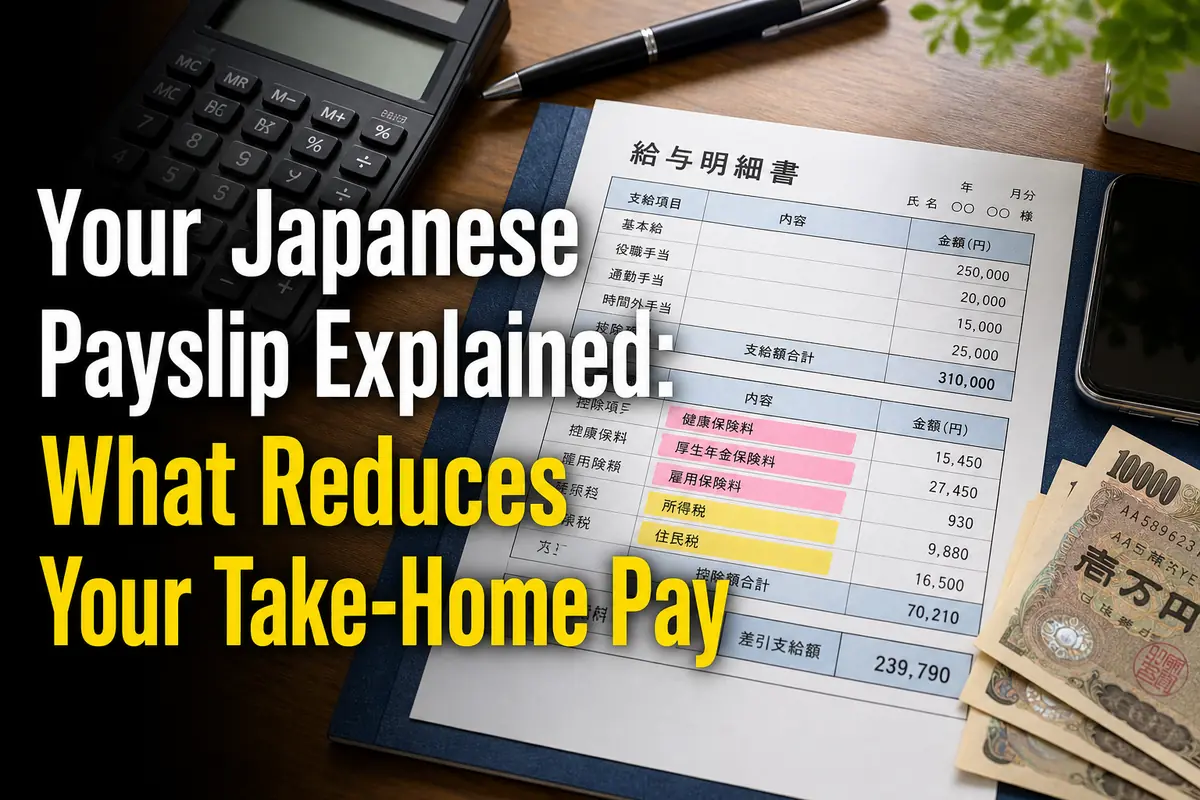
From Gross Pay to Take-Home Pay: A Guide to Japanese Salary Statements
The amount transferred to your bank account is usually your net pay, not the salary stated in your employment contract. A Japanese payslip starts with earnings, adds or subtracts attendance-related adjustments, deducts social insurance and taxes, and then shows the amount actually paid.
For most employees, the fastest way to check a payslip is to read it in this order:
- Confirm the pay period, payment date, and employee details.
- Check gross earnings, especially base salary, overtime, and allowances.
- Review health insurance, pension, employment insurance, income tax, and resident tax separately.
- Compare net pay with the bank deposit.
- Ask payroll promptly about unfamiliar deductions or incorrect attendance figures.
This guide is for foreign employees and their families, including people receiving their first salary in Japan. The examples reflect the general position as of August 1, 2026, but labels and deduction timing differ among employers, insurers, industries, and municipalities.
First, find the four main parts
Most Japanese payslips contain attendance, earnings, deductions, and the final payment amount. The exact layout varies, but the same basic information usually appears somewhere on the statement.
Common section headings include:
勤怠(kintai): attendance and working time支給(shikyū): earnings or payments控除(kōjo): deductions差引支給額(sashihiki shikyūgaku): net amount paid
Digital payroll systems may split these items across several screens. Download or save each monthly statement if your employer allows it; access may end after you leave the company.
The basic calculation
A useful simplified formula is:
Gross earnings − deductions = net pay
On a Japanese statement, these may appear as:
総支給額: total or gross earnings控除合計: total deductions差引支給額,手取額, or振込支給額: net pay or bank-transfer amount
Do not confuse net pay with taxable income. Income tax is not normally calculated by applying one simple percentage to the gross-pay line. Payroll uses official withholding rules, while annual tax calculations also involve the employment-income deduction and any applicable personal deductions.
Check attendance before checking money
An incorrect work record can change several earnings lines at once. Confirm attendance while the month is still fresh in your memory.
Look for terms such as:
出勤日数: days worked労働日数: working days労働時間: working hours残業時間or時間外: overtime hours深夜時間: late-night hours休日出勤: work on a day off or statutory holiday有給休暇: paid leave欠勤: absence遅刻早退: lateness or early departure
The attendance period may not match the calendar month. For example, a salary paid in late August might reflect attendance recorded from mid-July to mid-August. The closing date in your employment rules or payroll schedule explains which work period was used.
If overtime seems to be missing, first check whether it will be paid one month later. Many employers calculate fixed monthly salary for the current month but pay variable overtime after the attendance period has closed.
Read every earnings line—not only base salary
Your gross pay may include several payments with different purposes and tax or insurance treatment. Start with the amount promised in your employment contract, then account for additions and reductions.
Base salary and role-related payments
Common labels include:
基本給: base salary役職手当: position or managerial allowance職務手当: job-duty allowance資格手当: qualification allowance住宅手当: housing allowance家族手当or扶養手当: family or dependent allowance
These allowances are employer benefits, not universal legal entitlements. Eligibility and amounts come from the employment contract, work rules, or company policy.
Overtime and premium payments
You may see:
時間外手当: overtime allowance深夜手当: late-night premium休日手当: holiday-work allowance固定残業代orみなし残業代: fixed overtime payment
A fixed-overtime arrangement should identify what amount of overtime the payment covers. If actual qualifying overtime exceeds that allowance, an additional payment may be due depending on the arrangement and applicable labor rules. Ask HR for the written calculation if the payslip shows only one combined amount.
Commuting expenses
通勤手当 is a commuting allowance. It may be included in the payment total even when some or all of it receives different income-tax treatment from ordinary salary within statutory limits.
However, tax treatment and social-insurance treatment are not identical. Remuneration used for employee health insurance and employees’ pension generally includes salary and work-related allowances, including commuting payments. This is one reason you should not try to reproduce every deduction by multiplying base salary alone.
Other additions or reductions
Also check for:
賞与: bonusインセンティブ: incentive payment立替精算or経費精算: expense reimbursement欠勤控除: reduction for absence遅刻早退控除: reduction for lateness or early departure
A reimbursed business expense may appear on the statement without functioning like normal wages. Ask payroll how it is classified if it seems to affect tax or insurance unexpectedly.
Why social insurance is not a simple percentage of this month’s salary
Health insurance and employees’ pension are usually based on standardized remuneration bands, so small salary changes may not immediately change the deduction. This is one of the most important differences between a Japanese payslip and a simple gross-pay calculator.
Health insurance: 健康保険料
Employees enrolled through a covered workplace generally share health-insurance contributions with their employer. Your actual rate depends on the health insurer. For example, Japan Health Insurance Association rates differ by prefectural branch and are revised by fiscal year; a company health-insurance society may use different rates.
Your payslip normally shows only the employee share. It does not show the full cost jointly paid by you and the employer.
If your deduction changes after a move or job change, possible reasons include:
- a different health insurer or prefectural rate,
- a new standard monthly remuneration band,
- a scheduled rate revision,
- a correction or retroactive adjustment.
Employees’ pension: 厚生年金保険料
For covered employees, Employees’ Pension Insurance contributions are calculated from 標準報酬月額, or Standard Monthly Remuneration, and from a standardized bonus amount when a bonus is paid. The employee and employer share the contributions equally.
The standard remuneration is a band assigned from covered monthly remuneration; it is not necessarily identical to the gross total printed on one particular payslip. Regular reviews and certain significant pay changes can lead to a new band.
The current total Employees’ Pension Insurance rate is generally 18.3%, meaning the usual employee share is 9.15%, subject to the applicable standard amount and statutory limits. Do not add another employer share to the amount deducted from your salary—the employer pays that separately.
Nursing-care insurance: 介護保険料
Employees generally become subject to nursing-care insurance contributions through employee health insurance from age 40 through age 64. The line may appear separately or be combined with health insurance, depending on the statement and insurer.
A new deduction around your 40th birthday is therefore not necessarily a payroll error. Confirm the starting month and rate with the payroll team or health insurer.
Employment insurance: 雇用保険料
Employment insurance is generally calculated from wages paid, so it can move with overtime and other wage items more directly than pension or health-insurance deductions.
For the fiscal year from April 1, 2026, through March 31, 2027, the employee rate for a general business is 5 per 1,000 of wages, down from 5.5 per 1,000 in the previous fiscal year. Agriculture, forestry, fisheries, sake brewing, and construction use different rates; some specifically listed activities use the general-business rate.
If a payslip covering April 2026 or later still appears to use the old rate, first check the wage period and your industry classification, then ask payroll for the calculation.
Workers’ accident compensation insurance should not be your deduction
Workers’ accident compensation insurance, usually called 労災保険, is funded by the employer. It should not normally appear as an employee-paid deduction. A line with a similar name deserves an explanation from payroll.
ここがポイント: Health insurance and employees’ pension often use a standardized remuneration band; employment insurance generally follows wages paid. Applying one percentage to the gross-pay total will not reliably reproduce all three deductions.
Income tax and resident tax are different deductions
Income tax follows current salary withholding, while resident tax usually reflects income from the previous year. They can therefore move at different times and for different reasons.
Withholding income tax: 所得税
An employer normally withholds national income tax and the special income tax for reconstruction when paying salary. For a tax resident, payroll withholding depends on factors including taxable salary after social-insurance deductions and information declared for dependents.
Employees generally submit the 給与所得者の扶養控除等(異動)申告書, commonly called the dependent exemption declaration, to their main employer. If the form is missing, or the employer is not your main employer, a different withholding table may apply and the monthly deduction can be higher.
Tax residency is a tax classification, not the same thing as immigration status. The National Tax Agency explains that salary paid to a tax non-resident is generally subject to withholding at 20.42%, unless an applicable tax treaty or another rule changes the treatment. Anyone uncertain about residency or treaty treatment should consult the employer and an official tax service rather than relying only on the payslip label.
Year-end adjustment: 年末調整
For many employees, the employer performs a year-end adjustment using the last salary payment of the year. This reconciles income tax withheld during the year with the calculated annual amount after eligible information and documents are considered.
A December or January statement may therefore contain:
年調還付: year-end adjustment refund年調追徴: additional amount collected過不足税額: tax difference to refund or collect
A large change is not automatically a bonus or penalty. It may be the annual reconciliation of monthly withholding.
Most wage earners do not need a final income-tax return when the employer completes their tax through year-end adjustment. Exceptions exist—for example, the National Tax Agency lists cases involving employment earnings over ¥20 million or certain additional income over ¥200,000. A tax return may also be useful to claim deductions or a refund that payroll did not handle.
Resident tax: 住民税
Resident tax is a local tax, often displayed as 住民税, 市町村民税, 区民税, 都民税, or a combined label. It is generally based on the previous year’s income and is imposed by the municipality connected to your address on January 1.
For employees using salary-based special collection, the annual amount is normally divided across salary deductions from June through May of the following year. This timing explains several situations that often surprise new residents:
- A person with little or no Japanese income in the previous year may initially have no resident-tax deduction.
- Resident tax may begin or change in June even when monthly salary stays the same.
- A lower current salary does not immediately erase tax based on last year’s income.
- Leaving a job or Japan does not automatically cancel an amount already assessed.
Municipal procedures matter here. If you plan to leave Japan, ask your municipality and employer how the remaining resident tax will be paid. You may need a final payroll deduction, payment slips, or a tax agent, depending on your timing and circumstances.
A practical example of the calculation flow
Use an example to understand the order, but never treat it as a quotation of what your own deductions should be. Suppose a statement contains the following illustrative figures:
Earnings
- Base salary: ¥300,000
- Overtime allowance: ¥24,000
- Commuting allowance: ¥10,000
- Gross earnings: ¥334,000
Deductions
- Health insurance: ¥17,000
- Employees’ pension: ¥31,110
- Employment insurance: ¥1,670
- Income tax: ¥6,000
- Resident tax: ¥12,000
- Other agreed deduction: ¥2,000
- Total deductions: ¥69,780
Net payment
¥334,000 − ¥69,780 = ¥264,220
These figures are deliberately illustrative. The health-insurance amount depends on the insurer and applicable remuneration band; pension uses its statutory calculation basis; income tax depends on the withholding table and declarations; and resident tax comes from the municipality’s annual decision.
The example also shows why a job offer of “¥300,000 per month” does not predict a ¥300,000 bank deposit. It may refer only to base salary, while the final transfer reflects variable earnings and several deductions.
Why a deduction may suddenly change
A changed payslip usually has a traceable cause: a new rate, a new tax year, a remuneration review, an age threshold, or a correction. Check the timing before assuming the amount is wrong.
Common triggers include:
- April: employment-insurance rates and other fiscal-year rules may change.
- June: the new resident-tax amount commonly starts.
- After a remuneration review: health-insurance and pension deductions may move to another standard band.
- Around age 40: nursing-care insurance may begin.
- After changing jobs: the insurer, payroll timing, withholding category, and resident-tax collection method may change.
- After submitting dependent information: income-tax withholding may change.
- At year-end: a refund or additional income-tax collection may appear.
- In a bonus month: separate social-insurance and tax calculations may appear for the bonus.
For 2026, a particularly visible update is the reduction in the employee employment-insurance rate for general businesses from 5.5 to 5 per 1,000 from April 1. Health-insurance rates should be checked against your own insurer’s fiscal 2026 table, not a nationwide figure copied from another employee.
Common mistakes and how to avoid them
The biggest errors come from comparing unlike amounts or assuming every deduction uses the same month and calculation base.
Mistake 1: Comparing net pay with the advertised salary
A job advertisement may quote base salary, fixed overtime-inclusive pay, or expected annual compensation. Compare your employment contract and itemized earnings, not only the bank transfer.
Mistake 2: Treating every deduction as tax
Health insurance, pension, and employment insurance are social-insurance contributions. Income tax and resident tax are taxes. Their calculation methods, timing, and institutions are different.
Mistake 3: Assuming no resident tax means an exemption forever
A new arrival may have no previous-year Japanese income on which to base the current resident-tax assessment. A deduction can begin the following June.
Mistake 4: Using another employee’s health-insurance rate
Rates can differ by insurer and, under the Japan Health Insurance Association, by prefectural branch. Age and remuneration band can also affect the comparison.
Mistake 5: Ignoring the payroll closing date
Overtime, leave, and attendance deductions may be processed one pay cycle later. Check the period before reporting a missing payment.
Mistake 6: Confusing a dependent for tax with an insurance dependent
Tax-dependent rules and health-insurance dependent rules are separate. A family member may qualify under one system but not the other. Submit the correct documents to the employer and confirm overseas-dependent requirements with official guidance when relevant.
Mistake 7: Discarding payslips after checking the deposit
Keep payslips with your employment contract, annual withholding slip (源泉徴収票), resident-tax notice, and social-insurance records. Together they help explain annual totals, tax filings, benefit applications, and corrections.
What to do when something looks wrong
Ask for the calculation in writing and identify the exact line, month, and work period. A focused question is easier for payroll to investigate than “my salary is too low.”
Use this checklist:
- Save the payslip and attendance record.
- Mark the Japanese label and disputed amount.
- Check the pay period, closing date, and payment date.
- Compare the employment contract, work rules, previous payslip, and resident-tax notice.
- Ask payroll which calculation base, rate, and effective month were used.
- Request a corrected statement if the employer confirms an error.
Useful questions include:
- “Which attendance period does this overtime payment cover?”
- “What Standard Monthly Remuneration band was used for health insurance and pension?”
- “Which employment-insurance industry rate applies to me?”
- “Is this resident-tax amount based on the municipal notice for the current fiscal year?”
- “Was my dependent declaration applied to this income-tax calculation?”
For unresolved tax questions, contact the National Tax Agency or your municipality. For pension and employee social-insurance records, contact the Japan Pension Service or your health insurer. Labor Standards Inspection Offices and labor consultation services may help with wage-payment or overtime issues.
Payslip, withholding slip, and resident-tax notice: do not mix them up
These documents cover different periods and answer different questions.
- Monthly payslip (
給与明細): shows one payroll cycle’s earnings, deductions, and net payment. - Annual withholding slip (
源泉徴収票): summarizes annual salary, withholding, and selected deduction information after the year ends or when employment ends. - Resident-tax notice (
住民税税額決定通知書): states the local tax assessment and monthly special-collection amounts, usually for the June-to-May cycle. - Employment contract or working-conditions notice: states agreed pay, working hours, and other employment conditions; it does not show the final monthly calculation.
If annual totals on the withholding slip do not seem to match your saved statements, first account for bonuses, taxable allowances, year-end adjustments, and the employer’s payment-date basis. Then ask payroll to reconcile the figures.
Final monthly checklist
A payslip check should take only a few minutes once you know the labels:
- Confirm your name, pay date, and attendance period.
- Match base salary and allowances to the contract and current month.
- Compare overtime hours with your records.
- Review each insurance contribution separately.
- Expect resident tax to reflect the previous year and often change in June.
- Look for year-end adjustment entries near the end of the year.
- Confirm net pay against the bank transfer.
- Save the statement and question unexplained differences promptly.
The next item to watch is the effective month printed or implied by each charge. In Japan, work attendance, social-insurance bands, income-tax withholding, and resident tax can all follow different schedules. When two consecutive payslips differ, identifying which schedule changed is usually the quickest route to an answer.
参照リンク
- National Tax Agency: Withholding Tax
- National Tax Agency: Outline of Japan’s Withholding Tax System Related to Salary
- National Tax Agency: Wage Earners Who Must File a Final Tax Return
- National Tax Agency: Overview of Deduction for Employment Income
- Japan Pension Service: Employees’ Pension Insurance Contributions
- Japan Pension Service: Enrollment in Employees’ Pension and Employees’ Health Insurance
- Ministry of Health, Labour and Welfare: Fiscal 2026 Employment Insurance Premium Rates
- Ministry of Health, Labour and Welfare: Fiscal 2026 System Changes
- Tokyo Metropolitan Government: Guide to Metropolitan Taxes
- Shinjuku City: Resident’s Tax