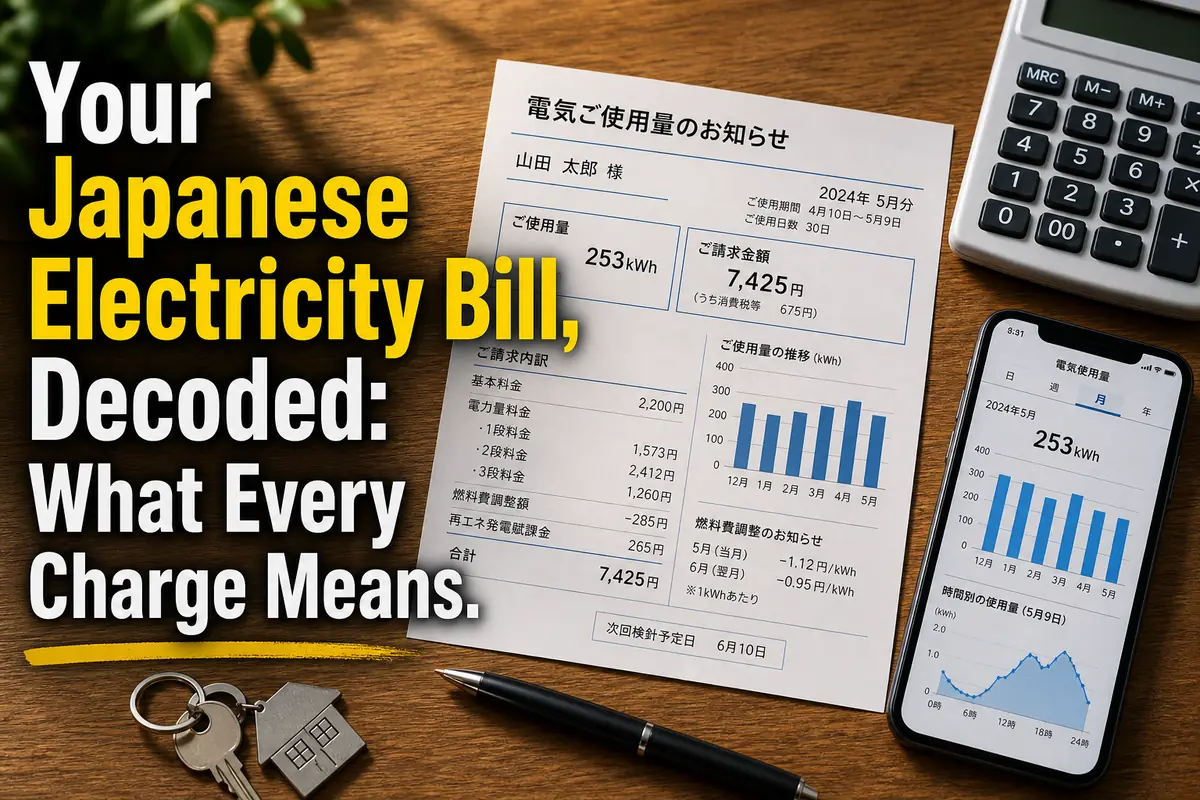
Your Japanese Electricity Bill, Decoded: What Every Charge Means
A Japanese electricity bill is easiest to understand in four parts: how much electricity you used, the price set by your plan, monthly adjustments, and the payment deadline. Do not judge a bill only by the final yen amount. Compare the billed days, kilowatt-hours, and adjustment rates with the previous month.
This guide is for new residents, students, workers, and anyone responsible for household utilities in Japan. The layout and wording differ by electricity retailer, but the same basic checks work for most residential bills.
What to find first
- 請求金額(seikyū kingaku): amount billed
- 使用量(shiyōryō): electricity used, measured in kWh
- 使用期間(shiyō kikan): period covered by the bill
- 料金プラン(ryōkin puran): your rate plan
- 支払期日(shiharai kijitsu): payment deadline
Start with the billing period, not the total
A higher total does not necessarily mean your rate increased. The bill may cover more days, greater use of air conditioning or heating, or a different monthly adjustment.
Look for these items near the top of the bill, statement, or online account:
- ご使用期間(go-shiyō kikan): the first and last dates covered
- 検針日(kenshinbi): meter-reading date
- ご使用量(go-shiyōryō): total consumption in kWh
- ご請求金額(go-seikyū kingaku): total amount due
- お支払期限日(o-shiharai kigenbi): due date
The number of billed days matters. Comparing a 34-day bill with a 28-day bill can make normal use look like a sharp increase.
A better comparison is daily consumption:
monthly kWh ÷ number of billed days = average kWh per day
For example, 240 kWh over 30 days is 8 kWh per day. A later bill showing 264 kWh over 33 days is also 8 kWh per day, even though its total consumption is higher.
The main parts of the charge
Most household bills combine a fixed or capacity-based charge, a usage charge, monthly adjustments, and the national renewable-energy surcharge. Your retailer may use different labels or add plan-specific discounts.
A simplified formula is:
electricity bill = basic charge + usage charge ± adjustments + renewable-energy surcharge − discounts
Taxes and rounding are handled according to the retailer’s terms. Always use the formula shown for your own plan when checking an exact amount.
1. Basic charge or minimum charge
Look for 基本料金(kihon ryōkin), meaning “basic charge.” This is usually the part you pay even when consumption is low.
Depending on the region and plan, it may be based on:
- contracted amperage, such as 20A, 30A, or 40A;
- contracted capacity in kVA or kW;
- the highest measured demand under certain plans;
- a minimum monthly charge instead of a separate basic charge.
This is one area where regional differences are important. Some plans in eastern Japan commonly show contracted amperage, while other regional or competitive plans may use a minimum charge or another capacity formula.
If 契約アンペア(keiyaku anpea), or contracted amperage, is higher than your home needs, a lower setting may reduce the fixed charge under plans that use amperage pricing. A lower setting also means that running several high-power appliances together may trip the breaker. Check with the retailer before changing it.
2. Electricity usage charge
The usage-based part may appear as 電力量料金(denryokuryō ryōkin). It is calculated from your electricity consumption in kilowatt-hours.
Some plans use tiered pricing. The first block of consumption has one unit price, the next block another, and use above a higher threshold costs more per kWh. Other plans use:
- one flat unit rate;
- different daytime and nighttime rates;
- weekday and weekend rates;
- market-linked prices;
- seasonal rates.
This distinction matters when comparing plans. Dividing the entire bill by total kWh gives an all-in average, not the advertised energy rate, because the total also contains fixed charges and other items.
3. Fuel-cost or market adjustment
Look for 燃料費調整額(nenryōhi chōseigaku), the fuel-cost adjustment amount. It may be positive or negative.
The fuel-cost adjustment system reflects changes in fuel prices used for power generation. The unit adjustment is generally multiplied by the electricity used during the billing period. Some competitive plans use a different formula or include a market-price adjustment, so read the contract terms rather than assuming every retailer calculates this line in the same way.
This line explains why two bills with the same kWh can have different totals. If your consumption is stable but the amount rises, compare the adjustment unit price on both statements.
4. Renewable-energy surcharge
The long label 再生可能エネルギー発電促進賦課金(saisei kanō enerugī hatsuden sokushin fukakin) means the renewable-energy power promotion surcharge. Bills often shorten it to 再エネ賦課金(saiene fukakin).
The national government sets one surcharge rate for each fiscal-year application period. The amount on an individual bill is:
renewable-energy surcharge rate × electricity used in kWh
For bills covered from the May 2026 meter reading through the April 2027 meter reading, the rate is ¥4.18 per kWh. At 250 kWh, that produces a surcharge of about ¥1,045. METI’s official example uses 400 kWh, resulting in ¥1,672 per month.
This charge rises and falls with consumption. It is not a separate optional renewable-energy plan.
ここがポイント: When a bill changes, compare three numbers before contacting the retailer: billed days, total kWh, and the adjustment rate per kWh. Together, they usually reveal whether the difference came from household use, the calendar, or pricing.
A practical way to check the calculation
Rebuild the bill line by line instead of trying to divide the total by one advertised rate.
Suppose a statement shows the following illustrative figures:
- Basic charge: ¥900
- Usage charge: ¥7,200
- Fuel adjustment: +¥300
- Renewable-energy surcharge: ¥1,045
- Government or plan discount: −¥875
The subtotal would be:
¥900 + ¥7,200 + ¥300 + ¥1,045 − ¥875 = ¥8,570
This is only an example, not a current tariff. Your retailer may show tax, rounding, bundled gas charges, point discounts, or other services differently.
If your own calculation does not match, check for:
- a previous unpaid balance;
- a paper-invoice or service fee;
- a gas or internet bundle;
- a plan discount shown on another page;
- a partial first or final month after moving;
- an estimated or corrected reading;
- tax and rounding treatment.
How to read the usage section
The kWh figure tells you more about household behavior than the final yen total does.
Meter readings and smart meters
A statement may show 今回指示数(konkai shijisū), the current meter reading, and 前回指示数(zenkai shijisū), the previous reading. With a traditional meter, the difference helps determine consumption. Smart-meter accounts may instead present automatically collected usage data without emphasizing those two figures.
Many retailers provide daily or half-hourly charts online. These are useful for finding patterns such as:
- a rise when air conditioning starts;
- high overnight use from water heating or heating equipment;
- steady consumption while nobody is home;
- a sudden change after adding an appliance.
Do not expect the online chart and the newest bill to update at exactly the same time. Data can be delayed or revised.
Compare seasons, not just consecutive months
Electric heating and cooling can make January and August poor reference points for mild months. For a useful comparison, check:
- the same month in the previous year;
- average kWh per day;
- whether the number of occupants changed;
- whether you worked from home more often;
- whether a dehumidifier, heater, dryer, or water heater ran longer.
A higher yen amount with lower kWh points toward price components. Higher kWh with similar unit rates points toward usage.
Payment details and deadlines
First identify the payment method, then confirm the date by which funds or payment must be received. Available methods and fees vary by retailer and plan.
Common labels include:
- 口座振替(kōza furikae): automatic bank-account withdrawal
- クレジットカード払い(kurejitto kādo barai): credit-card payment
- 払込票(haraikomihyō): paper payment slip
- 振込(furikomi): bank transfer or payment using the designated form
- 支払期日(shiharai kijitsu): payment deadline
- 振替予定日(furikae yoteibi): scheduled withdrawal date
Some retailers allow payment slips at convenience stores, banks, payment apps, or by QR-code card payment. Others restrict the available channels. TEPCO, for example, lists credit card, automatic withdrawal, paper invoice, and SMS among its household options, while noting that availability can depend on the contract.
If automatic payment fails
Do not assume the retailer will try again on the same schedule. Depending on the company and plan, it may:
- make another withdrawal;
- send a payment slip;
- add a late charge;
- issue a non-payment notice;
- eventually cancel the contract after notice.
Contact the retailer shown on the bill. If you paid shortly before a scheduled suspension or contract-termination date, keep the receipt and ask whether payment has been confirmed.
Important numbers on the bill
Keep contract identifiers private, but know where to find them before moving or changing retailers.
Customer number
お客さま番号(okyakusama bangō) identifies your contract in the retailer’s system. You may need it for inquiries, changing a payment method, or closing service.
Its length is not universal. For example, TEPCO states that its customer number can be 10 digits for a non-regulated plan or 13 digits for a regulated plan. Do not use that as a rule for other companies.
Supply point identification number
供給地点特定番号(kyōkyū chiten tokutei bangō) is the 22-digit electricity supply-point identification number. It identifies the location where electricity is supplied and is commonly needed when changing retailers.
This is not the same as your customer number. Treat both as account information and do not post an unredacted bill online.
Contract and plan name
Find 契約種別(keiyaku shubetsu) or 料金メニュー(ryōkin menyū). Without the exact plan name, an advertised unit price from a different plan cannot explain your bill.
Japan’s household electricity retail market has been fully open to competition since April 2016. Consumers can choose among registered retailers and rate plans, although a rental building’s collective supply arrangement or condominium rules may limit individual choice.
Current items to notice in 2026
Two national items may be visible on bills in 2026: the annual renewable-energy surcharge rate and temporary summer support.
FY2026 renewable-energy surcharge
As noted above, the surcharge is ¥4.18 per kWh for the application period from the May 2026 meter reading through the April 2027 meter reading. Because the bill amount is tied to kWh, reducing consumption also reduces this line.
Summer 2026 electricity support
The Japanese government is supporting low-voltage electricity charges for July through September 2026 usage. The announced discounts are:
- July 2026 usage, generally billed at the August reading: ¥3.50 per kWh
- August 2026 usage, generally billed at the September reading: ¥4.50 per kWh
- September 2026 usage, generally billed at the October reading: ¥3.50 per kWh
Retailers apply the support through electricity charges, including regulated plans and planned implementation through retailers for competitive plans. The wording and placement can differ. Look for 値引き(nebiki), “discount,” or an explanation connected to the fuel-cost adjustment.
No household application is normally needed for this bill-based support. However, check your retailer’s notice if the discount is missing or if your building manager bills electricity separately. A landlord, dormitory, serviced apartment, or collective electricity contract may use a billing arrangement that does not look like a direct retailer statement.
The summer discount is temporary. Do not use a discounted bill alone to estimate your normal monthly cost after the support period ends.
Regional and housing differences
The national surcharge is common, but the plan structure, base rate, payment methods, and statement design depend on the contract.
Your bill may differ because of:
- the regional grid area;
- the electricity retailer;
- a regulated or competitive rate plan;
- contracted amperage or capacity;
- all-electric housing and time-of-use pricing;
- a landlord or building-wide electricity arrangement;
- rooftop solar or electricity sold back to the grid;
- bundled electricity and gas services.
In a rental, check whether you contract directly with a retailer. If electricity is included in rent or billed by the property operator, ask for the usage period, kWh, unit rate, and calculation method. A line called “electricity fee” on a rent statement is not necessarily structured like a retail electricity bill.
Common mistakes to avoid
Most billing confusion comes from comparing the wrong figures or overlooking the contract details.
- Comparing yen but not kWh: Separate changes in consumption from changes in price.
- Ignoring billed days: Use kWh per day when periods have different lengths.
- Assuming one national household rate: Retail plans and regional structures differ.
- Treating every adjustment as a tax: Fuel and market adjustments come from pricing formulas; the renewable-energy surcharge is a separate national charge.
- Using the advertised unit price as the all-in cost: Fixed charges, adjustments, and surcharges remain.
- Missing a temporary discount: A supported month may be lower even when consumption is unchanged.
- Sharing an unredacted statement: Hide your name, address, customer number, supply-point number, barcode, and QR code.
- Paying from an unexpected message: Open the retailer’s official website or app yourself instead of following a suspicious payment link.
What to do when a bill looks wrong
Check the evidence first, then contact the company that issued the bill.
Have these items ready:
- Contract holder’s name and service address
- Customer number
- Billing month and usage period
- Total kWh and total amount
- Plan name and contracted amperage or capacity
- A photo of the meter, if the displayed reading appears inconsistent
- Payment receipt, if the question concerns an unpaid balance
Ask a specific question, such as:
- “Was this reading actual or estimated?”
- “Which unit rate and adjustment rate were applied?”
- “Does this bill include a previous balance?”
- “Where is the government discount shown?”
- “Why does the billing period contain this number of days?”
Contact your electricity retailer for contracts, rates, billing, and payment. Contact the regional transmission and distribution operator for a neighborhood outage or a grid emergency. Those companies can be different.
Quick checklist before paying
A one-minute check can catch the most important problems.
- Confirm the service address and billing month.
- Check the first and last dates of use.
- Compare total kWh and kWh per day with the previous bill.
- Identify the basic charge and usage charge.
- Check the fuel or market adjustment rate.
- Confirm the renewable-energy surcharge.
- Look for any temporary government or plan discount.
- Check previous balances, bundled services, and fees.
- Verify the payment method and deadline.
- Use the retailer’s official contact details if anything is unclear.
The most useful habit is to record kWh, billed days, and the final amount each month. When temporary support ends or adjustment rates change, those three figures will show whether your household used more electricity or the price of the same consumption changed.
参照リンク
- Agency for Natural Resources and Energy: Electricity retail liberalization and consumer choice
- Agency for Natural Resources and Energy: How to switch an electricity provider
- Agency for Natural Resources and Energy: Questions about switching and housing restrictions
- Agency for Natural Resources and Energy: Electricity-rate structure
- METI: FY2026 renewable-energy surcharge rate
- METI: Summer 2026 electricity and gas charge support
- TEPCO Energy Partner: English billing and payment FAQ