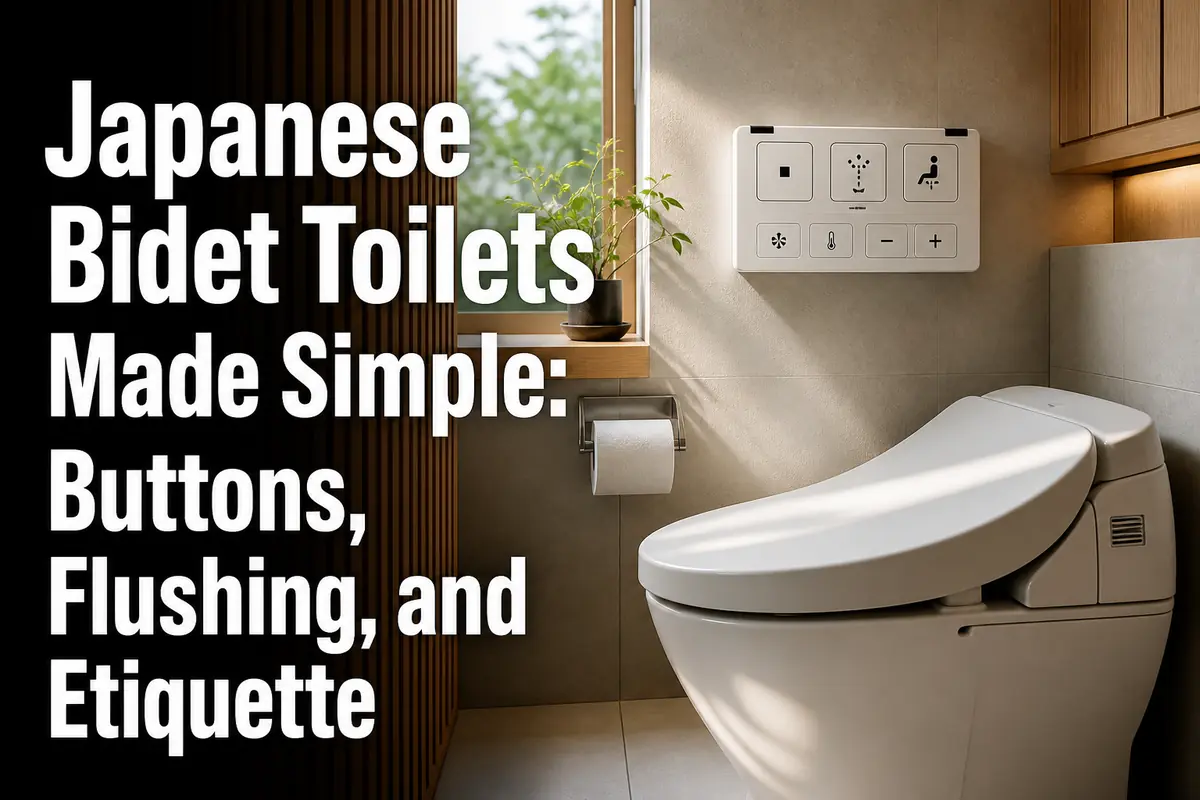
Japanese Bidet Toilets Made Simple: A First-Time User’s Guide
The safest way to use a Japanese bidet toilet is simple: sit down, choose “Rear” or “Front,” begin with low water pressure, press “Stop,” and then flush using the separate flush control. You do not need to use every button.
This guide is for visitors, students, workers, and new residents who are unfamiliar with the control panels found in Japanese homes, hotels, stations, shopping centers, and public buildings.
Quick guide:
止 (tomaru / Stop)ends washing or drying.おしり (oshiri / Rear)starts rear cleansing.ビデ (bide / Front)starts gentler front cleansing.水勢 (suisei / Water pressure)changes spray strength.大 (dai / Large)and小 (shō / Small)are flush settings—not bidet settings.- An emergency call button is not a flush button.
First, know what you are looking at
The many controls do different jobs, but only three are essential: start washing, stop washing, and flush.
“Washlet” is TOTO’s trademark for its electronic bidet seats, although people in Japan often use the word informally for this type of toilet. Other manufacturers use different product names. The general Japanese term is 温水洗浄便座 (onsui senjō benza), meaning “warm-water cleansing toilet seat.”
The seat usually has a small nozzle stored beneath its rear edge. When a seated user selects a cleansing function, the nozzle extends and sprays water. On supported TOTO models, water does not come out unless the seat detects that someone is sitting on it.
Controls may be located:
- on an arm attached to the seat;
- on a panel mounted beside the toilet;
- on a wireless wall remote;
- behind a movable cover on the remote;
- or, in some newer public facilities, in a touch-free or smartphone-based interface.
Designs vary by manufacturer and model. However, the Japan Sanitary Equipment Industry Association introduced standard toilet-control pictograms in 2017, so many newer panels share recognizable symbols for flushing, rear cleansing, front cleansing, drying, and opening or closing the seat.
The buttons you actually need
Start by finding the square Stop symbol. If you press the wrong washing button, this is your way out.
Stop: 止 (tomaru)
This button normally stops the water spray or warm-air dryer. It is often orange, yellow, or marked with a square pictogram, but color and layout are not universal.
Remember this button before trying anything else.
Rear cleansing: おしり (oshiri)
This starts a stream intended for rear cleansing. The label may also say “Rear” or show the standardized rear-cleansing symbol.
Some toilets offer related choices such as:
やわらか (yawaraka)— soft or gentle wash;ムーブ (mūbu)— a moving spray;マッサージ (massāji)— a pulsing spray;ワイド (waido)— a wider washing area.
These are optional. A first-time user can ignore them.
Front cleansing: ビデ (bide)
This is a gentler wash designed for front cleansing. English panels commonly label it “Front.” Its spray position and pattern differ from the rear function.
It is not the command for flushing the bowl.
Water pressure: 水勢 (suisei)
Look for plus and minus signs, arrows, bars, or the words “Pressure” and 水勢. Begin at the lowest comfortable setting, especially on an unfamiliar model.
The control changes spray force. It does not normally change the toilet’s flush strength.
Spray position: 位置 (ichi)
Buttons labeled 位置, “Position,” “Forward,” or “Backward” move the spray slightly. Adjust your seated position first; then use this control if necessary.
Dryer: 乾燥 (kansō)
A warm-air dryer is available only on some models. Press 乾燥 or “Dry,” then use 止 when finished. Drying can take longer than expected, so toilet paper is still commonly used.
Seat and water temperature
You may see:
便座 (benza)— toilet seat temperature;温水 (onsui)— warm-water temperature;温度 (ondo)— temperature;切 (kiri)or “Off” — function off.
These are comfort settings, not necessary steps. In a shared toilet, avoid changing stored settings unless needed. In a rented home, check the model’s manual before changing menus that are not clearly labeled.
ここがポイント: Find
止first, sit fully on the seat, start with low pressure, and treat flushing as a separate operation.
How to use the bidet, step by step
The sequence is almost the same across brands, even when the panel looks different.
- Sit fully on the seat. Many electric models use a seat sensor and will not spray when the seat is empty.
- Locate
止 (Stop). Do this before starting the wash. - Choose
おしり (Rear)orビデ (Front). Use only the function appropriate for you. - Keep the pressure low at first. Raise it gradually with the pressure control if needed.
- Adjust your position. Use the position buttons only if moving slightly on the seat is not enough.
- Press
止. Do not stand up while the spray is still running. - Dry if desired. Use a small amount of toilet paper or the dryer if the model has one.
- Flush separately. Look for a lever, wall button, sensor, or
大and小controls.
If nothing happens, do not repeatedly press random buttons. Check whether you are seated correctly, whether the panel has power, and whether the control is for washing rather than flushing.
Flushing is a separate task
The most common source of confusion is that the cleansing controls and the bowl’s flush control may be in different places.
Look beside or behind the toilet for:
- a tank lever;
- a wall-mounted button;
- a button on the control panel;
- a hand sensor marked with instructions;
- or an automatic flush that activates after you stand.
The Japanese flush labels are:
大 (dai)— larger flush, generally used for solid waste;小 (shō)— smaller flush, generally used for liquid waste;流す (nagasu)— flush;洗浄 (senjō)— washing or flushing, depending on its location and context.
Do not confuse 大 and 小 with water-pressure controls. They determine the volume or type of bowl flush on supported toilets.
Never guess when a red button is nearby
Accessible and public toilets may have an emergency call button close to the flush control. It may be labeled:
呼出 (yobidashi)— call;非常 (hijō)— emergency;非常呼出 (hijō yobidashi)— emergency call;- “Call” or “Emergency.”
Use it only when assistance is genuinely needed. If you cannot find the flush, check both sides of the toilet, the wall behind it, and the tank before touching an unfamiliar call button.
Everyday toilet etiquette in Japan
The bidet is optional, but several everyday rules matter in homes and public facilities.
Put toilet paper in the toilet
Japanese plumbing is generally designed for ordinary toilet paper to be flushed with bodily waste. Unless a sign gives different instructions, used toilet paper should go into the bowl—not into a small waste bin.
Do not flush:
- wet wipes, including products described as flushable unless the facility explicitly permits them;
- paper towels or tissues;
- sanitary products;
- diapers;
- food, packaging, or other rubbish.
A bin in the cubicle is usually intended for sanitary products or other non-flushable waste. Facility signs take priority, particularly in older buildings or places using special waste systems.
Sit on the seat; do not stand or squat on it
A Western-style toilet is designed for sitting. Standing on the seat can damage it and creates a risk of slipping or falling.
Some public restrooms also have separate Japanese-style squat toilets. Their shape and use are different, so do not treat a seated toilet as a substitute squat platform.
Leave shared settings reasonable
High pressure or extreme seat temperature may surprise the next user. If you change a shared toilet’s settings, returning them to a moderate level is considerate when the controls make that easy.
Avoid experimenting with maintenance modes, nozzle-cleaning controls, or hidden menus in a public restroom. A button labeled ノズルそうじ (nozuru sōji) is for nozzle cleaning, not personal washing.
Keep the surrounding area clean
If water or paper falls outside the bowl, clean it up when supplies are available. In a home, follow the resident’s rules about toilet slippers. Toilet slippers, when provided, normally remain inside the toilet room.
Public toilet, hotel, and home differences
The basic controls are similar, but the practical situation changes by location.
Stations and shopping centers
Public toilets may combine bidet controls, automatic flushing, sound-masking features, and accessibility equipment in a small area. Standard pictograms help, but older panels may still use manufacturer-specific symbols.
You may see 音姫 (Otohime) or a button with musical notes. This creates a flushing sound for privacy. It does not flush the toilet.
Hotels
Hotel toilets may have English labels, but remote layouts still vary. If the flush is not obvious, inspect the wall and tank or consult the room guide. Do not unplug the seat simply because a light remains on; the plug powers heating, washing, and other functions.
Rental homes
At home, you may control energy-saving schedules, automatic lid movement, deodorizing, seat heat, and water temperature. Find the model number on the unit and use the manufacturer’s manual rather than copying instructions for a different model.
Tenants should contact the landlord, property manager, or emergency maintenance service if there is a leak, burning smell, damaged power cord, or repeated malfunction. Do not dismantle an electric toilet seat.
What to do when something goes wrong
Most first-time problems have a simple explanation.
The wash button does nothing
Check these points in order:
- Are you sitting fully on the seat sensor?
- Is the toilet seat’s power light on?
- Does the remote appear to have working batteries?
- Is the panel displaying an error or lock symbol?
- Are you pressing a personal-wash button rather than a cleaning or flush control?
In a public restroom, use the toilet without the bidet if it does not respond. Report a fault to staff instead of trying to repair it.
The spray feels too strong, hot, or uncomfortable
Press 止 immediately. Lower the pressure or temperature before trying again. Stop using the feature if it causes pain, irritation, or other discomfort.
A bidet toilet is a hygiene appliance, not a treatment for a medical condition. Ask an appropriate healthcare professional for individual medical guidance.
Water will not stop
Press 止 once. If the normal Stop control does not work, stand only after the nozzle has stopped or retracted if you can do so safely. In a home, follow the product manual and contact the manufacturer, landlord, or property manager. If water is leaking onto the floor, keep clear of electrical parts and seek maintenance help promptly.
The toilet will not flush
Look for another flush control. Automatic toilets sometimes have a manual button or lever as a backup. If the bowl water is unusually high, do not flush repeatedly; that may cause an overflow. Notify staff in a public facility or contact building maintenance at home.
Common mistakes to avoid
A short check prevents most awkward situations:
- Starting with maximum pressure.
- Pressing
ビデwhen trying to flush. - Mistaking
音姫for the flush button. - Pressing an emergency call button because it is near the toilet.
- Standing before pressing
止. - Flushing wipes, tissues, or sanitary products.
- Assuming every toilet has the same controls.
- Changing hidden settings on a shared or public unit.
- Using harsh cleaner on an electric seat at home without checking its manual.
Current status as of August 2026
The essential functions have not changed: rear wash, front wash, Stop, optional drying, and a separate bowl flush remain the core controls.
What has improved is visual consistency. The industry’s standard pictograms, first published in 2017, cover common operations such as large and small flushes, rear and front cleansing, drying, and powered seat or lid movement. They make newer toilets easier to use across language barriers.
However, standardization does not mean every panel is identical. Older equipment remains in use, manufacturers offer different extra functions, and facilities choose different flushing systems. The best practical rule is therefore to rely on the familiar core symbols while reading the label on the toilet in front of you.
Final checklist for your next restroom visit
Before pressing anything, take five seconds to identify:
止— Stop;おしりorビデ— the wash you want;水勢— pressure, starting low;大,小, or流す— the separate flush;呼出or非常— an emergency control to leave alone unless help is needed.
That is enough for most Japanese bidet toilets. The remaining buttons are optional comfort features, and the model’s own label or manual should decide any detail that differs.
参照リンク
- TOTO: What Is Washlet?
- Japan Sanitary Equipment Industry Association: Standard Pictograms
- Japan Sanitary Equipment Industry Association: Toilet Pictogram Guidelines
- Japan Sanitary Equipment Industry Association: Toilet Information Labels
- Japan National Tourism Organization: Beyond the Bidet
- TOTO: Product Manual Search
- TOTO: Washlet Cleaning and Care
- Ministry of Land, Infrastructure, Transport and Tourism: Guidebook for Foreign Residents