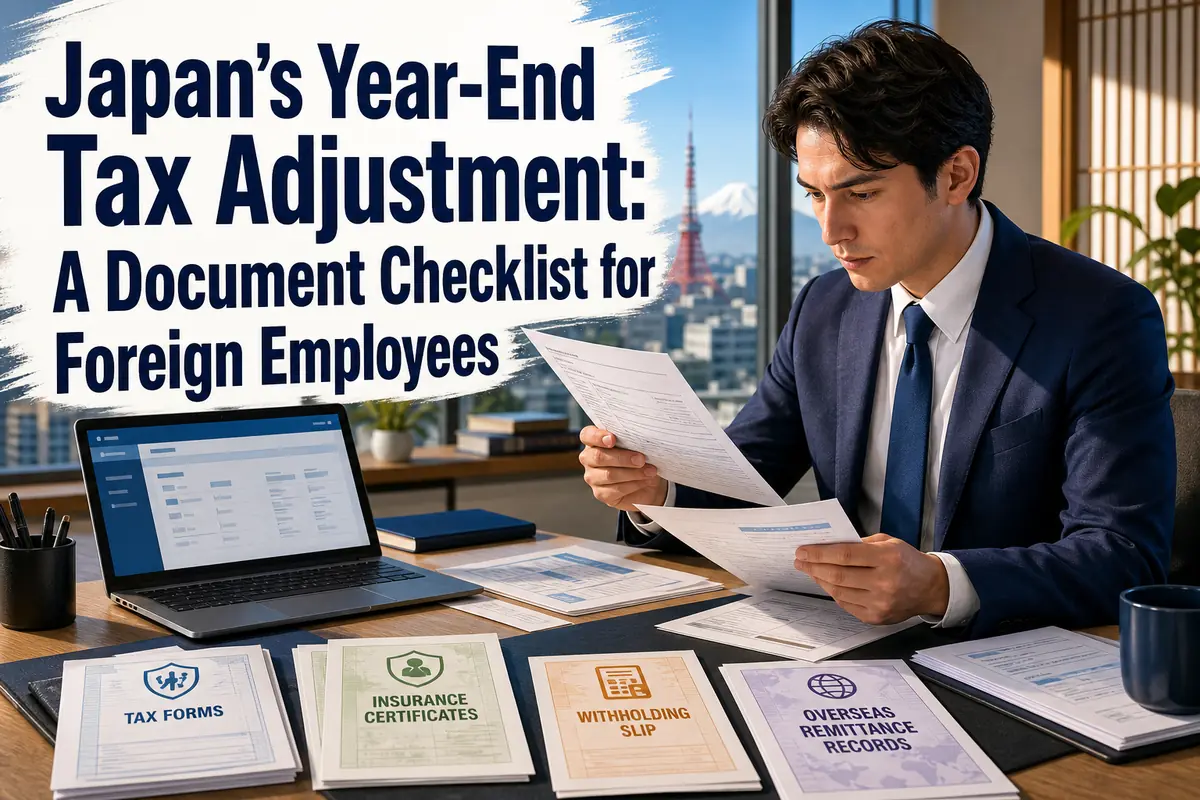
Japan’s Year-End Tax Adjustment: A Document Checklist for Foreign Employees
Japan’s year-end tax adjustment, called nenmatsu chōsei (年末調整), lets an employer recalculate the income tax withheld from your salary during the year. Most eligible employees complete it by submitting forms and supporting documents to their employer—not directly to the tax office.
What you need depends on your family, insurance, previous employment, housing loan, and whether any relatives live outside Japan. Employees supporting relatives overseas should start especially early because relationship records, remittance evidence, and Japanese translations may be required.
Quick checklist
- Confirm your employer’s internal deadline, usually set before the final salary payment of the year.
- Report your estimated annual income and eligible spouse or dependents.
- Collect insurance certificates and any previous employer’s withholding slip.
- Prepare extra evidence for relatives living outside Japan.
- Check whether you need a separate final tax return instead.
This guide is for foreign employees working in Japan as tax residents. It reflects official information available as of August 2026, but your employer’s submission method and deadline may differ.
What the year-end adjustment actually does
The adjustment compares the income tax withheld from your monthly salary with the amount calculated from your full-year employment income and eligible deductions.
Employers normally withhold income tax whenever they pay salary. That monthly amount is provisional because the employer may not yet know your final annual income, changes in your family, or premiums you paid personally.
During the year-end adjustment, the employer uses the information you submit to calculate the year’s tax again. The difference is generally collected from or refunded through a later salary payment.
This process concerns national income tax and the special income tax for reconstruction. It is not a full settlement of every tax obligation.
- Resident tax is separate. Your municipality generally calculates it later using income information from the previous year.
- A tax refund is not guaranteed. The calculation can produce either a refund or an additional deduction from salary.
- Your residence status is not the deciding factor. Immigration status and tax residency are different concepts.
- The adjustment has no application fee. However, obtaining or translating overseas documents may cost money.
Who normally completes the process through an employer
A typical full-time employee whose main employer has the required declaration can usually use the year-end adjustment.
The employer handling your main salary is normally the one to which you submitted the Application for Exemption for Dependents of Employment Income Earner. If you receive salaries from two employers, the second employer generally does not perform the same full adjustment for your secondary salary.
You may need a final income tax return instead—or in addition—if, for example:
- your annual employment earnings exceed ¥20 million;
- you receive salary from multiple employers and meet the filing conditions;
- you have significant income outside employment;
- you want to claim medical expense deductions, certain donation deductions, or another item not handled in the adjustment;
- you are claiming the housing loan tax credit for the first time;
- you left a job and no new employer completed the adjustment; or
- you left Japan and special departure procedures apply.
The National Tax Agency (NTA) provides a detailed list of wage earners who must file a final return. The commonly cited ¥200,000 threshold has conditions and exceptions, so it should not be treated as a universal exemption from filing.
The forms your employer may ask you to complete
Most employees receive several declarations, but they only complete the sections relevant to their circumstances.
Companies may use paper forms, an internal web portal, payroll software, or the NTA’s digital year-end adjustment system. The screen labels may therefore look different from the official forms.
Declaration for dependents and related personal information
The Application for (Change in) Exemption for Dependents of Employment Income Earner records information used for withholding, including eligible dependents and certain family circumstances.
Your employer may ask for information such as:
- your name, address, date of birth, and My Number;
- the names, birth dates, addresses, and estimated annual income of eligible family members;
- whether a family member lives with you or outside Japan;
- disability, single-parent, widow or widower, and working-student status where applicable; and
- changes that occurred after an earlier declaration.
The NTA publishes foreign-language versions of year-end adjustment forms, including an English 2026 dependent declaration. Your employer may still require data through its own system rather than accepting the PDF directly.
Basic, spouse, specified-relative, and income-adjustment declarations
A combined form may cover several deductions. You will normally need to estimate your total income for the calendar year, not simply copy one month’s salary.
Depending on your circumstances, the form can include:
- the basic exemption;
- the exemption or special exemption for a spouse;
- the special exemption for a specified relative;
- the employment income adjustment deduction; and
- estimates of your income and the relevant family member’s income.
A major source of error is confusing salary revenue with income after the employment-income deduction. They are not the same number. Use the worksheet or payroll instructions for the applicable year instead of subtracting expenses yourself.
The 2025 tax changes revised several income thresholds and introduced the special exemption for specified relatives. These changes continue to affect which family members qualify and what employees enter on the forms. Do not reuse an older form or an old threshold from a previous adjustment.
Insurance premium declaration
Complete this declaration when claiming eligible premiums that are not already fully handled through payroll. It can cover:
- life insurance premiums;
- nursing-care medical insurance premiums;
- private pension insurance premiums;
- earthquake insurance premiums;
- eligible social insurance premiums paid directly by you; and
- eligible small-enterprise mutual aid or individual defined-contribution pension payments, including certain iDeCo contributions.
For deductions that require proof, submit the certificate issued by the insurer, pension body, or other provider. The NTA’s insurance-premium procedure specifies supporting-document requirements, including proof for National Pension premiums.
Do not enter ordinary monthly health insurance, employees’ pension, or employment insurance deductions from your company payslip again unless your employer’s instructions specifically require it. Payroll already has those amounts.
Housing loan tax credit declaration
The first year of a housing loan tax credit normally requires a final tax return. From the second eligible year, an employee may usually claim it through the year-end adjustment by providing the required tax-office and lender information.
Depending on the applicable procedure, this may include:
- the housing loan tax credit declaration or electronic equivalent; and
- the year-end loan balance certificate from the financial institution.
Housing credits have detailed requirements concerning the property, move-in date, floor area, income, and loan. Confirm the rules for your own year of residence rather than assuming that having a mortgage is enough.
Supporting documents to collect
The fastest way to avoid a missed deduction is to gather original certificates and employment records before the employer opens submissions.
Use this practical list:
- Insurance premium deduction certificates received from insurers
- Proof of eligible National Pension or National Pension Fund payments made directly
- Certificates for eligible iDeCo or mutual-aid contributions
- A previous employer’s gensen chōshūhyō (源泉徴収票) if you changed jobs during the same calendar year
- Housing loan documents when claiming the credit through payroll
- Family and remittance evidence for eligible relatives outside Japan
- Japanese translations of foreign-language evidence where required
If you changed jobs, your new employer needs the previous employer’s withholding slip to combine eligible salary and tax-withholding information. A monthly payslip or employment certificate is not a substitute. Ask the former employer promptly if the slip has not arrived.
Digital certificates may be accepted when the employer’s system supports them. Follow the payroll team’s instructions before converting, printing, or editing electronic certificate data.
The extra evidence required for relatives outside Japan
Naming an overseas relative on a form is not enough; you must prove both the family relationship and the relevant financial support.
This is often the most document-heavy part of the process for foreign employees.
ここがポイント: Keep evidence for each overseas relative separately. A single transfer to one family member does not automatically prove that you supported every person named in your declaration.
Documents concerning relatives
The NTA requires official evidence showing that the person is your relative. Depending on the case, this can be a document issued by a foreign national or local government that includes the relative’s name, date of birth, and address or residence.
A document prepared in another language requires a Japanese translation. Ask your employer whether it wants the original for inspection, a copy, an upload, or a particular translation format.
Documents concerning remittances
You also generally need records proving that you paid living or education expenses to each overseas relative during the relevant year. Qualifying evidence can include records issued by a financial institution or eligible funds-transfer provider.
The NTA recognizes certain electronic payment transfer records for withholding and year-end adjustment purposes from the 2024 tax year onward. The record still needs to show the required transaction and recipient information.
Cash carried during a visit is difficult to establish with the required financial records. Likewise, sending the entire amount to one relative and asking that person to distribute it may not prove a remittance to each claimed relative.
Special rule for relatives aged 30 to 69
An overseas relative aged 30 or older but under 70 does not qualify for the dependent exemption unless that person falls into an eligible group. The main groups are:
- a person living abroad because of study, supported by the required student-status documents;
- a person with a qualifying disability; or
- a person who received at least ¥380,000 from you during the year for living or education expenses.
The ¥380,000 condition is tested for each relevant relative. Other age groups and spouse-related deductions have different document and eligibility rules.
The NTA’s English explanation for relatives living outside Japan sets out the age categories, relationship evidence, remittance evidence, study documents, and translation requirements.
A practical submission schedule
Your employer’s deadline controls the workplace process, so plan backward from that date rather than waiting for December 31.
August to September: identify difficult documents
Start early if you changed employers, support family abroad, or expect overseas government records to be slow.
- Request a missing withholding slip from a former employer.
- Check whether family certificates show every required detail.
- Make sure transfers identify the actual recipient.
- Arrange Japanese translations.
October to November: collect annual certificates
Insurance companies and pension organizations often issue deduction certificates during this period. Confirm whether you will receive paper or electronic data, and update an old address if necessary.
Estimate full-year income for yourself, your spouse, and dependents. Include expected salary and bonuses through December, using the form’s definition of income.
Before the employer’s deadline: submit and keep copies
The statutory timing for several declarations is tied to the day before the final salary payment, but employers set earlier internal deadlines so payroll can check the information and run calculations.
Before submitting:
- check names and birth dates against official documents;
- confirm that income estimates use the correct year;
- attach every required certificate;
- verify that overseas remittances are matched to each relative; and
- save copies of forms, translations, and evidence.
After the adjustment: inspect the result
Review your final payslip and withholding slip. Check whether the declared spouse, dependents, insurance deductions, and housing credit appear as expected.
If information was omitted or incorrect, contact payroll immediately. Depending on timing, your employer may be able to correct the adjustment. Otherwise, you may need to file a final return or a refund return.
Common mistakes and how to prevent them
Most problems come from missing evidence, incorrect income estimates, or assuming that every deduction belongs in payroll.
Using last year’s family information
Marriage, divorce, a child’s income, a move abroad, or a change in financial support can alter eligibility. Recheck the facts for the current calendar year.
Confusing a money transfer with proof of dependency
A transfer receipt proves a payment, not the family relationship. An overseas claim normally needs both types of evidence, plus a Japanese translation when the source document is in another language.
Treating one household transfer as support for several relatives
Keep recipient-specific remittance records. If you claim several overseas relatives, the NTA expects evidence connected to each person.
Entering gross salary in an income field
Read the exact label. Some fields ask for revenue; others ask for estimated total income after the employment-income deduction. The wrong figure can change eligibility for an exemption.
Claiming payroll deductions twice
Your employer already records social insurance and tax withheld from its salary payments. Do not duplicate those figures in a section intended for premiums paid personally.
Assuming year-end adjustment covers every deduction
Medical expenses, many donation claims, the first year of the housing loan credit, and various income situations are handled through a final return rather than the ordinary employer process.
Cases that need individual confirmation
Foreign employees should pause and confirm the procedure when tax residency, departure, multiple employers, or overseas income complicates the normal payroll route.
You arrived in Japan during the year
Your tax treatment can depend on when you became a Japanese tax resident, the source of the income, and whether you are treated as a non-permanent resident for tax purposes. These tax categories are not identical to visa categories.
You plan to leave Japan before year-end
The timing of your final salary, your loss of Japanese residence, and whether you appoint a tax agent can change the required procedure. Ask payroll and consult the NTA’s departure guidance before leaving.
You have two jobs or overseas income
A main employer’s adjustment may not settle tax on secondary salary or other income. The NTA lists circumstances in which a wage earner must file separately, but tax treaties and foreign tax credits can add further questions.
Your spouse or dependent’s income may change
Eligibility is based on the applicable annual-income rules, not simply whether a person is unemployed at the time you submit the form. If December salary or a bonus could move the person across a threshold, tell payroll and update the estimate.
What is current for the 2026 adjustment
As of August 2026, employees should use 2026 materials and their employer’s current instructions, while watching for the full annual adjustment package and later NTA updates.
The NTA has published an English 2026 Application for (Change in) Exemption for Dependents and lists a 2026 withholding guide. Its insurance-premium procedure also provides 2026 materials and includes a timing note for adjustments performed on or before November 30, 2026.
The practical consequences are clear:
- Do not copy income thresholds from a pre-2025 form.
- Use the form and instructions for the year being adjusted.
- Check the NTA page again when your employer begins the autumn process.
- Follow the employer’s portal and document rules even when an English NTA PDF is available.
National tax law is the same across Japan, but workplace procedures are not. A Tokyo employer and a company in another prefecture may use different software, translation support, and internal deadlines. Your municipality does not run the employer’s year-end income-tax adjustment, although the resulting income information can affect the following year’s resident tax.
Your next actions
Start with the documents that take longest to replace: overseas family records, remittance evidence, and a previous employer’s withholding slip.
Then take these steps:
- Ask payroll when the 2026 submission window opens.
- Download or review the current English forms before entering data.
- List every deduction you expect to claim and match it to a certificate.
- Separate evidence for each relative living outside Japan.
- Check the completed withholding slip after payroll finishes.
- Confirm whether any income or deduction still requires a final tax return.
A missing certificate can often be replaced. A year of transfers with no clear recipient record is much harder to repair in November, so overseas support documentation is the first item to check—not the last.
参照リンク
- National Tax Agency: Withholding Tax
- National Tax Agency: Foreign-language year-end adjustment forms
- National Tax Agency: Exemption for relatives living outside Japan
- National Tax Agency: Insurance premium deduction declaration
- National Tax Agency: Wage earners who must file a final tax return
- National Tax Agency: Final tax return
- National Tax Agency: Filing returns for a refund