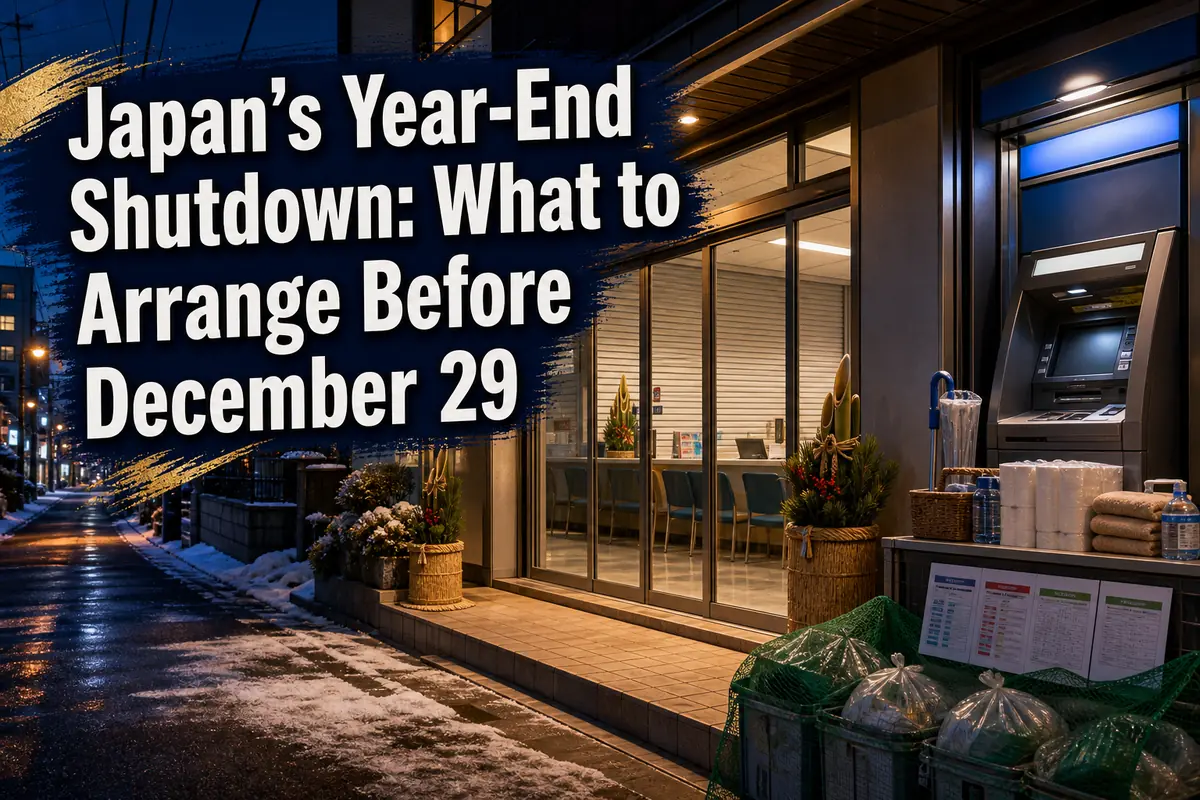
Japan’s Year-End Shutdown: What to Arrange Before December 29
For the 2026–2027 New Year period, plan to finish government procedures by Monday, December 28 and in-person banking by Wednesday, December 30. Bank branches generally close from December 31 through January 3, while national government offices generally close from December 29 through January 3.
Garbage collection, post offices, supermarkets, pharmacies, clinics, and other local services follow separate schedules. Their exact hours may not be announced until November or December, so do not treat one nationwide calendar as the answer for everything.
This guide is for foreign residents, students, workers, and newly arrived families who need to manage money, food, waste, medicine, or official paperwork during Japan’s year-end period.
The quick version
- Government counters: Expect national offices to close from December 29 to January 3. Municipal counters often follow a similar calendar, but check your city or ward.
- Bank branches: The standard bank holiday period is December 31 to January 3. ATMs and apps may remain available with restrictions.
- Garbage: Collection can stop or move to different dates. Your address and waste type determine the actual schedule.
- Stores and medical care: There is no single national closure rule. Large stores may open with shorter hours, while independent businesses and ordinary clinics may close for several days.
Why the shutdown lasts longer than New Year’s Day
January 1 is a national holiday, but several services close for a longer period under separate rules or operating practices.
The period is commonly called nenmatsu nenshi (年末年始), meaning “year-end and New Year.” It is not one uniform holiday applied to every organization.
Different calendars overlap:
- National administrative bodies are generally closed on weekends, national holidays, and December 29 through January 3 under the Act on Holidays of Administrative Organs.
- Bank offices have their own statutory holiday framework, including December 31 through January 3.
- Municipal governments set or publish their counter and garbage arrangements locally.
- Stores, clinics, delivery companies, and other private operators choose their own hours.
For the coming 2026–2027 period, December 29 falls on a Tuesday, January 1 on a Friday, and January 3 on a Sunday. Monday, January 4, 2027 is therefore the first possible ordinary weekday after the standard closure period, but an individual counter or business may reopen later.
ここがポイント: “Open online” does not always mean “processed today.” An application, transfer, or reservation may be accepted during the closure but remain pending until staff and settlement systems return.
Government offices: finish counter procedures before December 29
If a procedure requires a staff member, an original document, or an in-person identity check, aim to complete it by December 28 rather than waiting for the last open hour.
The national rule covers administrative organs of the central government. It does not automatically establish every city hall, ward office, immigration counter, tax office, or private service desk schedule. In practice, many public counters announce a similar year-end closure, sometimes with exceptions for essential duties.
Procedures that deserve early attention
Check deadlines and opening days if you need to handle matters such as:
- residence registration after moving;
- a change of address on local records;
- certificates such as a jūminhyō (住民票, certificate of residence);
- residence tax or National Health Insurance questions;
- My Number card collection, renewal, or electronic-certificate procedures;
- immigration applications or collection of a new residence card;
- school, childcare, or municipal benefit paperwork.
Some documents are available from convenience-store certificate machines when you have a compatible My Number card and municipality. That service can still have maintenance periods, and not every certificate or municipality is covered.
Online filing also has limits. A system may accept data while the counter is closed, but a human review, correction request, or document delivery will wait. If a legal or administrative deadline falls during an official holiday, special deadline rules may apply, but the result depends on the procedure. Confirm the date with the responsible authority instead of assuming an automatic extension.
Essential services do not disappear
A closed city hall does not mean every public function stops. Emergency response, fire services, police, and some urgent municipal duties continue. Birth and death notifications may be accepted by an after-hours desk, but related certificates and full processing can wait until normal operations resume.
Look for these Japanese terms on official notices:
- nenmatsu nenshi no gyōmu annai (年末年始の業務案内): year-end service information;
- heichōbi (閉庁日): office closure day;
- kyūjitsu madoguchi (休日窓口): holiday counter;
- yakan uketsuke (夜間受付): night or after-hours reception.
Banking: separate branch access from access to your money
Bank branches normally close from December 31 through January 3, but cash withdrawal, card payments, transfers, and branch services can each follow a different timetable.
Japan’s Banking Act Enforcement Order identifies Saturdays, Sundays, national holidays, and December 31 through January 3 as bank-office holidays, subject to limited approved exceptions. For 2026–2027, December 30 is the last standard weekday before that period and January 4 is the first weekday after it.
That does not guarantee that every branch will open at its usual time on those dates. A counter inside a commercial facility can also be affected by the building’s hours.
What may still work
Depending on your bank, card, ATM network, and account type, you may still be able to:
- withdraw cash from an ATM;
- pay by debit or credit card;
- use online or mobile banking;
- submit a domestic transfer instruction;
- check your balance.
However, a holiday surcharge may apply, an ATM may close with its host building, or scheduled maintenance may interrupt service. A submitted transfer may also show a different receiving time when the recipient bank, account type, fraud screening, or payment system requires additional processing.
What to do before December 30
- Keep enough cash for several days, especially if you will be in a rural area or visiting small businesses.
- Complete time-sensitive rent, tuition, tax, or supplier payments early.
- Confirm the date of any automatic debit called kōza furikae (口座振替).
- Check your bank’s ATM and transfer notices, not only the general branch calendar.
- Resolve a frozen card, forgotten PIN, name mismatch, or address update while a staffed counter is open.
- If you receive salary near year-end, ask your employer for the actual deposit date.
Do not withdraw an unnecessarily large amount simply because branches are closed. The practical goal is a modest backup for essential purchases, not carrying several days of expenses without normal security precautions.
Garbage collection: your address is the deciding factor
There is no nationwide New Year garbage timetable. Your municipality, neighborhood, collection day, and waste category control what happens.
Cities and wards commonly pause some collections around New Year and publish a special final collection of the old year and first collection of the new year. The dates for burnable waste may differ from bottles, cans, plastics, paper, or non-burnable waste.
Shinjuku City’s published 2025–2026 notice illustrates how detailed these differences can be: restart dates varied by normal collection weekday and waste category, and residents were instructed not to leave waste at collection points between the final and first collections. It is a useful example of the system—not a schedule to reuse in another municipality or year.
Find the correct notice
Search your city or ward website using:
- nenmatsu nenshi gomi shūshū (年末年始ごみ収集): year-end garbage collection;
- gomi calendar (ごみカレンダー): garbage calendar;
- saishū shūshūbi (最終収集日): final collection day;
- shinnen saisho no shūshūbi (新年最初の収集日): first collection day of the new year.
Then confirm all four details:
- Your municipality and neighborhood or collection district.
- The waste category.
- The last collection date in December.
- The first collection date in January and required set-out time.
Store waste without creating another problem
If a collection is missed, keep the bag inside your home or in an authorized storage area until the next collection. Do not place it at the neighborhood collection point for several days unless your municipality expressly allows that.
Reduce the amount you need to store by:
- avoiding a large refrigerator clear-out immediately after the final collection;
- draining and rinsing food containers;
- sealing food waste carefully;
- flattening boxes only if local rules permit bundled cardboard;
- postponing large purchases that create bulky packaging.
Oversized waste, called sodai gomi (粗大ごみ), usually requires a reservation and a paid disposal ticket. Booking slots can fill before year-end, so an unwanted chair or suitcase is unlikely to be collected simply because it is placed beside ordinary bags.
Stores: expect a patchwork, not a complete shutdown
Food will remain available in many places, but selection, opening hours, and delivery options can shrink from December 31 through the first few days of January.
Convenience stores are often the most reliable option, yet 24-hour opening should not be assumed for every location. Franchise decisions, staffing, building closures, and local conditions can change hours. Supermarkets and department stores are more likely to close for at least one day or operate shorter hours.
Independent restaurants, bakeries, pharmacies, and neighborhood shops may take a longer break. Stores inside stations, airports, hotels, hospitals, or shopping centers generally follow the host facility’s calendar.
A sensible food plan
Buy enough ordinary food for two or three days, including items you can prepare if nearby restaurants are closed. Prioritize what you will actually use:
- drinking water and staple foods;
- breakfast and simple meals;
- infant food or allergy-safe products;
- pet food;
- regular household supplies;
- prescription medicine and necessary health products.
There is no need for disaster-level stockpiling solely because of New Year. The more likely inconvenience is finding your preferred supermarket closed or discovering that fresh items and delivery slots are limited.
Online shopping is not an instant solution. An order page may remain open while warehouse handling, customer support, refrigerated delivery, returns, or scheduled delivery pauses.
Medical care and pharmacies: prepare regular needs in advance
Ordinary clinics and dispensing pharmacies may close for several days, so refill routine prescriptions before the break and identify the local holiday-care route.
Emergency systems continue, but they are not replacements for a normal appointment or a routine prescription. Holiday clinics may use rotations, cover limited specialties, or operate only during specified hours.
Before the closure:
- Count your medication through the first normal week of January.
- Ask your clinic and dispensing pharmacy for their final and reopening dates.
- Save your municipality’s holiday medical-care page.
- Keep your health insurance information and medication record, or okusuri techō (お薬手帳), accessible.
- Confirm where to seek help if a child or family member becomes ill.
Tokyo, for example, maintains holiday and nighttime emergency-care arrangements and publishes medical information for foreign residents. Other prefectures and municipalities operate their own systems, so use the official service for your location. For a life-threatening emergency, call 119.
Post offices and deliveries: check each location and service
A post office counter, a Japan Post Bank ATM, a postal box, and parcel delivery are separate services with separate schedules.
Some major offices have a yūyū madoguchi (ゆうゆう窓口), an extended-hours postal counter, but its available services and holiday hours may differ from the ordinary savings, insurance, or postal counters. Japan Post provides a location search showing office, ATM, postal-box, and counter information.
Before making a special trip, check:
- the exact branch rather than the brand’s general homepage;
- which counter handles your transaction;
- the final collection time displayed on the postal box;
- expected delivery delays for time-sensitive documents;
- whether the building containing the counter will be open.
If you must send immigration, school, employment, tax, or contract documents, leave enough time for both postal delivery and the receiving office’s closure.
Common mistakes that cause avoidable trouble
Most New Year problems come from applying one organization’s calendar to a different service.
Avoid these assumptions:
- “January 1 is the only closed day.” Many counters stop earlier and reopen after January 3.
- “The ATM is open, so every bank function is available.” Counter support and transfer processing may differ.
- “My usual garbage weekday still applies.” A special year-end calendar can replace it.
- “All convenience stores stay open all night.” Individual locations may shorten their hours.
- “An online submission will be reviewed immediately.” Acceptance and processing are different events.
- “Emergency care works like my regular clinic.” Available facilities, specialties, and hours may be limited.
- “Last year’s notice is good enough.” Dates and weekday patterns change each year.
Your 2026–2027 planning calendar
Use the fixed legal closure dates as a starting point, then add local and operator notices when they are published.
By late November
- Check whether your city or ward has posted its garbage and counter calendars.
- Note any prescription, visa, school, tax, or housing deadline near year-end.
- Make early reservations for oversized-waste collection.
By mid-December
- Confirm your bank’s ATM, transfer, and maintenance schedule.
- Check your clinic, pharmacy, post office, supermarket, and workplace calendars.
- Arrange document requests that may require several business days.
By Monday, December 28
- Complete in-person government procedures where possible.
- Collect certificates and resolve incomplete applications.
- Confirm emergency and after-hours contact details.
By Wednesday, December 30
- Finish necessary branch banking.
- Keep a reasonable amount of cash and essential food.
- Confirm the next garbage collection for each waste category.
From December 31 to January 3
Use only verified open locations and official emergency channels. Keep garbage at home until the correct collection date, and remember that online transactions may remain pending.
From Monday, January 4
Many standard services can resume, but queues and backlogs are likely. Check the specific office before traveling, especially when an appointment is required.
What is confirmed—and what still needs checking
As of August 22, 2026, the permanent national rules support the standard government and bank closure periods described above. The exact 2026–2027 schedules for individual municipalities, garbage districts, stores, clinics, post offices, ATMs, and delivery services must still be confirmed with each operator. Many detailed notices appear closer to the end of the year.
Your final check should therefore be local and specific:
- Which counter or location do you need?
- What exact service are you using?
- Is an appointment required?
- Will an online request be processed during the closure?
- What is the last usable date—not merely the official deadline?
The safest practical move is simple: put December 28 and December 30 in your calendar now, then replace estimates with official local dates when year-end notices appear.
参照リンク
- e-Gov Law Search — Act on Holidays of Administrative Organs
- e-Gov Law Search — Banking Act Enforcement Order
- Government of Japan — National holidays in 2026
- Shinjuku City — 2026 waste and recyclable collection information
- Shinjuku City — 2025–2026 year-end waste collection notice in English
- Japan Post — Search for post offices, ATMs, postal boxes, and counters
- Tokyo Metropolitan Government — Emergency medical-care system
- Tokyo Metropolitan Government — Medical information for foreign tourists and residents