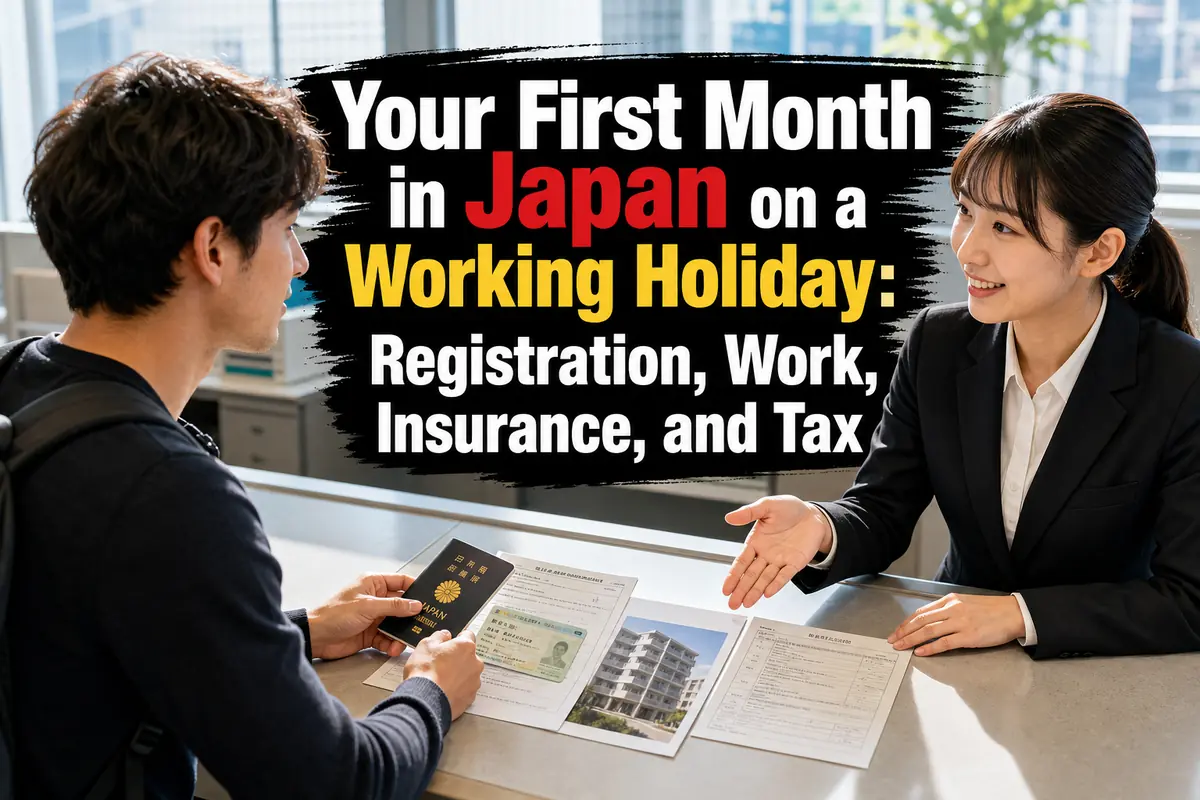
Your First Month in Japan on a Working Holiday: Registration, Work, Insurance, and Tax
A Working Holiday participant can travel around Japan and take paid work to help fund the stay. After arrival, however, the first priority is administrative: register your address within 14 days after finding a place to settle, check the activity conditions attached to your passport, and arrange health insurance and pension procedures.
This guide is for new Working Holiday participants who plan to live and work in Japan rather than remain in short-term accommodation throughout their stay.
The essentials:
- Register your address at the municipal office within 14 days after settling somewhere.
- Read the designation paper attached to your passport before accepting work.
- Do not work at prohibited adult-entertainment or public-morals businesses.
- Ask the municipality about health insurance and pension enrollment.
- Check how your employer will withhold tax before comparing job offers.
The information below reflects official sources available in August 2026. Your permitted activities and period of stay depend on the designation issued to you, while municipal procedures and insurance premiums vary locally.
Understand what your status allows
A Japanese Working Holiday is primarily for spending a holiday in Japan. Paid work is allowed as an incidental activity to supplement your travel funds; it is not the same immigration route as an ordinary work status tied to a professional occupation.
Japan places Working Holiday participants under Designated Activities. This matters because the label alone does not describe every condition. The designation paper attached to your passport states the activities individually permitted by the Minister of Justice.
Check three documents before accepting a job
Keep the following together and compare the details:
- Passport: Check the visa and the designation paper attached inside it.
- Residence Card: Confirm your name, period of stay, status, and address after registration.
- Written employment terms: Confirm the employer, workplace, duties, wages, hours, pay date, and contract period.
Do not assume that advice for a Student, Dependent, or ordinary work status applies to you. For example, the familiar 28-hour rule is associated with separate permission held by some students and dependents; it is not a general Working Holiday rule. Your own designation remains the controlling document.
Work that is prohibited
The Ministry of Foreign Affairs states that Working Holiday participants must not work at bars, cabarets, nightclubs, gambling establishments, or other premises affecting public morals. The restriction can depend on the establishment, not merely the job title.
That creates a practical trap. A position described simply as “service staff,” “cleaning,” or “reception” may still be unsuitable if the workplace is a prohibited business. Ask for the legal name, address, and business type before agreeing to work.
Here is the key point: A Working Holiday gives broad room to fund your travels through employment, but it is not permission to take every available job. Check the passport designation and the workplace itself.
If the designation is unclear, ask a regional Immigration Services office before starting. An employer’s reassurance does not replace confirmation from the authority responsible for your status.
Register your address after you settle
Address registration unlocks much of ordinary life in Japan. It connects your Residence Card to your local address and allows the municipality to handle resident records, public insurance, pension procedures, and My Number notifications.
The official Working Holiday guidance requires participants to visit the municipality where they live and report their address within 14 days of finding a place to settle.
What to take to the municipal office
Requirements differ slightly by city and ward, but a new resident should normally prepare:
- Passport
- Residence Card
- Address details, including the building and room number
- Any moving-in form requested by the municipality
- Household information if registering with relatives or another resident
Bring documents showing the spelling of your address if the building name is difficult to write. Some offices provide multilingual assistance, but availability varies.
A hotel used while searching for housing may not be treated as your settled residential address. If you are uncertain whether a guesthouse, share house, or employer-provided room can be registered, ask both the accommodation operator and the municipal office.
What happens to your Residence Card
When the moving-in procedure is accepted, the registered address is recorded on your Residence Card. Check the spelling before leaving the counter.
If you later move:
- Complete the required moving-out procedure with the old municipality, unless its online or local rules provide another route.
- Report the new address to the new municipality within the applicable deadline.
- Have the new address recorded on your Residence Card and, if held, your My Number Card.
Municipal instructions differ, especially for moves within the same city. Check the websites of both municipalities rather than relying on a previous move in another part of Japan.
Handle My Number without confusing the notice and the card
Registering your residence creates the record used for your My Number, the 12-digit individual number used in tax, social security, and certain administrative procedures.
Foreign residents receive an Individual Number Notice after registering their residence. You do not separately apply to receive the number.
The notice and the plastic My Number Card are different:
- Individual Number Notice: Tells you your number but cannot be used as a general identity document.
- My Number Card: A photo ID that must be applied for; it can support online and in-person public procedures.
- Residence Card: Evidence of your residence status and period of stay; it is not replaced by the My Number Card.
A new arrival from overseas may qualify for the express My Number Card issuance system. The official card site says eligible applicants generally apply at their municipality within 30 days of the qualifying event, with delivery normally expected in about one week after application. Eligibility, delivery method, and required identification should still be confirmed at the local counter.
You may need your My Number when an employer prepares payroll documents. Store the number securely and provide it only for a lawful administrative purpose.
Arrange health insurance and pension
Do not treat insurance and pension letters as optional bills. Which system applies depends mainly on whether an eligible employer enrolls you and on your registered residence.
Health insurance
A participant who becomes an eligible employee may be enrolled in Employees’ Health Insurance through the employer. Someone who is not covered through employment may instead need to join National Health Insurance through the municipality.
Ask these questions as soon as you receive a job offer:
- Will I be enrolled in Employees’ Health Insurance?
- On what date will coverage begin?
- What will be deducted from each wage payment?
- What should I do about municipal insurance before that date?
Do not cancel or ignore one form of coverage until the employer or municipality confirms the transition. Short contracts, changing weekly hours, and switching employers can alter the route.
National Health Insurance premiums are not a single nationwide price. The municipality calculates them under its local rules, usually using factors such as prior income and household circumstances. A recent arrival may have little or no previous-year income in Japan, but this does not mean the premium is automatically zero.
Pension
The Japan Pension Service states that residents aged 20 to 59 must generally be covered by Japan’s public pension system regardless of nationality. A qualifying employer handles Employees’ Pension enrollment. Otherwise, a resident may need to complete National Pension enrollment through the municipal office.
For fiscal year 2026, the standard National Pension contribution for a Category I insured person is ¥17,920 per month. This amount is national, unlike locally calculated National Health Insurance premiums.
If payment is difficult, do not simply leave invoices unpaid. Contribution exemption and payment-postponement systems exist, but approval requires an application and screening. Ask the municipal pension counter or Japan Pension Service which procedure fits your situation.
People covered by an applicable social security agreement may face different coverage rules. Confirm this before assuming that membership in a home-country system removes the Japanese obligation.
Know how wages may be taxed
Tax can make a large difference between the advertised wage and the amount deposited in your account. Ask for the expected withholding treatment before accepting a job.
The National Tax Agency explains that a Working Holiday visitor who stays in Japan for less than one year is basically treated as a non-resident for Japanese income-tax purposes. Salary paid in Japan to a non-resident is generally subject to income tax and reconstruction surtax withholding at 20.42%.
The agency also states that, in the case described by its Working Holiday guidance, this withholding completes the non-resident’s taxation and the worker cannot file a final return merely to obtain a refund of the deducted amount. A Japanese employer’s salary is not made tax-free by the relevant treaty treatment described on that page.
However, tax residence is a legal classification based on the person’s facts, not only the visa label. Plans, length of stay, domicile, employment arrangements, and a tax treaty can matter. For an individual answer, contact the National Tax Agency consultation service or a qualified tax professional.
Questions to ask before your first shift
Request a written answer to these points:
- Is the quoted wage before tax and social insurance deductions?
- How is my tax-residence classification being handled?
- What withholding rate will payroll use?
- When is the payroll closing date and payment date?
- Will transport costs be paid separately?
- Will I receive a wage statement for every payment?
A high hourly rate can produce a smaller-than-expected payment when tax, insurance, accommodation, uniforms, or transport are deducted. Compare the expected net amount, not only the headline rate.
Protect yourself as an employee
Working Holiday participants are workers when they take employment. Foreign nationality does not remove the employer’s responsibility to follow Japanese labor rules.
Before starting, obtain written working conditions. Keep copies of:
- Job advertisement and messages with the recruiter
- Employment contract or working-conditions notice
- Shift records and your own record of hours worked
- Wage statements and bank deposits
- Receipts for deductions or employer-provided housing
The Ministry of Health, Labour and Welfare publishes a multilingual Working Conditions Handbook and information for foreign workers. Hello Work, Japan’s public employment service, also has support for foreign job seekers, including specialized centers in Tokyo, Nagoya, Osaka, and Fukuoka.
Be cautious if an employer:
- Refuses to identify the actual workplace
- Offers cash work with no wage statement
- Keeps your passport or Residence Card
- Changes the wage after you start
- Demands a large recruitment or resignation penalty
- Says prohibited work is acceptable because it is only temporary
Do not surrender your passport or Residence Card to an employer for storage. An employer may need to inspect identification and immigration information for lawful hiring procedures, but that is different from retaining the original document.
Common mistakes during the first month
Most avoidable problems come from treating a Working Holiday as an extended tourist visit after beginning settled life.
Waiting too long to register an address
The 14-day period begins after finding a place to settle. Delaying registration also delays municipal insurance, pension procedures, and delivery of important notices.
Assuming the visa sticker explains every work condition
The passport designation contains the relevant activity details. Read it before accepting a role, especially when the business operates late at night or its service type is unclear.
Comparing jobs by gross hourly pay alone
Tax withholding, insurance, transport, housing, and irregular shifts affect take-home pay. Ask for a sample calculation based on realistic monthly hours.
Ignoring government mail
Municipalities, pension offices, insurers, and tax authorities may send notices only in Japanese. Translate them promptly or take them to the relevant counter. A letter that looks routine may contain an application deadline.
Believing every city uses the same forms and fees
Immigration status is governed nationally, but resident registration counters, National Health Insurance calculations, multilingual support, and document-issuance fees are handled locally. Instructions from a Tokyo ward may not match a city in Hokkaido, Kyushu, or elsewhere.
A practical arrival sequence
The order below reduces gaps between immigration, municipal, and employment procedures.
During your first days
- Check the passport designation and Residence Card.
- Keep evidence of your arrival and accommodation.
- Obtain a Japanese phone number or dependable contact method if needed for housing and job applications.
- Ask accommodation providers whether residence registration is possible.
Within 14 days after settling
- Submit the moving-in or address notification at the municipal office.
- Check the address recorded on your Residence Card.
- Ask which health insurance procedure applies.
- Complete or confirm pension enrollment.
- Ask when your Individual Number Notice will arrive and whether express My Number Card issuance is available.
Before accepting paid work
- Confirm that the establishment and duties are permitted.
- Get wages, hours, workplace, and contract dates in writing.
- Ask about health insurance, pension, tax withholding, transport, and housing deductions.
- Keep the employer’s legal name, address, and contact details.
After the first wage payment
- Compare the hours and rate with your wage statement.
- Identify every deduction.
- Save the statement and employment records.
- Ask payroll immediately about unexplained differences.
What may vary in your case
A checklist cannot replace the documents issued to you. Confirm details when any of the following applies:
- Your passport designation contains special conditions.
- You intend to stay in several short-term accommodations without one settled address.
- Your job changes from occasional work to a longer or more structured career plan.
- Your employer says social insurance is unavailable despite regular employment.
- You are covered by a social security agreement.
- You expect your tax-residence position to change.
- You want to remain in Japan beyond the period currently granted.
A Working Holiday status does not automatically convert into another residence status. If your plans change, consult Immigration Services well before the current period expires. Do not assume that a job offer alone guarantees a change or extension.
Final checklist
The most useful next action is simple: book enough time for the municipal office as soon as you have a registrable address. Bring your passport and Residence Card, then leave only after you understand your health insurance and pension route.
After that, treat each job offer as a document check rather than an informal promise:
- Is the workplace permitted?
- Are the hours and deductions written down?
- Who handles insurance and pension enrollment?
- How will tax be withheld?
- Does the job still fit the holiday-centered activities designated for you?
Keep the answers with your official documents. They will matter when you change jobs, move to another municipality, question a deduction, or make plans for the end of your stay.
参照リンク
- Ministry of Foreign Affairs: The Working Holiday Programmes in Japan
- Ministry of Foreign Affairs: Specified Visa—Designated Activities
- Immigration Services Agency: Living and Work Guidebook for Foreigners, 7th edition
- My Number Card: Frequently Asked Questions
- My Number Card: Express Issuance and Delivery
- Japan Pension Service: Enrollment in National Pension
- Japan Pension Service: National Pension Contributions
- Japan Pension Service: Employment, Job Change, and Retirement
- National Tax Agency: Working-Holiday Visa and Filing Returns for Refund
- Ministry of Health, Labour and Welfare: Labor Standards Information for Foreign Workers