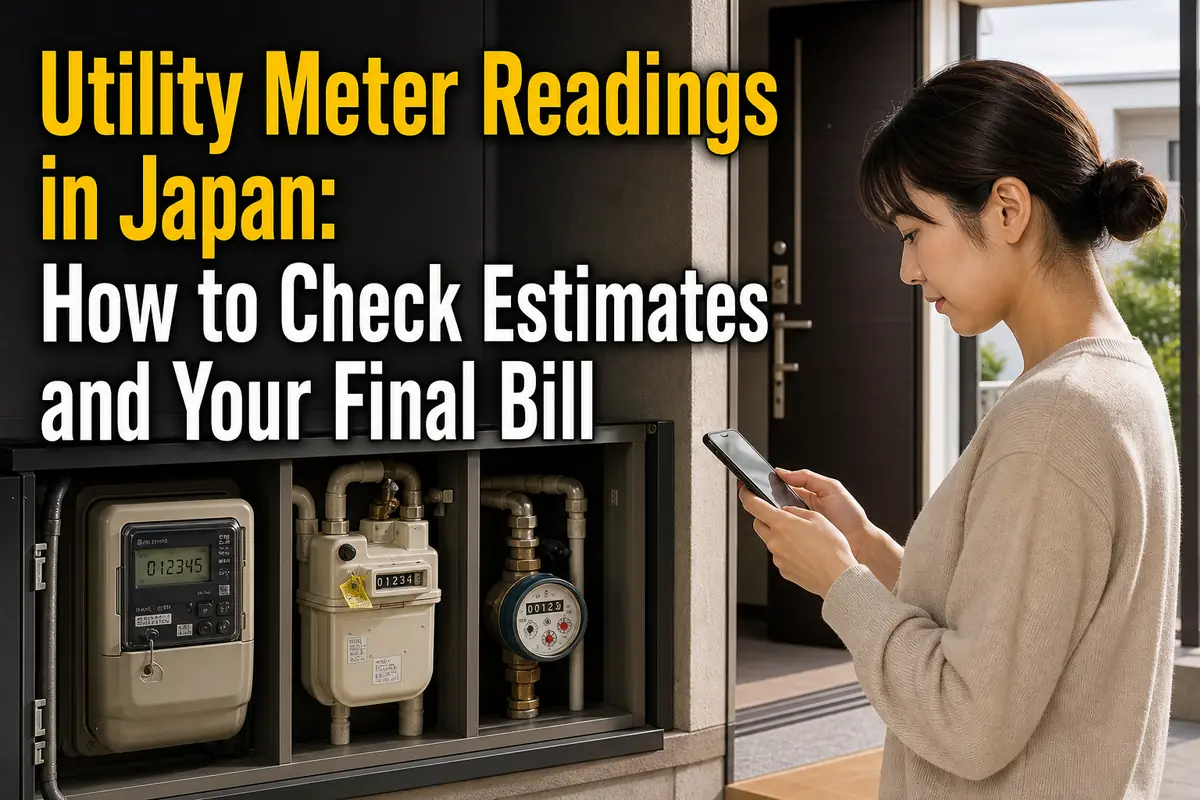
Utility Meter Readings in Japan: How to Check Estimates and Your Final Bill
A utility bill in Japan is normally based on the difference between two meter readings. If the provider cannot obtain a valid reading, it may calculate an estimated amount and adjust the account after an actual reading becomes available.
When moving out, do not assume that cancelling your lease also stops electricity, gas, or water. Contact each provider, confirm the service-ending date, and keep access to your Japanese bank account, card, email, or forwarding address until every final bill is settled.
This guide is for new residents, students, workers, and long-term residents who pay utilities directly. People whose rent includes utilities should first check their lease or ask the property manager how usage is calculated.
What you need to know first
- Electricity is commonly measured remotely by a smart meter, although an operator may visit if data cannot be collected.
- Gas and water reading methods depend on the provider, the building, and the type of meter.
- An estimated bill is provisional usage calculated under the provider’s contract or local rules; it is not automatically a penalty.
- A later actual reading may produce an adjustment, so a low estimated bill does not mean the missing usage has been waived.
- Moving-out procedures and attendance requirements differ among electricity, gas, and water services.
Japanese terms that may appear on a bill or online account include:
- kenshin (検針): meter reading
- kenshin-bi (検針日): meter-reading date
- shiyōryō (使用量): amount used
- shiji-sū (指示数): meter register or displayed reading
- santei (算定): calculation or assessment
- suitei (推定): estimate
- seisan (精算): final adjustment or settlement
- shiyō teishi (使用停止): stopping service
How a normal meter reading becomes a bill
The number displayed on a meter is usually cumulative; the provider bills the increase since the previous reading. It does not usually reset to zero every month.
For example, if an electricity meter shows 12,450.3 kWh at one reading and 12,612.8 kWh at the next, the measured difference is 162.5 kWh. The supplier then applies the rates and other charges in the customer’s plan.
The reading period may not match a calendar month. A gas payment slip from Tokyo Gas, for example, describes the usage period as generally running from the previous reading date through the day before the current reading. Electricity suppliers may use a similar billing period defined in their contracts.
Electricity: remote readings are now common
Japan’s Agency for Natural Resources and Energy explains that electricity smart meters allow the transmission and distribution operator to measure usage automatically on a fixed monthly measurement date. Older meters require an on-site reading.
A smart meter can record detailed usage even if the customer only sees a monthly total on the bill. In TEPCO Power Grid’s service area, its smart-meter information states that meters can measure electricity use in 30-minute intervals.
This changes the visit, not the basic principle: the supplier still calculates the bill from measured consumption and the selected rate plan. If remote data cannot be obtained, the network operator may investigate or visit the property.
Gas: the bill uses cubic metres
Gas usage is normally shown in cubic metres, written as m³. Tokyo Gas explains that its standard gas charge combines a basic charge with a usage charge calculated from the metered volume. The applicable basic and unit rates can change according to the usage band and contract.
Do not compare gas meter numbers directly with electricity numbers. They use different units, different prices, and different billing formulas.
Water: local rules matter most
Water is run by municipalities or regional authorities, so the reading cycle and billing method are not uniform across Japan.
Tokyo Waterworks states that ordinary households are generally read and billed every two months. A newcomer could therefore receive a larger-looking water bill covering two months while receiving electricity and gas bills on different cycles. Other cities may use different schedules.
In an apartment building, the water bureau may read a main meter while the owner or management company allocates charges among units. If the water charge appears on your rent statement rather than a utility notice, ask which meter, period, and allocation rule were used.
What an estimated bill means
An estimate fills a gap when reliable meter data is unavailable; the provider’s contract or local ordinance decides how the amount is calculated and corrected.
Possible reasons include:
- a meter malfunction;
- a failed smart-meter transmission;
- an inaccessible meter room or locked entrance;
- construction or another condition that makes measurement difficult;
- an omitted or delayed reading under the operator’s rules.
The calculation is not necessarily a simple national formula. One provider may refer to the previous month, the same month of the previous year, or another reasonable comparison. A municipal water authority may follow its own ordinance.
Tokyo Gas states that when electricity usage cannot be read even through an on-site visit because of meter failure, usage is generally determined by agreement, such as using the previous month or the same month in the previous year. The company says it contacts the customer in that situation.
Tokyo’s water regulations provide another example. When measurement is extremely difficult, the authority may estimate usage after considering the previous measured amount and other circumstances. After the next actual measurement, the regulation calls for the charge to be recalculated using usage since the earlier reading, minus the amount already billed from the estimate.
ここがポイント: An estimated amount may be corrected later. Keep the notice, compare it with the next bill, and ask the provider how the adjustment will appear.
“Estimated” is not the same as averaged interval data
Bills and online portals may use technical descriptions that sound similar but mean different things.
For example, TEPCO Energy Partner says that if installation of a smart meter occurs after electricity service starts, measured electricity may be distributed evenly to create 30-minute usage values for the period before installation. That allocation concerns the shape of interval data; it does not necessarily mean the total consumption for the period was guessed.
When contacting the supplier, ask a precise question:
- Was the total billed usage estimated?
- Were only the 30-minute values allocated?
- Which reading dates and register values were used?
- Will a later bill contain a correction?
How to check a suspicious bill
Start with the reading period and usage figure, not the yen total. Prices can change because of the tariff, fuel or raw-material adjustments, renewable-energy charges, taxes, or the number of billing days even when consumption is similar.
1. Confirm the contract and property
Check the following information on the bill or provider portal:
- customer number, okyakusama bangō (お客さま番号);
- service address;
- utility type and supplier;
- contract plan;
- reading date and usage period;
- usage in kWh or m³;
- any words indicating an estimate, correction, replacement meter, or later notification.
This matters after a move because a portal may display the old and new properties under the same login.
2. Compare usage, not only cost
Compare the billed consumption with:
- the previous billing period;
- the same season in an earlier year, if available;
- the number of days in each period;
- any long absence, guests, heating, cooling, or appliance changes;
- the current meter display, when it is safe and accessible.
Seasonal comparisons are important. Electric air conditioning and gas or electric heating can make winter and summer consumption very different from spring or autumn.
3. Photograph the meter carefully
A dated photograph can help you explain a discrepancy. Capture the full meter, its identification number, and the displayed register if these are visible without opening equipment or entering a restricted area.
Do not remove covers, touch seals, operate gas safety equipment merely to obtain a reading, or enter a locked meter room. Ask the building manager or provider for help if access is restricted.
Electricity smart-meter displays may alternate between screens. TEPCO Power Grid notes that one screen shows consumed electricity, while another marked with an arrow can show electricity purchased from customers with generation equipment. Customers with solar panels must therefore identify the correct display rather than copying the first number they see.
4. Ask the provider for the calculation basis
Give the provider the customer number, service address, bill period, displayed usage, and any photo. Useful questions include:
- “Was this bill based on an actual or estimated reading?”
- “What were the previous and current meter values?”
- “Why was an estimate necessary?”
- “How was the estimated usage calculated?”
- “When will the next actual reading occur?”
- “How will any overpayment or underpayment be adjusted?”
If a landlord or management company bills you, ask for the same information plus the clause in the lease or building rules that explains the allocation.
Moving out: how the final reading works
The safest approach is to schedule each utility stop before departure and confirm how the final charge will be collected. Returning your keys does not, by itself, close utility contracts held in your name.
Before your departure date
Contact the electricity retailer, gas supplier, and water authority as soon as your moving date is fixed. Providers commonly request:
- customer number;
- current address;
- contract holder’s name;
- requested stopping date;
- a telephone number or email address;
- forwarding address;
- preferred method for the final payment.
Use shiyō teishi (使用停止, stopping service) when searching a Japanese provider’s website. If you are moving within the same provider’s area, you may be able to submit the old address’s stop request and the new address’s start request together.
Do you need to be present?
Attendance depends on the utility and access conditions.
TEPCO’s English FAQ says customers should give notice as soon as their moving date is known. It also notes that attendance may be necessary for gas if the meter is inaccessible, including behind an automatically locking entrance.
Tokyo Gas likewise provides separate procedures for starting and stopping gas or electricity. For a move-out, it advises customers to switch off the main electricity breaker before leaving. Follow the instructions of your own retailer and building manager because equipment and contracts differ.
In general:
- Electricity with a communicating smart meter can often be stopped remotely.
- Gas may require access to the meter, and provider instructions take priority.
- Water procedures are set by the local water authority; apartment management may handle them in some buildings.
Record the final condition
On the day you leave, keep:
- dated photos of accessible meter displays;
- the cancellation confirmation or application number;
- the exact handover time if another occupant or the landlord takes responsibility that day;
- a copy of the final bill;
- proof of payment.
A photo does not replace the official reading, but it provides a useful time-stamped reference if usage continues after you leave or a number is entered incorrectly.
Keep the payment route open
The final bill may arrive after you have vacated. TEPCO’s moving FAQ, for example, describes different timing according to the payment method: a payment slip may be mailed after service stops, while bank debit, card, or SMS payment follows its own process.
Do not immediately close the linked bank account, cancel the card, discard the Japanese SIM, or stop checking the registered email. First confirm that the final charge has been collected. People leaving Japan should ask the provider in advance which payment and contact methods will continue to work overseas.
Common mistakes and how to avoid them
Most disputes are easier to prevent when you preserve the dates, readings, and cancellation records.
- Treating the bill date as the usage date: Read the full usage period; it may cross two calendar months.
- Assuming every high bill is an estimate: First compare actual consumption and the number of billing days.
- Assuming an estimate ends the matter: Check the next actual bill for an adjustment.
- Reading the wrong smart-meter screen: Confirm the consumption display, especially if the property has solar generation.
- Comparing kWh with m³: Electricity, gas, and water use different units and formulas.
- Expecting one national water rule: Check the municipality or regional water bureau.
- Cancelling only the lease: Stop each contract held in your name.
- Closing the payment account too early: Wait until the final settlement is complete.
- Entering a restricted meter area: Contact the manager or provider instead.
Special cases that need extra checking
The standard household pattern does not cover every rental or contract. Ask for written details when responsibility is unclear.
Utilities included in rent
Some furnished apartments, dormitories, company housing, and short-term rentals charge a fixed utility fee or include usage up to a limit. In such cases, the utility meter may not determine what you personally pay each month.
Check the lease for:
- a fixed monthly amount;
- an included usage allowance;
- excess-usage rates;
- shared-meter allocation;
- move-out settlement rules.
Meter replacement during a billing period
A replacement meter may begin with a different register value. This does not mean the provider has lost the earlier usage.
TEPCO Power Grid explains that electricity use for a replacement month is calculated by adding usage measured before removal of the old meter to usage after installation of the new meter. Tokyo Waterworks also states that its notice can show usage from the old meter when a meter has been replaced.
A large change or possible leak
A sudden water increase can indicate a leak, but it can also result from a longer billing period or changed household use. Tokyo Waterworks notes that when usage changes substantially, the amount or charge may be marked for later notification while it is checked.
If the meter continues moving while every tap and water-using appliance is off, contact the water authority, building manager, or an approved repair service. Do not assume that every provider offers the same leak adjustment; eligibility and documents vary locally.
Switching suppliers without moving
Electricity and city-gas retail competition means the company that sends the bill may differ from the network company responsible for the meter. Contact the retailer shown on your contract first. It can explain who supplied the reading and which organization must investigate a meter problem.
Current status as of August 2026
Smart meters have made remote electricity readings common, but estimates, visits, and manual checks have not disappeared. Communication failures, meter faults, special building access, and local water systems can still affect how usage is measured.
Online statements are also increasingly important. Some providers charge for paper notices or deliver reading results mainly through a customer portal. Save PDFs or screenshots before closing an account, since access to historical data may change after cancellation.
Because tariffs, provider terms, and municipal water rules can change, confirm the current procedure on your own supplier’s official website. Examples from Tokyo in this guide illustrate real operating rules; they are not nationwide guarantees.
Practical move-out checklist
- Submit stop requests for electricity, gas, and water.
- Confirm whether anyone must attend the final check.
- Record accessible meter displays without touching sealed equipment.
- Save each cancellation confirmation.
- Provide a working forwarding address, email, or phone number.
- Keep the payment method active until the final bills clear.
- Compare the final usage period with your departure date.
- Ask about any estimated amount or later adjustment before leaving Japan.
The key document is not simply the final yen total. It is the chain connecting the previous reading, the final reading, the dates, and the payment. Keep that chain intact until all three utility accounts show a zero balance.
参照リンク
- Agency for Natural Resources and Energy: How Smart Meters Change the Way Electricity Usage Is Checked
- TEPCO Power Grid: Frequently Asked Questions About Smart Meters
- TEPCO Energy Partner: Moving Procedures
- TEPCO Energy Partner: Frequently Asked Questions in English
- TEPCO Energy Partner: Moving FAQ and Final Payments
- Tokyo Gas: Procedures for Starting or Stopping Gas and Electricity
- Tokyo Gas: Electricity Measurement and Charge Calculation
- Tokyo Gas: Gas Charge Calculation
- Tokyo Gas: How to Read a Gas Payment Slip
- Tokyo Waterworks: Main Rules for Water Service
- Tokyo Waterworks: How to Read a Water Usage Notice
- Tokyo Metropolitan Water Supply Ordinance and Related Rules