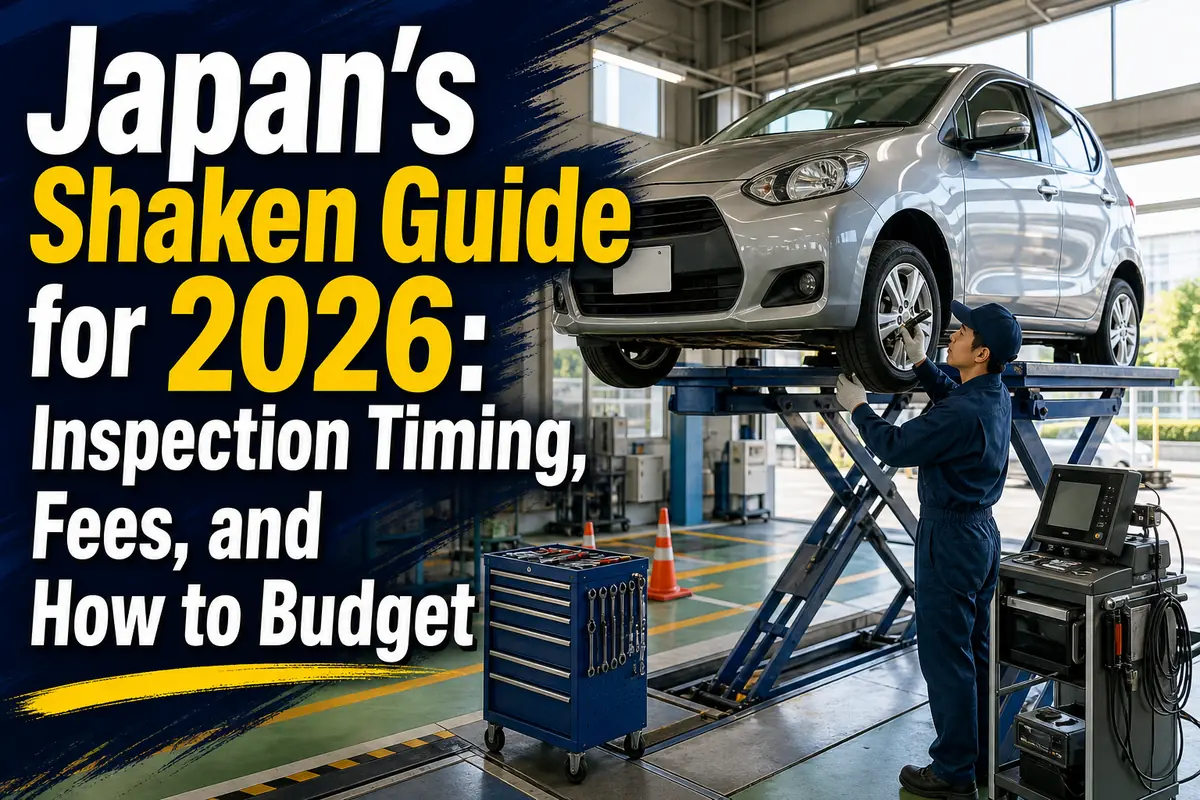
Japan’s Shaken Guide for 2026: Inspection Timing, Fees, and How to Budget
For most privately owned passenger cars in Japan, shaken is required after the first three years and then every two years. The bill is not one fixed inspection charge: it combines government fees, vehicle weight tax, compulsory insurance, garage labor, and any repairs needed to pass.
For a typical private passenger car weighing up to 1.5 tonnes, the statutory items alone can be about ¥44,350 when a designated garage completes the renewal before November 2026. The final garage bill is often higher because inspection packages, maintenance, replacement parts, and optional services are added separately.
This guide is for foreign residents and families who own—or are considering buying—a car in Japan.
The essentials:
- New private passenger car: first inspection after three years
- Later renewals: normally every two years
- Safe renewal window: from two months before the expiry date
- Typical statutory subtotal for a non-eco private car up to 1.5 tonnes: about ¥44,350 before garage labor and repairs
- Important 2026 changes: higher statutory inspection fees from April 1 and new weight-tax rates from May 1; compulsory insurance rates will change again on November 1
What shaken does—and does not cover
Shaken confirms that a vehicle meets Japan’s safety and environmental standards at the time of inspection. It also renews the vehicle inspection certificate needed to use an inspection-covered vehicle legally on public roads.
The Japanese term is short for jidōsha kensa tōroku seido, the motor vehicle inspection and registration system. During a renewal, the vehicle’s identity and items such as brakes, lights, steering, tires, exhaust emissions, and underbody condition may be checked.
Passing shaken does not mean that the car will remain trouble-free for two years. The owner is still responsible for routine checks and maintenance between inspections.
ここがポイント: Shaken is a legal inspection, not a complete warranty or a promise that every worn component has been replaced.
Inspection and maintenance are separate costs
This distinction explains why two garages may quote very different totals for the same vehicle.
A quote may include:
- Statutory taxes, insurance, and inspection fees
- A garage’s inspection or agency charge
- Periodic maintenance work
- Parts required to pass
- Recommended preventive work that is not immediately required
Ask the garage to separate these items. A low advertised price may cover only the basic service charge, while a high quote may include extensive maintenance.
The shaken schedule for private vehicles
Most private passenger cars receive a three-year certificate when new and two-year certificates afterward. Other vehicle classes can follow shorter schedules.
- New private passenger car: three years
- Used private passenger car with a valid certificate: until the date shown on that certificate
- Private passenger car after renewal: two years
- Many commercial vehicles, taxis, buses, and certain trucks: generally one year
- Inspection-covered kei cars used privately: normally the same three-year-then-two-year pattern as private passenger cars
Do not calculate the deadline only from the purchase date. A used car may have several months left, no remaining shaken, or a newly renewed two-year certificate. Check the expiry recorded in the vehicle inspection information.
The renewal window is now two months
Since April 1, 2025, owners can renew from two months before the expiry date without losing the remaining validity period.
For example, if the certificate expires on September 20, renewal within the protected window beginning July 20 can preserve September 20 as the basis for the next expiry. This gives owners more time to compare quotes and avoid busy periods.
Renewing even earlier may change how the next validity period is calculated. Confirm the result with the garage or transport office before proceeding outside the two-month window.
How to check the exact expiry date
The small electronic vehicle inspection certificate does not display every detail directly on its face. Owners can use the official Vehicle Inspection Certificate Viewing App to read stored information and receive expiry reminders.
The app can issue notifications 90, 60, and 30 days before expiry, as well as one day after expiry. Registering early is useful if the dealer’s reminder is sent to an old address or never arrives.
How much shaken costs in 2026
The predictable statutory subtotal is only the starting point; repairs and garage charges create most of the variation. Always compare quotes using the same list of included work.
The four main parts of the bill
-
Vehicle weight tax (jidōsha jūryōzei)
Paid when the inspection certificate is issued or renewed. The amount depends on vehicle weight, environmental classification, age, and use. -
Compulsory automobile liability insurance (jibaiseki hoken)
This mandatory insurance primarily covers bodily injury to other people. It does not replace voluntary automobile insurance for property damage, your own injuries, theft, or broader liability protection. -
Statutory inspection fee
The amount depends on the application route, vehicle class, and whether the car is presented at an inspection station or processed using a safety-standard conformity certificate from a designated garage. -
Garage service and repairs
Labor, inspection packages, agency fees, fluids, tires, brake parts, lights, and other work are priced by the business rather than fixed nationally.
Example: private passenger car up to 1.5 tonnes
The following example applies to a two-year renewal for a private passenger car outside Okinawa and designated remote-island rate areas. It assumes:
- Vehicle weight of more than 1 tonne and up to 1.5 tonnes
- A standard non-eco weight-tax category
- The car is not yet 13 years old
- A designated garage supplies a safety-standard conformity certificate
- The compulsory insurance policy begins by October 31, 2026
| Statutory item | Example amount | Why it may differ |
|---|---|---|
| Vehicle weight tax | ¥24,600 | Weight, eco status, and vehicle age |
| Compulsory insurance, 24 months | ¥17,650 | Policy start date and regional rate area |
| Renewal inspection fee | ¥2,100 | Application and inspection route |
| Statutory subtotal | ¥44,350 | Before garage labor and repairs |
This is not a guaranteed final price. If the garage charges ¥20,000 for its inspection package and the car needs ¥35,000 of repairs, the total would reach ¥99,350. Major tire, brake, suspension, or electronic-system work can raise it further.
Weight tax increases for older vehicles
For the same weight band under the rates effective May 1, 2026, the two-year weight tax is:
- Standard non-eco vehicle: ¥24,600
- More than 13 years old: ¥34,200
- More than 18 years old: ¥37,800
- Eligible eco vehicle at the basic rate: ¥15,000
- Qualifying exempt vehicle: ¥0
The exact category cannot be determined from age and engine size alone. Check the official next-inspection weight-tax inquiry service or ask the garage to show the category used in its estimate.
Kei-car example
For an inspection-covered private kei car outside special regional rate areas, a common statutory calculation before November 2026 is:
- Weight tax for a standard non-eco car under 13 years old: ¥6,600
- Compulsory insurance for 24 months: ¥17,540
- Renewal fee using a conformity certificate: ¥2,100
- Statutory subtotal: ¥26,240
A kei car is usually cheaper at this stage, but its repair and garage charges are still separate. An older kei car can also face higher weight tax.
The 2026 changes owners need to know
Three dated changes affect shaken budgeting in 2026. Quotes based on older fee tables may no longer be accurate.
Statutory inspection fees rose on April 1
From April 1, 2026, the renewal fee for an ordinary, small, or kei vehicle using a safety-standard conformity certificate became:
- ¥1,850 for an online OSS application
- ¥2,100 for a counter application
For a vehicle physically presented by the owner, the counter-route renewal fee is ¥2,600 for an ordinary car, ¥2,500 for a small car, and ¥2,500 for a kei car. The correct fee depends on how the inspection is handled, so do not add a user-inspection fee to a garage quote automatically.
Weight-tax tables changed on May 1
The national weight-tax table effective May 1, 2026 changes the classification and treatment of eligible environmentally performing vehicles. Owners should use the current table rather than an old calculator or a previous shaken receipt.
This matters especially when buying a used hybrid or low-emission vehicle. The model name alone does not prove that the individual car receives an exemption or reduced rate at its next renewal.
Compulsory insurance changes on November 1
For policies beginning from November 1, 2026, the 24-month reference premium outside Okinawa and specified remote islands will rise:
- Private passenger car: from ¥17,650 to ¥18,560
- Inspection-covered kei car: from ¥17,540 to ¥18,660
That is an increase of ¥910 for the passenger-car example and ¥1,120 for the kei-car example. The policy start date—not simply the day you request a quote—determines which rate applies.
Your three main ways to complete shaken
The best route depends on whether you prioritize convenience, price control, or direct involvement. All routes must lead to the same legal renewal, but the work included is different.
1. Dealer or full-service garage
This is usually the easiest option for readers who prefer English support, a replacement car, warranty-related knowledge, or one business handling inspection and repairs.
Before accepting the quote, ask:
- Is the figure an estimate or a fixed price?
- Which work is legally required to pass?
- Which work is recommended but optional?
- Are statutory charges included?
- Is a reinspection fee possible?
- Will approval be requested before extra work?
Convenience costs more, but it can reduce the risk of arriving at the inspection station with incomplete documents or unresolved faults.
2. Independent or vehicle-inspection specialist
Independent garages and inspection chains may offer lower service charges and faster packages. Compare what each package includes rather than comparing the headline price alone.
Confirm whether the business is a designated garage, which can issue a safety-standard conformity certificate, or a certified garage, which may need to present the vehicle at an inspection station. The route can affect time, fees, and how the car is transported.
3. User shaken
A vehicle owner can reserve an inspection and present the car personally. This may reduce agency and labor charges, but it does not remove taxes, compulsory insurance, or necessary repairs.
User shaken is most suitable when the owner:
- Can communicate at the inspection office or has reliable language support
- Understands the vehicle’s condition
- Can prepare the forms and payments
- Has time for a possible failed test and reinspection
- Can arrange repairs quickly if a defect is found
Appointments for registered vehicles are available through NALTEC’s official reservation system. Kei vehicles use the Light Motor Vehicle Inspection Organization’s procedures and facilities.
Documents and preparations
Start by confirming the expiry date, tax status, insurance period, and inspection route. The exact document handling differs between counter, garage, kei-car, and online applications.
A renewal commonly involves:
- Vehicle inspection certificate
- Renewal application form
- Inspection-fee payment record
- Periodic inspection and maintenance record
- Proof or electronic confirmation of vehicle weight-tax payment
- Valid compulsory automobile liability insurance certificate
- Confirmation that automobile tax or kei-car tax has been paid
Paper tax certificates are often unnecessary when the authority can verify payment electronically. However, electronic data may not appear immediately after payment. Keep the receipt or certificate if you paid shortly before shaken, and ask the relevant prefecture or municipality how long its system takes to update.
Also bring or confirm:
- The locking wheel-nut key, if fitted
- Any paperwork for approved modifications
- Warning-light status
- Tire condition and correct size
- Working headlights, brake lights, turn signals, and license-plate light
- An unobstructed chassis number
OBD inspection and newer vehicles
Some newer vehicles must now pass an electronic fault check as part of shaken. This is important because a car can appear to drive normally while storing a fault related to a regulated electronic safety or emissions system.
Japan began OBD inspection for eligible domestic models in October 2024 and for eligible imported models in October 2025. In broad terms, the system covers certain new vehicle types approved from October 2021, or October 2022 for imports.
Check the remarks recorded on the inspection certificate for “OBD inspection applicable.” Detailed start conditions and exclusions apply, so the certificate and official eligibility system should be treated as the final check.
If the vehicle fails the OBD inspection, the relevant fault must be repaired before it can pass. Ask the garage whether its estimate includes diagnosis, scanning, calibration, and post-repair confirmation; these may be separate charges.
Common mistakes that cause delays or surprise bills
Most avoidable problems come from waiting too long or misunderstanding the quote. A short check two months ahead can prevent both.
Treating the dealer’s reminder as the legal deadline
The expiry recorded for the vehicle is what matters. A reminder is only a service and may go to the wrong address.
Comparing totals that include different work
One quote may include only statutory items and a basic inspection. Another may include a 24-month maintenance package, fluids, filters, and preventive replacement. Request an itemized estimate.
Assuming compulsory insurance covers everything
Jibaiseki mainly addresses bodily injury liability within statutory limits. Most owners also purchase voluntary insurance for wider risks.
Paying automobile tax immediately before inspection
Electronic payment confirmation can take time. If shaken is close, retain proof and check whether paper evidence will be needed.
Ignoring warning lights or modifications
An active fault, non-compliant light, incorrect wheel fitment, excessive window tint, altered exhaust, or unapproved structural change can cause failure. Some modifications require a separate modification inspection rather than a normal renewal.
Letting the certificate expire
An inspection-covered vehicle cannot legally be driven on public roads after expiry. Compulsory insurance may also expire around the same time. Do not drive it to the test center; ask about legal transport, a carrier, or the applicable temporary-operation permit process.
Regional and vehicle-specific differences
The inspection standards are national, but the amount you pay and the practical process can still vary. Location matters mainly through insurance rate areas, garage pricing, booking availability, and local tax-confirmation procedures.
Check separately if:
- The vehicle is registered in Okinawa or used in a designated remote-island area
- It is a commercial, cargo, rental, taxi, bus, motorcycle, or special-purpose vehicle
- It is imported privately or heavily modified
- Ownership, address, or principal place of use has changed
- Automobile tax is unpaid or the electronic record is not current
- The garage quote uses an eco classification that you cannot verify
Municipalities handle kei-car tax, while prefectures handle automobile tax for registered vehicles. The national shaken procedure does not make those local payment records identical.
A practical two-month action plan
Use the expanded renewal window to separate price comparison from urgent repair decisions. The following schedule leaves room for a second estimate or replacement parts.
About two months before expiry
- Read the exact expiry date from the official vehicle information
- Check for recalls and warning lights
- Request two itemized quotes
- Ask whether the garage supports your preferred language
- Confirm whether you need a replacement car
Four to six weeks before expiry
- Choose the inspection route
- Approve essential repairs
- Confirm the weight-tax category
- Check automobile-tax payment status
- Arrange compulsory insurance through the chosen route
On completion
- Confirm that the inspection certificate was actually renewed
- Check the new expiry date
- Keep the detailed invoice and maintenance record
- Register the vehicle in the official viewing app for future reminders
The most useful number is not the advertised shaken price. It is the itemized total showing statutory charges, required repairs, optional work, and the new expiry date. Get that document before authorizing work, especially for an older vehicle where one repair can change whether continued ownership still makes financial sense.
参照リンク
- MLIT: Motor Vehicle Inspection
- MLIT: Inspection Procedure
- MLIT: Two-month shaken renewal window
- MLIT Kanto District Transport Bureau: Statutory fee changes from April 1, 2026
- MLIT: Vehicle weight-tax tables effective May 1, 2026
- General Insurance Rating Organization of Japan: Compulsory insurance reference rates
- General Insurance Rating Organization of Japan: 2026 compulsory insurance rate revision
- MLIT: OBD inspection information
- MLIT: OBD inspection guide for vehicle users
- NALTEC: User inspection reservation system
- Light Motor Vehicle Inspection Organization: Renewal inspection
- MLIT: Electronic Vehicle Inspection Certificate Portal
- MLIT: Vehicle Inspection Certificate Viewing App and expiry notifications