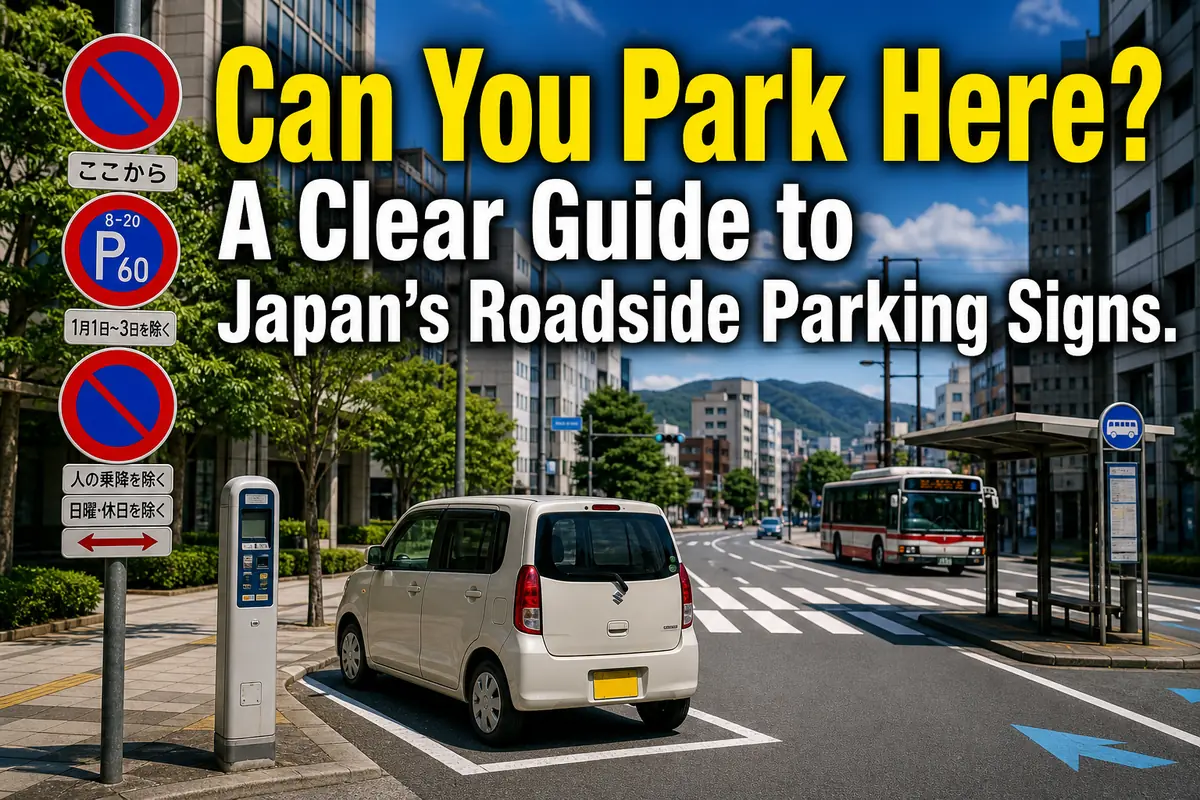
Can You Park Here? A Clear Guide to Japan’s Roadside Parking Signs
A road is not a legal parking place simply because there is no obvious sign beside your car. In Japan, you must check the main sign, any smaller plate below it, road markings, nearby intersections and entrances, and the way your vehicle would be positioned.
This guide is for residents, students, workers, and visitors who drive in Japan. It explains the national rules in plain English and shows when you should choose a paid car park instead of taking a chance at the roadside.
The quick answer
- A blue circle with a red border and red X means no stopping or parking.
- A blue circle with a red border and one red diagonal line means no parking, although a brief stop may be allowed when it meets the legal definition of stopping.
- A smaller white plate can limit the rule by time, vehicle type, direction, or distance.
- Some places are prohibited even without a sign, including areas close to intersections, crossings, bus stops, and driveways.
- If every condition is not clear, use an off-street car park or a marked, time-restricted parking space.
First identify which prohibition you are looking at
The most important distinction is between chūsha kinshi (駐車禁止, no parking) and chū-teisha kinshi (駐停車禁止, no stopping or parking).
Red X: no stopping or parking
The stricter sign is a blue circle with a red border and a red X. Its Japanese name is chū-teisha kinshi.
You may not voluntarily leave the car there or wait there. Do not use the location for:
- waiting for a friend;
- checking directions;
- making a phone call;
- loading luggage at your own pace;
- sitting in the driver’s seat with the hazard lights on.
Stopping because of a red light, congestion, danger, or a police instruction is different. Those are required by traffic conditions rather than a decision to use the road as a stopping place.
One red slash: no parking
A blue circle with a red border and one red diagonal line means chūsha kinshi, or no parking.
A legally brief stop may still be possible—for example, immediately allowing someone to get in or out. However, waiting for that person to arrive is not the same thing.
For loading and unloading, Japan’s traffic rules use a five-minute distinction, but the number alone is not a safe shortcut. If the driver leaves the vehicle and cannot move it immediately, it can be treated as parking even within five minutes.
Leaving the engine running or switching on the hazard lights does not change that.
ここがポイント: The X sign prohibits both stopping and parking. The single-slash sign prohibits parking, but any permitted stop must still be brief, necessary, attended, and legal under all other rules.
Read the small plate as part of the sign
The smaller plate under a main sign is called a hojo hyōshiki (補助標識, auxiliary sign). It is not optional information. It tells you where, when, or to whom the restriction applies.
Times and days
A plate such as 8–20 normally means that the restriction applies from 8:00 a.m. to 8:00 p.m. Japanese day labels may include:
- 日曜・休日を除く (nichiyō, kyūjitsu o nozoku): except Sundays and public holidays;
- 土・日曜、休日を除く: except Saturdays, Sundays, and public holidays;
- 休日 (kyūjitsu): public holidays;
- 平日 (heijitsu): weekdays, subject to the wording and context shown.
Do not assume that parking becomes legal outside the displayed hours. Another sign may apply, or the location may be prohibited by a nationwide rule that requires no sign.
Arrows showing the regulated section
Arrow plates indicate how the restriction extends along the road. Common meanings include:
- an arrow pointing toward the regulated section: beginning of the restriction;
- arrows pointing both ways: you are within the regulated section;
- an arrow pointing back toward the section you have passed: end of the restriction.
Interpret the arrow in relation to the road and the sign’s position, not merely as “left” or “right” on the signboard. If you entered halfway along a street, look behind you for the beginning sign as well as ahead for an end sign.
Vehicle types and special purposes
Words or symbols may restrict the rule to particular vehicles. Other signs reserve a space for uses such as taxis, buses, deliveries, or permit holders.
A space that is legal for one vehicle is not automatically legal for yours. Likewise, a disabled parking symbol identifies a reserved space; it is not a general parking area.
Places where signs are not required
National rules prohibit parking or stopping at several safety-sensitive locations. You must recognize them even when no roadside sign is immediately visible.
No stopping or parking
As a general national rule, do not stop or park:
- in an intersection or within 5 metres of its edge;
- at a road corner or within 5 metres of it;
- on a pedestrian crossing or bicycle crossing, or within 5 metres before or after it;
- on or within 10 metres before or after a railway crossing;
- beside a safety zone and within 10 metres before or after it;
- within 10 metres of a bus or tram stop marker while the service is operating;
- in a tunnel, on tram tracks, near the top of a hill, or on a steep slope.
These distances protect sight lines and space needed by pedestrians, buses, trains, emergency services, and turning vehicles. “I was only there for a minute” does not cancel a no-stopping rule.
No parking
Parking is also prohibited in locations including:
- within 3 metres of a vehicle entrance to a garage or car park;
- within 5 metres of the edge of roadworks;
- within 5 metres of designated firefighting equipment, fire-water facilities, or relevant entrances;
- within 5 metres of a fire hydrant or designated fire-water sign;
- within 1 metre of a fire alarm;
- anywhere your parked vehicle would leave less than 3.5 metres of usable road space to its right, unless a different clearance is specified.
The driveway rule matters on quiet residential streets. An open stretch of curb can still be illegal because it is too close to an entrance across or beside the car.
A legal location still requires a legal parking position
Finding no prohibition is only the first test. You must also place the vehicle correctly.
On an ordinary two-way road, vehicles generally park along the left edge in the direction of travel. Do not improvise by parking:
- on the right side facing oncoming traffic;
- diagonally unless markings require it;
- on a sidewalk;
- across a driveway;
- outside a marked parking bay;
- where the vehicle blocks pedestrian or bicycle space.
Roadside strips need special care. A rosokutai (路側帯) is an edge strip marked on a road without a sidewalk. Different line patterns can indicate an ordinary roadside strip, a strip where stopping and parking are prohibited, or a pedestrian-only strip. Do not treat every white edge line as permission to put a car beyond it.
How time-restricted roadside parking works
A jikan seigen chūsha kuikan (時間制限駐車区間) is a time-restricted parking area. It may use a parking meter or a ticket machine, but it is not an ordinary pay-and-stay car park.
The sign shows the permitted period and maximum parking time. The machine or local instructions show the applicable procedure and fee.
A safe sequence is:
- Confirm that the sign applies to your vehicle and the current day and time.
- Put the entire vehicle inside the marked bay.
- Read the meter or ticket-machine instructions at that location.
- Complete the required payment or activation promptly.
- Display a ticket when the system requires one.
- Return before the permitted time ends.
Tokyo police warn that a vehicle extending outside the marked bay may be treated as illegally parked. Charges, operating hours, exclusions, and equipment differ by location, so do not rely on what you used in another ward or city.
An exclusion such as “except Sundays and holidays” can mean that the time-restricted parking system is unavailable on those days. It does not necessarily mean that the bay becomes free, unrestricted parking. Read the accompanying prohibition and local instructions.
Private car parks use a different set of signs
The blue P signs at commercial or municipal facilities usually direct you to an off-street car park. The operator—not the roadside sign system—sets the price, opening hours, vehicle limits, and payment method.
Before entering, check:
- the rate per time block;
- whether there is a maximum daily charge;
- whether the maximum repeats after midnight;
- the hours during which you can remove the car;
- height, width, length, and weight limits;
- whether prepayment, a parking lock, a gate ticket, or number-plate recognition is used;
- discounts requiring a shop receipt or validation.
The phrase 最大料金 (saidai ryōkin, maximum charge) needs close attention. Conditions can vary by bay, day, time band, and length of stay. Photographing the rate board before leaving the vehicle gives you a record of the displayed conditions.
Common mistakes that lead to parking trouble
Most errors come from reading only one clue while ignoring the rest of the street.
“The hazard lights make it a stop”
They do not. Hazard lights communicate with other road users; they do not grant permission or change parking into stopping.
“Someone stayed in the passenger seat”
What matters includes whether the driver can move the vehicle immediately and what the vehicle is doing. A passenger’s presence is not a permit.
“Other cars were parked there”
They may have permits, fall within a different time condition, or simply be violating the rule. Their presence is not evidence that your car is legal.
“There was no sign beside my space”
The restriction may begin farther back, continue through an arrow plate, appear as a road marking, or arise directly from national rules.
“Five minutes is always allowed”
It is not. The five-minute loading distinction does not authorize stopping in a no-stopping area, and an unattended vehicle can count as parked immediately.
“I can wait at a convenience store entrance”
A store forecourt is private property, while the public road and sidewalk remain subject to traffic rules. Do not block an entrance, pedestrian route, delivery area, or space reserved for customers or disabled users.
What to do before leaving the car
Use this short check every time:
- Look up: Identify the main sign and every auxiliary plate.
- Look back: Check whether a restriction began before your chosen spot.
- Look down: Read bays, edge lines, painted symbols, and curbside markings.
- Measure mentally: Check intersections, crossings, stops, hydrants, entrances, and remaining road width.
- Check the purpose: Decide whether you are truly making an immediate stop or parking.
- Check local instructions: Read the meter, ticket machine, or private rate board.
- Choose another place if uncertain: A nearby off-street car park is usually safer than interpreting an unclear curb under time pressure.
Navigation and parking apps can help you find facilities, but they do not replace signs at the location. Temporary police controls, construction, events, and changed operating hours may not appear in an app.
If you find a parking notice on the car
Do not remove the notice and assume the matter is finished. Read it, photograph it, and follow the official instructions.
If the car is rented:
- contact the rental company promptly;
- tell the company exactly what document was attached or issued;
- follow police and rental-company instructions;
- keep notices, payment documents, and receipts.
Rental agreements may impose their own procedures and charges in addition to the official process. Do not rely on a friend’s previous case because the response can depend on the violation, vehicle, issuing authority, and contract.
For a privately owned car, contact the police station identified on the document if the required action is unclear. Exact consequences can differ between an attended violation and an abandoned-parking case, so this article should not be used to predict a specific fine or licence outcome.
Current position as of August 2026
The core distinction remains straightforward: the red X prohibits stopping and parking, while the single red slash prohibits parking. The National Police Agency’s current public materials also continue to list the distance-based restrictions described above.
What changes locally is where restrictions are installed, their hours, special vehicle conditions, parking-meter operation, temporary controls, and enforcement priorities. Tokyo, for example, publishes location information for its time-restricted parking areas and separate enforcement guidelines. Other prefectural police departments manage their own local information.
The final decision must be based on the signs and conditions at the exact location on the day you park. When a plate is damaged, hidden, contradictory, or too difficult to interpret safely from the road, move to a legal stopping place and ask the relevant prefectural police department or car-park operator.
Practical takeaway
Remember the order: sign, small plate, road marking, surroundings, parking position. Passing only one of those checks is not enough.
Before your next drive, save the National Police Agency’s illustrated road-sign guide on your phone. On the street, however, make the conservative choice: if you cannot explain why the location is legal after checking all five items, do not leave the car there.
参照リンク
- National Police Agency — Traffic Lights and Road Signs
- National Police Agency — Traffic Bureau English information
- National Police Agency — Rules of the Road (Japanese)
- National Police Agency — Pedestrian crossings and stopping restrictions (Japanese)
- Tokyo Metropolitan Police Department — Time-restricted parking areas (Japanese)
- Tokyo Metropolitan Police Department — How to use parking meters and ticket machines (Japanese)
- Tokyo Metropolitan Police Department — Time-restricted parking area map (Japanese)