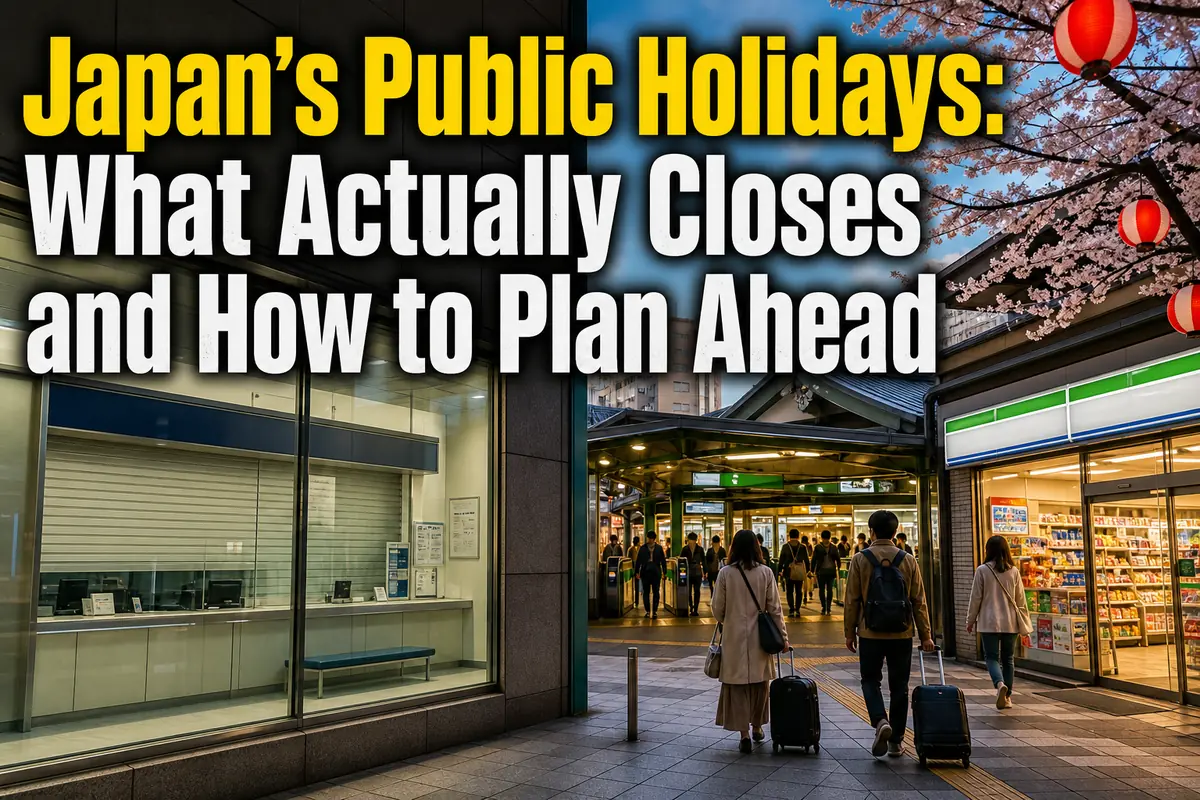
Japan’s Public Holidays: A Practical Guide to Closures, Work, Travel, and Daily Services
A public holiday in Japan does not mean that the whole country shuts down. Government counters, bank branches, schools, and many clinics usually close, while convenience stores, shopping centers, restaurants, and major transport services often remain open.
The safest rule is simple: check the exact office, clinic, store, or transport operator before you go. Hours can differ by municipality, company, branch, and season.
At a glance
- Public offices and bank counters are generally closed.
- Trains and buses usually run, often on a weekend or holiday timetable.
- Convenience stores and many large retailers remain open, but may shorten their hours.
- A national holiday is not automatically a paid day off for every employee.
- Obon and most year-end closure days are widely observed but are not national holidays.
This guide is for new residents, workers, students, and visitors who need to plan appointments, payments, travel, shopping, or medical care around Japan’s holiday calendar.
What counts as a public holiday in Japan?
Japan has 16 statutory national holidays, called kokumin no shukujitsu (国民の祝日), or national holidays. The Cabinet Office publishes the official calendar and explains the legal rules that can create additional days off.
Three terms are especially useful:
- Shukujitsu (祝日): a national holiday established by law.
- Furikae kyūjitsu (振替休日): a substitute holiday created when a national holiday falls on Sunday. The next eligible non-holiday becomes a day off.
- Kokumin no kyūjitsu (国民の休日): a day between two national holidays that becomes a holiday under the law.
These rules can produce a longer break than the list of named holidays suggests. In 2026, for example, Wednesday, May 6 is a substitute holiday. Tuesday, September 22 becomes a holiday because it falls between Respect for the Aged Day and the Autumnal Equinox Day.
ここがポイント: A date marked red on a Japanese calendar tells you that it is a legal holiday. It does not guarantee that every workplace, shop, clinic, or public service will close.
What usually closes?
Administrative and counter services are the most likely to stop. Online systems may remain available, but an application submitted online might not be examined until the next business day.
Municipal and government offices
City halls, ward offices, immigration counters, tax offices, and many other government facilities normally close on Saturdays, Sundays, national holidays, and their designated year-end period.
This matters if you need to:
- register an address after moving;
- submit residence, tax, pension, or health-insurance documents;
- collect a certificate such as a jūminhyō (住民票), or certificate of residence;
- ask staff to correct an application;
- meet a deadline that requires counter service.
Some municipalities open selected counters on certain weekends or offer certificates through convenience-store terminals. These services are local arrangements, not a nationwide holiday rule. Maintenance shutdowns may also suspend online or convenience-store issuance.
Check your municipality’s official website for kaichōbi (開庁日, office days), uketsuke jikan (受付時間, reception hours), and kyūchōbi (休庁日, office closure days).
Banks and financial processing
Bank branches and ordinary counter services generally close on national holidays. The Bank of Japan’s published schedule lists Saturdays, Sundays, national holidays, substitute holidays, and December 31 through January 3 as closure days for its offices in Japan.
ATMs and mobile banking may still work, but availability does not mean every transaction is completed immediately. Depending on the bank and service:
- an ATM may charge a higher fee;
- a transfer may be recorded for the next business day;
- branch-based procedures cannot be completed;
- maintenance may temporarily stop an app, ATM, or card service;
- an overseas remittance may follow both Japanese and foreign banking calendars.
If rent, tuition, a credit-card payment, or another bill is due near a holiday, arrange the funds early. Do not assume that making a transfer late on the holiday will satisfy a same-day processing requirement.
Schools, universities, and childcare
Public schools normally close on national holidays. Universities, language schools, private schools, and childcare facilities follow their own academic or operating calendars.
A university may hold a class on a national holiday and provide a different day off. A childcare center may close even when a parent’s employer remains open. Families and students should therefore check the school calendar rather than relying only on a phone calendar.
Clinics and ordinary medical services
Many neighborhood clinics close on public holidays, but emergency departments and designated holiday clinics continue to serve urgent cases. The available facility depends on the prefecture or municipality.
Before a long holiday period:
- check whether you have enough regular medication;
- note your clinic’s last opening day;
- locate the local holiday or after-hours medical information service;
- keep your health-insurance information and medication record accessible.
For a serious or life-threatening emergency, call 119 for an ambulance. Do not call 119 only to ask which ordinary clinic is open. The Fire and Disaster Management Agency advises people seeking holiday or nighttime treatment information to consult local health authorities or an appropriate local service.
What usually stays open?
Retail, food, and transport services often continue operating because holidays are busy commercial and travel days. Opening is still a business decision, so branch-level confirmation remains important.
Convenience stores and supermarkets
Most major convenience stores remain open, often for their normal hours. Many supermarkets also open, although smaller branches may shorten their schedules.
Remember that an open convenience store does not guarantee that every connected service is available. Ticket systems, bill-payment networks, parcel counters, ATMs, and certificate terminals can each have separate maintenance or processing rules.
Restaurants and shopping centers
Shopping malls, department stores, chain restaurants, cinemas, and leisure facilities often stay open. Some become busier than usual, especially during Golden Week and three-day weekends.
Independent restaurants may close instead. A restaurant’s regular closing day can also move when it overlaps with a holiday—for example, it may open on Monday’s holiday and close on Tuesday.
Trains, subways, and buses
Public transport generally operates on national holidays, but many operators use a Saturday, Sunday, or holiday timetable. Look for:
- heijitsu (平日): weekday;
- doyōbi (土曜日): Saturday;
- nichiyōbi/shukujitsu (日曜日・祝日): Sunday and public holiday;
- kyūjitsu daiya (休日ダイヤ): holiday timetable.
Holiday service can mean fewer commuter trains or buses. At the same time, operators may add reserved trains for major travel periods. Last-train times, local bus connections, and seat availability require separate checks.
Book intercity travel early for Golden Week, Obon, and the year-end/New Year period. Obon is not a national holiday, but the concentration of private leave can make transport extremely busy.
Postal and parcel services
Japan Post states that ordinary mail is generally not delivered on Sundays and holidays, with January 1 treated separately. Express mail, registered mail, Letter Pack, Yu-Pack, and certain other services can still be delivered on holidays.
Post-office counters have their own schedules. Some larger offices provide a yūyū madoguchi (ゆうゆう窓口), an after-hours or holiday counter, but its services and hours vary. Use Japan Post’s official office search instead of assuming that the nearest branch will open.
Police, fire, and emergency response
Police, fire, and ambulance services continue through holidays. For emergencies, use:
- 110 for police;
- 119 for fire or ambulance.
Non-emergency desks, licensing counters, consultations, and administrative services may close or use limited hours.
Does a national holiday mean you do not have to work?
No. Japanese law does not make every national holiday an automatic day off for every worker. Your actual days off depend on your employment contract, work rules, collective arrangements, and shift schedule.
The Labour Standards Act requires employers, in principle, to provide at least one day off each week or four days off during a four-week period. That statutory weekly rest requirement is different from the national-holiday calendar.
This distinction matters in sectors that commonly operate on holidays, including:
- hotels and tourism;
- restaurants and retail;
- hospitals and care services;
- factories with continuous operations;
- transport and delivery;
- security and emergency services.
Check the sections labeled kyūjitsu (休日, days off), shotei kyūjitsu (所定休日, scheduled days off), or shūgyō kisoku (就業規則, work rules). If the documents are unclear, ask your employer whether the holiday is:
- a scheduled day off;
- a normal working day;
- a day worked in exchange for another day off;
- covered by a company-specific premium or allowance.
Do not assume that working on any red-calendar day automatically produces the same premium as working on a statutory weekly rest day. The legal and contractual classification of the day matters. For an individual pay dispute, consult your employer, union, or an official labor consultation service rather than relying only on the calendar.
The 2026 public-holiday calendar
The following dates are from the Cabinet Office calendar current as of August 2026.
January to May
- January 1: New Year’s Day — Ganjitsu (元日)
- January 12: Coming of Age Day — Seijin no Hi (成人の日)
- February 11: National Foundation Day — Kenkoku Kinen no Hi (建国記念の日)
- February 23: The Emperor’s Birthday — Tennō Tanjōbi (天皇誕生日)
- March 20: Vernal Equinox Day — Shunbun no Hi (春分の日)
- April 29: Shōwa Day — Shōwa no Hi (昭和の日)
- May 3: Constitution Memorial Day — Kenpō Kinenbi (憲法記念日)
- May 4: Greenery Day — Midori no Hi (みどりの日)
- May 5: Children’s Day — Kodomo no Hi (こどもの日)
- May 6: Substitute holiday — Furikae kyūjitsu (振替休日)
July to November
- July 20: Marine Day — Umi no Hi (海の日)
- August 11: Mountain Day — Yama no Hi (山の日)
- September 21: Respect for the Aged Day — Keirō no Hi (敬老の日)
- September 22: Holiday created between two national holidays — Kokumin no kyūjitsu (国民の休日)
- September 23: Autumnal Equinox Day — Shūbun no Hi (秋分の日)
- October 12: Sports Day — Sports no Hi (スポーツの日)
- November 3: Culture Day — Bunka no Hi (文化の日)
- November 23: Labor Thanksgiving Day — Kinrō Kansha no Hi (勤労感謝の日)
There is no national holiday in June or December 2026. However, many organizations close for part of late December and early January under their own schedules.
The periods that cause the most disruption
The length of the break matters more than a single holiday. Reservations, deliveries, medical appointments, and administrative processing become harder when several closure days connect.
Golden Week
Golden Week centers on the holidays from late April through early May. In 2026, the May holidays run from Sunday, May 3 through Wednesday, May 6, including the substitute holiday.
Expect:
- crowded trains, airports, highways, and tourist sites;
- higher accommodation prices in popular destinations;
- longer processing times around closed business days;
- limited clinic and municipal-counter availability.
Not every employer closes for the entire period. Some workers use paid leave to connect the holidays, while service-sector staff may be especially busy.
Obon
Obon, usually observed around mid-August in many regions, is not a national holiday. Dates and customs vary, and some areas observe it at another time.
Government offices may remain open on ordinary weekdays, while private companies, clinics, and family-run businesses may close. Transport can be crowded because many people travel to their hometowns. This mix makes Obon less predictable than a statutory holiday.
Year-end and New Year
Only January 1 is a named national holiday, but many offices and companies close for several days around New Year. Banks observe December 31 through January 3 as closure days in addition to weekends and national holidays, while individual retailers and service providers publish their own schedules.
Complete bank-counter transactions, prescription refills, official paperwork, and parcel arrangements before the final business days. January 2 and 3 can affect services even though they are not separately named national holidays.
Local services that need a separate check
Municipal services do not follow one nationwide operating pattern. Your city or ward decides how to handle many everyday services.
Garbage and recycling
A public holiday does not automatically cancel household waste collection. Some municipalities collect normally; others change the schedule, especially around New Year.
Check the local gomi shūshū karendā (ごみ収集カレンダー, garbage collection calendar). Never leave bags out merely because the usual collection day appears on your general calendar.
Libraries, museums, and sports centers
Public facilities may open on a holiday and close the following weekday. Others close on the holiday itself. Special exhibitions and seasonal events can create additional changes.
Look for kyūkanbi (休館日, closed day) and rinji kyūkan (臨時休館, temporary closure) on the facility’s official page.
Local buses and community services
Municipal buses, community buses, welfare transport, and service counters may use holiday schedules different from major railways. Rural routes can be particularly limited, so verify both the outward and return journey.
Common mistakes and how to avoid them
Most holiday problems come from assuming that one calendar applies to every service. A few checks can prevent missed deadlines and unnecessary trips.
- Mistake: Treating every holiday as a guaranteed work-free day. Check your contract, work rules, and shift schedule.
- Mistake: Waiting until the holiday to transfer important money. Allow for bank processing days and possible ATM fees.
- Mistake: Assuming an open store means all in-store services work. Certificate machines, parcel systems, and payment networks may have separate downtime.
- Mistake: Visiting a clinic without checking. Find local holiday medical services before you need them.
- Mistake: Using a weekday train or bus schedule. Look for the Sunday/public-holiday timetable.
- Mistake: Treating Obon as a fixed national shutdown. Confirm each organization’s actual August schedule.
- Mistake: Forgetting the day after a Sunday holiday. It may become a substitute holiday.
A practical checklist before any long weekend
Make your checks two or three business days early whenever money, health, travel, or a legal deadline is involved.
- Confirm your workplace or school calendar.
- Finish municipal, immigration, banking, and postal counter business.
- Check medicine supplies and local holiday medical contacts.
- Review train and bus holiday timetables.
- Reserve long-distance seats and accommodation when needed.
- Check your municipality’s garbage calendar.
- Confirm the exact opening hours of shops and facilities you plan to visit.
The key date is not always the holiday itself. For practical planning, identify the last open business day before the break and act by then.
参照リンク
- Cabinet Office: National Holidays in 2026 and 2027
- Ministry of Health, Labour and Welfare: Working Hours and Days Off
- Ministry of Health, Labour and Welfare: Multilingual Labor Terms
- Bank of Japan: Holiday Schedule
- Japan Post: Frequently Asked Questions
- Japan Post: Search for Post Offices, ATMs, and Postboxes
- Fire and Disaster Management Agency: Guide for Ambulance Services
- Fire and Disaster Management Agency: Emergency and Rescue FAQ