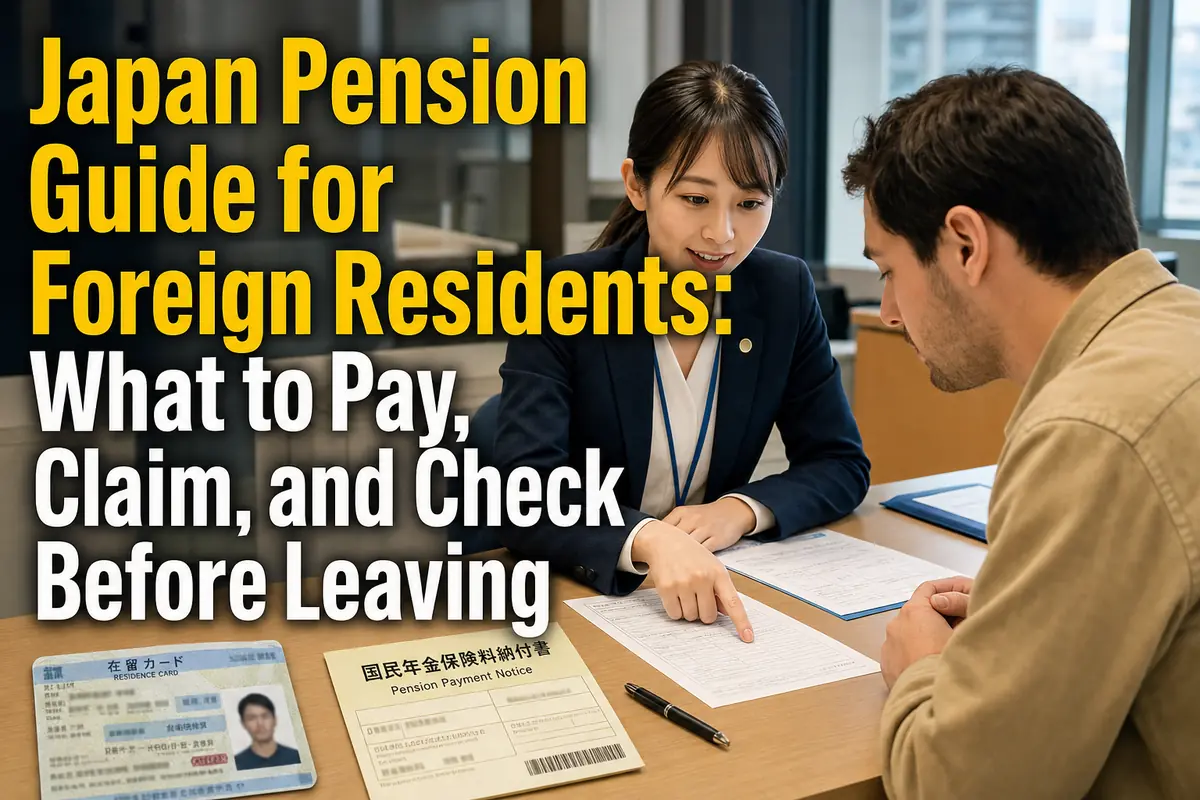
Japan Pension Guide for Foreign Residents: What to Pay, Claim, and Check Before Leaving
If you are registered as a resident of Japan and are aged 20 to 59, you generally must be covered by Japan’s public pension system, regardless of nationality. Employees are usually enrolled through their employer. Students, freelancers, and people between jobs normally handle National Pension procedures themselves.
The system is not only retirement savings. Depending on the conditions, it also provides disability and survivors’ benefits. If you later leave Japan, you may keep your record for a future pension or, if eligible, claim a lump-sum withdrawal payment—but that choice can permanently change what you may claim later.
Information in this guide is current as of August 2026. It is for foreign workers, students, self-employed residents, dependent spouses, and families trying to understand their next step.
The essentials
- Most registered residents aged 20 to 59 must have pension coverage.
- The National Pension contribution is ¥17,920 per month for fiscal year 2026, from April 2026 through March 2027.
- Employees’ Pension contributions are based on salary and bonuses and are shared equally by the worker and employer.
- Ten years of qualifying coverage is generally needed for an old-age pension, although an international agreement may help you reach that threshold.
- Before claiming a lump-sum withdrawal payment, check whether keeping the record could produce a better long-term result.
First identify which pension category applies to you
Your employment and family situation—not your nationality—usually determines who completes the procedure and how contributions are paid.
Japan’s public pension structure has two main layers:
- National Pension (Kokumin Nenkin): the basic system covering registered residents aged 20 to 59.
- Employees’ Pension Insurance (Kosei Nenkin): additional salary-based coverage for eligible company and public-sector workers.
The National Pension system divides insured people into three categories.
Category I: you normally arrange and pay yourself
This group commonly includes:
- Self-employed people and freelancers
- Students
- Unemployed residents
- Workers who are not enrolled in Employees’ Pension Insurance
A Category I resident must generally register at the municipal office for their address within 14 days of becoming eligible. This may apply when you first move into Japan, leave a covered job, or cease to qualify as a dependent spouse.
Category II: your employer handles enrollment
This category covers people enrolled in Employees’ Pension Insurance. At a covered workplace, enrollment is compulsory for eligible workers regardless of nationality; it is not normally something the employer and employee can choose to avoid.
Your employer submits the enrollment paperwork. Pension contributions then appear as deductions on your salary statement, and the employer pays its own matching share.
Part-time employees can also qualify when the legal conditions are met. Do not assume that “part-time” automatically means National Pension. Ask payroll or human resources whether you have been enrolled in Employees’ Pension Insurance and check your pension record afterward.
Category III: an eligible dependent spouse
This category generally applies to an economically dependent spouse, aged 20 to 59, of a Category II member. The spouse’s employer handles the registration, and the Category III member does not make a separate monthly National Pension payment.
Being married is not enough by itself. Dependency, residence, income, and the covered worker’s status matter. Ask the employer to confirm the current requirements when income or work hours change.
How much will you pay in fiscal year 2026?
Category I has a fixed national amount, while Employees’ Pension uses salary and bonus bands. Health insurance, employment insurance, and tax are separate deductions.
National Pension: ¥17,920 per month
For April 2026 through March 2027, the regular National Pension contribution is ¥17,920 a month. A month’s payment is generally due by the end of the following month. For example, April’s contribution is normally due at the end of May.
Japan Pension Service lists these payment methods:
- Payment slips
- Bank account transfer
- Credit card
- Supported smartphone payment apps
- Nenkin Net
Advance payment may provide a discount. Available methods and application timing can differ, so confirm the current details with Japan Pension Service before paying a long period in advance.
Employees’ Pension: based on standardized earnings
Employees’ Pension contributions are calculated from your Standard Monthly Remuneration and, when applicable, your Standard Bonus Amount. These are official pension calculation amounts based on earnings; they may not exactly match the gross amount on one particular payslip.
The total contribution is divided equally between employer and employee. Your employer deducts your share from salary and bonuses and sends both shares to Japan Pension Service.
Check three items on your payslip:
- Whether a Kosei Nenkin or Employees’ Pension deduction appears
- Whether the deduction changes after a major salary change
- Whether bonuses also show a pension deduction
A deduction that looks unfamiliar is not necessarily an error, but payroll should be able to explain the standard remuneration band used.
What to do when you arrive, change jobs, or stop working
The greatest risk is a gap between statuses—for example, after leaving one employer but before joining another.
After registering your address in Japan
If you are aged 20 to 59 and will not immediately enter Employees’ Pension through an employer, visit the pension counter at your city, ward, town, or village office. The official procedure for Category I enrollment is generally due within 14 days.
Bring or prepare documents that identify you and your pension record. Depending on the procedure, officials may ask for:
- Residence card or another identity document
- My Number information
- Basic Pension Number Notice or another document showing your Basic Pension Number, if already issued
- Student identification or enrollment certificate when applying for the student system
- Documents about income, unemployment, or a spouse when applying for an exemption
The precise document list can vary with the application and your circumstances. Check the municipality or Japan Pension Service before visiting.
When you start a covered job
Give your employer the information needed to connect enrollment to your existing Basic Pension Number. Do not obtain or use a second pension number simply because you changed jobs or your name is written differently. Duplicate records can make it harder to verify your full history later.
After enrollment, check that the employer name and covered months appear correctly in your pension record.
When you leave a job
Employees’ Pension coverage through that employer ends. If you remain in Japan and do not immediately enter another covered job, you may need to switch to Category I. An eligible spouse may instead qualify for Category III through their partner’s employer.
Do not wait for a payment slip before asking. A delayed category change can create several months of back payments at once.
ここがポイント: A job resignation does not end your obligation to have pension coverage while you remain an eligible resident. It usually changes who must register you and how the contribution is paid.
If you cannot afford National Pension contributions
Apply for an exemption or postponement instead of ignoring the bills. An approved period can protect your pension record in ways that simple non-payment does not.
Japan has several forms of relief for Category I members facing financial difficulty.
Contribution exemption
Approval can depend on the previous year’s income of the applicant, spouse, and head of household. For fiscal year 2026, the official partial-exemption amounts leave the applicant paying:
- Three-quarter exemption: ¥4,480 per month
- Half exemption: ¥8,960 per month
- One-quarter exemption: ¥13,440 per month
- Full exemption: no contribution for the approved months
With a partial exemption, you must pay the remaining amount. If you do not, the period is treated as unpaid rather than partially exempt.
Approved exemption periods can count toward the qualifying period for an old-age pension, but they normally produce a lower pension amount than fully paid months.
Student Special Payment System
A student whose income is below the applicable limit may apply to postpone payments. Student status does not automatically remove the obligation, and the school must generally be covered by the scheme.
This application is usually made for a defined academic or fiscal period. Check whether you must apply again when the new period starts.
Payment postponement and later recovery
Other qualifying residents may be able to postpone contributions. Approved exempted or postponed amounts can generally be paid later for up to 10 years, although an additional amount may apply when older periods are recovered after a certain time.
An application commonly covers no more than one year. If financial difficulty continues, plan to renew it rather than assuming approval continues automatically.
What benefits can foreign residents receive?
Nationality does not by itself prevent an insured person or eligible family from receiving pension benefits. Each benefit has its own coverage, payment, disability, age, or family requirements.
Old-age pension
You can generally receive the Old-age Basic Pension from age 65 after accumulating at least 10 years of qualifying periods. Paid months, certain approved exemption periods, and Employees’ Pension coverage can contribute to that test.
For fiscal year 2026, the full Old-age Basic Pension is ¥847,300 per year for a person with 40 years of fully paid coverage. A shorter record or exempted months usually results in a lower amount.
A person with Employees’ Pension coverage may receive an earnings-related Old-age Employees’ Pension in addition to the basic pension. Even one month of Employees’ Pension coverage can matter once the person satisfies the basic old-age pension qualification requirements.
Disability benefits
Public pension also provides protection before retirement. Disability Basic Pension may be available when a person has a legally specified Grade 1 or Grade 2 disability and meets rules concerning the first medical examination and contribution record.
For fiscal year 2026, the standard annual amounts are:
- Grade 1: ¥1,059,125
- Grade 2: ¥847,300
Possible additions for eligible children and Employees’ Pension disability benefits depend on the case.
The date of the first medical or dental consultation for the underlying illness or injury can be crucial. Keep clinic records and seek guidance early; reconstructing that date years later can be difficult.
Survivors’ benefits
Eligible family members may receive a survivors’ pension after an insured person dies. Survivors’ Basic Pension mainly protects a dependent spouse caring for eligible children, or the eligible children themselves. Employees’ Pension has a separate survivors’ benefit with different eligible-family rules.
These benefits are not automatic in every case. Contribution history, dependency, family relationship, and the insured person’s status at death all affect eligibility.
Social security agreements can change the calculation
Before treating your Japanese record as too short, check whether Japan has an agreement with a country where you were previously insured.
Social security agreements can serve two separate purposes:
- Preventing compulsory contributions in both countries during certain temporary assignments
- Combining, or “totalizing,” coverage periods to meet a minimum qualification period
As of August 2026, Japan has agreements in force with 24 countries. Austria’s agreement entered into force on December 1, 2025.
However, not every agreement provides both functions. The agreements with the United Kingdom, Republic of Korea, China, and Italy cover elimination of dual coverage but not totalization. Each agreement also defines which systems and workers it covers.
Totalization does not normally mean that one country transfers your money to the other. Each country generally calculates and pays its own benefit under its rules, using the combined periods only where the agreement permits.
Temporary assignees may need a Certificate of Coverage from the appropriate institution. Do not rely on nationality or an overseas payslip as proof that Japanese enrollment is unnecessary.
Leaving Japan: pension or lump-sum withdrawal?
Do not treat the lump-sum payment as an automatic refund of everything deducted from your salary. It is a separate benefit with conditions, a limited calculation period, and permanent consequences for your Japanese record.
A non-Japanese person may be eligible to claim after leaving Japan when all required conditions are met. Key conditions include:
- You do not have Japanese nationality.
- You no longer have an address in Japan.
- You are no longer covered by the relevant Japanese pension system.
- You have at least six months of qualifying National Pension payments or Employees’ Pension coverage.
- You have never become entitled to receive a Japanese pension, including relevant disability benefits.
- You file within two years from the date you cease to have an address in Japan.
Submitting a moving-out notification to the municipality is therefore an important practical step. Leaving on a re-entry permit without removing your registered address may delay when you can satisfy the claim conditions.
The decision you cannot undo
Once a lump-sum withdrawal payment is granted, all Japanese pension periods before that claim are no longer usable for a future pension. This applies even when the payment calculation uses fewer months than your complete record.
Before claiming, ask:
- Could I return to Japan and build a 10-year qualifying record?
- Can an international agreement totalize my Japanese and overseas coverage?
- Am I already close to 120 qualifying months?
- Is a future pension payable to me overseas?
- Does my family need the protection connected to keeping the record?
A person who already has at least 120 months of qualifying periods generally cannot claim the lump sum because they can qualify for a future Japanese old-age pension.
Tax on an Employees’ Pension lump sum
Japan generally withholds 20.42% income tax from an Employees’ Pension lump-sum withdrawal payment made to a non-resident. A qualifying claimant may seek a refund through a Japanese tax procedure, often using a tax representative appointed before departure.
A National Pension lump-sum withdrawal payment is handled differently and is not subject to the same withholding described above. Tax circumstances vary, so confirm the current procedure with Japan’s National Tax Agency or a qualified adviser.
Common mistakes that create expensive gaps
Most pension problems begin with a missed status change, an ignored notice, or a decision made without checking the complete record.
Avoid these common errors:
- Assuming foreigners or short-term residents are automatically exempt
- Believing a student visa removes the need to enroll
- Ignoring invoices instead of applying for an exemption or postponement
- Failing to change from Employees’ Pension to National Pension after leaving a job
- Using different or duplicate Basic Pension Numbers
- Assuming every international agreement allows totalization
- Claiming a lump sum without considering a return to Japan
- Waiting until after departure to collect pension and tax documents
- Confusing pension deductions with health insurance or resident tax
Keep copies of enrollment notices, exemption decisions, payslips, and documents showing your Basic Pension Number. Use Nenkin Net to review covered workplaces, National Pension payment months, standard remuneration, and benefit estimates where available.
Practical checklist for your next action
Your next step depends on what is changing now—not simply on how long you have lived in Japan.
If you have just arrived
- Confirm whether your employer will enroll you.
- If not, ask your municipality about Category I enrollment within 14 days.
- Keep your Basic Pension Number Notice in a secure place.
If you are a student or have low income
- Enroll first if required.
- Apply for the appropriate student, exemption, or postponement system.
- Note the approval period and renewal date.
If you are changing or leaving a job
- Confirm the final month of Employees’ Pension coverage.
- Ask the next employer when new coverage begins.
- Register as Category I for any uncovered period, if required.
If you plan to leave Japan
- Review your complete pension record before departure.
- Check the relevant social security agreement.
- Compare a future pension with a lump-sum withdrawal.
- Submit municipal moving-out procedures correctly.
- Keep a Japanese bank, tax representative, or overseas-payment arrangements only where the relevant procedure requires them.
The most important watchpoint is the choice made at departure. A lump sum can provide money sooner, but retaining the record may preserve access to a lifetime old-age pension—especially if you may return or can totalize coverage under an agreement. Check your exact months and agreement status before signing the claim.
参照リンク
- Japan Pension Service: Enrollment in National Pension
- Japan Pension Service: National Pension Contributions
- Japan Pension Service: Exemption of National Pension Contributions
- Japan Pension Service: Enrollment in Employees’ Pension Insurance and Employees’ Health Insurance
- Japan Pension Service: Employees’ Pension Insurance Contributions
- Japan Pension Service: Old-age Basic Pension
- Japan Pension Service: Disability Basic Pension
- Japan Pension Service: Apply for Pension Benefits
- Japan Pension Service: Lump-sum Withdrawal Payments
- Japan Pension Service: Status of Social Security Agreements in Force
- Japan Pension Service: Rules and Applications for Social Security Agreements