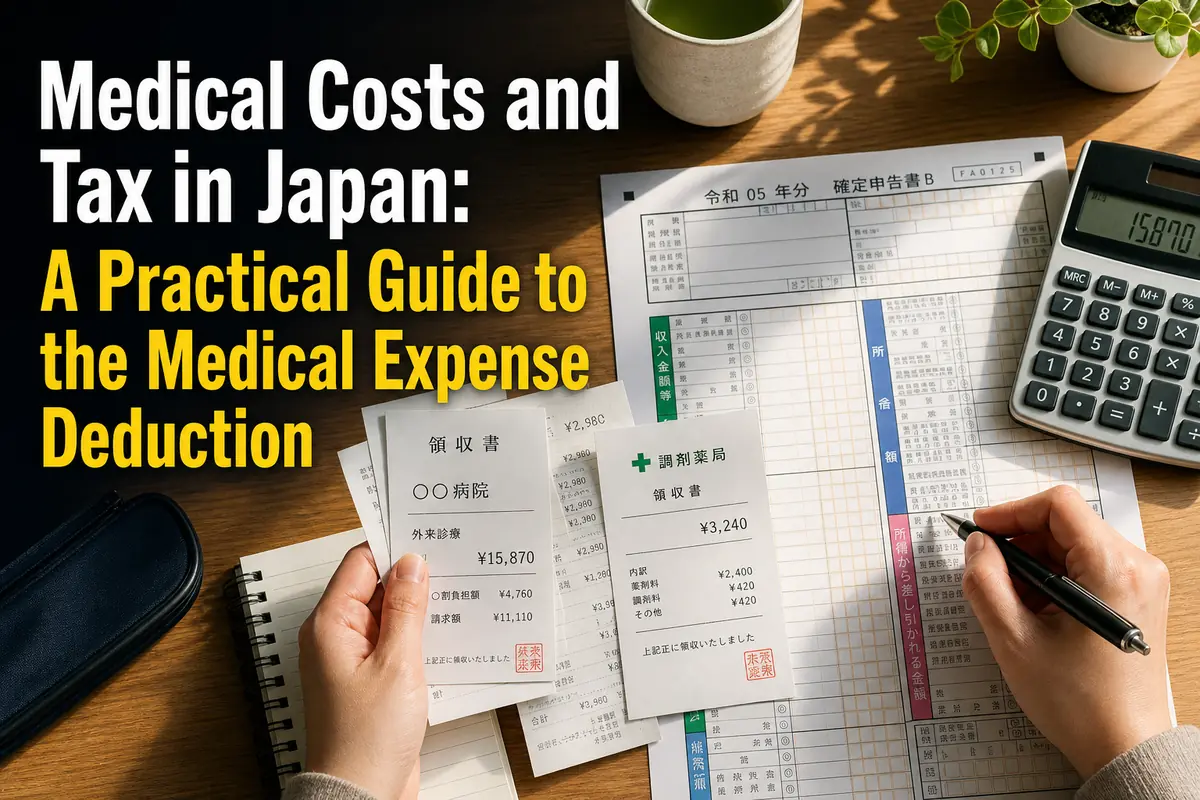
Medical Costs and Tax in Japan: A Practical Guide to the Medical Expense Deduction
Japan’s medical expense deduction can reduce your taxable income when you pay substantial healthcare costs during a calendar year. It is not a reimbursement of the full bill, and reaching ¥100,000 does not mean that ¥100,000 will be returned to you.
The deduction is claimed through a final tax return, called kakutei shinkoku (確定申告). Employees cannot claim it through the usual year-end adjustment alone.
This guide is for workers, students, long-term residents, and other taxpayers who pay medical costs in Japan for themselves or family members sharing the same household finances.
The essentials:
- Count eligible amounts actually paid from January 1 through December 31.
- Subtract insurance benefits and other payments that covered those expenses.
- The usual threshold is ¥100,000, or 5% of total income when total income is below ¥2 million.
- The deduction reduces taxable income; your actual tax saving depends on your tax position.
- You must file a tax return and normally keep supporting receipts for five years.
How the deduction works
The central calculation is simple, but three figures must be kept separate: your medical spending, compensation received, and the applicable threshold.
The basic formula
The ordinary medical expense deduction, iryōhi kōjo (医療費控除), is calculated as follows:
Eligible medical expenses paid
− payments that compensated those expenses
− the applicable threshold
= medical expense deduction
The maximum deduction is ¥2 million.
The threshold is normally:
- ¥100,000 if your sō shotoku kingaku tō (総所得金額等), broadly your total income for this calculation, is ¥2 million or more
- 5% of that total income if it is below ¥2 million
“Total income” is not necessarily the salary printed at the top of a payslip. If the lower-income rule may apply, use the figure calculated in your return or ask a tax office to confirm it.
A worked example
Suppose you paid the following during one calendar year:
- Hospital and clinic charges: ¥220,000
- Eligible prescription and pharmacy costs: ¥30,000
- Eligible train and bus fares for treatment: ¥20,000
- Total eligible spending: ¥270,000
- Insurance benefit covering part of a hospital bill: ¥50,000
If your threshold is ¥100,000, the calculation is:
¥270,000 − ¥50,000 − ¥100,000 = ¥120,000
The ¥120,000 is deducted from taxable income. It is not the amount automatically refunded. The effect depends on factors including your taxable income, income tax rate, tax already withheld, and other deductions.
If no income tax was withheld and you made no advance tax payments, an income-tax refund may not be available even when an expense qualifies.
ここがポイント: The deduction does not make healthcare free. It reduces the income on which tax is calculated, and only the person who actually paid the eligible expenses can claim them.
Whose medical expenses can you include?
You may generally include eligible expenses paid for yourself and relatives who share the same source of living expenses with you.
The Japanese expression is seikei o itsu ni suru (生計を一にする), meaning that you share household finances or support one another financially. It can cover a spouse, children, parents, and other relatives where the conditions are met.
Living at the same address is not the only test
A relative does not always have to live in the same home. The National Tax Agency explains that relatives living apart for work, study, or medical care may still share the same livelihood when living, education, or treatment costs are regularly sent to them.
However, family relationship alone is not enough. The facts must show shared financial support.
The payer matters
The claim normally belongs to the person who paid the expense. A medical notice may show one insured person’s name, but that does not automatically decide who may deduct the cost.
For couples or families, check:
- Who paid the clinic or pharmacy
- Whether the patient and payer shared the same livelihood
- Whether another family member has already included the same amount
- Which insurance benefit related to that payment
The same bill cannot be claimed twice. Do not move expenses between family members after payment merely to produce a larger tax result without checking whether that reflects who actually paid.
Expenses that commonly qualify
The test is whether the cost was normally necessary for diagnosis, treatment, or medical care. The public-insurance status of a service does not by itself settle the tax question.
Common eligible expenses can include:
- Fees for diagnosis or treatment by a doctor or dentist
- Prescription medicine
- Nonprescription medicine bought to treat an illness or injury
- Hospital room and meal charges that are ordinarily necessary for treatment
- Certain treatment by licensed practitioners, such as acupuncture or therapeutic massage
- Certain medical devices needed directly for treatment
- Certain childbirth and nursing-care expenses
- Public transportation needed to visit a medical provider
Keep enough information to identify the patient, provider, date, purpose, amount paid, and any related compensation.
Transportation needs careful records
Train and bus fares for necessary visits can qualify even when no receipt is issued. Record each journey while the details are fresh:
- Date
- Patient’s name
- Medical facility
- Route
- Reason for travel
- Fare paid
Taxi fares are generally excluded when trains or buses could reasonably be used. They may qualify where public transportation was unavailable or the patient’s condition made it impractical. Write down why the taxi was necessary and keep the receipt.
Fuel, tolls, and parking charges for a private car do not normally qualify as medical expenses.
Treatment and prevention are treated differently
Medicine purchased to treat a cold may qualify under the ordinary deduction. Vitamins, supplements, vaccinations, and other spending mainly intended to prevent illness or improve general health normally do not.
A health examination is also generally outside the ordinary deduction when it is only a routine check. Special treatment may apply when an examination discovers a serious condition and treatment follows, so retain the documents and confirm the rule if this affects your claim.
Costs that are often excluded
A payment from a hospital, dental clinic, pharmacy, or health-related business is not automatically deductible.
Common exclusions include:
- Cosmetic surgery performed only to change appearance
- General health products and supplements
- Routine health examinations with no qualifying connection to later treatment
- Vaccinations and other preventive expenses under the ordinary deduction
- Ordinary eyeglasses or contact lenses used to correct vision
- Private-room upgrades chosen for personal comfort rather than medical need
- Gifts or gratuities paid to medical staff
- Taxi fares where suitable public transportation was available
- Private-car fuel and parking charges
The purpose matters. For example, an item that is ordinarily a personal purchase may be treated differently when a doctor requires it directly for treatment. Keep the prescription, instruction, or certificate supporting that connection.
Subtract insurance benefits correctly
Before applying the threshold, subtract amounts that compensated the relevant medical cost.
Examples may include:
- Hospitalization benefits from private insurance
- High-cost medical expense benefits, kōgaku ryōyōhi (高額療養費)
- Health-insurance reimbursements
- Childbirth lump-sum benefits
- Other payments intended to cover a particular medical charge
The compensation is matched to the expense it covers. If a benefit exceeds that particular expense, the excess is not automatically subtracted from unrelated medical bills.
For example, if a ¥120,000 insurance benefit relates to a ¥100,000 hospital charge, the deductible amount for that charge becomes zero. The extra ¥20,000 is not normally used to reduce an unrelated dental bill.
A pending benefit creates a practical problem because you may not know the final net cost when preparing the return. Use the official instructions for estimating or later correcting the amount, or ask the relevant tax office before filing.
Ordinary deduction or self-medication tax system?
For 2026 expenses, some taxpayers may instead consider the self-medication tax system, self-medication zeisei (セルフメディケーション税制). You cannot use both systems for the same tax year.
Under the rules applying to eligible purchases through December 31, 2026, the special system generally deducts qualifying medicine purchases above ¥12,000, after compensation, up to a maximum deduction of ¥88,000. The claimant must also have completed a specified health-maintenance or disease-prevention activity, such as an eligible health check or vaccination.
The ordinary and special systems serve different spending patterns:
- The ordinary deduction can cover a broad range of eligible treatment costs, but its threshold is usually higher.
- The self-medication system has a lower ¥12,000 starting point, but only designated medicines count.
- A package or receipt may carry a mark identifying an eligible medicine, but the official product rules should be checked.
- Once one system has been selected in a return, the National Tax Agency states that the choice cannot be switched through an amended return or request for correction.
Calculate both before filing, then choose one. Do not compare only the amount spent; compare the resulting deduction.
Because the current statutory period for this special system reaches the end of 2026, anyone filing for purchases made from 2027 onward should check the latest National Tax Agency and Ministry of Health, Labour and Welfare guidance.
What to collect during the year
Good recordkeeping begins when you pay, not when filing season starts.
Create one folder or spreadsheet for each calendar year and retain:
- Clinic, hospital, dental, and pharmacy receipts
- A log of eligible train, bus, and exceptional taxi journeys
- Insurance benefit and reimbursement notices
- The annual iryōhi tsūchi (医療費通知), or medical expense notice, from your insurer
- Certificates required for special expenses
- Proof of qualifying medicine purchases if comparing the self-medication system
- Documents showing who paid family expenses when this is not obvious
Do not rely on the medical expense notice alone
An insurer’s medical expense notice can simplify the statement, and eligible data may be imported through MynaPortal. However, check it against your own records.
The notice may not include:
- Eligible public transportation
- Some medicine bought outside the insurance system
- Medical care not processed through that insurer
- Amounts paid late in the year that were not yet included
- Corrections or later insurance payments
It may also show an amount that differs from what you ultimately paid. Reconcile the figures instead of copying the notice without review.
How to claim the deduction
The deduction is claimed on a final income tax return. It is not one of the deductions completed solely through an employer’s nenmatsu chōsei (年末調整), or year-end adjustment.
Step 1: Sort expenses by person and provider
Group the records by:
- Person who received treatment
- Hospital, clinic, dentist, or pharmacy
- Amount paid
- Related insurance compensation
- Transportation and other separately recorded costs
Remove personal, preventive, cosmetic, and otherwise ineligible items.
Step 2: Prepare the medical expense statement
Complete the iryōhi kōjo no meisaisho (医療費控除の明細書), or Statement of Deduction for Medical Expenses.
A qualifying medical expense notice can reduce the amount of detail you must enter. If you file electronically, the NTA’s return preparation service also supports manual entry, an expense aggregation form, and eligible MynaPortal data.
Step 3: Complete the return
You can generally use the National Tax Agency’s online return preparation service and e-Tax, or submit the required forms on paper.
Depending on your circumstances, prepare items such as:
- Your annual withholding slip, gensen chōshūhyō (源泉徴収票)
- My Number information and identity documents
- Income and deduction information not already imported
- The medical expense statement
- Details of the bank account to receive a refund
Filing a refund return means reporting the income that must be included in that return. Do not submit only the medical figures while omitting another job, side income, or other reportable income.
Step 4: Keep the receipts
You normally submit the statement rather than attaching every receipt. The tax office may request receipts used to prepare it, so keep the applicable originals for five years from the relevant filing deadline or submission date under the NTA rules.
Records covered by a qualifying medical expense notice may be treated differently. Follow the instructions for the exact filing method you use.
Filing dates and late claims
A normal final return generally covers income and expenses from January 1 through December 31 and is filed in the following year.
For a person who was not otherwise required to file and is submitting a refund return, the NTA generally allows filing from January 1 of the following year for five years. This can help employees who discover an older unclaimed medical deduction.
Deadlines can work differently when you were required to file, already filed, need to correct a return, or use another provision with a fixed deadline. Check the rules for the particular tax year rather than assuming the five-year refund period solves every case.
Common mistakes to avoid
Most problems come from counting the wrong amount or losing the link between a payment and its medical purpose.
- Treating ¥100,000 as a refund: It is usually the threshold before a deduction begins.
- Using gross salary for the 5% test: The rule refers to total income as defined for tax purposes.
- Counting costs by treatment date: The ordinary rule uses the year in which payment was actually made.
- Forgetting compensation: Insurance and public benefits covering an expense must be considered.
- Subtracting excess compensation from every bill: Match it to the expense it was intended to cover.
- Claiming private-car costs: Fuel and parking are normally excluded.
- Including preventive or cosmetic spending: The medical purpose is essential.
- Claiming the same family bill twice: Confirm who paid it and whose return includes it.
- Choosing the self-medication system too early: Calculate both systems before making the final choice.
- Discarding receipts after e-filing: Keep records for the required period.
Questions foreign residents often have
Does nationality or visa type decide eligibility?
The deduction is part of Japan’s income tax system, not a health-insurance refund or immigration benefit. Your tax status, the income included in your Japanese return, who paid the expense, and the relationship to the patient are important. A residence card alone does not establish the answer.
People who arrived in or left Japan during the year, have overseas income, or may be treated as non-residents should obtain individual guidance before filing.
Can treatment outside Japan qualify?
Cross-border cases require care. Tax residence, the nature of the treatment, payment evidence, exchange-rate conversion, shared-livelihood rules, and insurance compensation may all matter. Keep itemized records and translations, then confirm the treatment with the tax office or a qualified tax professional.
Does public health insurance enrollment guarantee eligibility?
No. Health insurance determines how a medical bill is covered, while the tax deduction has its own conditions. Conversely, a cost outside public insurance is not automatically excluded if it otherwise meets the tax rules.
Can an employer process it at year-end?
Not through the ordinary year-end adjustment. Employees generally need to submit a final return or refund return.
Where can I get help?
Use the National Tax Agency website, the tax office responsible for your address, or a qualified Japanese tax professional. Municipal consultation counters may offer filing-season help, but availability and language support vary by city.
Bring your receipts, medical expense notice, benefit statements, income documents, identification, and a written list of questions. Showing the actual records is more useful than asking whether “medical costs” qualify in general.
Practical checklist before filing
The safest final review is short and specific:
- Confirm that every amount was actually paid within the calendar year.
- Separate treatment costs from preventive, cosmetic, and personal spending.
- Add eligible transportation that does not appear on the insurer’s notice.
- Match each reimbursement or benefit to the bill it covered.
- Confirm who paid family expenses and whether the shared-livelihood condition is met.
- Calculate both the ordinary deduction and self-medication alternative when relevant.
- Check the NTA instructions for the tax year being filed.
- Keep receipts and supporting records after submission.
For 2026 spending, the most useful action is to start the record now: note transportation, retain benefit notices, and separate treatment medicine from general health purchases. Those small records determine whether a valid deduction can be calculated when the return is prepared in 2027.
参照リンク
- National Tax Agency: Medical expense deduction (Japanese)
- National Tax Agency: Eligible medical expenses (Japanese)
- National Tax Agency: Procedures for the medical expense deduction (Japanese)
- National Tax Agency: Medical expense deduction statement and receipt-retention guidance (Japanese)
- National Tax Agency: Meaning of sharing the same livelihood (Japanese)
- National Tax Agency: Refund returns (Japanese)
- National Tax Agency: Final tax returns (English)
- National Tax Agency: Ordinary deduction and self-medication system cannot be combined (Japanese)
- National Tax Agency: Self-medication tax system (Japanese)
- e-Tax: Entering medical expense deductions (Japanese)
- Ministry of Health, Labour and Welfare: Self-medication tax system (Japanese)