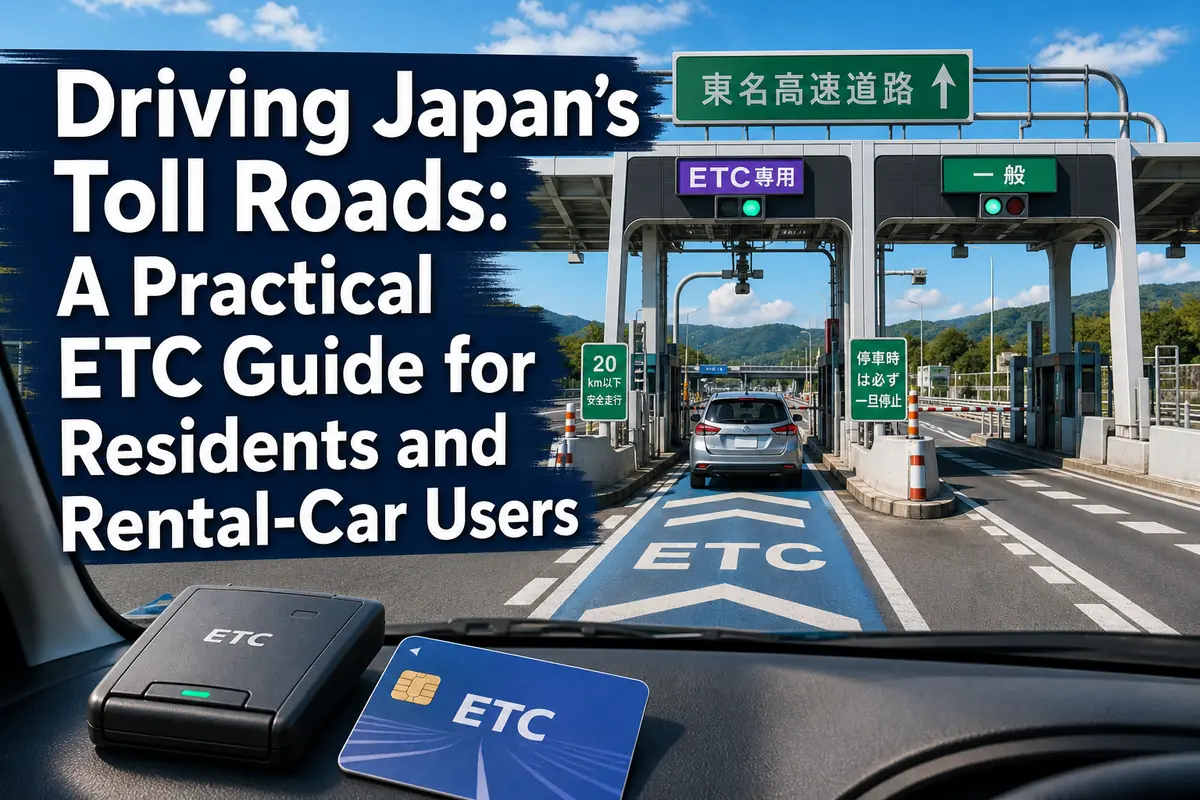
Driving Japan’s Toll Roads: A Practical ETC Guide for Residents and Rental-Car Users
ETC is Japan’s automatic highway-toll system. To use it, a vehicle needs both a working ETC onboard unit and a valid ETC card. Most rental cars already have the unit, but the card may need to be reserved separately.
Without ETC, you can still use many ordinary toll gates and pay in cash or by an accepted credit card. However, Japan is expanding ETC-only toll gates, so checking your route before departure is becoming increasingly important.
What you need to know before driving
- An ETC card is not the same thing as an ordinary credit card.
- The card must be inserted into a correctly set up onboard unit.
- Rental companies may lend ETC cards, but availability and fees vary.
- ETC lanes require drivers to slow to 20 km/h or less and wait for the barrier to open.
- Smart interchanges and ETC-only toll gates cannot normally be used without working ETC equipment.
This guide is for new residents, international students, workers, long-term residents, and visitors planning to drive a rental or privately owned car in Japan. Information is current as of August 2026, but tolls, discounts, passes, and ETC-only locations can change.
What ETC does—and what it does not do
ETC handles toll payment automatically, but the card and the machine have different jobs.
ETC, short for Electronic Toll Collection, uses wireless communication between an antenna at the toll gate and an onboard unit called an ETC shasai-ki (ETC車載器, ETC onboard unit). The ETC card identifies the payment account.
You therefore need both:
- A vehicle with a properly installed and registered ETC onboard unit
- A valid ETC card inserted in the correct direction
The card alone cannot communicate with the toll gate. Likewise, a car marked “ETC-equipped” cannot pay automatically if no valid card is inside the unit.
ETC card, credit card, and onboard unit
These three items are easy to confuse:
- ETC card: A dedicated IC card used to settle road tolls. It usually cannot be used for ordinary shopping.
- Parent credit card: The regular credit card account connected to an ETC credit card. The toll normally appears later on this account’s statement.
- ETC onboard unit: The reader installed in the vehicle. It stores vehicle-category information and communicates with toll equipment.
The toll is calculated using the road, entry and exit points, vehicle category, and applicable toll rules. ETC does not create one flat nationwide price.
How highway tolls are calculated
The practical rule is simple: check the exact route instead of estimating from distance alone.
Many intercity expressway tolls depend on the distance traveled and the vehicle category. Urban systems, bridges, tunnels, and roads operated by other companies may use different charging structures. A route crossing several networks can therefore produce separate charges.
Factors that can change the total include:
- Entry and exit interchanges
- Vehicle class, such as a standard passenger car or light vehicle
- The expressway operator
- The route recognized by the toll system
- Time- or day-based ETC discounts
- Use of an eligible regional pass or drive plan
- Travel outside a pass’s area or validity period
Use an official route-and-toll calculator before a long trip. The rental company’s vehicle class and pickup office also matter when checking a rental-car pass.
A toll shown at the gate may not be your final pass charge
Some regional rental-car expressway passes allow qualifying drivers to use covered roads for a fixed price. Even then, an ETC display may show the normal toll as the car passes a gate.
That display does not always mean the same amount will be collected. If the journey satisfies the pass conditions, covered tolls are handled under the pass. Roads outside the designated area, travel outside the booked period, and roads run by a nonparticipating operator can create additional charges.
Never assume that “unlimited travel” covers every toll road in the region. Check:
- The participating rental-car branches
- The covered road map
- The permitted dates
- The treatment of journeys that cross the coverage boundary
- Charges on urban expressways or roads run by another operator
Using ETC in a rental car
For a rental car, the most important question is not merely whether the car has ETC. Ask whether both the equipment and a usable card will be available.
Before making the reservation
Confirm these points with the rental company:
- Is the vehicle equipped with an ETC onboard unit?
- Can you reserve an ETC card at the pickup branch?
- Is there a rental or handling fee for the card?
- How and when are tolls settled?
- Is a regional expressway pass available for your route and dates?
- What happens if you return the car to a different branch?
Card availability can vary by company, office, and season. Reserve early when driving during national holidays or other busy travel periods.
At the rental counter
Ask the staff to show you the reader and confirm that the card has been recognized. The machine may announce its status in Japanese.
Useful terms include:
- ETC kādo (ETCカード): ETC card
- shasai-ki (車載器): onboard unit
- sōnyū (挿入): insertion
- yūkō kigen (有効期限): expiration date
- riyō ryōkin (利用料金): usage charge
- tsūkō-ryō (通行料): road toll
Also ask how to review the toll record. With a borrowed card, the rental company commonly calculates applicable tolls when the vehicle is returned. The exact procedure belongs to the rental contract, not to one national rule.
During the trip
Keep the same ETC card inserted from entry to exit. Do not swap cards midway through a journey.
Before entering the expressway:
- Start the vehicle in a safe parked location.
- Insert the card fully in the direction shown on the reader.
- Listen for the confirmation message or check the status light.
- Confirm the card has not expired.
- Plan an entrance that accepts your payment method.
Do not handle the card while driving.
When returning the vehicle
Remove personal ETC cards before leaving the car. If the card belongs to the rental company, follow its return instructions.
Check the final statement for:
- Card rental or handling fees
- Ordinary tolls
- Travel outside a pass area
- Travel outside the booked pass period
- Roads excluded from the pass
Keep the rental receipt and toll statement until you have confirmed the final amount.
ここがポイント: “ETC-equipped car” describes the machine in the vehicle. It does not guarantee that an ETC card is included with the rental.
Can you use your own ETC card in a rental car?
A personal ETC card can generally be used in another correctly equipped vehicle, including a rental car. The resulting tolls are billed to the account connected to that card.
This can be convenient for residents who already have a Japanese-issued ETC card. When reserving, specify an ETC-equipped vehicle, then insert your card only after receiving the car.
There are still several checks to make:
- Confirm that your card issuer permits the intended use.
- Make sure the card is valid for the full rental period.
- Check whether a promotional pass requires the rental company’s designated card instead.
- Remove your card before returning the vehicle.
A foreign credit card by itself is not a substitute for an ETC card. Visitors who do not already hold a compatible ETC card should ask the rental company about card rental rather than assuming one will be supplied.
Options for residents without a standard ETC credit card
Residents who cannot or do not want to obtain an ETC card linked to a credit card can investigate the deposit-based ETC Personal Card.
The application process is separate from simply renting a car. NEXCO EAST’s current guidance says applications are handled by mail, identity documents are required, and a deposit is set according to expected highway use, with a minimum deposit of ¥20,000. It also says delivery takes about two weeks after the deposit is confirmed.
This option is more relevant to residents who drive regularly than to short-term visitors. Review the current application rules and costs before applying.
How to pass through an ETC toll lane safely
The barrier is not an invitation to maintain normal road speed. Slow down early and be ready to stop.
At an ordinary ETC lane:
- Follow signs showing ETC or ETC専用 (ETC senyō, ETC only).
- Reduce speed to 20 km/h or less before entering.
- Leave enough space behind the vehicle ahead.
- Confirm that the barrier has opened.
- Accelerate only after passing the gate safely.
Do not change lanes sharply near a toll plaza. A vehicle ahead may stop because of a card error or failed communication.
Smart interchanges are different
A Smart IC (スマートIC, Smart Interchange) is an interchange intended for vehicles using ETC. Many require the vehicle to make a complete temporary stop before the barrier so communication can begin.
Smart interchanges can also have restrictions involving:
- Opening hours
- Permitted entry or exit directions
- Vehicle categories
- Temporary closures
Check the specific interchange before relying on it. A route suggested by a navigation app may be unusable if your vehicle has no working ETC setup or does not meet that interchange’s conditions.
What to do if the barrier does not open
Stop without reversing or leaving the vehicle. Reversing in a toll lane is dangerous because another vehicle may be approaching from behind.
Use the intercom or wait for instructions from the toll-gate staff. Follow the operator’s directions for confirming your entry point and arranging payment.
Common causes include:
- No card in the reader
- A card inserted in the wrong direction
- An expired or unreadable card
- Removal of the card before the trip was complete
- A communication problem
- Use of a lane that does not support the intended payment method
If you notice a card problem before reaching the toll plaza, do not stop on the roadway. Continue to a safe place such as a service area or parking area before checking the equipment.
Driving without ETC
Many conventional toll gates still accept drivers without ETC, but lane selection matters.
At an entrance, use a lane marked 一般 (ippan, general) and take the toll ticket if one is issued. Keep it until the exit. At the exit, enter a general lane, give the ticket to the attendant or insert it into the payment machine, and pay using an accepted method.
Depending on the toll gate, payment may include:
- Japanese yen in cash
- An accepted credit card
- ETC through a mixed ETC/general lane
Not every road or facility offers the same options. Cash acceptance at one interchange does not prove that the planned exit will accept a non-ETC vehicle.
ETC-only toll gates are expanding
The road operators continue to convert toll gates to ETC-only operation. For example, NEXCO West states that 30 additional toll gates became ETC-only in spring 2026, following other conversions in 2023, 2024, and 2025.
At an ETC-only toll gate:
- Cash is not accepted.
- An ordinary credit card cannot be handed over for payment.
- An ETC card cannot simply be handed to an attendant.
- The card must be working inside a compatible onboard unit.
If you reach one by mistake without usable ETC, enter a lane marked ETC/サポート or サポート when available, stop, and follow the instructions. Do not force your way through an ETC-only lane.
This expansion changes trip planning for drivers who rely on cash. Before departure, check the current official ETC-only map and identify a suitable alternative interchange.
ETC discounts are not automatic in every case
Using an ETC card can make certain discounts available, but paying with the card does not guarantee every advertised discount.
Some discounts require wireless ETC travel through the relevant entrance and exit. Others have requirements involving the time, day, road, vehicle, or prior registration.
For example, NEXCO EAST explains that merely handing over an ETC card for payment does not satisfy the wireless-driving condition for midnight or holiday discounts. Its weekday morning and evening discount also requires advance registration with the ETC Mileage Service.
Before counting on a discount, confirm:
- Whether advance registration is required
- Which roads participate
- Whether the date and time qualify
- Whether holiday exclusions apply
- Whether the vehicle and ETC setup qualify
- Whether the benefit is an immediate discount or a later mileage reward
ETC Mileage Service rules also differ among road operators. Points generally come from eligible tolls paid through registered wireless ETC use, and their exchange units depend on the operator.
Rental-car passes: useful, but route-dependent
A fixed-price pass can save money on a concentrated regional road trip. It can also cost more than ordinary tolls when the route is short or includes many excluded roads.
When a pass may be useful
Consider one when:
- You will make several long expressway journeys inside one covered region.
- Your rental branch participates in the program.
- Your travel dates fit the available plan.
- Most of the route is operated by the company offering the pass.
When ordinary toll payment may be better
Compare normal tolls when:
- You will use the expressway only once or twice.
- Much of the trip uses local roads.
- Your route crosses several operator networks.
- You plan to enter or leave the pass area repeatedly.
- The pass requires a different rental office or vehicle plan.
Programs can change, pause, or limit participating rental companies. For example, the current Kyushu Expressway Pass page lists conditions and indicates that some rental-company participation is not being accepted. Availability must therefore be checked for the actual booking date rather than assumed from an older travel guide.
Common ETC mistakes to avoid
Most ETC problems are preventable with a short check before moving the car.
Assuming the rental includes a card
An ETC-equipped vehicle may contain only the reader. Reserve the card separately and confirm any fee.
Entering an ETC lane with an ordinary credit card
An ordinary credit card cannot communicate with the gate. Use a general lane where that card brand is accepted.
Approaching the barrier too fast
The official maximum approach speed is 20 km/h, not the speed limit of the road behind you. Be prepared for the barrier to remain closed.
Using a Smart IC without checking its rules
A Smart IC may require a full stop and may restrict direction, hours, or vehicle type. Check it before setting the navigation route.
Expecting every ETC journey to receive a discount
Discounts have separate eligibility rules. Some require registration or wireless travel during a particular period.
Forgetting a personal card in the rental car
Make card removal part of the return inspection, together with checking the glove compartment, charging ports, and under the seats.
Ignoring operator boundaries
A regional pass may cover a NEXCO network but exclude a metropolitan expressway or another operator’s road. Review the map, not just the plan name.
A practical pre-drive checklist
Complete this check while the car is safely parked:
- Confirm that your driving licence and any required international permit are valid for driving in Japan.
- Verify that the rental is ETC-equipped.
- Confirm whose ETC card you are using.
- Check that the card has been recognized by the reader.
- Review the planned entry and exit interchanges.
- Check whether either interchange is ETC-only or a Smart IC.
- Look up normal tolls and compare any regional pass.
- Confirm exclusions, dates, and operator boundaries.
- Save the rental company’s contact details.
For a privately owned car, also confirm that the onboard unit was correctly set up for that vehicle. Vehicle replacement or changes affecting the registered vehicle information may require professional re-setup.
What drivers should watch next
ETC is moving from a convenience toward a practical requirement on more parts of Japan’s toll-road network. That does not mean every toll gate is already cashless. It means drivers without ETC must plan entrances and exits more carefully than before.
Before each unfamiliar trip, check three things:
- Access: Does the planned interchange accept a non-ETC vehicle?
- Payment: Do you have both the onboard unit and an accepted ETC card?
- Coverage: Are all roads on the route included in your discount or rental-car pass?
The most expensive mistake is not necessarily the toll itself. It is discovering at the interchange that the car cannot use the planned entrance. Check the current toll-gate map before starting the engine, especially when a navigation app proposes a Smart IC or a small interchange converted to ETC-only operation.
参照リンク
- ETC General Information Portal: ETC Cards
- ETC General Information Portal: ETC-Only Toll Gates
- ETC General Information Portal: ETC Availability FAQ
- ETC General Information Portal: ETC Mileage Service
- NEXCO Central: Toll Collection Methods
- NEXCO Central: How to Start Using ETC
- NEXCO Central: Smart Interchanges
- NEXCO Central FAQ: Using Your ETC Card in a Rental Car
- NEXCO Central: Central Nippon Expressway Pass Usage Guide
- NEXCO East: Frequently Asked Questions
- NEXCO East: Expressway Payment Rules
- NEXCO West: Toll Gates Information
- NEXCO West: ETC-Only Toll Gate Information
- NEXCO West: Kyushu Expressway Pass