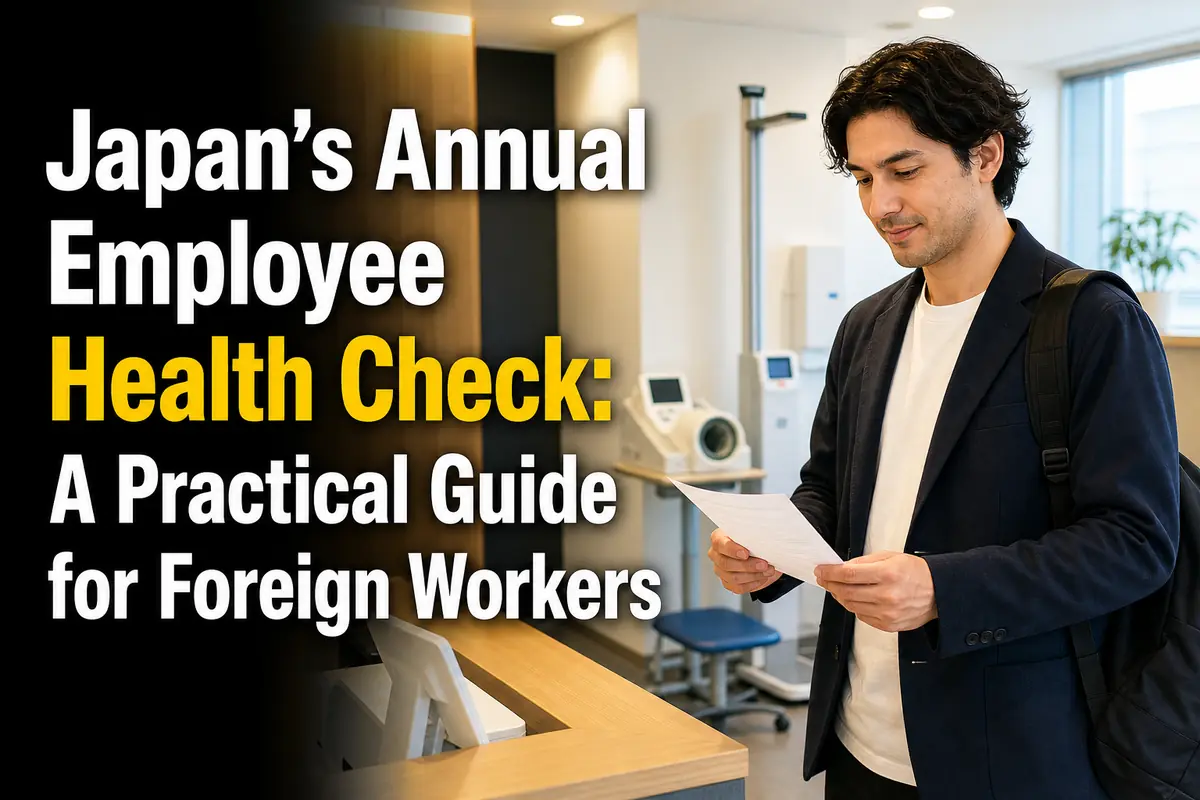
Your Company Health Check in Japan: Tests, Costs, and What Happens Next
In Japan, many employees receive a company-arranged medical examination once a year. If you are covered, your employer normally arranges and pays for the legally required tests. You may be asked to attend a clinic, a mobile examination unit at the workplace, or a designated medical center.
This is preventive screening, not a full diagnosis. A result marked for follow-up does not automatically mean that you have a disease, but it does mean you should read the instructions and, when advised, consult a medical provider.
Quick guide:
- Regularly employed workers generally receive a check when hired and at least once each year.
- Eligible part-time and fixed-term workers can also be covered.
- Fasting and medication instructions depend on the tests and appointment time.
- The employer pays for the statutory examination, but optional tests and follow-up treatment may be handled differently.
- From April 1, 2027, serum creatinine testing will be added to the general examination framework.
This guide is for foreign employees, including workers who are attending a Japanese company medical check for the first time. The rules below are national minimum requirements; booking procedures, optional tests, paid time, and language support vary by employer and clinic.
Who is usually eligible for a company health check?
The rule is based on your employment relationship and working hours, not your nationality. Employers must provide general medical examinations to workers classified as regularly employed under Japan’s occupational safety and health rules.
This normally includes indefinite-term, full-time employees. A part-time or fixed-term employee is generally within the mandatory group when both of these conditions apply:
- The person is employed without a fixed end date, is expected to be employed for at least one year, or has already been employed continuously for at least one year.
- The person’s scheduled weekly hours are at least three-quarters of those of a regular worker doing comparable work.
Government guidance also encourages examinations for some workers who meet the employment-duration condition and work roughly half or more of regular weekly hours, even if they do not reach the three-quarter threshold.
Ask human resources if you are unsure. Labels such as “part-time,” “contract employee,” or “temporary staff” do not settle the question by themselves.
Temporary agency workers
For a dispatched worker, known in Japanese as a haken shain, the dispatching agency generally handles the regular medical examination. Responsibility for examinations connected to hazardous work may differ because the host workplace controls the work environment.
Check both your agency’s notice and the host company’s safety instructions when your work involves chemicals, dust, radiation, high heat, or another regulated hazard.
Night and hazardous work
Some employees need examinations more often than once a year. Workers regularly assigned to specified work, including qualifying night work, generally receive an examination when transferred into that work and once every six months.
Separate special examinations apply to particular occupational hazards. Their test items, timing, and rules are not the same as those of the standard annual check.
ここがポイント: The familiar annual company check is only the general minimum. Your contract length, weekly hours, night schedule, and exposure to workplace hazards can change which examination applies and how often you receive it.
What tests should you expect?
A standard examination checks broad health indicators that may affect safe work, but it is not the same as a comprehensive medical screening package.
The statutory list for a regular examination includes the following areas:
- Medical and work history
- Current symptoms and signs observed by the examining doctor
- Height, weight, waist measurement, vision, and hearing
- Chest X-ray and, when applicable, a sputum examination
- Blood pressure
- Anemia markers
- Liver function
- Blood lipids, including cholesterol and triglycerides
- Blood glucose
- Urine protein and glucose
- Electrocardiogram, commonly shortened to ECG or EKG
A doctor may omit certain items under official criteria after considering factors such as age, previous results, current health, and the nature of the work. The clinic or doctor makes that decision; an employee should not simply skip an item because it was omitted in a previous year.
The examination at hiring has overlapping but not identical rules. It is intended to support appropriate work placement and health management after employment. It is not a general legal requirement for screening applicants before a hiring decision.
Tests that may be optional
Employers or health insurance societies sometimes offer extras such as:
- Stomach cancer screening
- Colorectal cancer screening
- Cervical or breast cancer screening
- Abdominal ultrasound
- Hepatitis testing
- More extensive blood panels
These can be useful, but they are not automatically part of the employer’s statutory examination. Confirm whether an optional test requires a copayment and whether it is suitable for your age, medical history, or pregnancy status.
How to prepare for the appointment
Follow the clinic’s own instructions, because preparation changes according to the tests and the time of day. Do not rely only on advice from a colleague who attended a different facility.
A typical process looks like this:
- Read the company notice. Check the appointment date, location, deadline, examination type, and whether you must make the booking yourself.
- Complete the medical questionnaire. List current treatment, previous conditions, symptoms, allergies, and relevant work history accurately.
- Confirm eating and drinking restrictions. Blood glucose and lipid testing may require restrictions before the appointment. The clinic should tell you when to stop eating and what you may drink.
- Ask about regular medicine. Do not stop prescription medication on your own. Contact the clinic or prescribing doctor if the written instructions are unclear.
- Prepare the requested items. These may include the examination form, employee ID, glasses or contact lenses, a urine sample, and any documents supplied by the company.
- Report pregnancy or possible pregnancy before imaging. Tell the clinic before a chest X-ray so medical staff can decide how to proceed.
- Request language support early. Ask whether translated forms, an interpreter, or permission to bring a support person is available.
Wear clothing that is easy to remove and avoid metal accessories if the notice mentions chest imaging. If you miss the company’s group date, contact human resources promptly rather than booking an unrelated private package without approval.
Who pays, and is the appointment paid working time?
The employer must bear the cost of the legally required examination. Employees should not normally be charged for the statutory test package arranged under the employer’s duty.
Costs can arise in other situations:
- You select optional screening outside the required package.
- You visit a different clinic without following the employer’s reimbursement procedure.
- A result leads to a diagnostic visit, treatment, or medication under the health insurance system.
- You request a certificate or additional copy for a private purpose.
Ask before agreeing to optional tests. A clinic form may place statutory and optional items on the same page, making the price difference easy to miss.
Is the examination time paid?
For a general medical examination, Japanese government guidance says treatment of wages during the appointment should be decided between labor and management, although paying wages for that time is considered desirable to support attendance. Your employer’s rules may therefore determine whether the appointment is treated as paid work, special leave, or personal time.
For a legally required special examination connected directly to hazardous work, the examination time counts as working time and wages must be paid.
Also check how the company handles travel time and transportation expenses. Those details can differ even when the examination itself is free.
What happens to the results?
You should receive your results, and your employer uses legally necessary health information to decide whether workplace measures are required. A company is not supposed to treat the examination as casual access to an employee’s full medical life.
Results commonly use categories such as:
- No significant finding
- Lifestyle improvement recommended
- Repeat testing or monitoring recommended
- Medical consultation or detailed examination recommended
- Treatment required or continued treatment advised
The wording and grading system vary by clinic. Read the explanation printed on your own report instead of comparing only letters or numbers with a coworker’s results.
When an examination identifies an abnormal finding, the employer must obtain a medical opinion and consider appropriate work-related action. Depending on the case, that can include changing the workplace or duties, reducing working hours, or limiting night work. It does not mean that every abnormal number automatically results in a job restriction.
Health information is sensitive personal data. Employers are expected to establish rules limiting collection, access, use, and storage to what is necessary for employee health and safety. If you want to know who can see your information, ask for the company’s health-information handling policy or contact the occupational health staff.
A company check is not medical treatment
The examination clinic may recommend follow-up, but the initial screening itself usually does not provide a final diagnosis. If your report says 要精密検査 (yō seimitsu kensa, detailed examination required) or 要治療 (yō chiryō, treatment required), arrange the recommended medical visit.
Bring the result sheet to the doctor. Follow-up diagnosis and treatment are normally separate medical services, so ordinary health insurance copayments may apply.
Seek medical attention promptly for urgent symptoms even if the annual examination is months away. The company check is not a substitute for care when you are unwell.
Do not confuse three different health programs
The annual company examination, specific health checkups, and private comprehensive screening have different purposes and administrators. Their Japanese names can make them sound interchangeable.
Company general medical examination
Known as ippan kenkō shindan or, for the annual version, teiki kenkō shindan, this is arranged under the employer’s occupational safety and health duties. It focuses on the employee’s health in relation to safe work and ongoing health management.
Specific health checkup
The tokutei kenshin is operated by health insurers for people aged 40 to 74 and focuses on risks associated with metabolic syndrome. An eligible employee’s company examination data may cover relevant items, so receiving a separate invitation does not always mean that every test must be repeated. Ask your insurer if the instructions are unclear.
Comprehensive private screening
A ningen dock is a broader voluntary screening package. Its contents and price depend on the provider and plan. It does not automatically replace the employer’s examination unless equivalent required items are completed and the necessary documentation is accepted.
Common mistakes and how to avoid them
Most problems come from treating the check as either a complete medical service or an optional company benefit. It is neither in the usual covered case.
- Ignoring the booking deadline: Contact human resources immediately. The employer may have a second date or an approved clinic.
- Eating despite fasting instructions: Tell clinic staff honestly. They will decide whether testing can continue or must be rescheduled.
- Stopping medicine without medical advice: Confirm with the clinic or prescribing doctor first.
- Assuming all tests are free: Separate required items from optional screening before signing the form.
- Using a private examination without approval: Ask what tests and documents the employer will accept before booking.
- Ignoring a follow-up notice: Screening only helps when a significant result leads to appropriate review.
- Assuming a normal result covers every disease: The standard package has a limited purpose and cannot rule out all medical conditions.
- Confusing the health check with a stress check: They are separate systems with different procedures and rules for handling results.
Can you use results from another doctor?
An equivalent examination may sometimes be accepted, but arrange this with the employer in advance. Under the occupational safety framework, a worker who undergoes a qualifying examination by another doctor may submit documentation covering the required items instead of repeating the employer-arranged examination.
Before choosing this route, ask human resources:
- Which test items must appear on the report?
- How recent must the examination be?
- Is a Japanese form or translation required?
- Must the report include a doctor’s findings or work-fitness opinion?
- Will the company reimburse any cost?
- What is the submission deadline?
A general letter saying that you are “healthy” may not contain the legally required measurements and findings.
What changes from April 2027?
A kidney-function marker will join the general examination framework on April 1, 2027. The announced revision adds a serum creatinine test, which is used to calculate estimated glomerular filtration rate, or eGFR.
The change applies to general examinations including hiring, regular, and specified-work examinations. Under the announced omission criteria, a doctor may determine that the creatinine test is unnecessary for a person under 40. Employers and clinics will need to update forms and examination packages before the effective date.
For an appointment before April 2027, do not assume that creatinine is already a mandatory item merely because it appears in an expanded package. For an appointment on or after the change, follow the clinic’s current instructions and confirm how the new test is handled.
Practical checklist for employees
Before the appointment:
- Confirm whether you are covered and who arranges the booking.
- Check the date, clinic, deadline, fasting rules, and required items.
- Ask about medication, pregnancy, disability accommodations, and language support where relevant.
- Separate free statutory tests from paid options.
After the appointment:
- Keep your personal result sheet.
- Follow any instruction for repeat testing, consultation, or treatment.
- Ask how to submit outside results if you used another provider.
- Check the company policy if you have concerns about access to health information.
The next date that matters is April 1, 2027, when the revised test items take effect. Until then, use the instructions for your actual appointment date—not an old checklist, a coworker’s package, or a clinic plan designed for a different employer.
参照リンク
- Ministry of Health, Labour and Welfare: Basic knowledge for employers on medical examinations
- Ministry of Health, Labour and Welfare: Wages during medical examinations
- Ministry of Health, Labour and Welfare: Handling health-check and stress-check information
- Aichi Labour Bureau: Regular medical examinations and eligibility for part-time workers
- Gunma Labour Bureau: Statutory examination items and omission criteria
- Osaka Labour Bureau: Medical examinations during recruitment
- Ministry of Health, Labour and Welfare: Specific health checkups and health guidance
- Tottori Labour Bureau: Changes to regular medical examination items from April 2027
- Ministry of Health, Labour and Welfare: Ordinance on Industrial Safety and Health