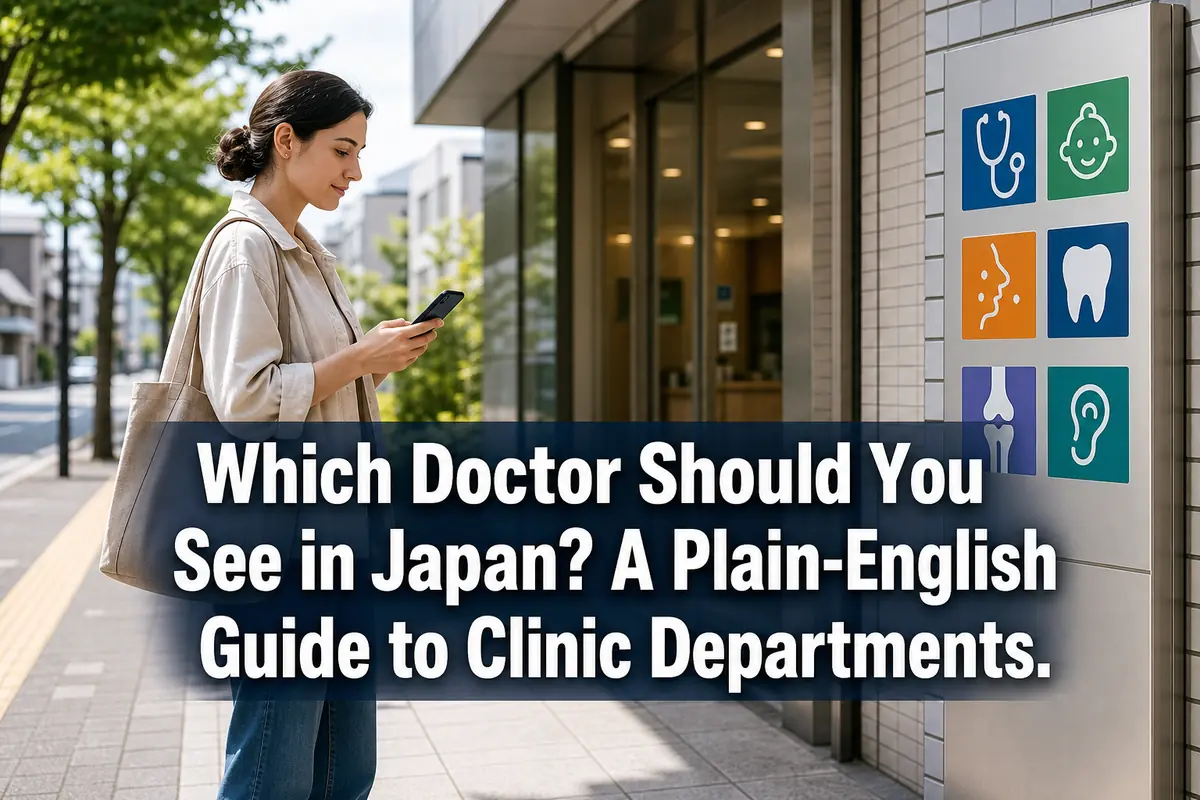
Which Doctor Should You See in Japan? A Plain-English Guide to Clinic Departments
If you are unsure where to go, start with naika (internal medicine) for a general adult illness, or ask for sōgō shinryōka (general medicine). For joint, bone, or injury-related problems, look for seikei geka (orthopedic surgery). For skin problems, choose hifuka (dermatology).
The right department depends on your main symptom—not on whether the clinic’s English name sounds familiar. This guide is for new residents, students, workers, and visitors who need to read clinic signs or search for care in Japan.
Quick department guide
- Fever, cough, stomach trouble, or a general adult illness: 内科 — naika — internal medicine
- Bone, joint, back, or injury-related problem: 整形外科 — seikei geka — orthopedic surgery
- Rash, eczema, hives, or another skin problem: 皮膚科 — hifuka — dermatology
- Ear, nose, or throat problem: 耳鼻咽喉科 — jibi inkōka — ENT
- Eye problem: 眼科 — ganka — ophthalmology
- Child’s illness: 小児科 — shōnika — pediatrics
- You cannot identify the right department: 総合診療科 — sōgō shinryōka — general medicine
This is a navigation guide, not a diagnosis. A clinic may redirect you after checking your symptoms, and severe or rapidly worsening symptoms may require emergency care instead of an ordinary appointment.
Why choosing a department in Japan can be confusing
Many Japanese clinics specialize in one field, so the department name often determines whether the clinic can examine you.
A small neighborhood clinic may display several specialties, such as 内科・消化器内科 (naika, shōkaki naika: internal medicine and gastroenterology). Another may handle only dermatology. Even when two clinics use the same department label, their equipment, opening hours, and accepted cases can differ.
Japan also has terms whose literal translations are misleading. The most important example is 整形外科 (seikei geka). It means orthopedic surgery, not cosmetic surgery.
Before traveling to a clinic, check:
- whether it treats your main symptom;
- whether a first visit requires an appointment;
- the final reception time, which can be earlier than closing time;
- whether the clinic offers support in your language;
- whether it accepts your insurance or travel-insurance arrangement;
- whether it is currently handling fever or infectious symptoms through a separate entrance or appointment process.
Calling first can prevent a wasted trip. A clinic listed as English-friendly may have English-speaking staff only during certain hours.
The main departments and what they usually handle
Match the department to the body area and main symptom that need attention first. The descriptions below are starting points; the clinic decides whether it can treat the particular case.
内科 — Naika — Internal medicine
Naika is often the best first stop for a non-emergency adult illness when the cause is unclear. Typical reasons include:
- fever, cough, sore throat, or fatigue;
- diarrhea, nausea, or mild abdominal symptoms;
- headaches without an obvious injury;
- ongoing conditions such as high blood pressure or diabetes;
- a general feeling of being unwell.
Some signs use a more specific form of internal medicine:
- 消化器内科 — shōkaki naika: digestive system and gastrointestinal medicine
- 循環器内科 — junkanki naika: heart and circulation
- 呼吸器内科 — kokyūki naika: lungs and respiratory medicine
- 脳神経内科 — nōshinkei naika: neurological disorders managed medically
If your symptoms are broad or you do not know the cause, a general naika clinic is usually more suitable than guessing a narrow subspecialty.
整形外科 — Seikei geka — Orthopedic surgery
Seikei geka treats the musculoskeletal system: bones, joints, muscles, tendons, ligaments, and many back or neck problems. Despite the word geka (“surgery”), an orthopedic visit does not automatically mean an operation.
Common reasons to visit include:
- a suspected fracture or sprain;
- joint pain or reduced movement;
- back or neck pain;
- a sports injury;
- pain after a fall;
- numbness that may be connected to the spine or a limb.
Do not confuse it with these departments:
- 形成外科 — keisei geka — plastic and reconstructive surgery: wounds, burns, scars, and reconstruction are among the areas it may cover.
- 美容外科 — biyō geka — cosmetic surgery: elective procedures intended mainly to change appearance.
For a serious accident, heavy bleeding, loss of consciousness, or a limb that appears badly deformed, do not spend time searching ordinary clinic listings. Seek emergency help.
皮膚科 — Hifuka — Dermatology
Hifuka handles diseases and symptoms affecting the skin, hair, and nails. Common reasons include:
- eczema or a persistent rash;
- hives;
- acne;
- suspected fungal infection;
- an unusual mole or skin growth;
- nail or scalp problems.
Burns can involve dermatology, plastic surgery, surgery, or emergency medicine depending on their depth, size, location, and severity. A wide or severe burn should not be treated as a routine dermatology visit.
耳鼻咽喉科 — Jibi inkōka — Ear, nose, and throat
This long name is often shortened in speech to jibika. It covers the ears, nose, throat, and related areas.
Typical reasons include ear pain, hearing problems, persistent nasal symptoms, throat problems, dizziness connected to the inner ear, or tinnitus. A general fever and cough may still be appropriate for naika; choose based on the symptom that is most important.
眼科 — Ganka — Ophthalmology
Ganka is for eye diseases, injuries, vision changes, and eye pain. Sudden loss of vision, a chemical splash, or a serious eye injury requires urgent assessment rather than waiting for a convenient routine appointment.
An optician or glasses shop is not a substitute for medical assessment when you have pain, injury, sudden visual changes, or signs of disease.
小児科 — Shōnika — Pediatrics
Shōnika treats children. Each clinic may set its own age range, so confirm the policy for teenagers or young adults.
For urgent concerns involving a child, #8000 is the pediatric emergency telephone-advice service available across Japan, mainly during evenings, nights, and holidays. Hours and the number used from some phones can vary by prefecture, so check your local government’s information before you need it.
産婦人科 — Sanfujinka — Obstetrics and gynecology
Sanfujinka combines:
- 産科 — sanka — obstetrics, including pregnancy and childbirth;
- 婦人科 — fujinka — gynecology, including reproductive-system concerns outside pregnancy.
Not every gynecology clinic provides prenatal care or delivery services. If you are pregnant, confirm which stages of care the facility accepts. Urgent pain, bleeding, possible rupture of membranes, or concern about the baby should be discussed promptly with your maternity provider or an emergency service.
泌尿器科 — Hinyōkika — Urology
Hinyōkika covers the urinary system and parts of the male reproductive system. Reasons to visit may include pain when urinating, blood in urine, difficulty urinating, or other urinary symptoms.
Because abdominal or back pain can have several causes, a patient may sometimes start at internal medicine and be referred onward.
外科 — Geka — Surgery
A clinic marked simply 外科 may assess wounds, cuts, some injuries, lumps, or conditions that could require a surgical opinion. Its exact scope varies.
The label does not mean that surgery will happen during the first visit. The doctor may examine the problem, provide initial treatment, order tests, or refer you to a hospital.
精神科 and 心療内科 — Psychiatry and psychosomatic medicine
These two labels overlap in everyday searches but are not interchangeable.
- 精神科 — seishinka — psychiatry: mental health conditions and psychiatric treatment.
- 心療内科 — shinryō naika — psychosomatic medicine: commonly focuses on physical symptoms associated with psychological stress and mind-body conditions.
Individual clinics define their services differently. Check whether they treat your concern, accept new patients, require a referral, or need advance booking. Initial appointments may have limited availability.
歯科 — Shika — Dentistry
Shika means dentistry. Dental clinics are separate from medical clinics, and medical insurance cards or eligibility documents do not replace any appointment requirements the dentist may have.
For jaw trauma, facial injury, or a complex oral condition, the relevant hospital department may be 歯科口腔外科 — shika kōkū geka — oral and maxillofacial surgery.
What to do when several departments seem possible
Choose the department most closely connected to your main symptom, then let the clinician redirect you if necessary.
For example:
- Fever plus a mild rash: start with internal medicine if the general illness is the main concern, but call first because the clinic may use a separate process for fever.
- Back pain after a fall: orthopedic surgery is usually a more direct starting point than internal medicine.
- Dizziness with ringing in the ears: ENT may be appropriate; dizziness with other neurological warning signs may need urgent care.
- Abdominal pain: internal medicine or gastroenterology may be suitable, but pregnancy-related symptoms may require obstetrics and gynecology.
If the symptoms do not fit a clear specialty, search for 総合診療科 (sōgō shinryōka), 総合内科 (sōgō naika), or a general internal-medicine clinic. Large hospitals may also have a 初診受付 (shoshin uketsuke, first-visit reception desk) that helps route patients.
ここがポイント: You do not need to identify the disease yourself. Your task is to describe the main symptom, choose a reasonable first department, and confirm that the facility can see you.
How to find a suitable clinic
Use an official search service, but confirm the details directly with the facility before leaving.
Option 1: Search Japan’s Medical Information Net
The Ministry of Health, Labour and Welfare operates Medical Information Net, nicknamed Navi, a nationwide database of hospitals, clinics, dental clinics, midwifery centers, and pharmacies. It can search by location, department, opening status, and foreign-language support.
A practical search sequence is:
- Select your prefecture or current location.
- Choose the Japanese department name from this guide.
- Add a foreign-language filter if needed.
- Check the consultation day and reception hours.
- Call the facility to confirm that it can treat your symptom and provide the stated language support at that time.
The official database publishes information reported by medical institutions. A listing is useful for narrowing the choices, but it does not guarantee same-day acceptance, a particular treatment, or an interpreter.
Option 2: Use JNTO’s medical search for foreign visitors
The Japan National Tourism Organization’s illness and injury guide lets users filter facilities by area, language, department, payment card, and certain international-patient support categories. It also provides a symptom-to-department guide.
JNTO warns that language availability can change with staffing and recommends contacting the institution before visiting. The search is designed mainly for visitors, but its department explanations are also useful to newer residents.
A current point to check in 2026
As of August 22, 2026, the Ministry of Health, Labour and Welfare’s consolidated list of institutions accepting foreign patients was published on June 30 and partly revised on August 6 for Hokkaido, Tokyo, Ishikawa, Shizuoka, Osaka, Hiroshima, and Okinawa.
This matters because an old downloaded list may not reflect the latest entries. Use the current official page and still confirm availability with the facility.
Before the appointment: what to say and bring
A short symptom summary and the correct documents make reception much easier.
Prepare these details:
- your main symptom;
- when it started;
- whether it is getting worse;
- current medicines and known allergies;
- pregnancy status when relevant;
- recent treatment or test results connected to the problem.
Useful Japanese phrases include:
- 初めてです。— Hajimete desu. — This is my first visit.
- 予約は必要ですか。— Yoyaku wa hitsuyō desu ka? — Do I need an appointment?
- 英語で対応できますか。— Eigo de taiō dekimasu ka? — Can you assist me in English?
- この症状を診てもらえますか。— Kono shōjō o mite moraemasu ka? — Can you examine this symptom?
- いつからですか。— Itsu kara desu ka? — Since when? This is a question staff may ask you.
Depending on your status and the facility, bring:
- a My Number Card registered for use as a health-insurance credential, or another valid insurance eligibility document;
- identification;
- your medicine notebook, お薬手帳 — okusuri techō, or a medicine list;
- a referral letter, 紹介状 — shōkaijō, if you have one;
- travel-insurance information if you are a visitor;
- a payment method accepted by the clinic.
Residents covered by Japanese public health insurance generally pay the applicable patient share for insured treatment. Visitors without Japanese coverage may have to pay the full amount and seek reimbursement from private or travel insurance. Non-covered services and document fees can be charged separately, so ask the facility or insurer about your own case.
Clinic, hospital, or emergency care?
A neighborhood clinic is often the practical first stop for a stable, non-emergency problem; emergency care is for urgent or potentially life-threatening conditions.
Choose a clinic when
- the condition is stable enough to wait for normal consultation hours;
- you know the likely department;
- you need an initial examination or ongoing routine care.
Consider a hospital or specialist center when
- a clinic refers you;
- the required testing or treatment is not available locally;
- you have a complex condition already managed by a hospital;
- the facility instructs you to attend its hospital department.
Call 119 in an emergency
Call 119 for an ambulance when a condition appears life-threatening or urgent—for example, unconsciousness, severe breathing difficulty, major trauma, or other serious sudden symptoms. Do not delay an emergency call while trying to choose between naika and another department.
If you are unsure whether an ambulance or immediate hospital visit is necessary, #7119 provides emergency advice in participating areas. Medical professionals can advise on urgency and direct callers to suitable care. It is not yet a uniform nationwide service: coverage, hours, age rules, and language support differ by area.
The Fire and Disaster Management Agency also provides the Q-Suke emergency-assessment app. For children, check the local use of #8000.
Regional and facility differences that matter
Department names are broadly recognizable nationwide, but access rules are set locally and by each institution.
Differences may include:
- appointment-only versus walk-in consultation;
- morning and afternoon reception windows;
- separate procedures for fever or infectious symptoms;
- languages available on a particular day;
- accepted ages at pediatric clinics;
- whether obstetrics services include delivery;
- after-hours clinics operated by a municipality or local medical association;
-
7119 coverage and operating hours;
- payment methods and insurance paperwork.
A map result showing “open” is not enough. Japanese clinics may stop accepting patients before the displayed closing time, close on a weekday afternoon, or use different hours for each department.
Common mistakes to avoid
Most failed visits happen because the patient relied on a translated label without checking the clinic’s actual services.
- Mistaking seikei geka for cosmetic surgery: it means orthopedics.
- Going to a glasses shop for a medical eye problem: use ganka for pain, injury, disease, or sudden visual change.
- Assuming every hospital accepts walk-ins: some departments require appointments or referrals.
- Assuming “English available” guarantees an interpreter: staffing can change by day and time.
- Arriving just before closing: reception may already have ended.
- Choosing a narrow subspecialty without knowing the cause: general internal medicine may be a better first step.
- Waiting during a possible emergency: call 119 when the condition is urgent or life-threatening.
Beginner FAQ
Do I need a family doctor in Japan before visiting a specialist?
Not always. Many clinics accept first-time patients directly, although appointment and referral policies vary. For a stable problem, a nearby clinic can provide an initial examination and refer you if more specialized care is needed.
Is “internal medicine” only for internal organs?
No. General naika clinics commonly see adults with fever, respiratory symptoms, digestive symptoms, headaches, fatigue, and chronic conditions. The clinic may refer you when another specialty is more appropriate.
Does “surgery” in a department name mean I will need an operation?
No. Departments such as orthopedic surgery also provide examinations, imaging, medication, rehabilitation planning, and other non-operative care.
Can clinic reception staff choose the department for me?
They can often help route you, especially at a larger hospital, but they need a clear description of the main symptom. Reception guidance is not a medical diagnosis.
What if no nearby clinic offers my language?
Call before visiting and ask what support is available. You can also search official databases by language, ask your municipality about multilingual consultation services, or check whether your school, employer, insurer, or travel-insurance provider offers medical-assistance support.
A practical decision checklist
Remember three actions: identify the main symptom, check the department, and confirm acceptance before you travel.
- If the situation may be life-threatening, call 119.
- If urgency is unclear, check whether #7119 operates in your area; use #8000 for pediatric advice where appropriate.
- For a stable adult illness with no obvious specialty, start with naika or general medicine.
- Search Medical Information Net or JNTO by department, location, and language.
- Call to confirm reception hours, appointment rules, language support, and whether the clinic can handle the symptom.
- Bring your insurance credential, identification, medicine information, and a short symptom timeline.
The department name gets you to the right door, but the final check is operational: can that facility see this symptom, at this time, with the support you need? Make that call before setting out.
参照リンク
- Japan National Tourism Organization — Guide for When You Are Feeling Ill
- Ministry of Health, Labour and Welfare — Medical Information Net and the Medical Function Information System
- Ministry of Health, Labour and Welfare — Medical Information Net (Navi)
- Ministry of Health, Labour and Welfare — List of Medical Institutions Accepting Foreign Patients
- Ministry of Health, Labour and Welfare — Overview of Health Insurance Policy in Japan
- Fire and Disaster Management Agency — #7119 Emergency Advice Service
- Fire and Disaster Management Agency — Q-Suke Emergency Assessment App