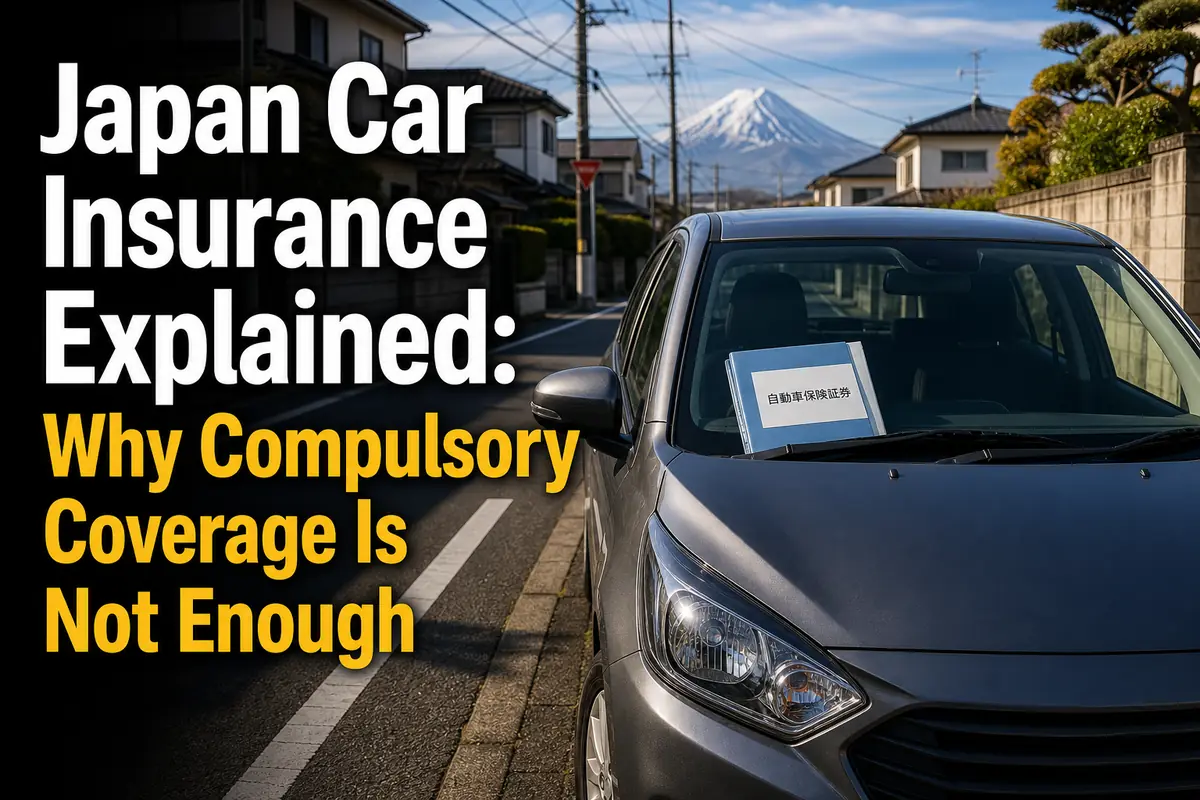
The Insurance Gap Every Driver in Japan Needs to Understand
Compulsory automobile liability insurance in Japan is not complete car insurance. It provides limited compensation when another person is injured or killed, but it does not cover damaged cars, buildings, the driver’s own injuries, or the full cost of a serious liability claim.
For most foreign residents who own or regularly drive a car, the practical answer is to maintain both compulsory insurance—called jibaiseki hoken—and suitable voluntary insurance. This matters when buying a car, renewing the vehicle inspection, allowing a family member to drive, or borrowing someone else’s vehicle.
What you need to know first
- Jibaiseki is required by law and covers bodily injury to other people only, within fixed limits.
- Voluntary insurance can cover liability above those limits, property damage, injuries to the driver and passengers, and damage to the insured car.
- As of August 1, 2026, the standard 24-month compulsory premium for a private passenger car is ¥17,650 in most of Japan. A new rate of ¥18,560 is scheduled for policies starting on or after November 1, 2026.
- Driver restrictions, age conditions, and the named insured person must match everyone who may actually use the car.
The two layers do different jobs
The central distinction is simple: compulsory insurance protects traffic-accident victims at a basic level; voluntary insurance manages the wider financial risk of driving. One is not a smaller version of the other.
Layer 1: compulsory liability insurance
Japan’s compulsory automobile liability insurance is formally known in English as Compulsory Automobile Liability Insurance, or CALI. The Japanese name is jidosha songai baisho sekinin hoken, commonly shortened to jibaiseki hoken.
All motor vehicles covered by the system must carry it. This includes ordinary cars, motorcycles, mopeds, certain motorized bicycles, and specified small motorized vehicles such as qualifying electric kick scooters.
Its purpose is narrow: it pays basic compensation when the operation of a vehicle causes another person’s injury or death and the vehicle owner or driver has legal liability.
The national payment limits are set per victim:
- Injury: up to ¥1.2 million
- Death: up to ¥30 million
- Residual disability: from ¥750,000 to ¥40 million, depending on the officially assessed grade and whether nursing care is required
Covered injury-related losses can include reasonable medical costs, documents, lost earnings, and compensation for distress. Payment is assessed under the applicable rules; the headline limit is not an automatic lump-sum payment.
Layer 2: voluntary automobile insurance
Voluntary insurance—nin’i hoken—is purchased from an insurer or mutual-aid provider. Its terms and price vary by company, vehicle, driver profile, claim history, coverage, and deductible.
A policy can combine several protections:
- Bodily injury liability: pays covered liability above the compulsory-insurance limit
- Property damage liability: covers legal liability for damage to another car, a building, road equipment, cargo, or other property
- Personal injury protection: may compensate the insured driver and passengers for covered injuries, including the insured person’s share of fault, according to the policy
- Passenger accident coverage: pays specified benefits when covered occupants are injured or killed
- Uninsured motorist coverage: helps in specified serious accidents involving a driver without adequate liability resources
- Vehicle damage coverage: covers eligible damage to the insured car, subject to the selected scope, exclusions, and deductible
- Legal-expense, roadside-assistance, and rental-car options: availability and conditions depend on the product
Voluntary policies are contracts, not one national package. Two plans with similar English labels may have different exclusions or definitions.
What compulsory insurance leaves unpaid
The largest risk is not that jibaiseki pays nothing. It is that it pays only one part of a much larger loss.
Suppose a driver causes a collision that injures another person and seriously damages the other vehicle. Compulsory insurance may contribute to the injured person’s eligible bodily-injury loss, up to its statutory limit. It will not pay for the other vehicle.
The driver may still be personally responsible for:
- Bodily-injury damages above the compulsory limit
- Repair or replacement of the other vehicle
- Damage to a shop, guardrail, utility pole, railway equipment, or cargo
- The driver’s own treatment and loss of income
- Repair or replacement of the driver’s car
- Certain legal, towing, or substitute-transport costs
Japan’s General Insurance Association recommends unlimited limits for both bodily injury and property damage liability. Its published examples include court-recognized total damages exceeding ¥500 million in a bodily-injury case and ¥200 million in a property-damage case. These are exceptional cases, not typical claims, but they show why the compulsory limits cannot be treated as a complete financial shield.
ここがポイント: A valid compulsory policy makes the car legal on this insurance requirement, but it does not make the driver financially prepared for every accident.
How much compulsory insurance costs in 2026
The compulsory premium is standardized by vehicle category and contract period rather than individually priced from a driver’s age or accident history. Rates can differ for Okinawa and certain islands, so confirm the applicable table when registering or inspecting the vehicle.
For policies beginning before November 1, 2026, the standard rates in areas other than Okinawa and specified islands include:
| Vehicle category | 24-month current rate | 24-month rate from Nov. 1, 2026 |
|---|---|---|
| Private passenger car | ¥17,650 | ¥18,560 |
| Inspection-subject kei car | ¥17,540 | ¥18,660 |
| Private small goods vehicle | ¥20,340 | ¥21,430 |
| General moped category | ¥8,560 | ¥9,630 |
The Non-Life Insurance Rating Organization of Japan filed revised compulsory rates in April 2026. The revised table applies to contracts whose insurance period starts on or after November 1, 2026. For example, the 24-month rate for a private passenger car rises by ¥910, or 5.2%.
The rate change does not turn compulsory insurance into broader coverage. Its role remains basic victim protection.
Why the contract period matters
Cars subject to Japan’s periodic vehicle inspection usually need compulsory coverage extending beyond the inspection’s validity. Dealers and inspection providers often arrange the policy during registration or inspection, which can make it feel like part of the inspection fee.
It is still a separate insurance contract. Check the start and end dates rather than assuming that a valid inspection sticker proves every insurance detail is correct.
Motorcycles of 250 cc or less generally do not go through the same periodic inspection process. Their owners must pay particular attention to the compulsory-insurance sticker and expiry date. Some eligible motorcycle policies can be purchased through convenience stores or online.
What voluntary insurance should include
For a typical household, the first priority is protection against losses that could exceed savings—not reimbursement for every small scratch.
Start with third-party liability
Consider unlimited bodily injury and property damage liability first. A low property limit can be exhausted by a multi-vehicle collision, damage to commercial premises, or an accident involving railway infrastructure or valuable cargo.
Check whether the policy includes settlement-negotiation support. Where the policy conditions allow it, this service lets the insurer handle negotiations with the other party. That can be especially valuable if the policyholder is not confident communicating in Japanese.
Protect the people in the car
Compulsory insurance is designed around injury to “other persons.” It does not simply function as personal accident insurance for the at-fault driver.
Personal injury protection or related occupant coverage can address medical costs, lost income, disability, or death involving the driver and passengers, subject to the contract. Compare:
- Who qualifies as an insured person
- Whether protection applies only while riding in the listed car
- How losses are calculated
- Whether benefits overlap with another household policy
- How the policy handles single-vehicle accidents
Decide whether the car itself needs coverage
Vehicle coverage is optional within a voluntary policy. Its value depends on the car’s replacement value, outstanding loan, parking environment, disaster exposure, and the household’s ability to absorb a loss.
Broader plans may include single-vehicle crashes and hit-and-run damage. Limited plans may cover events such as an identified collision, fire, flood, typhoon, or theft but exclude some single-vehicle and unidentified-party accidents. Labels differ among insurers, so read the event list rather than relying on a package name.
A higher deductible can reduce the premium but increases the amount paid personally after a covered accident. For an older car with a low market value, broad vehicle coverage may cost more than the protection is worth. Liability coverage, however, addresses damage based on what happens to other people—not the age of your own car.
Why voluntary premiums vary so much
There is no single reliable “average price” for foreign residents. A useful quote must reflect the actual car and everyone who may drive it.
Insurers may consider factors such as:
- Vehicle model and risk class
- Main use, such as personal use or commuting
- Annual distance or other usage information
- Driver’s age and the youngest covered household driver
- Driver’s licence colour or other product-specific factors
- Claim history and the no-claim class, called tōkyū
- Driver restrictions
- Coverage limits, optional benefits, and deductibles
A first voluntary automobile policy normally begins at Class 6 under the common no-claim class system. A claim-free year generally moves the contract up one class, while a covered accident may reduce the class and create an accident-history period. Precise rating rules vary by insurer.
Foreign driving history is not automatically treated the same way by every company. If you have a claim-free record from abroad, ask whether the insurer accepts any official certificate and exactly what translation or original document it requires. Do not assume that overseas history will transfer.
Documents and information to prepare
Buying voluntary insurance is easier when the information on the application matches the vehicle registration and the real driving arrangement.
Prepare or confirm:
- Vehicle inspection certificate or the relevant registration record
- Compulsory-insurance certificate
- Japanese driver’s licence details for the main driver
- Vehicle make, model code, first-registration date, and registration number
- Name and address of the vehicle owner
- Name of the policyholder and the named insured driver
- Purpose of use and expected driving pattern
- Details of all household members who may drive
- Previous Japanese policy and no-claim class, if applicable
- Bank account or payment information requested by the insurer
Insurers may request additional identification or documents. Residence status does not create one universal set of voluntary-insurance rules, but an insurer’s application channels, payment methods, language support, and identification checks can differ.
The driver restrictions that cause costly mistakes
A cheap policy is not useful if the person behind the wheel falls outside its conditions.
Named driver and household relationships
The kimei hokensha is the named insured person, usually the person who mainly drives the car. This is not necessarily identical to the person who pays the premium or legally owns the vehicle.
Tell the insurer if those roles belong to different people. A policy based on an incorrect main driver can create serious problems when a claim is reviewed.
Driver-limitation clauses may restrict driving to:
- The named insured only
- The named insured and spouse
- A wider group defined by the product
Definitions of spouse, cohabiting relative, and child living separately are contract-specific. A visiting relative or friend should not be assumed to qualify.
Age conditions
Policies can limit coverage to drivers over a selected age. The lowest-priced option may exclude a younger spouse or adult child living in the household.
The General Insurance Association notes that age conditions and the people to whom they apply can differ from driver-limitation clauses. Some policies commonly treat non-household drivers differently, but this must be checked against the actual wording.
Review the contract before:
- A child receives a licence
- A partner begins using the car
- A relative moves into the home
- A friend borrows the vehicle
- The car’s main driver changes
- The household moves or changes parking location
- The vehicle is replaced
Do not wait until renewal if the risk changes during the policy year.
Common misunderstandings to avoid
Most preventable errors come from treating insurance as paperwork attached to the car rather than a contract tied to people, dates, and stated use.
- “The vehicle inspection is valid, so all insurance must be valid.” Check the compulsory certificate’s dates separately.
- “Compulsory means every accident is covered.” It covers defined bodily-injury liability only, within limits.
- “Any licensed family member can drive.” Driver and age restrictions may exclude them.
- “Property damage means my own car.” Property liability protects against liability for someone else’s property; vehicle coverage protects the insured car.
- “The cheapest quote is equivalent to the others.” Compare limits, deductibles, excluded drivers, vehicle-damage events, roadside support, and language assistance.
- “My insurance automatically follows me into every borrowed or rental car.” Some contracts have other-car provisions, but their vehicles, drivers, and uses are restricted. Rental-company coverage is a separate contract.
- “I can update the insurer after an accident.” Changes to the vehicle, named driver, address, or use should be reported when they happen.
What to do after an accident
Safety and official reporting come before deciding who was at fault.
- Stop the vehicle and prevent further danger where possible.
- Call 119 for an ambulance or fire service if anyone may be injured.
- Call 110 and report the accident to the police, even if the damage initially appears minor.
- Exchange names, contact details, registration information, and insurance details without arguing about a private settlement at the scene.
- Record the location and damage safely with photographs, and note possible witnesses.
- Contact the voluntary insurer or agent promptly and follow its instructions.
- Seek medical attention if symptoms appear, even if they were not obvious immediately after the collision.
Police reporting is important for obtaining the traffic-accident certificate commonly needed during a claim. Do not leave solely because the other driver suggests handling repair costs privately.
If language is a concern, save the insurer’s accident number and confirm in advance whether interpreting support is available at all hours. Keep the policy number, roadside-assistance details, emergency contacts, and a short Japanese accident phrase card in the car.
Special situations that need a separate check
The basic two-layer structure is national, but the correct contract depends on how the vehicle is used.
Company and shared vehicles
Do not assume an employer’s vehicle policy covers private use, commuting outside approved conditions, every employee, or family members. Ask the employer who is authorized to drive and what to do after an accident.
Car sharing and rentals
Car-sharing and rental charges often include a defined insurance package, but exclusions, deductibles, and non-operation charges can remain. Read the operator’s accident procedure before driving. Reporting late or violating the rental agreement may affect the protection offered.
Delivery and other paid use
A policy declared for ordinary personal use may not fit food delivery, passenger transport, or other commercial activity. Tell the insurer exactly how the car will be used. Platform-provided protection, if any, may apply only during specified stages of a job.
Moving away from Japan
If you sell or dispose of the car, do not simply stop paying the voluntary premium. Ask about cancellation, vehicle replacement, refunds, and a suspension certificate. Under qualifying conditions, a suspension arrangement may preserve the no-claim class for a later Japanese policy.
A practical buying checklist
Before accepting a voluntary-insurance quote, ask for written confirmation of the points that would matter on the worst day—not only the annual premium.
- Are bodily injury and property damage limits unlimited?
- Are the named insured person, owner, and main driver correctly recorded?
- Is every likely driver included under the driver and age conditions?
- What protection applies to the driver and passengers?
- Is vehicle coverage broad or event-limited, and what is the deductible?
- Are floods, typhoons, theft, single-vehicle crashes, and hit-and-run damage included or excluded?
- Does the plan provide settlement support, roadside assistance, a replacement car, or legal-expense coverage?
- Is accident support available in English or another language you can use?
- What changes must be reported during the policy period?
- When do both the compulsory and voluntary policies expire?
For a policy starting before November 1, 2026, verify the existing compulsory rate. For a policy starting on or after that date, check the revised table. Then review the voluntary contract whenever the car, main driver, household drivers, address, or use changes. The next practical step is to compare exclusions and driver conditions—not just the total premium printed at the bottom of the quote.
参照リンク
- MLIT: What is Compulsory Automobile Liability Insurance?
- MLIT: How to Claim Compensation under CALI
- MLIT: Compulsory Automobile Liability Insurance FAQs
- MLIT: Be Mindful of the Expiration Date of Your CALI
- General Insurance Rating Organization of Japan: Compulsory Automobile Liability Insurance Reference Rates
- General Insurance Rating Organization of Japan: April 2026 Rate Filing Announcement
- General Insurance Association of Japan: Automobile Insurance
- General Insurance Association of Japan: No-Claim Class System
- General Insurance Association of Japan: Common Voluntary-Insurance Endorsements