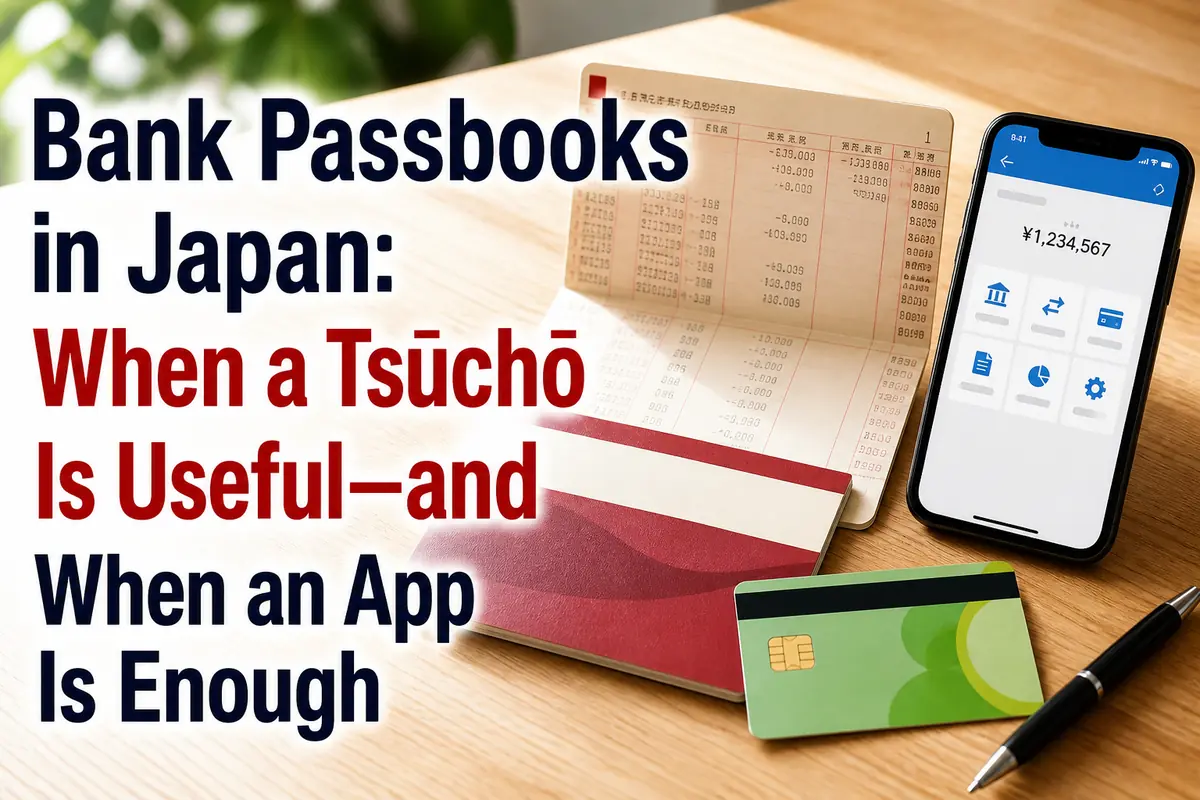
Bank Passbooks in Japan: When a Tsūchō Is Useful—and When an App Is Enough
Most people opening a bank account in Japan do not need a paper passbook. A banking app or online statement is usually enough for checking your balance, receiving salary, paying bills, and making transfers.
A paper passbook—tsūchō (通帳)—can still be useful if an employer or other organization requests a copy showing your account details, you prefer an offline record, or you regularly deposit cash at compatible ATMs. However, some banks now charge for paper passbooks, and accounts opened through an app may be paperless by default.
This guide is for new residents, students, workers, and long-term residents deciding whether to request, keep, or stop using a tsūchō.
The short version
- A tsūchō is an account record, not a payment card.
- You normally use a cash card—kyasshu kādo (キャッシュカード)—to withdraw money.
- Paper passbooks are optional or unavailable with some account types.
- Fees and age exemptions differ by bank.
- Before choosing paperless banking, check how long digital transaction records remain available.
What is a tsūchō?
A tsūchō is a small paper booklet that records activity in a Japanese bank account. When inserted into a compatible ATM, it can print deposits, withdrawals, transfers, interest, and other entries.
Important words you may see include:
- Tsūchō (通帳): bank passbook
- Kichō (記帳): printing recent transactions in the passbook
- Kur越oshi / kurikoshi (繰越): transferring the record to a new passbook when the old one is full
- Mutsūchō (無通帳): no-passbook or paperless account
- Web tsūchō (Web通帳): digital transaction record
- Zandaka (残高): account balance
- Nyūshukkin meisai (入出金明細): deposit and withdrawal details
The passbook is separate from your cash card. Having a tsūchō does not replace the card, and switching to a paperless account does not normally stop card transactions.
Do foreign residents need a paper passbook?
There is no general rule requiring foreign residents to have one. The practical question is whether another person or organization expects information that is easy to show with a passbook.
Situations where digital records are usually enough
You can normally manage without paper when you:
- check balances and transactions through an app;
- receive salary or scholarship payments;
- pay utilities by account transfer;
- send domestic bank transfers online;
- use a cash card at ATMs; or
- download or print statements when evidence is needed.
The exact features depend on the bank and account type. Check whether the app can display your account holder name, branch, account number, and older transactions—not only the current balance.
Situations where a passbook may still help
A physical record can be convenient when:
- an employer asks for a copy of the account-information page for payroll registration;
- a school, local organization, or service provider uses a paper application process;
- you want to review cash deposits without signing in online;
- you have limited access to a compatible smartphone or Japanese-language app;
- you assist a family member who manages money offline; or
- you want a simple backup record of routine transactions.
Even in these cases, a passbook may not be essential. An account-information screen, bank-issued statement, cash-card copy, or account certificate may be accepted instead. Ask exactly which document and which details are required before paying for a paper passbook.
ここがポイント: A tsūchō can be convenient evidence of account details, but it is not the only evidence. Confirm what the receiving organization accepts before ordering one.
Paper passbook fees are set by each bank
Japan does not have one nationwide passbook fee. Each bank decides whether paper is available, which accounts are charged, and who is exempt.
The following examples were checked against bank information available in August 2026.
MUFG Bank
MUFG charges an annual paper-passbook fee of ¥550, including tax, for eligible ordinary deposit accounts opened on or after April 1, 2022.
According to MUFG, individuals who are under 18 or at least 70 on the annual assessment date are exempt. Ordinary deposit accounts opened by March 31, 2022, are also outside this fee scheme. Customers using an Eco Passbook can view transactions by smartphone or computer without the paper-passbook fee.
If the balance is insufficient when the fee is collected, MUFG may take the available balance and suspend passbook-based transactions. Card transactions and automatic payments can continue, but restoring passbook use requires a procedure.
Sumitomo Mitsui Banking Corporation
SMBC lists an annual fee of ¥550, including tax, for paper passbooks on eligible personal ordinary deposit accounts opened on or after April 1, 2021.
Its stated exemptions include customers under 18, customers aged 75 or older, and non-resident customers. If the fee cannot be collected after the bank’s retry period, the account may be converted to a no-passbook type. SMBC also states that an account may be changed to paperless if the passbook has not been updated for more than one year.
Mizuho Bank
Mizuho uses a different charging model. For accounts opened on or after January 18, 2021, its ordinary-deposit product information dated April 1, 2026 states that issuing a paper passbook costs ¥1,100 per book, including tax, at initial issue and when a replacement book is needed because the previous one is full.
This is not the same as an annual fee. A person who frequently fills passbook pages could therefore face a different total cost from someone paying a yearly fee elsewhere.
Japan Post Bank
Japan Post Bank offers the paperless Yūcho Direct Plus (ゆうちょダイレクト+), which provides online transaction details for up to 20 years, covering eligible records from March 2021 onward.
Accounts opened through the Yūcho Tetsuzuki App are no-passbook accounts. If you later need a passbook, Japan Post Bank says you can switch at an ATM with passbook-carryover capability or at a savings counter. For an initial passbook issued within two months of opening the paperless account, the switch is free; after that period, the bank’s prescribed fee applies.
These examples should not be treated as a complete market comparison. Regional banks, online banks, credit unions, and other institutions may use different rules.
How to choose between paper and digital
Choose based on record access and real paperwork needs, not on the idea that every Japanese account should include a booklet.
Choose a paperless account when
- you are comfortable using the bank’s app or website;
- you want to avoid a paper-passbook fee;
- you need searchable transaction records;
- you move often and do not want another item to protect; or
- the account will mainly receive salary and pay recurring bills.
Before choosing it, confirm:
- how many years of transactions you can view;
- whether statements can be downloaded as PDF or CSV files;
- whether the app supports your preferred language;
- how you regain access after changing or losing your phone; and
- whether paperless conversion can be reversed, and at what cost.
Keep or request a passbook when
- a specific organization has confirmed that it wants a passbook copy;
- you cannot reliably use the digital service;
- you prefer ATM-printed records for budgeting; or
- your bank provides the passbook without a fee that matters to you.
A paper passbook is not a complete backup plan by itself. Transactions may be combined into a summarized entry if you leave the booklet unupdated for a long period, depending on the bank. Save important statements separately when you need a detailed record for work, tax, immigration, study, or another formal procedure.
What to check when opening an account
Ask about the account type before completing the application, because changing later may cost money or require a branch visit.
Use this checklist at the counter or during an online application:
- Is this account yūtsūchō (有通帳, with a passbook) or mutsūchō (無通帳, without one)?
- Is there an annual, initial, renewal, or reissue fee?
- Does an age or account-opening-date exemption apply?
- How far back can online transaction records be viewed?
- Can statements be downloaded or printed?
- Can the account-information page be shown in the app for payroll registration?
- Can a paperless account later be changed to a passbook account?
- Which ATMs accept passbooks and perform kichō or kurikoshi?
If you are not confident in Japanese, show the staff the terms on this list. Do not assume that “bankbook app” means the account includes a physical bankbook.
Using a physical passbook at an ATM
A passbook works only at ATMs that support that bank’s book format and the requested operation. A convenience-store ATM may accept your cash card but not your tsūchō.
The usual process is:
- Find an ATM displaying 通帳 or a passbook insertion slot.
- Select 記帳 if the ATM asks which service you want.
- Insert the passbook in the direction shown on the machine.
- Wait while recent transactions are printed.
- Take the passbook and check that the machine has returned every item.
When the pages are full, you need tsūchō kurikoshi (通帳繰越), meaning passbook renewal or carryover. Some ATMs can issue the next booklet automatically; other banks require a counter visit.
ATM availability and operating hours vary by bank, branch, and region. An ATM that handles cash outside branch hours may not necessarily provide passbook services at the same time.
Common mistakes to avoid
The main problems come from assuming that paper and digital services are interchangeable. Check the details before you discard, request, or convert anything.
- Confusing the passbook with the cash card: A tsūchō records transactions; the card is normally used for withdrawals and many ATM operations.
- Requesting paper automatically: You may create an annual or per-book cost without gaining a service you need.
- Switching to paperless before saving old records: Download any transaction history that may become unavailable after conversion.
- Expecting every ATM to update the book: Use your bank’s ATM locator and check for passbook functions.
- Ignoring an annual fee notice: Insufficient funds may suspend passbook use or trigger automatic conversion under the bank’s rules.
- Losing the booklet: Banks commonly charge for reissue. MUFG and SMBC each list a standard passbook reissue fee of ¥1,100, although exceptions may apply when the problem is caused by the booklet or equipment rather than loss.
- Sending a full transaction history unnecessarily: For payroll setup, the recipient may need only your bank name, branch, account type, number, and account-holder name. Hide unrelated balances and transactions when they are not required.
If your passbook is lost or stolen
Contact the bank promptly and ask it to stop passbook-based transactions. Do not wait until your next planned branch visit.
The bank may ask for:
- a cash card;
- a residence card, My Number card, passport, or another accepted ID;
- the registered seal—todokede-in (届出印)—if your account uses one;
- your account number and branch information; and
- a reissue fee.
Required documents and emergency contact hours differ by institution. Use the bank’s official lost-card and lost-passbook contact channel, not a telephone number copied from an unofficial forum.
Frequently asked questions
Can I withdraw cash with only a passbook?
It depends on the bank, ATM, and account settings. Do not rely on the passbook as a universal substitute for a cash card. Check your bank’s rules, especially if you have not registered a seal or other authentication method.
Will my employer require a tsūchō for salary payments?
Usually, the employer needs verified account details rather than the booklet itself. Ask whether an app screenshot, account-information page, cash-card copy, or bank document is acceptable. Make sure the account-holder name matches the bank’s registered form, including spacing and the order of names.
Is a digital passbook the same as online banking?
Not always. A digital-passbook service may focus on balances and transaction history, while online banking may also support transfers, address changes, and other procedures. The names and functions are bank-specific.
Should I close an old paper-passbook account to avoid fees?
First check the account-opening date, exemption rules, balance, linked payments, and whether switching to the bank’s digital option removes the fee. Closing an account can disrupt salary deposits, rent, utilities, credit-card payments, or refunds.
Can I use a damaged or full passbook?
A full passbook must be carried over to a new one. If the magnetic strip or booklet is damaged, an ATM may reject it. Ask the bank whether it can repair or replace the book and whether the fee is waived for a technical failure.
The practical decision
Start paperless unless you have a confirmed reason to need paper. It is usually the simpler choice for a new resident who uses a smartphone, wants searchable records, and needs ordinary salary and bill-payment functions.
Before making the final choice, check three things:
- what proof your employer, school, or other organization will accept;
- how much your bank charges for issuing and keeping a passbook; and
- how you will save older digital records before they expire.
Bank policies can change, and the examples above are not universal. Check the official fee page and product terms for your exact bank and account. The most important next step is not obtaining a booklet—it is making sure you can retrieve your account details and transaction history when a real procedure requires them.
参照リンク
- MUFG Bank: Paper passbook usage fee
- MUFG Bank: Other fees, including passbook reissue
- SMBC: Cash-card and passbook fees
- SMBC: Web Passbook and related fees
- Mizuho Bank: Ordinary Deposit Product Information, April 1, 2026
- Japan Post Bank: Yūcho Direct Plus no-passbook account
- Japan Post Bank: What to do if you later need a passbook
- Japan Post Bank: Yūcho Tetsuzuki App