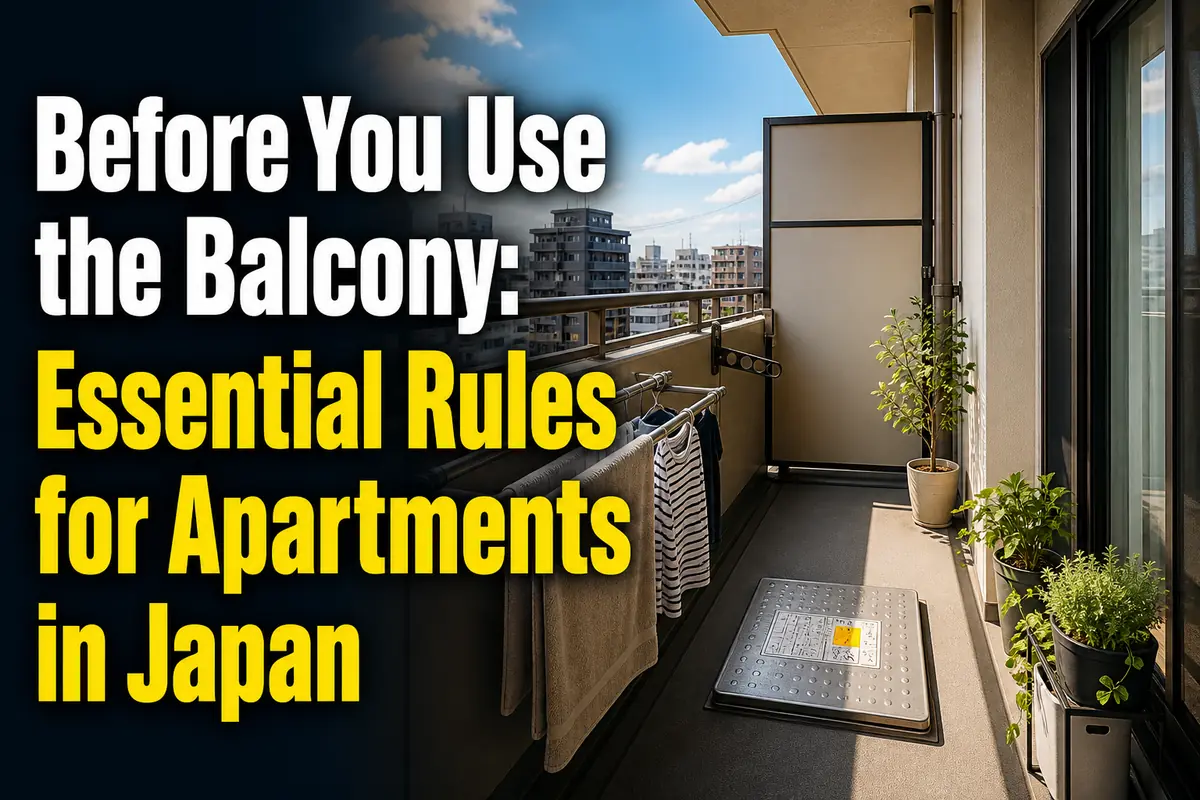
Before You Use the Balcony: Essential Rules for Apartments in Japan
The safest rule is simple: treat your apartment balcony as a shared building area that you may use, not as a private storage room. Laundry may be allowed, but smoking, large furniture, satellite dishes, and even plant pots can be restricted by your lease or building rules. Emergency partitions and escape hatches must always remain clear.
This matters to tenants, students, workers, and new residents because the controlling rule is often found in a Japanese document received at move-in—not on a sign outside.
The essentials
- Check the lease, building rules, and move-in notices before using the balcony.
- Never block an emergency partition, escape hatch, or the route leading to one.
- Use only the installed laundry fittings unless the building permits something else.
- Do not assume outdoor smoking is allowed. Your building can prohibit it.
- Secure every permitted item against wind, falling, water damage, and evacuation hazards.
ここがポイント: A balcony may be attached to one apartment, but its structure and emergency functions can affect the entire building. Exclusive access does not mean unrestricted control.
Why your balcony may not be fully private
In many condominium buildings, the balcony is treated as a common part with an exclusive right of use. Renters normally receive that use through the owner, subject to the building’s rules.
Japan’s Ministry of Land, Infrastructure, Transport and Tourism uses the term sen’yō shiyōken (専用使用権), meaning an exclusive right to use a specified common area. Its standard condominium rules list balconies among the areas that may carry this right. The ministry also warns that the exact arrangement differs by building.
That distinction explains why a resident can hang laundry on a balcony but may be unable to drill into a wall, install a deck, repaint a railing, or leave bulky furniture there. The resident uses the space; the owner or management association controls the building structure and common safety rules.
For a rental apartment, check these documents in this order:
- Chintai shaku keiyaku-sho (賃貸借契約書): tenancy agreement
- Kanri kiyaku (管理規約): management bylaws
- Shiyō saisoku (使用細則): detailed use rules
- Move-in guide, noticeboard instructions, or notices from the management company
The national standard rules are a model for condominium management, not a universal rulebook automatically imposed on every apartment. Your signed lease and the rules adopted for your building are the practical starting point.
Emergency partitions and escape hatches come first
The most important part of balcony use is preserving the escape route. Storage and decoration become secondary when a balcony forms part of the building’s emergency plan.
The partition beside the next apartment
The lightweight panel between neighboring balconies is commonly called a hedate-ita or 隔て板 (partition board). It may also be described as an emergency partition.
It is designed so that residents can open, remove, or break through it during an emergency when the normal exit cannot be used. Fire and Disaster Management Agency standards require applicable partitions to show:
- that the balcony is an evacuation route;
- how to open, remove, or break the panel; and
- that objects must not be placed nearby if they would obstruct evacuation.
Do not put a cabinet, bicycle, planter, tire, washing machine, or stack of boxes against the panel. Leave enough open space to approach it and pass through the opening. The safe route may continue across several neighboring balconies, so blocking your own panel can affect other households.
Do not test the panel by kicking or striking it. Learn what it is for, read its printed instructions, and ask the management company about evacuation drills or building-specific procedures.
The hatch in the floor
Some balconies have a metal hinan hatchi (避難ハッチ), or evacuation hatch, containing a ladder or another escape device.
Keep all of the following clear:
- the hatch cover;
- the area where a person must stand to open it;
- the space above it;
- the space below the hatch on the balcony underneath, where a ladder may descend.
A table or planter placed beside the hatch can still be a problem if it prevents the lid from opening fully. Never cover the hatch with artificial grass, wooden decking, a storage box, or a drying rack.
If your upstairs neighbor has a hatch, avoid placing tall objects directly below its likely descent point. Ask management if the position is unclear.
Keep a continuous route, not just the equipment
An uncovered partition and hatch are not enough if the path between them is narrow or slippery. Keep a usable route from the apartment door to the emergency equipment.
This means avoiding:
- loose floor tiles or mats that can shift;
- trailing cords and hoses;
- overloaded drying racks;
- deep rows of plant pots;
- rubbish bags waiting for collection;
- snow, algae, or other material that makes the floor unsafe.
Your management company can tell you the required clearance for your particular building. Do not invent a minimum width based on a different apartment or an online photograph.
Hanging laundry: usually possible, but not automatic
Laundry is commonly dried outside in Japan, yet each building can control where and how it is hung. The main concerns are falling objects, appearance, wind, water, and obstruction of emergency equipment.
Use the fittings provided
Many balconies have fixed metal holders for a monohoshi-zao (物干し竿), or laundry pole. Using those fittings keeps laundry lower and farther inside the railing.
Before hanging anything:
- confirm that the pole fits securely;
- use end stoppers or other approved restraints;
- fasten hangers and laundry frames against wind;
- keep sheets and blankets from reaching the apartment below;
- do not overload an old or damaged holder;
- bring laundry inside before severe wind or a typhoon.
A pole balanced on a railing or an unsecured freestanding rack can fall from the building. If no laundry fitting exists, ask management before installing a rack, tension pole, hook, or wall-mounted part.
Railing-height and appearance restrictions
Some buildings require laundry to remain below railing height, particularly on prominent façades. Others prohibit bedding over the railing because it can fall, drip onto lower floors, or change the building’s appearance.
These are building-specific rules rather than one nationwide laundry standard. Search your documents for terms such as:
- sentakumono (洗濯物): laundry
- futon-hoshi (布団干し): airing bedding
- tesuri (手すり): railing
- bikan (美観): external appearance
- rak下 bōshi (落下防止): fall prevention
If the wording is difficult, send a photograph of the relevant page to the management company and ask for a written explanation.
Water and strong smells
Do not pour large amounts of water across the floor or let dirty water flow to neighboring balconies. Balcony drains may be shared, and blocked drains can contribute to leaks or overflow.
Strongly scented detergent, fabric softener, smoke, and cooking odors can also trigger complaints where balconies are close together. A product being legal to buy does not override the building’s nuisance rules.
Storage: temporary use can become a safety problem
A few permitted, movable items may be acceptable, but a balcony should not become a warehouse. Emergency access, wind, weight, drainage, and maintenance all matter.
Items that commonly require caution or permission include:
- large storage cabinets;
- bicycles and tires;
- fuel, paint, gas cylinders, or other flammable materials;
- heavy planters or deep soil containers;
- wooden decks and fixed flooring;
- large outdoor furniture;
- rubbish, cardboard, and newspapers;
- satellite dishes, screens, signs, or fixtures attached to the structure.
The important question is not only “Does it fit?” Ask instead:
- Can it move or fall in strong wind?
- Does it obstruct a partition, hatch, drain, or maintenance route?
- Could it damage the waterproof floor or railing?
- Can workers remove it quickly for inspection or repair?
- Does the lease or building rule prohibit it?
Air-conditioner outdoor units are a special case
An outdoor condenser may be expected where the building provides a designated space, sleeve, drain route, and electrical supply. That does not give permission to install it anywhere.
Ask the landlord or management company before installation. Confirm:
- the approved position;
- whether drilling is prohibited;
- where condensation water must drain;
- whether the unit blocks an escape route;
- whether installation work requires an application;
- who must remove or restore it when the tenancy ends.
Use the landlord’s or management company’s procedure even if an installer says the work is physically possible.
Plants are not exempt
Small plants may be allowed, but they still need secure pots, controlled watering, and regular care. Soil and leaves can block drains. Water can fall onto laundry below. Pots near a railing can become falling hazards, while pots near a partition can block escape.
Avoid attaching planters to the outside of a railing unless the building explicitly permits it. Bring movable items inside before severe weather.
Smoking: being outdoors does not guarantee permission
Balcony smoking can be prohibited by building rules, and smoke drifting into nearby homes can lead to complaints even without an explicit balcony sign. Check before lighting anything.
In October 2025, the Ministry of Land, Infrastructure, Transport and Tourism revised its standard condominium management-rule commentary. The update expressly explains that a building may establish detailed smoking rules for common areas, including whether smoking is allowed, where it is allowed, what residents must observe, and how violations are handled. It also encourages rules that consider surrounding residents.
This is important because a balcony’s legal and managerial position is different from an ordinary private room. A rule can appear in the management bylaws or detailed use rules rather than in the short tenancy agreement.
Smoke and ash can enter another apartment through open windows or ventilation inlets. They can also reach drying clothes. A portable ashtray does not solve those effects, and throwing cigarette ends from a balcony creates obvious fire and injury risks.
If smoking is prohibited, do not replace it with smoking beside the entrance, on an exterior corridor, or in another common area. Those places may have separate restrictions. Ask management where smoking is permitted, if anywhere.
For complaints about smoke:
- Record dates, times, and where smoke appears to enter.
- Check the building’s smoking and nuisance rules.
- Contact the landlord or management company calmly in writing.
- Avoid confronting or identifying a neighbor without reliable information.
- If there is an immediate fire danger, call emergency services rather than waiting for management.
What changes by building or region
There is no single nationwide list that settles every balcony activity. National building and fire-safety standards create the framework, while the property’s design and adopted rules determine many everyday details.
Differences can include:
- whether laundry may be visible above the railing;
- whether futons may be hung over the railing;
- whether planters, chairs, or storage boxes are allowed;
- whether smoking is banned throughout the property;
- whether a satellite dish or privacy screen needs approval;
- where an air-conditioner unit may be installed;
- how much clearance must remain around emergency equipment;
- whether items must be removed before repair work or inspections.
Municipal fire rules and the approved safety design can also differ. The visible equipment on your balcony is the best clue: read every label and obtain the building’s evacuation information.
The 2025 national standard-management-rule revision does not automatically rewrite your lease or your building’s bylaws. As of August 2026, residents should check whether their management association has adopted updated wording, especially for smoking and other common-area use.
A practical move-in check
Photographing and checking the balcony at move-in prevents both safety problems and deposit disputes. Do this before adding furniture, laundry equipment, or plants.
Step 1: Identify the emergency features
Find the partition, floor hatch, ladder labels, drain, and route from the apartment door. Photograph their condition without operating them.
Step 2: Read the property documents
Search for barukonī (バルコニー), beranda (ベランダ), kyōyō bubun (共用部分, common area), hinan keiro (避難経路, evacuation route), and kitsuen (喫煙, smoking).
Do not assume that barukonī and beranda mean different rule categories. The ministry notes that both describe outdoor floor areas and that building standards generally treat them together as balconies.
Step 3: Ask narrow questions in writing
Instead of asking only, “Can I use the balcony?”, ask:
- May I dry laundry using this freestanding rack?
- May I place two small plant pots here?
- Is smoking prohibited on private-use balconies?
- Where must the evacuation route remain open?
- Do I need approval for an air-conditioner outdoor unit?
Written answers are easier to follow later and reduce misunderstandings between a landlord, real-estate agent, and management company.
Step 4: Record existing damage
Take dated photographs of stains, cracks, rust, loose fittings, drain problems, and damaged labels. Report defects promptly. Do not repair structural parts or waterproofing yourself unless the owner authorizes the work.
Step 5: Recheck before bad weather and inspections
Before strong wind, bring in loose laundry equipment, slippers, pots, and other movable objects. Before façade repairs, waterproofing work, or a fire-safety inspection, follow the removal deadline in the building notice.
Common mistakes to avoid
Most balcony problems begin with an assumption that feels reasonable but conflicts with the building’s design or rules. Watch for these errors:
- Assuming access from your room makes the balcony completely private
- Copying what another resident does without checking whether it is permitted
- Placing “temporary” boxes beside an emergency partition
- Covering an evacuation hatch with flooring or furniture
- Hanging bedding over the railing without checking the rules
- Leaving poles, hangers, slippers, or pots unsecured during strong wind
- Washing the floor with enough water to affect lower or neighboring units
- Drilling into walls or railings to install equipment
- Treating an outdoor smoking area as automatically acceptable
- Ignoring notices because they are available only in Japanese
If a notice is unclear, ask for help before the deadline. A management company may not provide a full translation, but it can usually confirm the required action in simple terms.
Quick questions
Can I keep a bicycle on my balcony?
Only if the lease and building rules allow it and it does not block an evacuation route, hatch, partition, drain, or maintenance access. Carrying a bicycle through common corridors or elevators may also be regulated.
Can I cook or use a barbecue there?
Do not assume so. Fire, smoke, odor, fuel, and nuisance rules make balcony cooking unsuitable or prohibited in many buildings. Obtain explicit permission before using any flame, heater, grill, or cooking appliance.
Can I put artificial grass or deck tiles on the floor?
Ask management first. Flooring can cover a hatch or drain, interfere with waterproofing, trap moisture, add combustible material, and delay maintenance. Permission may come with removal conditions.
What if my lease says nothing about balconies?
Request the management bylaws, detailed use rules, and current notices. Silence in the tenancy agreement does not necessarily cancel rules that apply throughout the building.
Who should I contact?
For ordinary permission questions, start with the management company or landlord listed in your contract. Contact the local fire department for general fire-safety guidance, but ask building management about the approved evacuation layout. Call 119 for an active fire or immediate emergency.
The rule to remember
Your balcony can be useful for laundry, fresh air, and a few approved items, but the escape route is its non-negotiable function. Before placing anything outside, locate the partition and hatch, read the property rules, and get written approval for installations.
The next practical step is concrete: open your move-in documents, search for the five terms barukonī, kyōyō bubun, hinan, kitsuen, and sentakumono, then photograph the emergency route while it is still clear.
参照リンク
- Ministry of Land, Infrastructure, Transport and Tourism — Standard Condominium Management Rules
- MLIT Condominium Management Portal — What is an exclusive right of use?
- MLIT — Overview of the 2025 revision to the Standard Condominium Management Rules
- Fire and Disaster Management Agency — Standards for the structure of specified apartment buildings
- MLIT PLATEAU documentation — Balconies and verandas