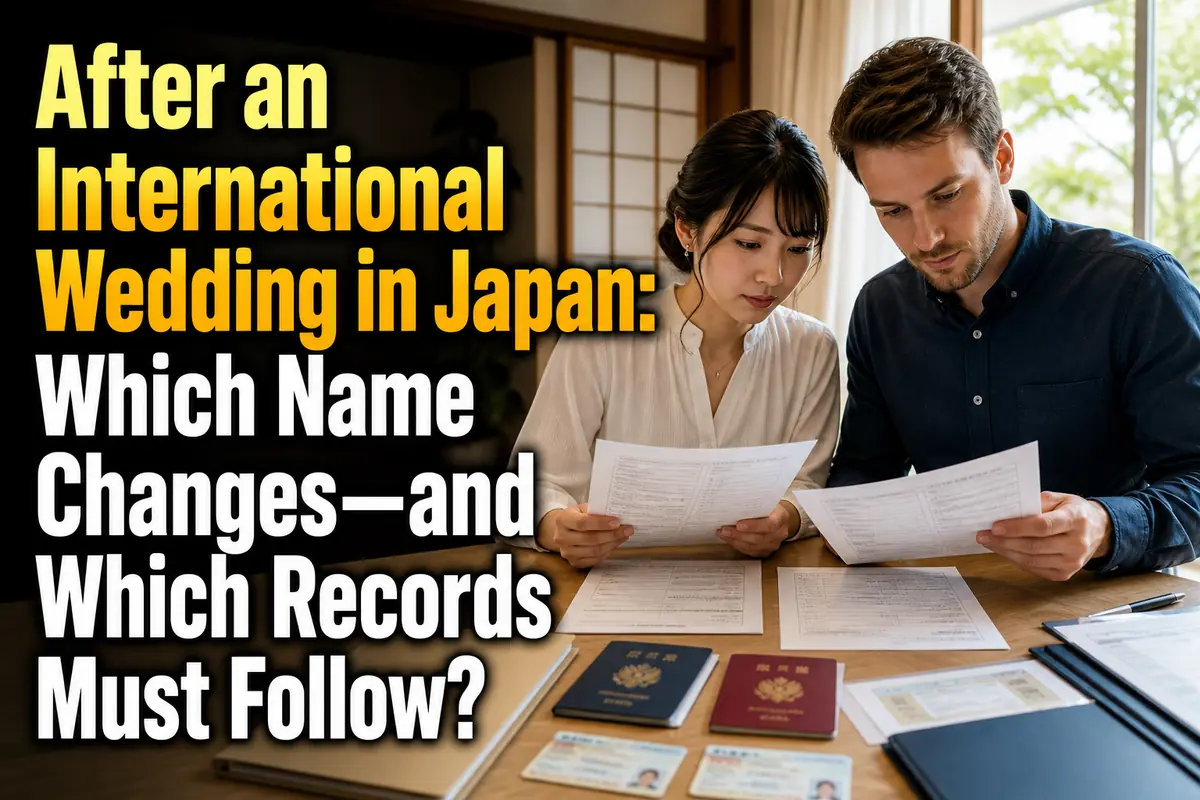
After an International Wedding in Japan: Which Name Changes—and Which Records Must Follow?
Marriage in Japan does not automatically give both spouses the same surname when one spouse is a foreign national. The Japanese spouse normally keeps the surname recorded in their family register, while the foreign spouse keeps the legal name recognized by their own country.
If either person chooses and legally completes a name change, the next job is to make passports, residence records, immigration documents, bank accounts, and workplace records match. The safest order is to update the document that establishes the legal name first, then work through Japanese records and private accounts.
This guide is for international couples living in Japan, especially foreign residents and Japanese spouses deciding whether to use one surname in daily life.
Quick answer:
- A marriage notification does not automatically change the foreign spouse’s legal name.
- The Japanese spouse does not automatically take the foreign spouse’s surname.
- A Japanese spouse can generally notify the municipality within six months of marriage to take the foreign spouse’s surname without first obtaining Family Court permission.
- A foreign resident whose legal name changes must notify Japan’s immigration authorities within 14 days.
- Using a shared name socially is different from changing the legal name on official documents.
First, identify whose legal name can change
The key is to separate the couple’s two legal systems. Japan controls the Japanese spouse’s family-register name, while the foreign spouse’s nationality and passport authority normally determine that person’s legal name.
The Japanese spouse’s family-register name
A Japanese citizen has a family register called a koseki (戸籍, family register). When a Japanese citizen marries a foreign national, the foreign spouse does not become a registered member in the name section of that koseki. Instead, the marriage and information about the foreign spouse are recorded in the Japanese spouse’s personal-status entry.
The Japanese spouse therefore keeps their existing surname unless they separately complete a surname-change procedure.
If the Japanese spouse wants to take the foreign spouse’s surname, the important Japanese term is gaikokujin to no kon’in ni yoru shi no henkō todoke (外国人との婚姻による氏の変更届, notification of surname change following marriage to a foreign national).
In general:
- Filing within six months of the marriage allows the Japanese spouse to change to the foreign spouse’s surname by notification.
- After the six-month period, permission from the Family Court is generally required before the municipal procedure can be completed.
- The exact Japanese rendering of the foreign surname should be checked with the municipality before filing.
This is separate from the kon’in todoke (婚姻届, marriage notification). Do not assume that writing a preferred surname on marriage-related paperwork completes the legal change.
The foreign spouse’s legal name
A foreign national does not acquire a Japanese koseki simply by marrying a Japanese citizen. Japan also does not normally change that person’s legal name merely because the marriage was accepted by a Japanese municipality.
The foreign spouse must check the rules of their own country. Depending on the country, a marriage certificate may permit a surname change, but the change might not become usable on Japanese records until the person receives a new passport or another official document showing the new name.
Questions for the foreign spouse’s embassy or consulate include:
- Does marriage itself change my name under my country’s law?
- Must I submit a separate name-change application?
- Can I use a hyphenated or combined surname?
- Will my given names or middle names be displayed differently in a new passport?
- Which marriage certificate and translation are required?
ここがポイント: A shared family name used at home, school, or work is not necessarily the legal name. For official procedures, start with the name recognized by the relevant country and shown on the primary identity document.
Legal name, registered alias, and everyday name are different
A couple may use one family name socially without changing both legal names. That can be practical, but it does not make the names interchangeable on contracts or identity checks.
Legal name
For a foreign resident, the name on the passport is normally the foundation for the name shown on the residence card. For a Japanese citizen, the koseki is the core public record.
Airline tickets, immigration applications, and identity checks should use the name shown on the relevant official ID. Even a small difference in spacing, name order, or omitted middle names can cause a mismatch.
Registered alias for a foreign resident
Some municipalities allow a foreign resident to register a tsūshō (通称, registered alias) on the resident record if the person can show that the name is genuinely used in daily life. Marriage alone may not be enough; the municipality decides what evidence is acceptable.
A registered alias can be useful for some domestic situations, but it does not replace the legal name on a passport or residence card. It also may not be accepted by every bank, employer, airline, or overseas authority.
Ask the municipal resident-registration counter:
- Whether alias registration is available in your circumstances
- What proof of established use is required
- Which local certificates will display the alias
- Whether the alias can be used for the specific service you need
Former surname for a Japanese spouse
A Japanese spouse who legally changes surname may be able to add a former surname, called kyūji (旧氏, former surname), to the resident record and My Number Card. This can help connect older professional or financial records with the current legal name.
Former-surname notation is not the same as keeping two legal surnames. Once registered, it appears on specified public records according to the applicable rules, so confirm the consequences with the municipality before applying.
Use the right order when updating documents
The most reliable sequence is legal source document first, Japanese public records second, private accounts last. Updating a bank or employer too early can create records that do not match the passport, residence card, or My Number Card.
Step 1: Obtain proof of the marriage and name change
Keep certified documents showing what happened and when. The useful document depends on which spouse changed their name and which organization is asking.
Possible records include:
- Kon’in todoke juri shōmeisho (婚姻届受理証明書, certificate of acceptance of the marriage notification)
- Koseki tōhon (戸籍謄本, certified copy of the full family register)
- A marriage certificate issued overseas
- A certificate or decision showing the foreign spouse’s legal name change
- Japanese translations identifying the translator
Municipal fees and processing times vary. Ask how many originals or certified copies you will need before submitting a document that may not be returned.
Step 2: Update the passport or family register
For the foreign spouse, follow the embassy or consulate’s procedure to obtain a passport in the new legal name. Requirements, costs, processing times, and rules for keeping the old passport vary by country.
For the Japanese spouse, complete the surname notification at the municipal family-register counter. After the new surname is recorded, obtain an updated koseki certificate if another organization requires it.
Do not book international travel under the new name until you know which passport will be valid on the travel date. The reservation name should match the passport used for the trip.
Step 3: Update the foreign resident’s residence card
A mid- to long-term foreign resident must notify the Immigration Services Agency when the name shown on the residence card changes. The official procedure covers changes to the holder’s name, date of birth, sex, or nationality or region.
The notification period is 14 days from the change. The procedure is handled by the competent Regional Immigration Services Bureau, not simply by changing the resident record at city hall.
Check the current official instructions before visiting. The required set generally includes the passport, residence card, photograph where applicable, and evidence of the change. Requirements can differ for applicants under 16 or for particular filing methods.
Marriage does not automatically change a person’s status of residence. A person who wants to change to a spouse-related status must make a separate immigration application; it is not part of the name-update notification.
Step 4: Update the resident record and My Number Card
Take the revised identity documents to the municipality where you live. Ask for the counter handling jūminhyō (住民票, resident records) and My Number Card changes.
Bring the My Number Card if you have one. A change to card information may affect the electronic certificate used for online signatures, so ask whether it must be reissued or reactivated.
Municipal workflow and appointment systems differ. A ward office in Tokyo may not use the same counter sequence as a smaller city, even though the underlying national systems are the same.
Step 5: Update work, insurance, tax, and pension records
Tell the employer or school only after you can show the updated official name. The payroll name, tax records, social-insurance information, and bank account used for salary payments must be able to connect to the same person.
Check, as applicable:
- Employer payroll and personnel records
- Employees’ health insurance and pension records
- National Health Insurance or National Pension records
- Resident-tax and income-tax information
- School enrollment and scholarship records
- Professional licences and qualifications
Ask the employer which changes it submits and which ones you must make yourself. Do not assume that changing the payroll system updates every public record.
Step 6: Update financial accounts and everyday contracts
Banks and service providers have their own identity-verification rules. Work through the accounts that can cause immediate disruption first.
A practical order is:
- Salary-receiving bank account
- Credit cards and loan accounts
- Mobile phone and internet contracts
- Lease, utilities, and insurance policies
- Securities, remittance, and payment services
- Driver’s licence and vehicle records, if applicable
- Memberships and delivery accounts
Keep one old ID or a copy where lawful, the new ID, and the certificate linking the names. Never send original identity documents by ordinary mail unless the receiving organization expressly requires and safely handles them.
Build a name-matching sheet before visiting counters
A one-page record prevents small differences from spreading across several systems. Write each version exactly as it appears, including spaces and hyphens.
Record these fields:
- Name in the old passport
- Name in the new passport
- Name on the residence card
- Name and script used on the resident record
- Name on the My Number Card
- Japanese spouse’s name in the koseki
- Katakana reading used by banks or employers
- Registered alias, if any
- Former surname notation, if any
This matters because Japanese private systems may divide a name into “surname” and “given name” fields even when the passport format does not fit neatly. Middle names may be joined to the given-name field, spaces may disappear, and character limits may apply.
When a system cannot display the passport name exactly, ask the organization to record how it mapped the name. Keep that explanation with your account records.
Common mistakes that create delays
Most problems come from treating one update as if it changes every record.
Assuming the marriage notification changes both names
It does not. Confirm separately what happened to the Japanese spouse’s koseki name and the foreign spouse’s passport name.
Missing the two important time limits
Couples should distinguish between:
- The Japanese spouse’s six-month period for the simplified surname notification
- The foreign resident’s 14-day immigration notification after a legal name change
These periods apply to different people and different procedures.
Updating private accounts before primary ID
A bank may reject a name change if the residence card still shows the old name. Complete the legal and public-document steps first unless an institution gives different written instructions.
Mixing an alias with a legal name
A workplace may accept a social name for email or a name badge while still requiring the legal name for payroll and tax reporting. Ask which field is being changed.
Forgetting reservations and automatic payments
A card replacement can affect recurring charges. A passport change can also create a mismatch with existing flight reservations or visa records. Review upcoming travel and essential payments before starting the update sequence.
Expecting every municipality to request identical evidence
National law sets the framework, but the documents needed to prove an overseas event or an alias can depend on the country, the document, and the municipality’s examination. Contact the actual filing office before ordering certificates or translations.
What changed recently: furigana in Japanese family registers
Since May 26, 2025, Japanese family registers have included a system for recording the furigana (フリガナ, kana reading) of registered names. The initial one-year notification period ended on May 25, 2026.
From May 26, 2026, municipalities began recording the notified reading—or, where no notification was made, the reading previously notified by the municipality—under the national transition process. This mainly concerns people whose names are entered in a Japanese koseki. A foreign spouse is not added to the koseki as a registered member merely through marriage.
For a Japanese spouse changing surname now, the reading matters because passport applications must follow the furigana recorded in the koseki and the corresponding romanization rules. A mismatch may lead to another passport procedure or changes to pension and other records.
Before choosing the reading of a foreign-origin surname, the Japanese spouse should compare:
- The spelling in the foreign spouse’s passport
- The proposed katakana and furigana
- The romanization expected for the Japanese passport
- Existing spellings used for children, banking, or professional records
If the reading is unusual, officials may request material showing established use. Confirm the acceptable evidence with the family-register office rather than relying on a bank’s informal katakana entry.
Special cases need individual confirmation
The basic sequence works for many couples, but some cases require advice from the relevant authority.
Contact the municipality, embassy, immigration office, or a qualified professional if:
- Both spouses are foreign nationals
- The marriage took place overseas and has not yet been reported where required
- One country does not recognize the intended surname form
- The new name includes multiple surnames, particles, or characters that do not fit Japanese systems
- The passport and marriage certificate use different name orders or transliterations
- A child’s surname or nationality documents must also be updated
- The six-month period for the Japanese spouse has passed
- A visa, overseas trip, inheritance matter, or major contract is pending
A municipal officer can explain Japanese filing requirements, but cannot decide how another country recognizes a name. An embassy can explain its own country’s passport rules, but cannot update a Japanese residence card. International couples often need both answers.
A practical checklist for the couple
The central task is not making every display name identical. It is ensuring that each official record uses the correct legal name and that documents clearly connect the old and new versions.
Before filing anything:
- Decide whether either spouse is making a legal change or only using a social name.
- Ask the municipality about the Japanese spouse’s surname procedure and exact spelling.
- Ask the foreign spouse’s embassy or consulate what creates a legal name change.
- Note the six-month and 14-day deadlines that apply to your case.
- Check upcoming travel, visa applications, salary payments, and automatic charges.
- Obtain enough certified evidence and translations.
- Update primary identity documents before private accounts.
- Keep a dated list of every organization contacted and the name it recorded.
The next document to check is the one that proves the person’s legal name: the Japanese spouse’s koseki or the foreign spouse’s passport. Once that record is correct, the rest of the update process has a clear starting point.
参照リンク
- Ministry of Justice: International marriage, overseas birth, and family-register Q&A
- Immigration Services Agency: Notification of a change to information other than address on a residence card
- Ministry of Justice: Process for recording furigana in family registers
- Ministry of Justice: Family-register furigana FAQ
- Ministry of Foreign Affairs: Passport guidance after furigana was added to family registers
- City of Yokohama: Marriage notification and documents for a foreign-national spouse
- Shinjuku City: Family-register Q&A
- Shinjuku City: Adding a former surname to resident records