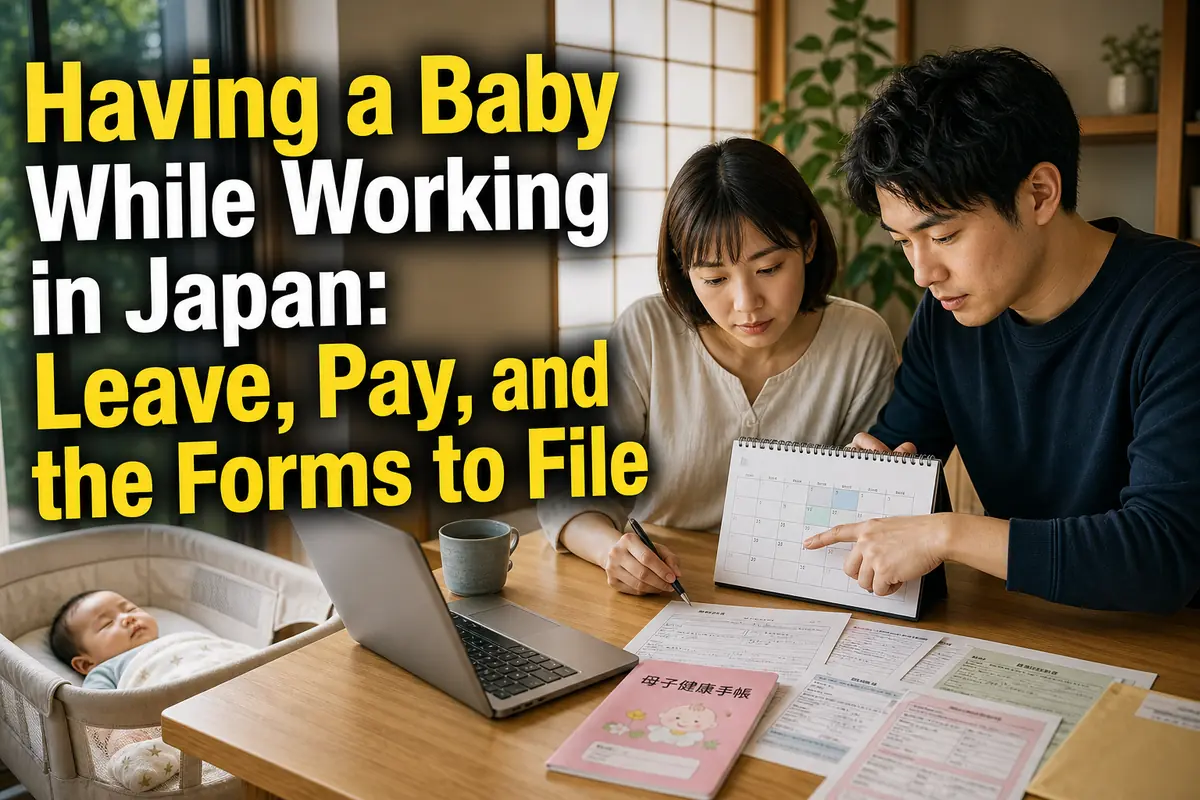
Having a Baby While Working in Japan: Leave, Pay, and the Forms to File
If you are employed in Japan and expecting a baby, start by separating time off from income support. Your employer approves or records the leave, while health insurance and employment insurance usually pay the benefits.
The main systems are:
- Maternity leave: generally six weeks before birth and eight weeks after birth for the person giving birth
- Postnatal paternity leave: up to 28 days during the first eight weeks after birth, usually for the other parent
- Childcare leave: normally available until the child turns one, with limited extensions
- Income support: maternity allowance from employee health insurance and childcare-leave benefits from employment insurance
This guide is for foreign employees and their families in Japan. The national rules generally depend on employment and insurance status—not nationality—but company procedures, contract terms, and family circumstances can change what you need to submit.
First, identify the four systems involved
No single application covers every part of childbirth and parental leave. You may need to deal with your employer, health insurer, maternity clinic, municipal office, and Hello Work at different stages.
Maternity leave: sanzen sango kyūgyō
Maternity leave is the protected period around childbirth for the employee who gives birth.
Under the national rule:
- Prenatal leave can begin six weeks before the expected delivery date when the employee requests it.
- The prenatal period is 14 weeks for a multiple pregnancy.
- The employer must not require the employee to work for eight weeks after childbirth.
- After six weeks have passed, an employee may request an earlier return if a doctor confirms that the proposed work will not cause a problem.
If the baby arrives after the expected date, the extra days between the expected date and actual birth are generally included in the prenatal leave period. They do not reduce the eight-week postnatal period.
This statutory leave is different from ordinary paid annual leave. Japanese law protects the time away from work, but it does not require the employer to continue paying normal salary unless company rules provide paid leave.
Postnatal paternity leave: sango papa ikukyū
Postnatal paternity leave, formally called childcare leave at birth (shusshōji ikuji kyūgyō), is designed for the period immediately after a baby arrives.
An eligible employee can usually take:
- Up to 28 days in total
- Within the first eight weeks after birth
- In as many as two separate periods
The employee normally gives the employer at least two weeks’ notice. A company may require an earlier notice period in limited circumstances when it has established an appropriate labor-management arrangement.
Some work during this leave may be possible only when a labor-management agreement exists and the employee agrees to the dates and hours. Working too much can also reduce or eliminate the related employment-insurance benefit. Do not treat this as ordinary remote work without checking both HR rules and benefit limits.
Regular childcare leave: ikuji kyūgyō
Childcare leave is available to eligible workers caring for a child under one year old. It can normally be divided into two periods for each parent, separately from postnatal paternity leave.
Leave may continue beyond the first birthday in specific cases, such as when the family applied for nursery care but could not obtain a place. The usual extension points are:
- Until the child reaches 18 months
- Then, if the qualifying situation continues, until the child reaches two years
These extensions are not automatic. Nursery applications, rejection notices, dates, and evidence of a genuine intention to use childcare are important. Applying only to obtain an extension, or missing the municipality’s application schedule, can prevent approval.
Childbirth payments are separate again
Two health-insurance payments are often confused:
- Maternity allowance (shussan teatekin) replaces part of an eligible employee’s lost income while unable to work around childbirth.
- Childbirth and childcare lump-sum allowance (shussan ikuji ichijikin) helps cover delivery costs.
For births covered by the standard rule from April 2023, the childbirth lump sum is generally ¥500,000 per child at an eligible medical institution. A lower amount can apply in certain cases. Many hospitals use a direct-payment system, under which the insurer pays the hospital and the family pays any remaining balance.
The ¥500,000 payment is not salary replacement and does not determine whether your employer grants leave.
Who can take leave and receive benefits?
The right to take leave and the right to receive money use different eligibility tests. Check both before estimating your household budget.
Eligibility for statutory childcare leave
Most employees can request childcare leave, including many fixed-term, part-time, and non-Japanese employees. Daily workers are excluded.
For a fixed-term employee, it must not be clear at the time of application that the employment contract will end before the child reaches the relevant age specified by the law. A labor-management agreement may also exclude certain workers, including people who:
- Have worked for the employer for less than one year
- Are clearly due to leave employment within the prescribed period
- Work two scheduled days or fewer per week
Ask HR whether such an agreement applies at your workplace. A company cannot refuse an eligible request merely because its work rules do not describe childcare leave.
Eligibility for childcare-leave benefits
Childcare-leave benefits come from employment insurance. A common qualifying test is at least 12 months during the two years before leave began in which the employee had:
- At least 11 wage-payment basis days, or
- At least 80 working hours when the 11-day test is not met
Additional rules apply to fixed-term workers, people who change employers, employees receiving wages during leave, and anyone working while on leave.
Self-employed people and freelancers are generally outside employment-insurance childcare-leave benefits. A spouse who is not insured through employment may still affect the documents needed for the new post-birth support benefit.
Eligibility for maternity allowance
Maternity allowance is generally for the person giving birth who is personally insured through an employees’ health-insurance plan and is not receiving normal wages for the covered absence.
A dependent family member or a person enrolled only in National Health Insurance usually does not receive this employee maternity allowance. National Health Insurance can still provide the childbirth lump sum, subject to its rules.
If the employer pays some wages during the absence, the insurer may pay only the difference between the wages and the calculated allowance. Eligibility after leaving a job has additional conditions, so obtain advice from the insurer before resigning.
ここがポイント: Leave approval does not guarantee an insurance payment. Confirm your employment-insurance record and health-insurance category before deciding how long each parent can afford to stop working.
How much income support can you receive?
Many insured employees receive roughly two-thirds of their reference pay at first, but the formulas, caps, and payment agencies differ. Benefits also arrive after applications are processed, so families need cash for the gap.
Maternity allowance
For an eligible employee, the daily maternity allowance is broadly calculated as:
Average standard monthly remuneration for the relevant 12-month period ÷ 30 × two-thirds
The covered period generally runs from 42 days before the expected birth date—98 days for a multiple pregnancy—through 56 days after birth, for days when the employee did not work. Different calculations can apply when the insured period is shorter than 12 months.
“Standard monthly remuneration” is an insurance calculation base. It is not always identical to the amount deposited into your bank account each month.
Childcare-leave benefit
For an eligible employment-insurance member, the regular childcare-leave benefit is generally calculated at:
- 67% of the leave-start wage base during the first 180 benefit days
- 50% after the first 180 days
Payment limits and reduction rules apply. Wages paid during leave and the amount of work performed can change the benefit.
The same basic 67% rate is used for the birth-time childcare-leave benefit associated with postnatal paternity leave, subject to its separate eligibility and work limits.
The additional 13% post-birth benefit
Since April 1, 2025, eligible parents may receive the post-birth leave support benefit (shusshōgo kyūgyō shien kyūfukin).
It adds 13% of the leave-start wage base for up to 28 days. Combined with the existing 67% benefit, the total rate can reach 80% of the wage base for the covered period.
The Ministry of Health, Labour and Welfare describes this as approximately 100% of prior take-home pay because the benefit is tax-free and qualifying leave may receive social-insurance premium exemptions. It is not 100% of gross salary.
The central condition is generally that both parents take at least 14 days of qualifying leave during the specified post-birth periods. Exceptions may apply when the other parent cannot take qualifying leave—for example, because the person is self-employed, not employed, or falls within another listed exception.
Do not assume that one parent’s 14 days automatically proves the household qualifies. The applicant may need documents showing the spouse’s leave, employment status, or reason an exception applies.
A simplified example
Suppose the official leave-start wage base is ¥300,000 for a 30-day equivalent period. Ignoring caps, wages paid during leave, and day-count adjustments:
- A 67% benefit would be about ¥201,000.
- An additional 13% would be about ¥39,000.
- Together, the covered amount would be about ¥240,000, or 80% of the wage base.
This is only an illustration. Hello Work determines the employment-insurance amount, while the health insurer separately calculates maternity allowance.
Application steps: what to do and when
Tell your employer early, then track each leave request and benefit claim as a separate item. Verbal notice alone makes dates, documents, and responsibility difficult to prove.
Step 1: Check your insurance and contract
Ask HR or payroll to confirm:
- Whether you are enrolled in employment insurance
- Which health insurer covers you
- Your fixed-term contract end date, if applicable
- Whether a labor-management agreement creates an eligibility exclusion
- Whether the company pays salary or an additional allowance during leave
- Who submits each benefit claim
Also ask for the company’s maternity, postnatal paternity, and childcare-leave forms. The names may differ even when the underlying rights come from national law.
Step 2: Build a leave calendar for both parents
Record the expected delivery date and make a draft schedule showing:
- Planned prenatal leave
- The eight-week postnatal period
- The other parent’s postnatal paternity leave
- Each parent’s regular childcare-leave periods
- The child’s first birthday
- Nursery application deadlines if an extension may be needed
This calendar matters because postnatal paternity leave, regular childcare leave, and the 14-day condition for the additional benefit use different windows.
Step 3: Notify the employer in writing
For regular childcare leave, apply in writing or through the employer’s accepted electronic process at least one month before the planned start date. Leave beginning after the child turns one under an extension generally has a shorter notice period of two weeks.
For postnatal paternity leave, the ordinary deadline is two weeks before the start date.
Provide the planned start and end dates. Keep copies of forms, emails, and the employer’s written confirmation. If an early birth changes the schedule, contact HR immediately; special rules can allow a planned start date to be brought forward.
Step 4: Prepare evidence after birth
The exact list depends on the claim, but commonly requested items include:
- A document confirming the birth and relationship to the child
- Maternal and Child Health Handbook pages or another birth record
- The employer’s leave record
- Wage records and attendance information
- Bank-account details for payment
- My Number information where required
- Evidence of the spouse’s leave or employment status for the 13% benefit
- Medical certification for maternity allowance
Ask before submitting foreign documents. A Japanese translation may be required, especially when a child is born abroad or a family relationship is documented outside Japan.
Step 5: Submit the benefit claims
Employers commonly submit childcare-leave benefit applications to Hello Work, although an insured employee may be able to apply directly in some circumstances. Confirm who is responsible and ask for the expected filing cycle.
Maternity allowance is submitted to the employee’s health insurer. The form normally contains sections for the applicant, employer, and medical institution or midwife. It can often be claimed after the covered absence is confirmed, either for the full period or in installments.
The childbirth lump sum follows a different route. If your hospital offers direct payment, you normally sign an agreement with the medical institution. If direct payment is not used, ask your insurer how to claim reimbursement.
Step 6: Check social-insurance and payroll treatment
Qualifying maternity and childcare leave can allow exemptions from employee and employer health-insurance and employees’ pension premiums. The employer normally files the relevant notice.
Ask payroll to show:
- Which months receive a premium exemption
- Whether resident tax will still be deducted or must be paid separately
- How company benefits and bonuses are treated
- Whether any salary paid during leave reduces an insurance benefit
Resident tax does not disappear simply because employment income stops. If payroll cannot deduct it, the municipality may send payment slips directly.
Common mistakes that delay leave or payment
The most expensive errors come from assuming that HR will coordinate every system automatically. Use a checklist and ask for written confirmation.
- Calling every absence “maternity leave.” The employee giving birth, the other parent, and the later childcare period may use different statutory systems.
- Confusing leave with benefits. An employee may have a right to time off but fail an employment-insurance payment test.
- Waiting until after birth to plan paternity leave. The ordinary notice deadline arrives before the requested start date, and the first eight weeks pass quickly.
- Counting on immediate payment. Insurance benefits are generally paid after supporting wage and leave records are available and reviewed.
- Assuming the additional 13% is automatic. The second parent’s leave or an applicable exception must be established.
- Working informally during leave. Even short periods of work must fit the legal arrangement and benefit limits.
- Missing nursery deadlines. A childcare-leave extension requires qualifying circumstances and timely evidence; it is not granted merely because a parent prefers to remain home.
- Using gross salary as the estimate. Benefits use statutory wage or remuneration bases and are subject to caps and adjustments.
- Resigning before checking eligibility. Leaving employment can change access to maternity allowance, childcare leave, and employment-insurance benefits.
What changed in 2025 and still matters in 2026?
The largest recent changes added income support and stronger options for combining childcare with work. These rules are now part of practical leave planning in 2026.
April 2025: two new employment-insurance benefits
The post-birth leave support benefit added up to 13% for qualifying early leave, bringing the combined rate to 80% for up to 28 days.
A separate childcare reduced-hours benefit (ikuji jitan shūgyō kyūfukin) was also introduced. An eligible employment-insurance member who reduces working hours to care for a child under two may generally receive a benefit equal to 10% of wages earned during reduced-hours work, subject to adjustment rules.
This creates an additional choice after returning: a parent may compare full leave with a reduced schedule rather than treating return to work as an all-or-nothing decision.
October 2025: flexible-work measures for older preschool children
Employers must now provide at least two measures from a national list for eligible employees raising children from age three until elementary-school entry. The options include:
- Changed starting or finishing times
- Remote work at least 10 days per month
- Employer-supported childcare facilities
- At least 10 days of work–childcare support leave per year
- A reduced-hours system
An employee chooses from the measures adopted by that employer. This does not mean every company must offer every option, and it does not guarantee remote work.
Employers also have duties to explain relevant arrangements and confirm employees’ intentions at specified stages. In practice, this makes an early meeting with HR useful not only before birth but again before the child turns three.
Special situations for foreign families
Foreign residents use the same national employment systems, but documents and timing can become more complicated. Confirm these cases before relying on a standard checklist.
A child is born outside Japan
Ask the employer, insurer, municipality, and your country’s embassy or consulate what birth and family-registration documents are required. Benefit agencies may request the foreign birth certificate and a Japanese translation.
Immigration and nationality procedures are separate from employment leave. If the child will live in Japan without Japanese nationality, check the applicable status-of-residence procedure promptly with the Immigration Services Agency.
One parent works abroad or is self-employed
The 13% post-birth benefit has exceptions to the usual two-parent leave condition, but the applicant may need proof of the spouse’s status. Ask Hello Work which declaration, tax certificate, employment record, or other evidence applies.
A contract will expire during leave
Fixed-term employment does not automatically prevent childcare leave. The important question is whether contract expiration is clearly scheduled within the statutory eligibility period. Benefit entitlement and contract renewal remain separate questions, so ask both HR and Hello Work.
Company benefits are more generous
Some employers offer paid parental leave, supplemental payments, longer leave, or a return-to-work program. These can improve the statutory minimum, but company wages may affect insurance-benefit calculations. Request a written simulation from payroll.
Municipal support differs
National employment rights and insurance benefits are broadly uniform, but these items can differ by city or ward:
- Pregnancy and birth registration procedures
- Prenatal examination subsidies
- Child medical-expense assistance
- Childcare and nursery applications
- Postpartum support services
- Local cash benefits or vouchers
Check the municipality where your resident record is registered, not only the city where your hospital or workplace is located.
A practical checklist before speaking to HR
The best next step is to turn your expected delivery date into a dated application plan. Bring the following questions to HR or payroll:
- What are my prenatal, postnatal, and childcare-leave dates?
- Is the other parent using postnatal paternity leave, regular childcare leave, or both?
- Do we appear to meet the 14-day condition for the post-birth support benefit?
- Which office submits each claim, and what must we submit ourselves?
- How much salary, maternity allowance, or childcare benefit is expected in each month?
- When could the first payment realistically arrive?
- How will health-insurance premiums, pension premiums, resident tax, and bonuses be handled?
- What evidence will be needed if the child is born abroad or the other parent is self-employed?
- Which nursery deadline must we meet if an extension may become necessary?
Rules and forms can change, and individual results depend on the employment contract, insurance record, wages, dates, and family situation. Confirm the final schedule with your employer, health insurer, Hello Work, and municipality. The most urgent watchpoint is the other parent’s first-eight-week leave window: once it passes, it cannot be recreated by filing later.
参照リンク
- Ministry of Health, Labour and Welfare: Outline of the Act on Childcare Leave and Family Care Leave, October 2025 (English PDF)
- Ministry of Health, Labour and Welfare: Childcare leave
- Ministry of Health, Labour and Welfare: Childcare-leave benefits
- Ministry of Health, Labour and Welfare: Questions and answers on childcare-leave benefits
- Ministry of Health, Labour and Welfare: April 2025 system changes
- Ministry of Health, Labour and Welfare: Flexible-working measures
- Japan Health Insurance Association: Maternity allowance
- Japan Health Insurance Association: Childbirth and childcare lump-sum allowance