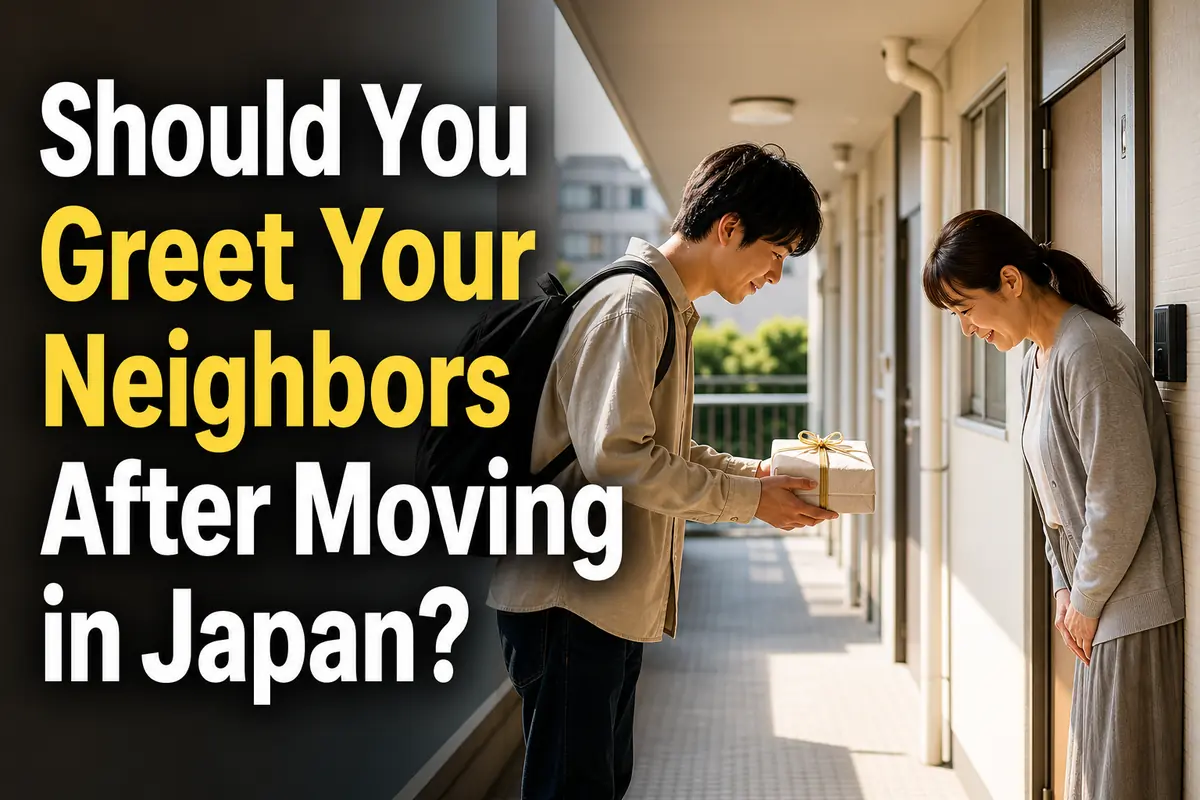
A Simple Guide to Greeting Neighbors After Moving in Japan
You do not have to visit your new neighbors after moving into a home in Japan. It is a social custom, not a national rule or a rental procedure.
A short introduction can still be useful, especially in a small apartment building, a family-oriented neighborhood, or an area where residents share garbage stations and disaster information. Bring a modest gift only if it feels appropriate. If the building emphasizes privacy or you feel unsafe, skip the visit and greet people naturally when you meet them.
Quick guide:
- Ask the landlord or property manager what residents normally do.
- In an apartment, consider the homes beside yours; include the unit below when moving noise may affect it.
- At a detached house, the homes next door and directly opposite are a practical starting point.
- Visit during daylight or early evening—not early in the morning or late at night.
- Keep the conversation brief and do not ask personal questions.
- A gift is optional; an inexpensive packaged item is enough.
This guide is for students, workers, families, and other residents setting up a new home in Japan. It explains what the custom means, how to handle it politely, and when respecting distance is the better choice.
The custom is optional, but the introduction has a practical purpose
The real value of a moving greeting is exchanging enough information to live comfortably near one another. It is not a test of whether you understand Japanese culture.
The custom is called hikkoshi aisatsu (引っ越し挨拶), meaning a greeting made when moving. Japan’s Agency for Cultural Affairs describes greeting nearby residents as a custom and notes that neighbors can become a source of local information. Higashihiroshima City similarly recommends a simple introduction and says an expensive present is unnecessary.
That local connection can matter when you need to confirm:
- where and when to leave garbage;
- whether a garbage station is shared by specific households;
- how parcels are handled in the building;
- where the nearest evacuation site is;
- whether a jichikai (自治会, neighborhood association) distributes local notices;
- whom to contact about a shared hallway, parking area, or bicycle space.
These arrangements are not uniform across Japan. Garbage rules come from the municipality, while use of a collection point may also depend on the building or neighborhood. Your property manager and municipal office remain the official places to confirm them.
First ask what is normal in your building
One question to the property manager can prevent an awkward or unnecessary visit. Customs differ between a large city tower, a small company dormitory, student housing, and a row of detached homes.
Try asking:
Hikkoshi no aisatsu wa hitsuyō desu ka? (引っ越しの挨拶は必要ですか?) — “Is a moving greeting customary here?”
You can also ask whether residents use a shared garbage point or belong to a neighborhood association. These practical questions give the manager a clearer reason for your inquiry.
Situations where a visit may be useful
A brief visit is more likely to help when:
- the building has only a few units;
- your household includes children or a pet whose everyday sounds may carry;
- movers will use a narrow road, entrance, elevator, or shared corridor;
- houses share a garbage station or other community space;
- you expect construction, furniture assembly, or another temporary source of noise;
- the landlord or employer says introductions are usual there.
A greeting does not give you permission to make excessive noise. It simply lets affected residents know who has moved in and, when relevant, when a short disruption may occur.
Situations where skipping the visit is reasonable
Do not treat the custom as an obligation when the surroundings suggest that privacy comes first. It is reasonable to skip a door-to-door introduction when:
- the building has controlled access or rules against visiting other units;
- a sign asks residents not to knock, solicit, or leave items;
- you live in short-term or highly anonymous accommodation;
- no one answers after one attempt;
- you would have to reveal personal details that make you uncomfortable;
- visiting alone creates a safety concern;
- the manager advises against it.
Never follow someone into a secured area or bypass an intercom to complete a greeting. A friendly konnichiwa (こんにちは, hello) when you later meet in a shared space is enough.
ここがポイント: A moving greeting is optional. Follow the property’s access rules, protect your privacy, and use the custom only when it helps residents share practical local information.
Who should you greet?
Keep the circle small and focus on people directly affected by your household or the move. There is no nationwide list that every resident must follow.
In an apartment or condominium
Higashihiroshima City recommends greeting the apartments on either side. Some local guidance also includes the homes immediately above and below because sound travels through apartment buildings.
A practical approach is:
- Beside you: the first people to consider because you share walls or a nearby entrance.
- Below you: particularly relevant if you have children, regularly move furniture, or expect moving-day noise.
- Above you: optional; ask the manager whether this is customary in the building.
- Caretaker or resident landlord: appropriate when this person manages shared facilities or is your regular contact.
Do not roam through the entire building. In a large property, that can feel more intrusive than polite.
In a detached house
Higashihiroshima City suggests the houses on both sides and three houses opposite. Treat this as local guidance rather than a national formula.
Road layout matters. A home sharing a narrow access lane or garbage point may be more relevant than a home that happens to be physically close. Ask the real-estate agent or landlord which households share facilities with yours.
When and how to make the visit
Choose a normal waking hour, introduce yourself, and leave within a minute or two. The aim is recognition, not a long conversation.
Choose a considerate time
If practical, greet neighbors before the move when trucks, elevators, or a narrow road will be affected. Otherwise, visit after moving in, once the busiest work has finished.
Good general choices are:
- daytime on a weekend;
- late afternoon or early evening on a weekday;
- a time when the building is not unusually busy or quiet.
Avoid mealtimes where possible, as well as early mornings and late evenings. Shift workers, parents, and older residents may keep different schedules, so there is no perfect hour. Make one reasonable attempt rather than returning repeatedly.
Use a short script
You do not need advanced Japanese. A simple introduction is enough:
Hajimemashite. Tonari no 203-gōshitsu ni hikkoshite kita Alex desu. Dōzo yoroshiku onegaishimasu.
(はじめまして。隣の203号室に引っ越してきたアレックスです。どうぞよろしくお願いします。)
“Hello. I’m Alex, and I have moved into apartment 203 next door. It is nice to meet you.”
If moving work may create noise, add:
Hikkoshi de oto ga dete shimau kamo shireません. Sumimasen.
(引っ越しで音が出てしまうかもしれません。すみません。)
“There may be some noise from the move. I’m sorry for the inconvenience.”
A small bow or nod is sufficient. You do not need to shake hands, enter the home, or explain your job, relationship status, nationality, or schedule. Share only what you want the other resident to know.
If speaking Japanese is difficult, Higashihiroshima City suggests going with a friend or workplace contact who understands Japanese. A short written message can also help, but do not put sensitive personal information in it.
Gifts: optional, small, and easy to accept
A gift should be a minor courtesy, not something the recipient feels obliged to repay. Higashihiroshima City suggests everyday items such as towels or laundry detergent, or boxed sweets, and explicitly says the present need not be expensive.
Older local living guides commonly describe roughly ¥500 to ¥1,000 as a conventional range. This is not a fee or an official current price. Product prices and local expectations vary, and giving nothing is acceptable.
Practical gift choices
Choose something new, packaged, and uncomplicated:
- a small towel;
- sealed tea or coffee;
- individually wrapped sweets with clear ingredient information;
- a simple household consumable;
- a small item associated with your previous region, if it is easy to explain.
For food, check the label for common allergens and the expiration date. Avoid homemade food unless you already know the recipient. Dietary restrictions, allergies, and religious requirements are not visible.
Gifts to avoid
Skip anything that creates pressure or uncertainty:
- expensive goods or cash;
- alcohol when you do not know whether the person drinks;
- refrigerated or frozen food;
- strongly scented products;
- a large object that needs storage;
- an opened item;
- anything requiring the resident to meet you at a specific time.
A plain paper bag is fine. Elaborate wrapping and formal gift knowledge are unnecessary for this everyday introduction.
What to do when nobody answers
One missed visit does not require repeated knocking. The resident may be out, working from home, sleeping, caring for someone, or simply unwilling to open the door.
Use this sequence:
- Confirm that you have the correct unit.
- Try once at a reasonable hour.
- If no one answers, leave without waiting outside.
- Do not make repeated visits unless the manager says there is a practical reason.
- Greet the person naturally if you later meet near the entrance or garbage area.
Leaving a gift outside a door is not always a good solution. Building rules may prohibit objects in corridors because they obstruct shared or emergency routes. Food can spoil, and an unidentified package may worry the resident. Ask the manager before leaving anything.
Privacy, safety, and different household expectations
Politeness never requires you to ignore a safety concern. The same principle applies whether you are a student living alone, a worker in company housing, or a family in a new neighborhood.
If you live alone
You do not need to announce that you live alone, explain your working hours, or give a telephone number. Use a surname or first name according to your comfort level. If you want support, ask a friend, employer, school staff member, or housing representative to accompany you.
If the resident does not speak with you
A short response, refusal of a gift, or closed door is not necessarily hostility. Some residents avoid unplanned visitors for security, health, work, or privacy reasons. Thank them briefly and leave.
If your household may create temporary disruption
For scheduled furniture delivery, repair work, or another noisy activity, contact the property manager first. The lease or building rules—not the moving-greeting custom—determine what notice or permission is required.
If a serious noise or shared-space dispute develops, do not repeatedly confront the other household. Keep a factual record and contact the landlord, management company, dormitory supervisor, or other responsible office.
Common mistakes to avoid
Most problems come from doing too much, not too little. Keep the contact modest and respect the building’s boundaries.
Avoid these mistakes:
- presenting the custom as mandatory;
- visiting very early, late, or repeatedly;
- introducing yourself to a whole large building;
- giving an expensive present;
- asking who lives in the home or when they are usually away;
- blocking a corridor while talking;
- leaving food or gifts at an unattended door without permission;
- assuming the neighbor can explain official municipal rules;
- treating a greeting as permission for noise, smoking, parking, or misuse of shared space.
Neighbors can point you toward local information, but confirm garbage schedules, disaster sites, and administrative procedures through the municipality or property manager.
Neighborhood associations are a separate question
Greeting a neighbor does not automatically enroll you in a neighborhood association. A jichikai or chōnaikai (町内会, neighborhood association) is a resident organization that may help with community cleaning, festivals, disaster drills, crime-prevention activities, or circulating notices.
The role and membership process vary by area. If someone mentions fees, duties, or a kairanban (回覧板, circular notice passed between homes), ask for a written explanation and confirm:
- whether membership is optional under the local arrangement;
- the amount and purpose of any fee;
- how notices are delivered;
- whether members take turns with cleaning or other duties;
- whether multilingual information is available;
- whom to contact when you cannot participate.
Do not agree to a payment or recurring duty simply because it is discussed during an introduction. Take time to understand the local arrangement.
Current status in August 2026
Moving greetings remain a local social practice, not a standardized national requirement. Public guidance still varies: Higashihiroshima City recommends a simple visit and an inexpensive gift, while broader government information presents neighbor contact as a useful way to learn local customs and community information.
Housing style is the key dividing line. In a small building or neighborhood with shared facilities, an introduction can solve practical questions early. In a secured urban property with little resident interaction, following management rules and offering a natural hallway greeting may be more suitable.
Before deciding, check these three points:
- Property rules: Are visits, unattended items, or corridor storage restricted?
- Local practice: Does the landlord say introductions are common in this building or street?
- Your comfort: Can you make brief contact without giving away information or taking a safety risk?
If the answer points toward a visit, keep it short. If it points toward privacy, skip the doorbell. The useful goal is not completing a ritual—it is knowing where to confirm garbage rules, shared-space arrangements, and emergency information before you need them.
参照リンク
- Agency for Cultural Affairs — Handbook of Learning Japanese and Life in Japan
- Higashihiroshima City — Communication With Your Neighborhood
- Shiga Intercultural Association for Globalization — Living Guide Q&A: Daily Living
- Mito City International Association — Living Information for Foreign Residents
- Japan National Tourism Organization — Understanding and Mastering Japanese Manners and Etiquette