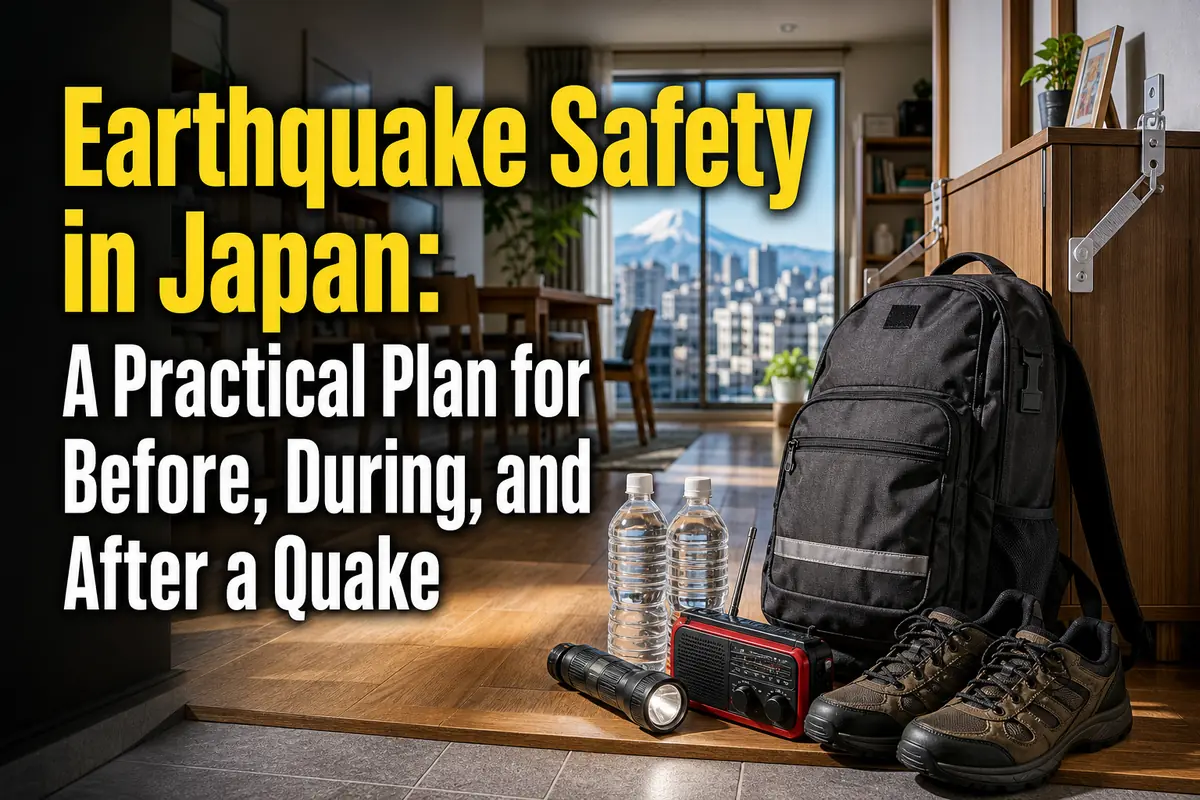
Earthquake Safety in Japan: A Practical Plan for Before, During, and After a Quake
When an earthquake starts, protect your head, stay away from falling objects, and do not rush outside. Once the strong shaking stops, check for injuries and fire, then use official information to decide whether to remain where you are or evacuate.
If you are near the coast and feel strong or long-lasting shaking, move to higher ground immediately. Do not wait for a phone notification.
This guide is for foreign residents and their families, including people who have recently moved to Japan and may not yet know their local evacuation system.
Quick action plan:
- Before: Secure furniture, prepare water and other supplies, and check local hazard maps.
- During: Drop low, protect your head, and stay away from glass and unsecured furniture.
- After: Check injuries and hazards, put on shoes, and confirm official earthquake and tsunami information.
- Evacuate when necessary: Leave if there is a tsunami risk, fire, structural damage, or an instruction from local authorities.
Information and local arrangements can change, so confirm your municipality’s current guidance. The practical details in this article were checked against official sources available on August 1, 2026.
Prepare before an earthquake happens
The most useful preparation is a household plan that still works when electricity, water, mobile networks, and trains are unavailable. Buying an emergency bag helps, but it is only one part of that plan.
Secure the places where you spend time
Many immediate injuries can come from objects inside a building. Start with the bedroom, living area, kitchen, and children’s rooms.
- Secure tall shelves and wardrobes so they cannot fall.
- Keep heavy items on lower shelves.
- Move furniture away from beds and doorways.
- Apply shatter-resistant film to vulnerable glass where appropriate.
- Do not place heavy decorations above beds or sofas.
- Keep slippers or sturdy shoes, a flashlight, and glasses beside the bed.
- Check that an exit route will not be blocked by fallen furniture.
Ask a landlord or property manager before drilling into the walls of a rental home. Tension rods and other non-damaging devices may be options, but they must suit the wall, ceiling, and furniture. An incorrectly installed device can give false confidence.
Keep supplies for staying at home
A shelter is not automatically the safest or most comfortable place after every earthquake. If your home remains structurally safe and the surrounding area has no immediate hazard, local authorities may expect residents to remain at home while services recover.
Tokyo’s official stockpiling guidance recommends starting with at least three days of supplies and planning toward one week or longer. Your municipality may publish different guidance based on local risks and expected recovery times.
A practical household stockpile includes:
- Drinking water; Tokyo guidance uses about 3 liters per person per day as a planning figure
- Food that your household already eats and can prepare with little water
- Prescription medicine and copies of important medical information
- Portable toilet bags, toilet paper, wet wipes, and hygiene products
- A flashlight or lantern, spare batteries, and charged power banks
- A battery-powered or hand-crank radio
- A first-aid kit, masks, work gloves, and a whistle
- A portable stove and fuel, stored and used according to the manufacturer’s safety instructions
- Baby supplies, pet supplies, allergy-safe food, or disability-related equipment as needed
- Some cash in small denominations in case electronic payments are unavailable
Use “rolling stock”: keep extra packages of food and daily necessities, consume the oldest items normally, and replace them. This is easier to maintain than an emergency box that remains unopened for years.
Pack a separate evacuation bag
Your home stockpile and evacuation bag serve different purposes. The stockpile supports life at home; the bag contains what you can carry if you must leave quickly.
Consider packing:
- Water and compact food
- Regular medicines
- Identification copies and essential contact details
- A phone cable and power bank
- Flashlight, radio, batteries, and whistle
- Rainwear, warm layers, gloves, and a change of underwear
- Basic toiletries and portable toilet bags
- A paper map of the local area
- Simple Japanese emergency phrases
Store the bag near an exit, but do not make it so heavy that the person assigned to carry it cannot move safely.
Learn the two types of evacuation place
Japan uses similar English terms for facilities with different purposes:
- A designated emergency evacuation site is a place to escape an immediate threat such as a tsunami, fire, flood, or landslide. A site may be designated for only certain hazards.
- A designated shelter is a facility where people can stay when they cannot safely remain at home.
The nearest school is not necessarily the correct site for every hazard. Check your city or ward’s hazard map, confirm which locations accept evacuees for earthquakes and tsunamis, and walk at least one route in advance.
Save the address in Japanese as well as English. During a disaster, signs, announcements, and conversations may mainly be in Japanese.
ここがポイント: Do not treat “go to the nearest school” as a complete earthquake plan. First identify the hazard, then use a location designated for that hazard.
Make a family communication plan
Mobile calls can be difficult when many people try to connect at once. Agree in advance on:
- One meeting place near home and another outside the neighborhood
- A contact outside the affected region
- Who will collect children or assist relatives
- What to do if an adult is at work and trains stop
- A short message format, such as “Safe—staying at home” or “Safe—at ABC Elementary School”
NTT’s Disaster Emergency Message Dial 171 can be activated during major disasters. Call 171 and follow the prompts to record or play back a message associated with a telephone number. Learn the process before an emergency; NTT provides an English guide, although actual availability and operating conditions depend on the event.
What to do while the ground is shaking
Your first task is personal safety, not evacuation, filming, or protecting belongings. An Earthquake Early Warning may provide only seconds before strong shaking arrives, and an alert may not reach you before the movement begins.
If you are at home
- Get low so the shaking does not knock you down.
- Protect your head and neck under a sturdy table if one is immediately available.
- Stay away from windows, unsecured shelves, and hanging objects.
- Do not run outside during strong shaking; glass, signs, roof tiles, and exterior materials may fall.
- Do not try to cross a room to switch off a flame while objects are falling.
Modern gas equipment may have automatic safety functions, but systems differ. Deal with fire or gas controls only after the shaking and only when it is safe.
If you are in a shop, station, or office
Protect your head and follow staff instructions. Do not rush toward exits, escalators, or stairs with a crowd.
In a high-rise building, slow swaying can continue longer than expected. Stay clear of unsecured furniture and wait for reliable instructions before moving.
If you are on a train or bus
Hold a strap, rail, or seat firmly. Vehicles may stop suddenly, and rail service may remain suspended for inspection after the shaking.
Do not force doors open or enter the tracks. Follow the operator’s instructions, even if waiting feels inconvenient.
If you are in an elevator
Press the buttons for nearby floors and leave at the first floor where the doors open safely. If the elevator stops and the doors do not open, use the emergency call system. Do not try to force your way out between floors.
If you are driving
Do not brake suddenly. Turn on the hazard lights, reduce speed gradually, and move to the left side of the road when safe, following police and road-authority instructions.
If you eventually leave the vehicle, avoid blocking emergency access. Local instructions may require the key to remain available so the vehicle can be moved, but follow current police guidance for your location and situation.
If you are outdoors
Move away from block walls, vending machines, glass-fronted buildings, signs, utility poles, and other objects that may fall. Protect your head with a bag if necessary.
Near a cliff or steep slope, watch for falling rocks and landslides. Do not shelter directly beside a damaged wall or building facade.
If you are near the sea
Strong or long shaking near the coast can mean a tsunami risk. Leave the coastal area and move to higher ground or an officially designated tsunami evacuation building immediately. Do not go to the shore to check the water.
Follow tsunami warnings and advisories from the Japan Meteorological Agency and local authorities. Remain in a safe place until officials say the danger has passed; later waves may arrive after the first one.
What to do in the first minutes after shaking stops
Pause, check immediate dangers, and gather official information before deciding to move. Going outside without assessing the area can expose you to falling debris, fire, damaged roads, or a tsunami.
1. Check people and protect your feet
Look for injuries in your household and give basic first aid if you can do so safely. Call 119 for an ambulance or fire emergency when urgent help is needed, while recognizing that response times may be longer during a widespread disaster.
Put on sturdy shoes before walking through rooms where glass or dishes may have broken. Check on children, older relatives, and anyone who may need help understanding alerts or moving safely.
2. Check fire, gas, electricity, and structural damage
Watch and listen for:
- Smoke, flames, or burning smells
- A gas smell or hissing sound
- Sparking wires, damaged outlets, or water near electrical equipment
- Large new cracks, leaning walls, or doors that no longer fit their frames
- Falling ceiling material or unstable furniture
If you suspect a gas leak, avoid flames and electrical switches, leave the area, and contact the gas provider or emergency services from a safe place. Do not enter a visibly damaged building to collect belongings.
3. Check official alerts
Use several channels if available:
- Japan Meteorological Agency earthquake and tsunami information
- Municipal emergency websites, apps, outdoor speakers, and official social media accounts
- Television and radio
- Mobile alerts and the JNTO-supervised Safety tips app, which provides disaster notifications in multiple languages
- Announcements from building managers, employers, schools, and transport operators
The JMA seismic intensity scale describes the strength of shaking at a location. It is different from magnitude, which describes the overall size of an earthquake. A high local intensity may mean serious nearby damage even when the magnitude number does not look extraordinary.
4. Expect aftershocks
Aftershocks can bring down structures or furniture weakened by the first earthquake. Move away from damaged buildings and slopes, keep shoes and your evacuation bag ready, and repeat the same protective action if shaking resumes.
Do not assume a damaging earthquake is finished because several quiet minutes have passed.
Should you stay home or evacuate?
Evacuate because of a specific danger, not simply because an earthquake occurred. A safe home may be better than a crowded shelter, but remaining in a damaged building can be life-threatening.
Leave promptly if:
- You are in a tsunami-risk area after strong or long shaking, or a tsunami warning or advisory applies.
- There is fire, smoke, a suspected gas leak, or another immediate hazard.
- The building appears seriously damaged or officials say it is unsafe.
- A local evacuation instruction applies to your area.
- A landslide, cliff failure, or other secondary hazard threatens the property.
If you evacuate, take only what you can carry safely. Use stairs rather than elevators. Tell family members where you are going, and leave a simple note only if doing so does not delay evacuation or expose personal information unnecessarily.
You may be able to remain at home if the building and surrounding area are safe, there is no applicable evacuation instruction, and you have adequate supplies. Continue monitoring official information because conditions can change.
Shelter conditions and local differences
Shelter locations, opening times, registration methods, language support, and available supplies vary by municipality and by the scale of the event. Do not assume every shelter will immediately provide food, bedding, medicine, privacy, charging facilities, or pet accommodation.
Ask your municipality in advance about:
- Accessible shelters and support for people with disabilities
- Pregnancy, infant-care, and medical needs
- Food allergies and religious or dietary requirements
- Rules for pets and whether animals stay in a separate area
- Support for residents who do not speak Japanese
Foreign nationality does not make a person ineligible for emergency protection. However, procedures and available assistance depend on the municipality and actual disaster conditions. Carry identification if readily available, but never delay an urgent evacuation to search for documents.
If trains stop while you are away from home
Do not immediately begin a long walk home through an unfamiliar or damaged city. Stations, roads, and bridges may be crowded, while fires and falling objects can make routes unsafe.
In Tokyo, official policy encourages people to avoid unnecessary movement after a major earthquake and remain at a safe workplace, school, or similar location for up to three days when possible. Other regions and organizations may use different plans.
Before leaving a safe place:
- Check whether your route crosses rivers, coastal areas, steep slopes, or dense wooden neighborhoods.
- Confirm transport status through the operator, not rumors.
- Check that your family is safe using text, a message service, or the agreed contact.
- Follow instructions from the facility and local authorities.
- Keep enough battery power for alerts and essential communication.
Employers and schools may have their own emergency supplies and release procedures. Ask about these arrangements before a disaster, especially if you commute a long distance or collect a child from another district.
Common mistakes that increase risk
Most avoidable mistakes come from acting before checking the immediate hazard. Keep these points simple enough to remember under stress.
- Running outside during strong shaking: Exterior glass, signs, walls, and tiles may fall.
- Using an elevator to evacuate: Power failure or safety systems may stop it.
- Returning home at once from work: Roads may be dangerous and emergency routes may need to remain clear.
- Waiting for a tsunami alert after severe coastal shaking: The shaking itself is a reason to move to safety.
- Going to any school or park: Not every location is designated for every hazard.
- Depending only on a smartphone: Batteries, networks, or internet service may fail.
- Assuming a shelter supplies everything: Bring essential medicine and portable supplies when possible.
- Sharing unverified messages: Old images and warnings can circulate again during a new event. Confirm the date, location, and official source.
- Taking unnecessary risks to turn off utilities: Personal safety comes first.
A 30-minute preparation plan
You can improve your household’s safety today without completing every task at once. Start with actions that remove the largest uncertainties.
- Open your municipality’s hazard map and identify earthquake, fire, tsunami, and landslide risks around home.
- Save the correct emergency evacuation site and designated shelter in your phone and on paper.
- Install or configure an official disaster-information service in a language you understand.
- Put shoes and a flashlight beside each bed.
- Move one heavy object away from a sleeping or exit area.
- Write down one family meeting place and one out-of-area contact.
- Check whether every household member has at least three days of essential medicine and suitable supplies.
- Ask your employer, school, or nursery what happens when transport stops.
The next watchpoint is local, not national: confirm exactly which site your municipality designates for each hazard and whether your household can safely stay home without water, power, or working toilets. That decision is much easier to make before the floor begins to move.
参照リンク
- Japan Meteorological Agency — Earthquake Early Warning System
- Japan Meteorological Agency — Emergency Warning System
- Japan Meteorological Agency — Tips to Protect Yourself from Earthquakes
- Japan Meteorological Agency — Earthquake and Tsunami Safety Guidance
- Cabinet Office — Designated Emergency Evacuation Sites and Designated Shelters
- Cabinet Office — Disaster Preparedness Guidebook in English
- JNTO — Safety tips App
- Tokyo Stockpiling Navi — Why Stockpiling Matters
- Tokyo Stockpiling Navi — Household Emergency Stockpile Checklist
- Tokyo Metropolitan Government — Measures for Stranded Persons
- NTT EAST — Disaster Emergency Message Dial 171