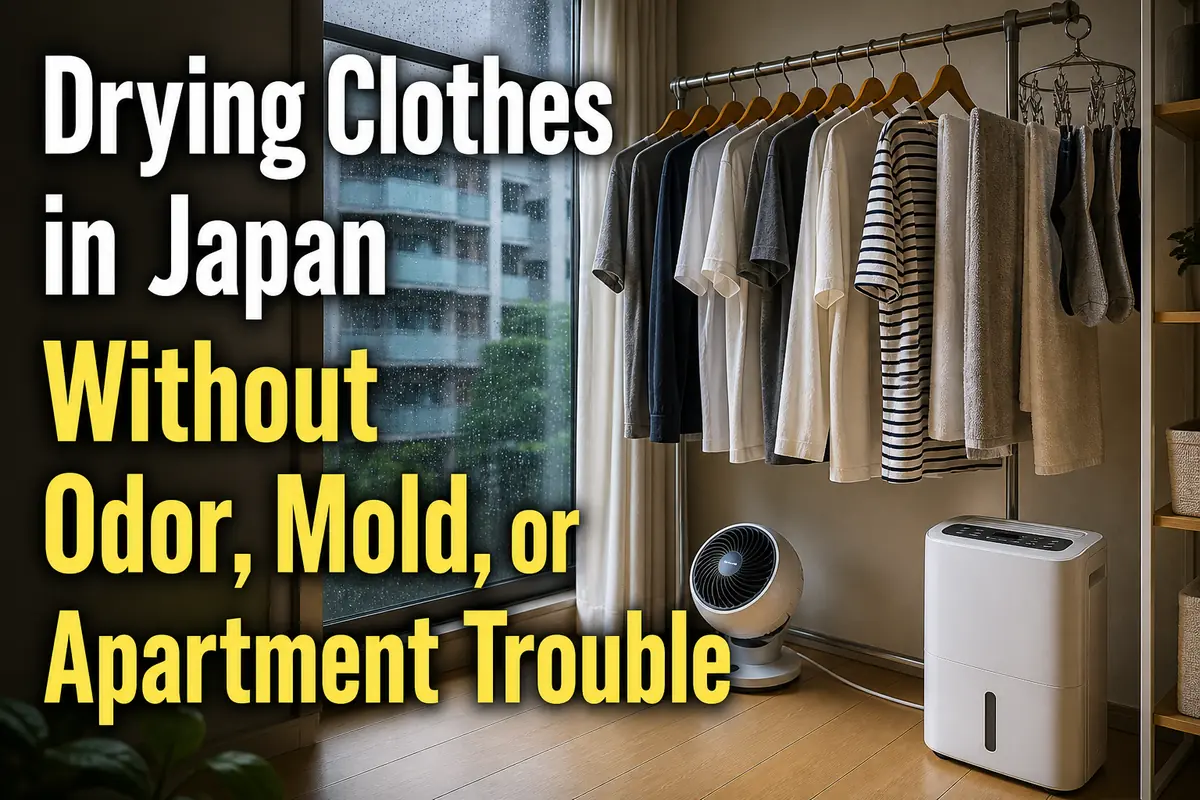
Drying Clothes in Japan Without Odor, Mold, or Apartment Trouble
The safest default in Japan is simple: check your building rules before using the balcony, and use indoor airflow—not heat alone—when rain or humidity makes outdoor drying unreliable. Keep laundry and drying equipment away from balcony escape panels, evacuation hatches, heaters, and cooking appliances.
This guide is for new residents, students, workers, and anyone facing Japan’s humid rainy season for the first time.
Quick answer:
- Balcony drying is common, but your lease or building rules may limit where and when you can hang clothes.
- A balcony may also serve as an emergency escape route. Never block partitions, hatches, ladders, or the path leading to them.
- For indoor drying, remove as much water as the garment allows, leave space between items, and move air across the fabric.
- Check the care label before using a tumble dryer. Some clothes must be line-dried, dried flat, or kept out of direct sunlight.
First decide where you can dry the load
The best location depends on your building, the weather, and the garment—not on one rule for all of Japan. Before washing a full load, check what your home actually permits and supports.
Your main options are:
- an apartment balcony or designated outdoor area;
- a room with a drying rack, fan, air conditioner, or dehumidifier;
- a bathroom equipped with a ventilation or drying function;
- a washer-dryer or separate household dryer;
- a neighborhood coin laundry, called a coin randorī (coin laundry).
If you rent, look for laundry instructions in the lease, resident handbook, move-in guide, or posted notices. Useful Japanese terms include:
- kanri kisoku (管理規則): management rules;
- shiyō saisoku (使用細則): detailed use rules;
- sentakumono (洗濯物): laundry;
- hosu (干す): to hang something out to dry;
- heya-boshi (部屋干し): indoor drying.
Ask the landlord, management company, dormitory office, or housing desk if the documents are unclear. A neighbor’s setup does not prove that the same use is permitted for your unit.
Balcony drying: common, but controlled by the building
There is no single nationwide rule saying that every resident may—or may not—hang laundry on a balcony. Your lease and building regulations usually decide the practical details, while fire-safety features must remain usable.
Keep the emergency route completely clear
Many apartment balconies have one or more of these features:
- a thin partition marked koko o yabutte hinan (ここを破って避難), meaning “break here to evacuate”;
- a floor hatch marked hinan hatchi (避難ハッチ), or evacuation hatch;
- a folding escape ladder below the hatch;
- a route across the balcony to the neighboring unit or an escape point.
Do not place a drying rack, storage box, planter, washing machine, or heavy load where it blocks access to these features. Do not cover warning labels with sheets or blankets. UR housing guidance also warns residents not to obstruct balcony escape equipment and routes.
ここがポイント: A balcony may look private, but parts of it can function as a shared emergency route. Laundry must never prevent another resident from escaping.
Check how laundry may be hung
A building may prohibit laundry from extending above or beyond the handrail. Possible reasons include falling objects, the building’s appearance, wind, and water or dirt reaching another unit.
Before using an outdoor rack, confirm:
- whether laundry may be visible above the railing;
- whether bedding, rugs, or futons may be placed over the handrail;
- whether permanent hooks or fixtures are allowed;
- whether outdoor drying is restricted on certain sides of the building;
- whether the balcony can be used during repair or inspection work.
Use the installed laundry pole holders if available. Secure hangers and lightweight items on windy days, and bring everything inside when strong wind, heavy rain, or a typhoon is expected.
Avoid creating trouble below
Wet laundry should not drip onto another balcony, public path, or stored property. Run only the spin cycle permitted by the care label, or gently remove water with a towel when an item should not be strongly spun.
Strongly scented products can also bother nearby residents. Fragrance preferences are personal, but in close housing the practical approach is to use only the necessary amount and avoid treating an open balcony as a place to spray fragrance products.
How to dry laundry indoors efficiently
Indoor laundry dries faster when you combine water removal, open spacing, moving air, and a way for moisture to leave the room. Raising the temperature without managing humidity is often not enough.
1. Remove water before hanging
Use the washing machine’s spin setting only when the care label allows it. Heavy cotton items may benefit from an additional short spin, but delicate clothing may stretch or crease.
For an item that must not be strongly spun:
- Lay it on a clean, dry towel.
- Roll or fold the towel around it.
- Press gently to transfer water.
- Reshape the garment before hanging or laying it flat.
The Japanese Consumer Affairs Agency explains that care symbols show the strongest permitted treatment. Using a hotter or harsher method can damage the fabric.
2. Create gaps between items
Do not pack wet clothes tightly on one rail. Leave visible space so air can pass around both sides of the fabric.
A practical arrangement is:
- place longer items toward the outside of a rack;
- keep shorter items toward the center;
- open shirt buttons and trouser pockets;
- separate thick waistbands, hoods, and overlapping fabric;
- turn very thick items partway through drying if one side stays damp.
The exact gap is less important than preventing wet surfaces from touching each other.
3. Move air across the wet fabric
Point a fan or circulator so air travels across the laundry rather than only at the floor. A gentle, continuous flow can reach more of the load than a narrow blast at one shirt.
If you open windows, do so only when outdoor conditions help. During warm rain, outside air can already contain a great deal of moisture. In that situation, closed windows plus mechanical ventilation or dehumidification may work better.
4. Give the moisture somewhere to go
Choose one workable route:
- run a dehumidifier and close the room as directed by its manual;
- use the air conditioner’s joshitsu (除湿, dehumidify) or dry mode;
- use mechanical ventilation when it can exhaust damp air outdoors;
- ventilate with windows when the outdoor air is drier and weather conditions are safe.
Empty a dehumidifier’s water tank before it becomes full. Clean filters according to the appliance manual; restricted airflow reduces performance and can create safety or maintenance problems.
5. Check thick areas before putting clothes away
Cuffs, waistbands, pockets, hoods, and the center of folded towels often remain damp after the main fabric feels dry. Check these areas by touch before moving the load into a closet.
If anything still feels cool and damp, give it more time and airflow. Putting partly wet laundry into closed storage can transfer moisture and odor to surrounding clothes.
Using a Japanese bathroom dryer
A bathroom is useful for laundry only when it has suitable ventilation or a dedicated drying function. Simply hanging wet clothes in a closed, unventilated bathroom can leave both the laundry and the room damp.
Common control-panel terms include:
- kansō (乾燥): drying;
- kanki (換気): ventilation;
- danbō (暖房): heating;
- suzukaze or ryōfū (涼風): cool-air mode;
- teishi (停止): stop;
- taimā (タイマー): timer.
These modes are not interchangeable. Kanki moves air, while kansō generally activates a dedicated drying program if the unit has one. The exact operation, energy use, and permitted drying load depend on the installed model.
Before starting:
- Read the label on the control panel and the appliance manual.
- Remove standing water from the bathroom floor.
- Spread garments along the installed pole without covering air inlets or outlets.
- Confirm whether doors, windows, or vents should be open or closed for that model.
- Select the correct mode and timer.
Do not install an improvised pole or hang more weight than the fixture supports. In a rental, ask management before adding screws, hooks, or permanent fittings.
Rainy-season strategy: wash smaller loads earlier
During tsuyu (梅雨), Japan’s early-summer rainy season, laundry planning matters more than waiting for perfect sunshine. The Japan Meteorological Agency describes Baiu as a cloudy and rainy period affecting Japan except Hokkaido, generally from early June to late July, although timing varies by region and year.
Use a forecast as a planning tool, not a guarantee. A workable routine is:
- wash smaller loads that fit your indoor drying space;
- start early enough to inspect thick areas before bedtime;
- separate quick-drying clothes from towels and bedding;
- reserve a coin laundry or dryer for large items when necessary;
- avoid leaving washed clothes sitting inside the machine.
Hokkaido does not have the same established Baiu season described for the rest of Japan, but local rain, temperature, building insulation, and winter conditions still affect drying. On the Sea of Japan side and in snowy regions, indoor drying may be important during winter as well as summer.
Tumble dryers and coin laundries
Read the care label before paying for a dryer cycle. A square containing a circle is the tumble-drying symbol. Under Japan’s current JIS-based system:
- two dots permit tumble drying with an exhaust-temperature limit of 80°C;
- one dot permits low-temperature tumble drying with a limit of 60°C;
- a crossed-out tumble-dryer symbol means tumble drying is not permitted.
Natural-drying symbols can require hanging, drip hanging, flat drying, or drying in shade. A sweater that needs flat drying should not be placed in a hot commercial dryer simply because speed is convenient.
At a coin laundry:
- Check the garment labels at home.
- Confirm the machine type and capacity.
- Read the displayed instructions and prohibited-item list.
- Check pockets and remove items that should not be heated.
- Select a suitable machine and cycle.
- Remove the load promptly when the cycle ends.
Prices, payment methods, temperatures, and machine capacities are set by each operator. Some locations accept only coins; others support cards or apps. Check the signs at the specific shop instead of relying on a national price estimate.
Never put items containing oil, flammable chemicals, rubber unsuitable for heat, or anything prohibited by the operator into a dryer. If you cannot identify a stain or material, ask the operator or use a professional cleaner.
Safety rules for indoor drying equipment
Keep water, textiles, and heat-producing appliances properly separated. Do not drape clothes over a space heater, stove, lighting fixture, or ordinary electrical appliance.
Follow these precautions:
- keep wet fabric away from flames and hot surfaces;
- do not cover appliance air inlets or outlets;
- use dehumidifiers and dryers only on stable surfaces and as their manuals direct;
- keep plugs and extension connections away from wet floors;
- stop using equipment that smells burnt, overheats, leaks, or has a damaged cord;
- clean dryer lint filters at the interval stated in the manual;
- use the washing machine or dryer’s earth connection where required.
Japan’s Fire and Disaster Management Agency advises that washing machines and clothes dryers used around water should be properly earthed. Never attach an earth wire to a gas pipe.
Common mistakes and better alternatives
Most laundry problems come from ignoring one of three things: the building, the fabric, or the moisture. These are the mistakes to avoid.
“The balcony belongs to my unit, so I can use it freely”
Better approach: read the management rules and keep all emergency equipment clear. Exclusive everyday use does not remove evacuation or building restrictions.
Hanging bedding over the railing without checking
Better approach: confirm the building rule first. Use approved supports inside the railing if required, and secure items against wind.
Closing wet laundry in a room with no airflow
Better approach: create gaps, move air across the load, and remove moisture through ventilation, dehumidification, or a suitable drying function.
Choosing the hottest dryer setting
Better approach: follow the garment’s tumble-drying symbol. Heat can shrink, deform, or otherwise damage unsuitable materials.
Assuming every “dry” button works the same way
Better approach: identify the appliance model and read its instructions. An air conditioner’s dehumidifying mode, bathroom ventilation, and bathroom drying mode perform different jobs.
Washing more than the available drying space can handle
Better approach: divide the load. A smaller load with proper spacing can be more manageable than a crowded rack that remains damp for a long time.
What changed in the current care-label system
The most relevant current update is Japan’s use of JIS L 0001:2024-based care symbols. The Consumer Affairs Agency states that some symbols were revised in August 2024, including a 30°C hand-wash symbol and an iron symbol allowing up to 120°C without steam.
For drying, continue to distinguish between:
- tumble-drying limits;
- hanging or flat drying;
- whether the item should remain unspun or dripping wet;
- whether drying should take place in shade.
Older clothes can carry symbols from an earlier labeling system. When a symbol is unfamiliar, use the Consumer Affairs Agency’s guide rather than guessing from its shape.
A practical setup for a small apartment
You do not need a large home, but every item in the setup should have a clear role. A basic arrangement can include:
- one foldable rack sized for the room;
- hangers or clips that stay secure under airflow;
- a fan or circulator positioned away from splashing water;
- either a dehumidifier, an air-conditioner mode, or effective exhaust ventilation;
- an unobstructed route through the room and to the balcony exit.
Before buying equipment, measure the storage area as well as the drying area. Check the appliance’s rated voltage, power use, tank capacity, noise information, and clearance requirements in the official manual.
Electricity cost varies by appliance, setting, operating time, and your utility contract. To compare two methods, use the appliance’s power consumption in kilowatts, multiply it by operating hours, and then multiply by your electricity price per kilowatt-hour. This is more useful than assuming that one drying method is always cheaper.
Final checklist before each load
The reliable routine is to check the rules, check the label, and control moisture. Before walking away from wet laundry, confirm:
- Is outdoor drying permitted today under the building rules and current notices?
- Are the balcony partition, evacuation hatch, ladder, and route fully clear?
- Does each garment permit the selected spin or dryer treatment?
- Is air moving around—not merely toward—the laundry?
- Can moisture leave the room or be collected by an appliance?
- Are heaters, flames, outlets, and appliance vents safely separated from wet fabric?
- Will you have time to check cuffs, pockets, towels, and other thick areas before storage?
If the lease, posted notice, and resident handbook appear to disagree, pause outdoor drying and ask the property manager for the rule that applies to your building. That one check is more reliable than copying how another balcony is being used.
参照リンク
- Japan Meteorological Agency: Climate—Baiu
- Japan Meteorological Agency: Overview of Japan’s Climate
- Consumer Affairs Agency: Care Labels Since August 20, 2024
- Government of Japan: Understanding Laundry Care Labels
- UR Housing: Guide to Everyday Living, March 2026 edition (PDF)
- Ministry of Land, Infrastructure, Transport and Tourism: Apartment Search and Housing Guide (PDF)
- Fire and Disaster Management Agency: Electrical Safety