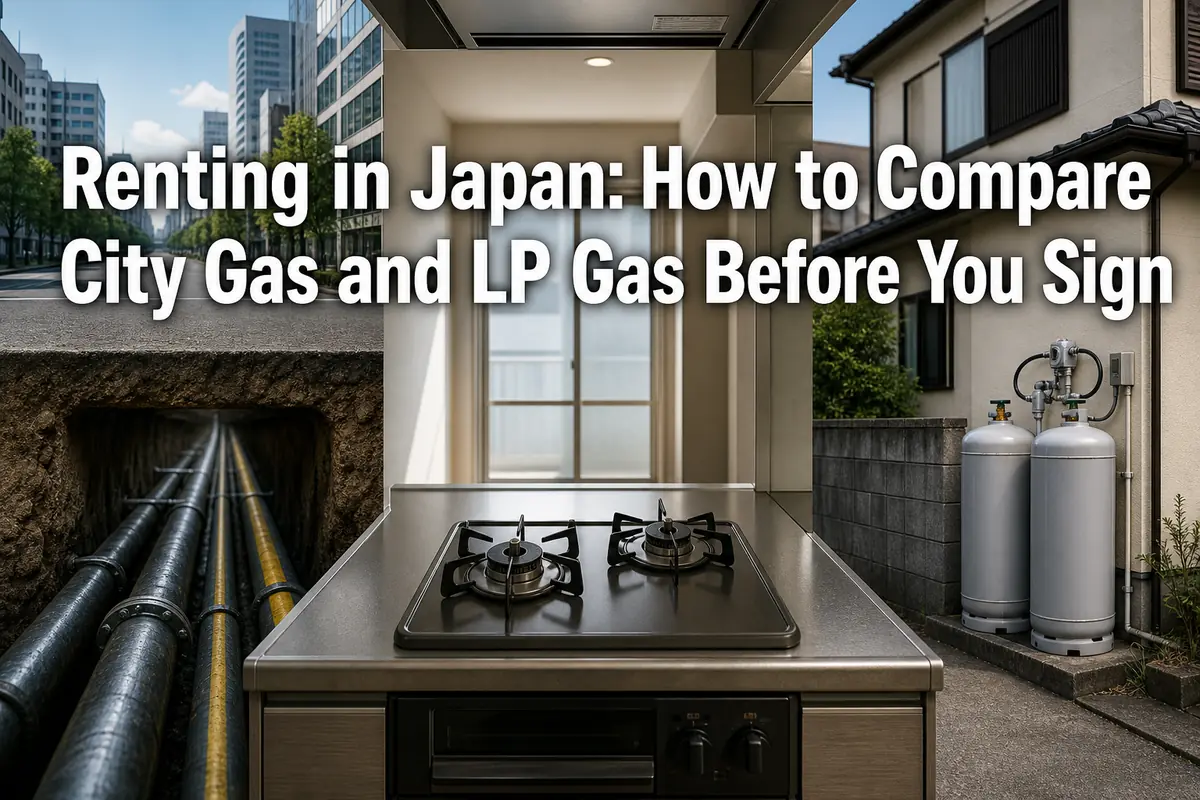
Renting in Japan: How to Compare City Gas and LP Gas Before You Sign
For most renters, city gas is usually the easier option to compare and often the less expensive one for regular hot-water use. However, LP gas can be the only practical supply in buildings or areas without a city-gas pipeline. The important point is not the label alone: ask for the building’s actual rate sheet before signing the lease.
This guide is for newcomers, students, workers, and long-term residents comparing rental homes in Japan. It explains how to identify the gas type, read the charges, question an LP gas quote, and avoid buying incompatible appliances.
What you need to know first
- Gas type is normally fixed by the property. A tenant usually cannot convert a rental apartment from LP gas to city gas.
- Compare the basic monthly charge and usage rate, not the price per cubic meter alone.
- For an LP gas rental, request the rate information before signing the lease.
- Since April 2, 2025, LP gas bills must separate basic, usage, and equipment charges under national rules.
- Check every gas stove or heater for compatibility. City gas and LP gas appliances are not automatically interchangeable.
The practical difference: pipelines or cylinders
City gas reaches the building through a pipeline, while LP gas is stored and delivered locally. That supply method affects availability, pricing, and the amount of choice a renter has.
City gas: toshi gas
City gas is called toshi gasu (都市ガス). It is distributed through underground pipes in covered areas, especially cities and densely populated neighborhoods.
Japan opened the household city-gas retail market to competition in April 2017. If several registered retailers serve your address, you may be able to choose a seller or switch plans while using the same local pipeline. This does not mean every address has several useful offers, and it does not let a renter bring city gas into a building with no suitable connection.
LP gas: LP gasu or puropan gasu
LP gas is written as LPガス and is also commonly called puropan gasu (プロパンガス). It is liquefied petroleum gas delivered to cylinders or a shared storage system near the property.
Because it does not need a city-gas pipeline, LP gas is widely used in suburban, rural, mountainous, and island communities. It is also found in urban apartment buildings. Delivery, inspection, security, and local operating costs form part of its retail price, so rates can differ substantially among suppliers and regions.
ここがポイント: A low rent can be offset by a high gas bill, particularly when gas heats both the bath and kitchen water. Compare the rent and expected utilities together.
Which one costs less?
There is no single national household price, but city gas commonly has the cost advantage when gas consumption is high. Your result still depends on the property, supplier, region, season, and equipment.
A household gas bill often follows this basic structure:
Monthly bill = basic charge + metered usage charge + applicable adjustments and taxes
The Japanese terms to find are:
- Kihon ryōkin (基本料金): basic charge paid even with little or no consumption
- Jūryō ryōkin (従量料金): charge linked to the amount used
- Tanka (単価): unit rate
- Genryōhi chōsei (原料費調整): fuel-cost adjustment
- Seikyū kingaku (請求金額): amount billed
Do not compare cubic-meter prices directly
One cubic meter of LP gas and one cubic meter of city gas do not contain the same amount of usable energy. A simple comparison such as “¥X per cubic meter versus ¥Y per cubic meter” can therefore give the wrong impression.
Instead, compare one of the following:
- Estimated bills for the same household size and pattern of use
- The previous occupant’s monthly consumption and bills, with personal details removed
- Annual estimates for the same uses, such as cooking, showers, bath filling, and space heating
- Total housing cost: rent, management fee, gas, electricity, and any required service charges
The Agency for Natural Resources and Energy publishes links to regional household LP gas price surveys. These are useful benchmarks, but they are not a promise of what a particular building will charge.
Hot water matters more than cooking for many homes
A gas stove may run for only a short period each day. A gas water heater can operate through every shower, bath, and hot-water tap.
Before estimating costs, check which equipment uses gas:
- Kitchen stove only
- Kitchen stove and water heater
- Bath reheating system, called oidaki (追い焚き)
- Bathroom dryer or heating
- Floor heating, called yukadanbō (床暖房)
- Gas clothes dryer or room heater
A person who cooks occasionally but takes long hot showers may use more gas than expected. Winter use can also rise because incoming water is colder and must be heated further.
The questions to ask before signing a lease
The best time to investigate gas charges is before paying or signing, when you can still compare properties. Ask the real-estate agent or property manager for written answers.
Use this checklist:
- Is the property supplied by toshi gasu or LP gasu?
- What is the gas supplier’s full name?
- What are the current basic charge and usage rate?
- Does the usage rate change by consumption band?
- Is there a fuel-cost adjustment or another variable component?
- Is any equipment charge shown?
- Can the tenant select or change the supplier?
- Which appliances and hot-water systems use gas?
- Can you see a sample bill or the official rate sheet?
- Are cancellation, deposit, opening, or account-closing fees possible?
A useful Japanese request is:
Keiyaku mae ni, LP gasu no ryōkinhyō to ryōkin no uchiwake o kakunin shitai desu.
契約前に、LPガスの料金表と料金の内訳を確認したいです。
“Before signing, I would like to check the LP gas rate sheet and breakdown.”
Do not rely only on “city gas is cheap” or “the gas charge is normal.” Request numbers and the date on which those rates apply.
The 2025 LP gas rules renters should know
National rules now give renters a clearer way to see LP gas charges, but tenants still need to request and read the information. The revised framework became fully effective on April 2, 2025.
Information before the rental contract
A prospective tenant must be able to obtain information about the LP gas rates associated with a rental property before entering the lease. The Consumer Affairs Agency advises renters to ask the real-estate company or another relevant party before signing.
In practice, ask early—ideally while comparing properties. Keep the supplied rate sheet or written response with the property listing and estimate documents.
The three-part charge display
LP gas charges are organized into three categories:
- Kihon ryōkin (基本料金): basic charge
- Jūryō ryōkin (従量料金): metered usage charge
- Setsubi ryōkin (設備料金): equipment charge
For rental housing, the equipment-charge field should generally state that there is no applicable charge under the rules for LP gas sales contracts concluded on or after April 2, 2025. The Consumer Affairs Agency notes that a renter generally bears no such cost without prior agreement.
If setsubi ryōkin contains an amount, do not ignore it. Ask:
- What exact equipment does the charge cover?
- Who owns that equipment?
- Where did the tenant agree to pay?
- How long will the charge continue?
- Does the rule for newer rental LP gas contracts apply?
The reform also prohibits loading costs unrelated to LP gas consumption—such as air-conditioning or Wi-Fi equipment—into LP gas charges. For rental housing, restrictions also cover the inclusion of gas-consumption equipment costs in new LP gas contracts under the revised system.
What the reform does not guarantee
The change improves disclosure and separates charges. It does not create one regulated nationwide price, guarantee that LP gas will be cheaper, or give every apartment tenant the power to replace the building’s supplier.
Older agreements and individually agreed costs can also require closer examination. If the explanation is unclear, request the contract date, written breakdown, and legal basis rather than assuming that every equipment-related amount is automatically invalid.
Can a renter change the gas company?
City-gas customers may have retail choices, but LP gas tenants in apartment buildings often have little individual control. The physical supply arrangement comes first.
Switching a city-gas retailer
Where competing retailers operate, a customer can normally apply to the new retailer. Before changing, confirm:
- Registration and identity of the retailer
- Rate calculation and adjustment clauses
- Length of discounts
- Bundled electricity conditions
- Contract period and cancellation charge
- Payment method and customer support language
For many ordinary city-gas retail switches, the new company manages the switching process. Moving to a new address is different: you must arrange service for that property and close the old account.
Changing an LP gas supplier
A homeowner may be able to negotiate with or replace an LP gas supplier, subject to the contract and equipment arrangements. A tenant in a multi-unit rental usually cannot make that decision alone because the cylinders, pipes, and supply agreement serve the building.
Ask the landlord or management company if:
- The rate is far above the relevant regional benchmark
- The supplier refuses to provide a breakdown
- An unexplained equipment charge appears
- The rate sheet shown before the lease differs from the actual contract
Do not disconnect equipment, arrange a replacement supplier, or modify piping yourself.
Starting service after moving in
Gas usually requires a formal opening procedure and an in-person safety check. Do not expect it to work simply because electricity and water are available.
A typical process is:
- Confirm the supplier with the landlord, agent, meter label, or move-in documents.
- Apply online or by telephone.
- Provide your name, address, start date, contact details, and payment information requested by the operator.
- Book an opening appointment.
- Attend yourself or arrange an authorized representative.
- Let the technician inspect the installation, test ignition, and explain safety points.
- Keep the contract documents and opening-work record.
Exact procedures vary by operator. Tokyo Gas, for example, recommends applying about one week in advance and earlier during busy moving periods such as March and April. Its English guidance says that the customer or a representative must attend the opening visit for an ignition test and safety explanation. Treat this as an operator example, not a nationwide deadline.
When moving out, contact the supplier to stop service and settle the final bill. Attendance may be necessary when the technician cannot reach the meter, such as inside a locked building.
Check appliance compatibility before buying
A stove made for one gas type must not be assumed safe for another. This is a safety issue, not just a matter of connector size.
Look for a label on the appliance, packaging, or specification sheet. Common markings include:
- Toshi gasu-yō (都市ガス用): for city gas
- 12A/13A: city-gas category markings commonly seen on appliances
- LP gasu-yō (LPガス用): for LP gas
- Puropan gasu-yō (プロパンガス用): for propane/LP gas
Before buying a second-hand stove, send a clear photograph of its rating label to the gas supplier or appliance manufacturer. Also confirm the required hose and connection method.
If you move from an LP gas home to a city-gas home, or the reverse, ask a qualified provider whether the appliance can be adjusted or must be replaced. Never attempt to convert it yourself.
Common mistakes that lead to higher costs or delays
Most avoidable problems begin before move-in, when renters focus on rent but leave gas unanswered. Watch for these errors:
- Comparing only the advertised rent and ignoring utilities
- Asking about the gas type but not requesting the rate sheet
- Comparing LP gas and city gas only by cubic-meter price
- Assuming a tenant can choose any supplier
- Buying a stove before confirming the gas label
- Waiting until move-in day to book the opening visit
- Missing a changing unit rate or fuel-cost adjustment
- Treating a temporary bundle discount as a permanent saving
- Showing a meter-reading slip or customer number to an unexpected salesperson
- Canceling an old account without checking final-bill and access arrangements
The National Consumer Affairs Center warns that people who have just moved are targeted by sales approaches involving energy contracts. Do not show a meter-reading slip to an unverified visitor. Check the company independently and speak to the landlord or building manager if the visitor claims that everyone in the building must switch.
Regional and property-level differences
The building can matter as much as the prefecture. Two apartments in the same neighborhood may use different gas systems and have different rates.
Important variables include:
- Whether a city-gas pipeline reaches the address
- The local LP gas supplier and delivery conditions
- Detached house versus shared apartment supply
- Local climate and winter hot-water demand
- Water-heater efficiency and age
- Bath reheating, floor heating, or other gas equipment
- Contract date and applicable clauses
- Whether the building owner, management company, or tenant controls supplier selection
This is why national averages are only a starting point. Compare the exact property’s written tariff with the latest regional LP gas survey and available city-gas plans.
Where to ask for help
Unclear charges should first be put to the supplier in writing; unresolved contract concerns can then go to a public consultation service. Keep the lease, rate sheet, bills, sales material, and messages.
Possible contacts include:
- Gas supplier: billing calculation, contract date, equipment, and opening or closing service
- Property manager or landlord: building supplier, pre-contract disclosure, and responsibility for installed equipment
- Real-estate agent: information presented before the lease
- Consumer hotline 188 (Shōhisha Hotline / 消費者ホットライン): connection to a nearby consumer-affairs consultation service
- Electricity and Gas Market Surveillance Commission: city-gas retail contracts, switching, and registered retailers
- Agency for Natural Resources and Energy’s LP gas information channel: suspected problems with LP gas business practices
For an immediate gas smell or suspected leak, do not use electrical switches, flames, or appliances. Ventilate only if it can be done safely, close the gas valve when appropriate, leave the area, and call the supplier’s emergency number from a safe place.
A five-minute decision check
Before choosing a rental, turn the gas question into a written cost check. Use this final sequence:
- Identify city gas or LP gas.
- Obtain the supplier’s dated rate sheet.
- Estimate bills from the basic charge, usage bands, and adjustments.
- Check every gas-powered appliance and the required fuel label.
- For LP gas, inspect the three-part breakdown and question any equipment charge.
- Add the estimate to rent and other fixed housing costs.
- Save the documents you were shown before signing.
If an agent cannot provide an LP gas rate or repeatedly says it can be checked only after move-in, that is a practical reason to pause. The next property may have slightly higher rent but a clearer—and potentially lower—total monthly cost.
参照リンク
- Consumer Affairs Agency: Check LP gas charges before signing a rental contract
- Agency for Natural Resources and Energy: Fair LP gas transactions and current rules
- Agency for Natural Resources and Energy: LP gas contract transparency
- Agency for Natural Resources and Energy: Household LP gas price surveys
- Electricity and Gas Market Surveillance Commission: City-gas retail FAQ
- Electricity and Gas Market Surveillance Commission: Consumer information and contract guidance
- Tokyo Gas: English guidance for starting or stopping service
- National Consumer Affairs Center of Japan: Warning about energy contract solicitations