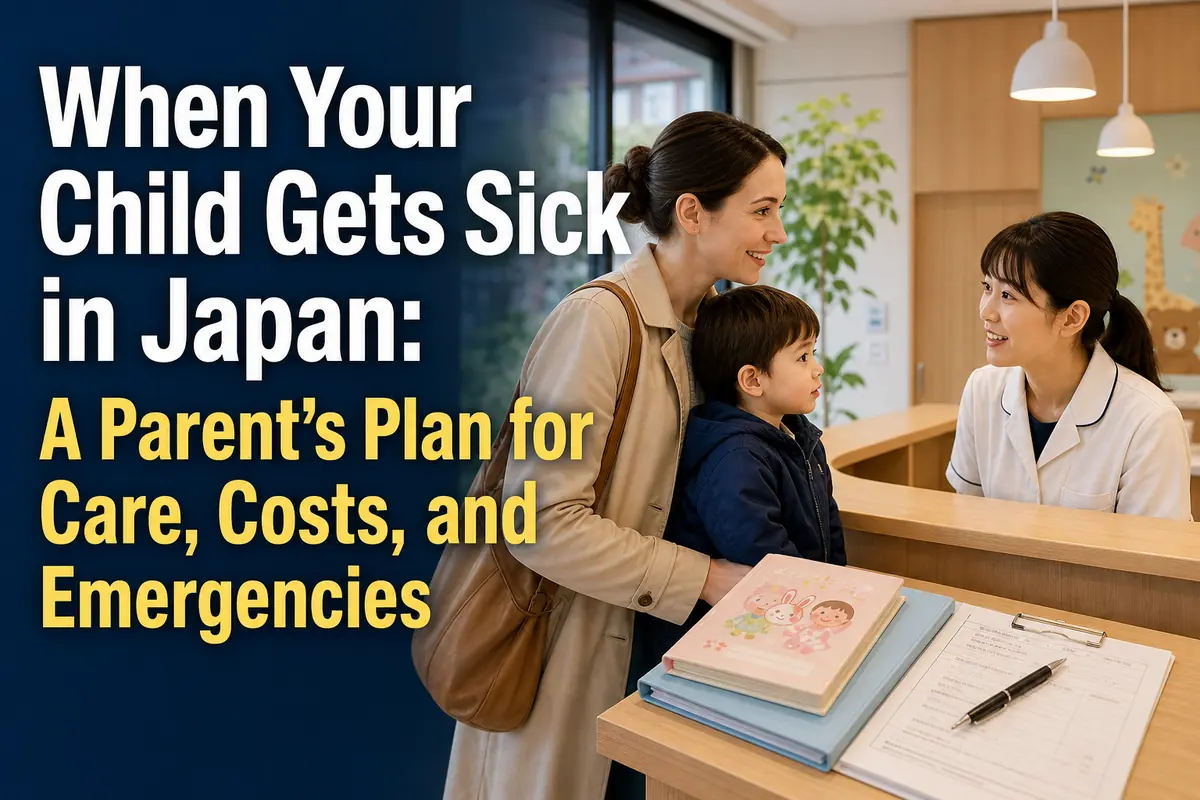
When Your Child Gets Sick in Japan: A Parent’s Plan for Care, Costs, and Emergencies
When a child becomes sick in Japan, the usual first step is to call a nearby pediatric clinic during its opening hours. For urgent danger, call 119 for an ambulance. If the situation happens at night or on a holiday and you are unsure what to do, call #8000 for pediatric telephone advice.
The bill may be much lower than the standard health-insurance copayment if your child has a medical subsidy certificate from your municipality. This local certificate is separate from the child’s health-insurance coverage, so families generally need both.
This guide is for foreign residents caring for children in Japan, including newly arrived families who have not yet chosen a regular pediatrician.
The essential plan:
- Save the phone number and opening hours of a nearby pediatric clinic.
- Enroll the child in the appropriate public health-insurance system.
- Apply separately for your municipality’s child medical expense subsidy.
- Use #8000 when you need advice during its local operating hours.
- Call 119 immediately when the child appears to be in serious danger.
Choose the right place for care
A local pediatric clinic is normally the best starting point for a non-emergency illness or minor injury. A larger hospital is more appropriate when the child needs specialist treatment, admission, or emergency care.
Pediatric clinics for ordinary illnesses
Search for 小児科 (shōnika), which means pediatrics. Pediatric clinics commonly handle concerns such as fever, cough, vomiting, rashes, minor injuries, and follow-up care.
Many clinics divide the day into short consultation periods. Some also separate general appointments from vaccination or infant-checkup appointments. Before leaving home, check:
- whether an appointment is required;
- whether online booking is available;
- the final reception time, which may be earlier than the closing time;
- whether patients with fever must call before entering;
- whether the clinic can provide support in English or another language;
- which ages the clinic accepts.
A clinic can issue a referral if hospital tests, specialist care, or admission may be needed. Going directly to a large hospital without a referral can sometimes result in an additional charge, depending on the hospital and circumstances.
Hospitals and after-hours facilities
Hospitals do not all provide walk-in pediatric emergency treatment around the clock. The hospital nearest your home may not have a pediatrician on duty at night.
Municipalities often publish separate information for:
- holiday clinics;
- nighttime emergency centers;
- hospitals on pediatric emergency duty;
- regional medical-information telephone services.
Check your city or ward website before an emergency occurs. Search the municipality’s name with 小児救急, meaning pediatric emergency care.
For a broader search, the JNTO medical institution guide lets users filter facilities by area, language, and medical department, including pediatrics. Its listings are a starting point rather than a guarantee: call the facility to confirm its hours, language availability, and ability to treat the child’s condition.
What to take to the appointment
Bring proof of insurance and the local subsidy certificate whenever possible. Missing either document can change what you must pay at reception.
Prepare the following:
- the child’s Myna Health Insurance Card or Certificate of Eligibility;
- the municipality’s child medical subsidy certificate or medical card;
- the Maternal and Child Health Handbook;
- the clinic’s patient card, if the child has visited before;
- a list or photograph of current medicines;
- allergy and chronic-condition information;
- temperature readings and the time symptoms began;
- cash or another accepted payment method;
- diapers, a towel, drinks, or feeding supplies for a young child.
If the family has recently moved to Japan, also bring overseas vaccination and medical records. A short English summary can help, but ask the clinic whether it can read documents in that language.
Make the symptoms easier to explain
Write down a simple timeline before the appointment. Include what changed and when.
Useful details include:
- the highest measured temperature and how it was measured;
- how often the child vomited or had diarrhea;
- whether the child is drinking and urinating;
- any medicine already given, including the dose and time;
- whether the child fell, hit their head, or swallowed something;
- recent travel, known infections, or unusual foods when relevant.
Do not rely only on a translated name for medicine. Show the package, prescription record, or a photograph of the label.
How pediatric medical costs work
Public health insurance and municipal child subsidies are two different layers. Insurance determines the standard covered amount; the municipality may then reduce some or all of the child’s remaining insured copayment.
The standard health-insurance share
For covered treatment, preschool children generally pay 20% under Japan’s public health-insurance system. From school age, the ordinary share generally becomes 30% until the rules for older adults apply. An official Yokohama National Health Insurance explanation, for example, lists a 20% share for preschool children and 30% for most other people.
This is the starting calculation before any eligible local child subsidy is applied.
If you cannot present valid insurance information, the facility may ask for the full amount at first. Ask whether you can claim a refund later after submitting the missing documents. The procedure and deadline depend on the insurer and facility.
What the municipal subsidy changes
Municipal child medical expense subsidies reduce the insured copayment for eligible children. Depending on the municipality, the family may pay:
- nothing for eligible insured treatment;
- a small fixed amount per visit or day;
- part of the normal copayment;
- the bill first, followed by reimbursement after an application.
These programs are local. They are not one uniform national benefit.
The Children and Families Agency’s survey as of April 1, 2025 found that every prefecture and municipality operated some form of child medical expense assistance. Among municipalities, the most common upper age limit for both outpatient and inpatient support was the end of the fiscal year in which the child turns 18.
That does not mean every municipality has identical rules. Differences can include:
- the maximum eligible age;
- income restrictions;
- per-visit or monthly charges;
- treatment inside versus outside the prefecture;
- outpatient, inpatient, pharmacy, and meal coverage;
- reimbursement deadlines;
- treatment related to school injuries or another assistance program.
ここがポイント: Health insurance does not automatically activate the local child subsidy. Ask your city or ward office whether a separate application and certificate are required.
Costs that may remain outside the subsidy
A subsidy usually focuses on treatment covered by public health insurance. Families may still have to pay for items such as:
- private or otherwise uninsured treatment;
- health checks not covered by insurance;
- routine vaccination outside a public vaccination program;
- medical certificates and other documents;
- upgraded rooms or extra bed charges;
- selected-treatment fees at certain hospitals;
- meals during hospitalization, depending on local rules;
- convenience items such as diapers or rented clothing.
Ask the facility which part of an estimate is insured treatment and which part is not. This distinction is more useful than asking only whether the subsidy “covers the hospital.”
Apply for the child medical subsidy early
Contact the municipality soon after the child joins insurance or moves into the city. Waiting until the first illness can leave the family paying upfront while documents are processed.
The responsible counter may be called the child-rearing support, medical subsidy, insurance, or welfare section. The exact name varies by municipality.
Common eligibility conditions
Although local rules differ, programs commonly require the child to:
- have a registered address in the municipality;
- fall within the local age limit;
- be enrolled in an eligible Japanese health-insurance plan;
- not receive overlapping assistance that takes priority.
Foreign nationality alone does not normally exclude a resident child who meets the published conditions. However, address registration, insurance enrollment, residence circumstances, and other individual facts can affect eligibility. Confirm the current requirements with the municipality.
Documents commonly requested
Prepare to show or submit some combination of:
- the child’s insurance information;
- identification for the applicant;
- the child’s My Number information;
- proof of the family’s address;
- bank-account information for reimbursements;
- income or tax information if the municipality applies an income test;
- an application form from the city or ward.
Do not assume that an application for Child Allowance also covers medical expenses. They are separate benefits with separate procedures.
What happens at the clinic
Where direct local processing is available, present both the insurance document and subsidy certificate before payment. The facility calculates the eligible reduction at the counter.
The certificate may not work directly when care is received outside the municipality or prefecture. In that case, you may need to:
- pay the insurance copayment;
- keep the original itemized receipt;
- obtain any form required by the municipality;
- apply for reimbursement before the local deadline.
Keep receipts until the payment and any reimbursement are complete.
Why checking your municipality still matters in 2026
Age limits and application methods continue to change locally. National survey results show the broad direction, but they cannot tell an individual family what card to use next week.
For example, Yokohama expanded its subsidy in June 2026 to cover eligible insured treatment through the first March 31 after a child turns 18. The city states that covered inpatient and outpatient insurance copayments are fully subsidized, while uninsured charges remain outside the program.
Shinjuku’s English guidance also describes certificates for insured children through the first March 31 after age 18. It explains that families can generally use the certificate with their insurance information at medical facilities in the Tokyo metropolitan area, while some other payments require a reimbursement application.
These examples show why a certificate from one city should not be treated as a nationwide card. Confirm the following after a move:
- whether the old certificate must be returned;
- the final date on which it remains valid;
- when to apply in the new municipality;
- whether expenses during the transition can be reimbursed;
- whether a new certificate is issued automatically or only after application.
Nighttime uncertainty: call #8000
#8000 is for situations in which a child suddenly becomes ill or injured and a caregiver is unsure whether urgent medical attention is needed. It is not a substitute for an ambulance in a clear emergency.
The national short number connects callers to the service for their prefecture. According to the Ministry of Health, Labour and Welfare, pediatricians or nurses provide advice about home care and whether the child should be seen at a medical facility.
As of May 22, 2026, all 47 prefectures provided service after midnight, but operating schedules and alternative telephone numbers differed by prefecture. Check the MHLW list for your location and save the ordinary telephone number as well as #8000. A short number may not work from every phone service.
Before calling, note:
- the child’s age;
- the main symptom;
- when it began;
- current temperature;
- medicines already given;
- relevant illness, allergy, or injury information;
- your present location.
Ask your prefecture whether interpretation is available. Do not assume that the #8000 adviser can respond in English.
When to call 119
Call 119 when the child appears to need immediate emergency help. Do not wait for #8000 or search for a clinic when there is an obvious threat to life.
Examples include a child who is not breathing normally, is unresponsive, has severe breathing difficulty, or has another sudden and severe condition. The Fire and Disaster Management Agency’s English ambulance guide provides illustrated examples for adults and children.
When calling 119:
- State that you need an ambulance:
Kyūkyūsha onegaishimasu. - Give the address and a nearby landmark.
- Describe what happened and the child’s condition.
- Give the child’s age.
- Provide your name and telephone number.
- Follow the dispatcher’s instructions.
If another adult is present, ask that person to wait outside and guide the ambulance crew to the correct entrance. Gather the child’s insurance information, subsidy certificate, medicines, Maternal and Child Health Handbook, and basic supplies only if doing so does not delay urgent care.
Japan’s ambulance service is available to anyone in the country. Treatment at the destination medical facility is billed separately under the applicable insurance and medical-cost rules.
Common mistakes that create delays or extra costs
Most avoidable problems come from missing local procedures, not from the medical consultation itself. Check these points before your child needs care.
Assuming the subsidy is automatic
Registering an address or enrolling in health insurance may not complete the medical subsidy application. Apply through the municipality and confirm when coverage begins.
Showing only one card or document
The insurance document and municipal subsidy certificate serve different purposes. Keep both accessible, including during travel within Japan.
Going straight to a major hospital for a minor problem
A neighborhood clinic is usually a better first contact for ordinary symptoms. A large hospital may require a referral, charge an additional fee, or direct the family elsewhere.
Expecting every pediatric clinic to accept walk-ins
Online booking slots can close early. Fever patients may use a separate entrance or waiting process. Call before traveling when the clinic’s instructions are unclear.
Throwing away receipts
Original receipts may be needed for reimbursement, high-cost medical expense procedures, private insurance, or other claims. Ask before submitting an original that cannot be returned.
Using an old certificate after moving
Municipal benefits are tied to the registered place of residence. A move can end eligibility under the old city and require a new application.
A practical setup checklist
The best time to prepare is while your child is well. Complete these tasks after moving, changing insurance, or welcoming a child into the household:
- Choose a nearby pediatric clinic and save its booking page.
- Find the local nighttime or holiday pediatric facility.
- Save #8000 and your prefecture’s alternative number.
- Confirm whether #7119 or another general emergency advice service operates locally.
- Save 119 with a note explaining that it is for fire and ambulance emergencies.
- Apply for the municipal child medical subsidy.
- Photograph both sides of important cards for reference, while keeping the originals secure.
- Prepare a medicine, allergy, and medical-history note.
- Check which language-support services are actually available.
Review the list whenever you move to another municipality. The most important watchpoint is not the nationwide insurance percentage but the local rule that determines which certificate to present, where it works directly, and when reimbursement must be claimed.
参照リンク
- Children and Families Agency: 2025 Survey on Medical Expense Assistance for Children
- Ministry of Health, Labour and Welfare: Pediatric Telephone Consultation #8000
- Fire and Disaster Management Agency: Guide for Ambulance Services
- JNTO: Guide for When You Are Feeling Ill
- Yokohama City: National Health Insurance Medical Care Benefits
- Yokohama City: Child Medical Expense Subsidy
- Shinjuku City: Medical Subsidies for Children