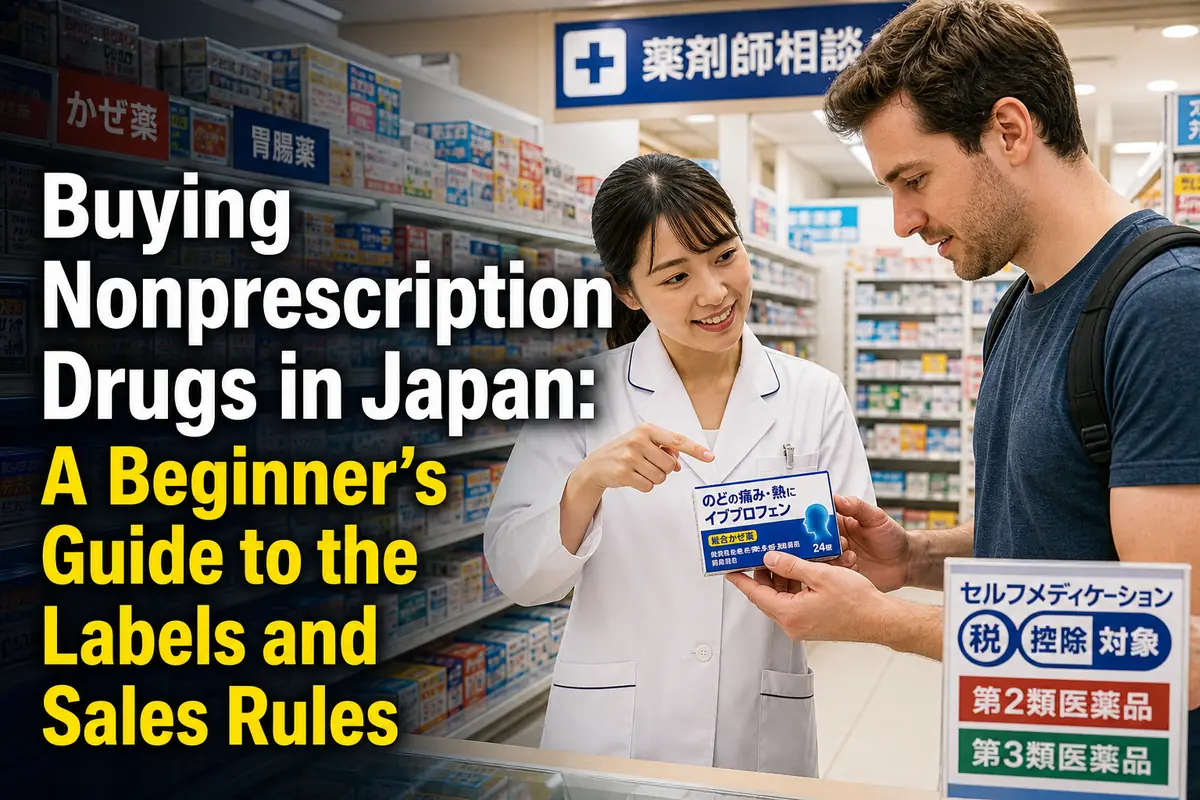
Buying Nonprescription Drugs in Japan: A Beginner’s Guide to the Labels and Sales Rules
You can buy medicines for many common problems in Japanese pharmacies and drugstores without visiting a clinic. Typical options cover pain, fever, cold symptoms, allergies, stomach trouble, minor skin conditions, eye irritation, and motion sickness.
The important difference is how each product is classified and who must help you buy it. A medicine on an open shelf may have different sales rules from one kept behind the counter—even when both treat similar symptoms.
This guide is for new residents, students, workers, and visitors who need to choose a nonprescription product safely.
What to know before shopping:
- Look for the words ippan-yō iyakuhin (一般用医薬品, general-use medicine) or yō-shidō iyakuhin (要指導医薬品, guidance-mandatory medicine).
- First-category medicines require a pharmacist; second- and third-category products can also be handled by a registered seller.
- The category describes the level of sales control and safety information required. It is not a simple ranking of effectiveness.
- Since May 1, 2026, certain medicines with misuse risks have stricter quantity, age-check, and consultation rules.
OTC medicine in Japan is divided into several categories
The label on the package tells you what kind of professional involvement is required. Japan’s nonprescription system includes guidance-mandatory medicines and three risk categories of general-use medicines.
Guidance-mandatory medicine: 要指導医薬品
Yō-shidō iyakuhin (要指導医薬品) generally includes products that need especially careful guidance, such as some medicines that have relatively recently moved from prescription-only use.
A pharmacist must confirm relevant information and explain how to use the product. Depending on the product’s legal subcategory and the approved sales method, you may need an in-person consultation or another form of direct professional guidance. These products are usually not placed where customers can simply pick them up and pay.
This matters when you see an advertisement for a medicine but cannot find it on the shelf. Ask at the pharmacy counter and confirm whether a pharmacist is available.
Category 1: 第1類医薬品
Dai-ichi-rui iyakuhin (第1類医薬品, Category 1 medicine) has the highest level of control among general-use medicines.
- A pharmacist must handle the sale.
- The pharmacist must provide the required information using written or electronic material.
- The shop may ask about your age, symptoms, other medicines, allergies, pregnancy, breastfeeding, or medical conditions.
- The product may be behind the counter or represented by an empty display card.
A drugstore can be open while its Category 1 counter is closed. If no pharmacist is on duty, staff cannot complete the sale merely because the product is in stock.
Category 2 and designated Category 2: 第2類医薬品・指定第2類医薬品
Dai-ni-rui iyakuhin (第2類医薬品, Category 2 medicine) includes many products for everyday symptoms. A pharmacist or a tōroku hanbaisha (登録販売者, registered seller) can sell them.
Some are marked shitei dai-ni-rui iyakuhin (指定第2類医薬品, designated Category 2 medicine). This subgroup requires extra attention because certain people should not use the product or may need professional advice first. Stores must make it easy for buyers to recognize the warning and seek help.
Do not read “Category 2” as “safe for everyone.” A cold remedy, for example, can contain several active ingredients that overlap with a painkiller, allergy tablet, or sleep aid.
Category 3: 第3類医薬品
Dai-san-rui iyakuhin (第3類医薬品, Category 3 medicine) has a lower risk level under the sales classification.
A pharmacist or registered seller can handle the sale. Mandatory proactive explanations are more limited than for Category 1, but you can—and should—ask questions when the ingredients or directions are unclear.
ここがポイント: The number on the box controls how the product is sold and how information must be provided. It does not tell you which medicine is best for your symptoms.
What you can usually buy without a prescription
Japanese drugstores cover many minor, short-term symptoms, but the exact products and ingredients vary. Start with the symptom, then compare active ingredients rather than choosing by package design.
Common nonprescription groups include:
- pain and fever reducers (chin-tsū kai-netsu-yaku, 鎮痛解熱薬)
- cold remedies (kaze-yaku, かぜ薬)
- cough suppressants and expectorants (seki-dome and kyotan-yaku, せき止め・去痰薬)
- oral allergy and rhinitis medicines (bikōen-yō naifukuyaku, 鼻炎用内服薬)
- stomach and digestive medicines (ichō-yaku, 胃腸薬)
- eye drops (megusuri, 目薬)
- medicated creams and patches for minor skin or muscle problems
- motion-sickness medicine (norimono-yoi-yaku, 乗り物酔い薬)
- some smoking-cessation products and other condition-specific medicines
Availability is not proof that a product suits you. Age limits, maximum treatment periods, contraindications, and dose instructions differ by product.
What may still require a clinic or prescription
Do not assume that a medicine sold freely in another country is also OTC in Japan. Products that commonly require medical assessment or a prescription include many systemic antibiotics, regular contraceptive pills, and medicines for ongoing treatment of chronic conditions.
Even when a similar OTC option exists, its active ingredient, dose, or approved purpose may differ from the version sold overseas. Show the pharmacist the generic ingredient name, strength, and a photo of the original package if possible.
If your usual medicine is unavailable, a pharmacist can explain whether Japan has an OTC alternative or whether you should visit a clinic. They cannot diagnose every condition or substitute freely for a prescription product.
How to read a Japanese medicine package
Four parts of the box matter more than the brand name: the category, ingredients, intended use, and warnings. Photographing these sections also makes it easier to ask for translation help.
Look for:
- risuku kubun (リスク区分): sales-risk category
- seibun (成分): active ingredients
- kōnō / kōka (効能・効果): approved uses or effects
- yōhō / yōryō (用法・用量): directions and dose
- shiyō-jō no chūi (使用上の注意): precautions
- shite wa ikenai koto (してはいけないこと): “do not” warnings
- sōdan suru koto (相談すること): situations requiring professional advice
The package may display “第1類医薬品,” “第2類医薬品,” “指定第2類医薬品,” or “第3類医薬品.” The official PMDA OTC search database can also be searched by product name, ingredient, dosage form, intended use, or contraindication, although the interface and most documents are in Japanese.
Paper package inserts continue to be included with consumer-purchased OTC medicines. Keep the insert until you finish using the product.
Medicine, quasi-drug, cosmetic, or supplement?
A drugstore sells many health-related products that are not legally classified as medicines.
- Iyakuhin (医薬品) means medicine.
- Iyakubu-gaihin (医薬部外品) means quasi-drug. Some packages use shitei iyakubu-gaihin (指定医薬部外品).
- Keshōhin (化粧品) means cosmetic.
- Supplements and health foods are generally foods, not medicines.
These labels affect what claims a product may make and how it is regulated. A vitamin supplement and a vitamin-containing medicine can sit close together but have different approved purposes and instructions.
A practical way to ask for the right product
Bring a short symptom-and-medicine checklist instead of relying on a translated product name. This gives the pharmacist or registered seller information they can use.
Tell the staff:
- who will use the medicine and their age
- the main symptom and when it started
- whether it is improving or becoming worse
- any fever and, if known, the temperature
- allergies or previous reactions to medicine
- current prescription drugs, OTC products, and supplements
- pregnancy or breastfeeding, if relevant
- conditions such as asthma, glaucoma, high blood pressure, kidney disease, liver disease, or stomach ulcers
Useful phrases include:
- Kusuri ni tsuite sōdan shitai desu (薬について相談したいです) — “I would like advice about medicine.”
- Eigo de sōdan dekimasu ka? (英語で相談できますか) — “Can I ask in English?”
- Kono seibun wa haitte imasu ka? (この成分は入っていますか) — “Does this contain this ingredient?”
- Ima kono kusuri o nonde imasu (今この薬を飲んでいます) — “I am taking this medicine now.”
Translation apps can help with basic words, but ingredient names and negative warnings are easy to misread. Confirm uncertain points with the professional serving you.
Avoid accidental double dosing
The most common practical danger is taking two products that contain the same or similar ingredients. Combination cold medicines may already include ingredients for fever, pain, cough, runny nose, or drowsiness.
Before combining products:
- Compare every entry under seibun (成分).
- Show all current packages or clear photographs to the pharmacist.
- Ask whether the products can be used together.
- Follow the stated dose and interval.
- Do not continue beyond the package’s recommended period without advice.
Alcohol can increase drowsiness or other adverse effects with some medicines. Certain cold, allergy, cough, and motion-sickness products may also impair driving or machine operation. Read the warnings even if you have used a similarly named product abroad.
Children’s doses require particular care. Do not estimate a dose by splitting an adult product unless the package or a healthcare professional specifically says to do so.
The 2026 rules for medicines with misuse risks
Since May 1, 2026, designated misuse-prevention medicines have stronger nationwide sales controls. These rules can affect some products for colds, coughs, allergies, pain, or sleep because classification depends on their ingredients, not simply the symptom printed on the front.
The Japanese term is shitei ran-yō bōshi iyakuhin (指定濫用防止医薬品, designated misuse-prevention medicine).
When buying one, staff may:
- confirm whether you are under 18
- ask your name when you are under 18, or when otherwise necessary
- ask whether you bought the same or another designated product elsewhere
- ask why you want more than one package or a large package
- limit the quantity or refuse a sale when proper use cannot be confirmed
- provide information about misuse and safe use
For buyers under 18, sales of multiple packages or a large package are prohibited. A single “small package” is generally defined by the amount of medicine it contains: up to five days at the stated dose, or up to seven days for cold medicines, fever and pain medicines, and oral rhinitis medicines.
The consultation method also changes according to age and package size. Buyers under 18 must receive the required interaction in person or through real-time video and audio. Large-package or multiple-package sales to adults also require an in-person or real-time video consultation. The official rules allow more flexible communication for an adult buying a small package, while still requiring the prescribed checks and information.
These questions are part of the national sales system. They are not an accusation against an individual customer.
Buying medicine online
Use an online seller only after confirming that it is connected to a licensed Japanese pharmacy or drugstore. The Ministry of Health, Labour and Welfare publishes a list of reported OTC sales websites.
A legitimate site should clearly display information about its operating pharmacy or store, its permit, and the professionals responsible for medicine sales. Category 1 and other controlled products may require questions and information exchange before checkout or shipment.
Be cautious when a site:
- hides the seller’s physical store or permit information
- promises a prescription-only medicine without a prescription
- sells a foreign product that is not approved for sale in Japan
- allows required safety questions to be skipped
- promotes unusually large quantities without explanation
A product’s approval overseas does not automatically permit its commercial sale in Japan. Personal import rules are a separate subject and carry additional health and legal risks; confirm them with the relevant Japanese authority before ordering.
When self-treatment should stop
OTC medicine is intended for symptoms suitable for self-care, not for delaying necessary medical attention. Seek professional help if symptoms are severe, unusual, rapidly worsening, or outside the uses printed on the package.
Stop using the product and seek advice if you develop a suspected adverse reaction. Urgent symptoms—such as difficulty breathing, loss of consciousness, signs of a severe allergic reaction, or possible poisoning—require emergency assistance rather than another drugstore purchase.
Call 119 for an ambulance in a medical emergency. Availability of non-emergency medical consultation lines and foreign-language support differs by prefecture and municipality, so check your local government’s official information after moving.
For non-urgent medicine questions, take the package and insert to a pharmacist. PMDA also provides information about medicine safety and relief systems, although much of its product-level material is in Japanese.
Common mistakes to avoid
A few checks at the counter prevent most purchasing problems.
- Do not choose only by brand color or a familiar-looking package.
- Do not assume the same brand name has the same formula in every country.
- Do not combine cold, pain, allergy, or sleep products without checking ingredients.
- Do not remove tablets from their labeled package for long-term storage.
- Do not use someone else’s prescription medicine.
- Do not buy extra packages by visiting several stores to avoid safety questions.
- Do not wait until late at night to seek a Category 1 product; a pharmacist may no longer be on duty.
What to check before paying
The safest purchase is one you can explain in terms of ingredient, dose, and stopping point. Before leaving the counter, confirm:
- what symptom the product is approved to treat
- how much to take and how often
- whether it overlaps with anything you already use
- whether it can cause drowsiness
- how many days you may use it
- what warning signs mean you should stop
- whether you need a clinic if the symptom continues
Japan’s classification labels make those questions easier once you know where to look. The next time you enter a drugstore, start with the category printed on the box—and if it is missing, unclear, or behind the counter, ask before choosing a substitute.
参照リンク
- Ministry of Health, Labour and Welfare: Pharmaceutical sales system
- Government of Japan: Drug risks and proper use
- Ministry of Health, Labour and Welfare: 2026 designated misuse-prevention medicine rules
- PMDA: OTC and guidance-mandatory medicine search
- PMDA: Information on electronic and paper package inserts
- Ministry of Health, Labour and Welfare: List of reported online OTC sellers
- Ministry of Health, Labour and Welfare: Reporting potentially illegal medicine websites