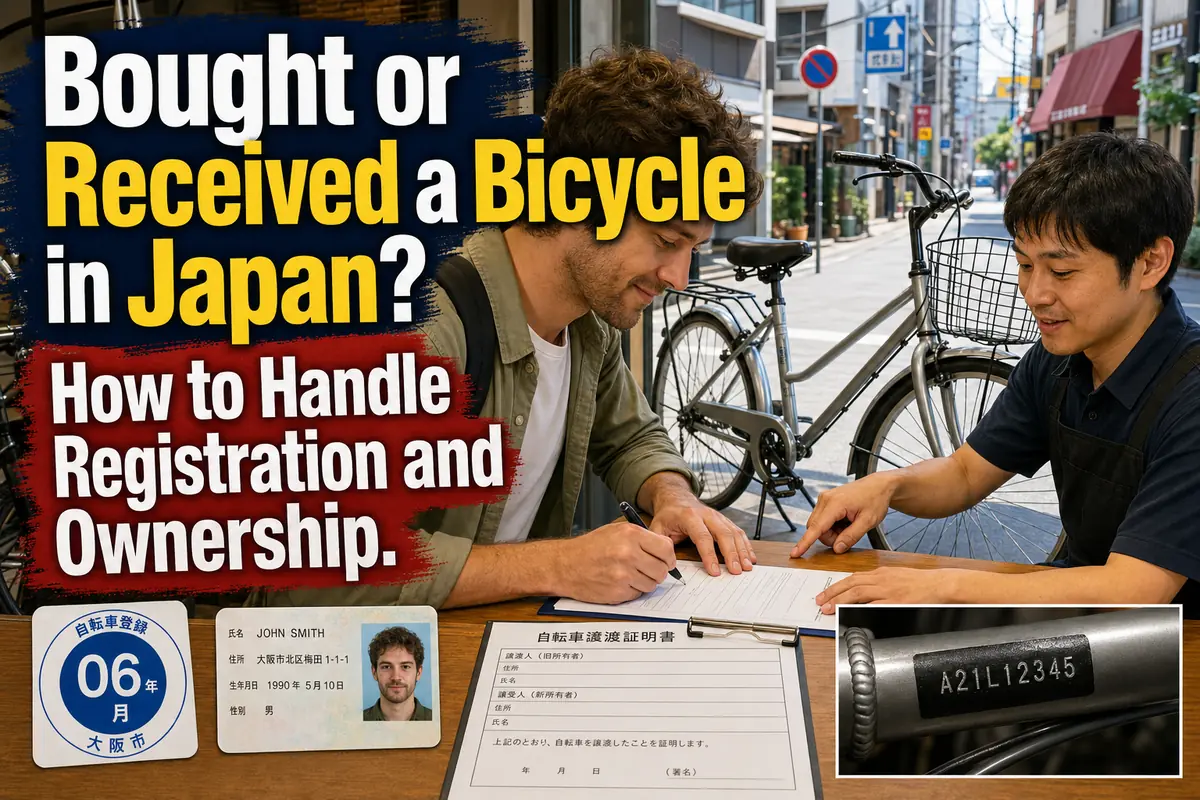
Bought or Received a Bicycle in Japan? Complete the Ownership Paperwork First
If you buy a new bicycle in Japan, register it at an authorized registration counter. If you receive or privately buy a used bicycle, ask the previous owner to cancel their registration and give you proof of transfer before you register it under your own name. When you sell, give away, discard, or move a bicycle to another prefecture, check whether cancellation is required.
The system is called bōhan tōroku (防犯登録), usually translated as anti-theft or crime-prevention registration. Bicycle users are legally required to register, but fees, accepted documents, validity periods, and cancellation procedures are managed at the prefectural level.
This guide is for foreign residents, students, workers, and families who own or plan to acquire a bicycle in Japan.
Quick guide
- New bicycle: the selling shop can normally register it at purchase.
- Online purchase: take the bicycle, identification, purchase evidence, and fee to an authorized counter.
- Used bicycle: obtain the previous registration record or a signed transfer certificate, preferably after the seller cancels the old registration.
- Giving away or discarding a bicycle: cancel the registration according to the rules of the prefecture where it was recorded.
- Moving across prefectures: do not assume the old record can simply be edited; ask both prefectures what they require.
What bicycle registration does—and does not do
Bōhan tōroku links a bicycle’s frame information to its registered user. It helps police identify the owner if the bicycle is stolen, found, or removed from an illegal parking area.
The registration normally records information such as:
- the anti-theft registration number shown on the sticker;
- the bicycle’s frame or serial number;
- the registered user’s name, address, and telephone number;
- details identifying the bicycle.
Registration is not the same as insurance, a bicycle parking permit, or a theft report. Completing one does not complete the others.
Registration is required, but the system is local
Article 12 of Japan’s bicycle-use law requires bicycle users to obtain crime-prevention registration. However, designated organizations in each prefecture operate their own records and procedures.
This local structure has practical consequences. A fee quoted for Tokyo may not apply in Osaka or Kyoto. A Tokyo shop may also be unable to cancel a record created in another prefecture.
For example, information current in August 2026 shows:
- Tokyo charges ¥660 for a new or replacement registration. Since April 1, 2025, a change or cancellation in Tokyo has cost ¥500.
- Osaka Police lists a registration fee of ¥600.
- Kyoto Police lists a ¥600 fee and a ten-year validity period.
These are examples, not a national price list. Confirm the current amount with the registration organization for the prefecture where you will use the bicycle.
ここがポイント: Ownership does not automatically transfer when someone hands over the bicycle, its key, or its registration sticker. The seller’s old record and the buyer’s new registration must be handled as separate steps.
How to register a newly purchased bicycle
The simplest case is a bicycle bought from a shop that displays the 自転車防犯登録所 sign, meaning it is an authorized registration location. The shop will usually offer registration during the sale.
What to prepare
Requirements vary, but expect to need:
- the bicycle itself;
- an official identity document showing your current details;
- the registration fee;
- a receipt, warranty, or sales certificate identifying the shop and bicycle.
A residence card is commonly useful for foreign residents because it shows identity and a Japanese address. Ask the shop in advance if your address has recently changed or if you have another type of identification.
Before leaving, compare the number on the registration card with the sticker attached to the bicycle. Check the spelling of your name, address, and telephone number as well.
Keep the customer copy. You may need it to report theft, change your details, transfer the bicycle, or cancel the record. Photograph both the card and the bicycle’s frame number, then store the images somewhere you can access if the bicycle disappears.
If you bought the bicycle online
An online sale does not remove the registration requirement. Find a bicycle shop, home center, supermarket, or other counter displaying the authorized-registration sign.
Bring the bicycle rather than only its receipt. In Tokyo, the registration organization states that the bicycle and user must appear at the counter in person. It also recommends presenting a warranty or sales certificate showing the seller, product, and frame number.
Call before visiting. A shop may handle registrations for bicycles bought elsewhere, but confirming its hours and document requirements can prevent a wasted trip.
How to take ownership of a used bicycle
The safest order is cancellation by the old owner, followed by a new registration for the new owner. Do not treat the existing sticker as proof that the bicycle is now registered to you.
This matters when receiving a bicycle from:
- a friend, colleague, or departing resident;
- a private seller on a marketplace or auction service;
- a family member whose name is on the current record;
- a secondhand seller that does not complete registration for you.
What the previous owner should do
Before the handover, the registered owner should contact an authorized registration counter in the prefecture that holds the record. Depending on local rules, the owner may need:
- the bicycle;
- official identification;
- the customer copy of the registration card, if available;
- a cancellation fee;
- a cancellation form supplied by the local organization.
After cancellation, the seller should give the buyer the cancellation record and a signed transfer certificate. The original registration card is also useful when available.
A transfer certificate is called jōto shōmeisho (譲渡証明書). Tokyo’s registration organization provides a downloadable form. At minimum, it should identify both parties and the bicycle, including its registration and frame numbers when known.
What the new owner should do
Take the following to an authorized counter in the prefecture where you will use the bicycle:
- the bicycle itself;
- your official identification;
- the required registration fee;
- the transfer certificate;
- the old registration card and cancellation record, if supplied;
- any receipt or marketplace transaction record that supports the purchase.
The exact procedure differs by prefecture. In Tokyo, a change of owner receives a new registration number; the old number is not simply renamed. Kyoto Police likewise advises buyers to confirm that the previous record has been cancelled before making a new registration.
Why a transfer certificate alone may not cancel the old record
This is a common source of confusion. A transfer certificate proves that ownership was handed to another person. It does not necessarily authorize the buyer to delete the seller’s personal registration data.
Osaka’s registration organization explicitly states that the previous owner’s data cannot be cancelled merely because the buyer holds a transfer certificate. It also warns that registering while the old record remains can create duplicate records.
The practical lesson is simple: the seller should complete cancellation before the bicycle changes hands whenever possible.
How to cancel a registration
Cancellation is usually needed when you sell or give away the bicycle, permanently discard it, or move it to another prefecture and must register there.
Selling or giving the bicycle to someone
Do not hand over only the key and bicycle. Complete these steps:
- Locate the registration card and confirm which prefecture issued it.
- Ask that prefecture’s authorized registration organization where cancellation can be completed.
- Bring the required bicycle, identification, documents, and fee.
- Obtain evidence that the record was cancelled.
- Sign a transfer certificate for the recipient.
- Give the recipient the cancellation evidence and relevant bicycle documents.
Shinjuku City’s English guidance describes this seller-first sequence for ownership changes in Tokyo. It also states that the recipient should then bring the bicycle, documents, and identification to a registration location.
Discarding the bicycle
Cancelling the registration does not physically dispose of the bicycle. Disposal rules are separate and vary by municipality.
Your city may treat a bicycle as oversized waste, require a paid collection sticker, or direct you to another service. A bicycle left at an ordinary rubbish point or station is not properly discarded simply because its registration has been cancelled.
Complete both jobs:
- cancel the ownership record through the appropriate registration channel;
- follow your municipality’s bicycle-disposal instructions.
Moving to another prefecture
An address update within one prefecture and a move across prefectural borders may be treated differently.
Tokyo, for example, distinguishes between changing an address within Tokyo and cancelling because the owner is moving outside Tokyo. Its guidance tells owners moving out of Tokyo to cancel the Tokyo record. The rider can then follow the destination prefecture’s procedure.
Before moving:
- identify the prefecture shown on the existing sticker and registration card;
- ask whether cancellation must be completed before departure;
- retain the cancellation certificate and proof of ownership;
- ask the destination prefecture whether a new registration is required immediately.
Do this while you can still visit a local counter. Osaka’s registration organization notes that Osaka registration data can only be cancelled in Osaka, illustrating why postponing the task may create extra work.
Address changes, name changes, and expired records
Not every change means that ownership has changed. A new address or surname may require an amendment rather than cancellation and re-registration.
Moving within the same prefecture
Contact the prefectural registration organization and ask for its change procedure. In Tokyo, a move within Tokyo or a surname change is handled as a change registration, currently costing ¥500.
Do not assume that changing the address on your residence card or at city hall updates the bicycle database. They are separate records.
Registration validity is not uniform nationwide
Check the expiry rule printed on your card or published by the issuing organization. Tokyo’s registration is valid for ten years beginning from the start of the year after registration, while Kyoto states that its registration is valid for ten years from the registration date.
When a record expires, you may need a new registration rather than a simple extension. Tokyo states that data are deleted after ten years and the user must register again if continuing to use the bicycle.
Special cases that need extra care
A small amount of preparation prevents most registration problems, but several cases deserve closer attention.
The seller has lost the registration card
Ask the registration organization that issued the record what substitute evidence it accepts. The seller may still need to appear personally with identification and the bicycle.
Do not create a false receipt or sign for the former owner. If ownership cannot be established, walk away from the transaction rather than accepting a bicycle that may be difficult to register.
The bicycle already has a sticker from another prefecture
A sticker from another prefecture is not automatically invalid, but it signals that another organization holds the record. Contact that organization before attempting a new registration.
A new local sticker placed over an unresolved record can leave two ownership records connected to one bicycle. That may delay a police ownership check or recovery after theft.
You imported the bicycle from overseas
Bring the bicycle and documents showing how you obtained it, such as an overseas receipt, shipping record, warranty, or sales certificate containing the frame number. Ask a local counter what evidence it accepts before visiting.
It has pedals, but it may not legally be a bicycle
Some throttle-equipped or self-propelled vehicles look like electric-assist bicycles but are legally treated as mopeds or motorcycles. Tokyo’s registration organization states that a pedal-equipped vehicle capable of moving under motor power cannot receive ordinary bicycle anti-theft registration merely because the rider chooses not to use that mode.
Such a vehicle may require a licence, number plate, compulsory motor insurance, and other equipment before it can be used on public roads. Confirm the vehicle classification with an official authority or qualified seller before purchase.
Common mistakes to avoid
Most difficulties occur during a private sale, move, or disposal—not when buying a standard bicycle from a shop.
- Assuming the sticker belongs to the bicycle forever: registration connects the bicycle to a particular registered user.
- Calling every procedure a “name change”: a new owner may need a new number, while the previous owner separately cancels the old record.
- Leaving cancellation until after moving overseas: the issuing prefecture may require the bicycle or the registered owner’s participation.
- Using fees from another prefecture: there is no single nationwide registration price.
- Throwing away the customer copy: it supports later changes, cancellation, transfer, and theft reporting.
- Going to city hall automatically: city halls generally do not operate the registration counter. Inagi City, for example, directs residents to a bicycle shop.
- Assuming every police box processes registration: official local instructions may direct users to designated shops instead. Confirm locally before visiting.
- Confusing registration with a theft report: if the bicycle is stolen, report the theft to police and provide the registration and frame numbers.
A practical handover checklist
Use this checklist when buying or receiving a used bicycle:
Before paying or accepting it
- Compare the frame number with the paperwork.
- Ask who is named on the current registration.
- Confirm which prefecture issued the sticker.
- Request cancellation by the registered owner.
- Obtain a signed transfer certificate.
- Keep the sales listing, receipt, or message confirming the transaction.
At the registration counter
- Bring the complete bicycle.
- Bring current official identification.
- Bring the transfer, cancellation, and purchase documents.
- Carry enough money for the local fee.
- Check the completed card before leaving.
After registration
- Confirm that the sticker and card numbers match.
- Photograph the card, sticker, and frame number.
- Store the original card safely.
- Record the local registration organization’s contact details.
Current position as of August 2026
The national duty to register remains, while the process is still administered by prefectural organizations. That means foreign residents should continue to expect differences in price, accepted identification, cancellation channels, and validity periods.
Tokyo’s 2025 introduction of ¥500 fees for changes and cancellations is an important reminder that even a familiar local procedure can change. Check current official instructions shortly before a sale, move, or disposal instead of relying on information received when the bicycle was purchased.
The next action depends on your situation:
- Buying new: register through the seller before riding away when possible.
- Buying used: make cancellation and transfer documents conditions of the transaction.
- Giving a bicycle away: cancel first and provide a signed transfer certificate.
- Moving prefectures: contact both the issuing and destination organizations before departure.
- Discarding: complete registration cancellation and municipal disposal separately.
The most useful document is the small customer copy many owners misplace. Find it now—before theft, a private sale, or an international move turns a simple counter visit into an ownership problem.
参照リンク
- e-Gov: Act on Promotion of Safe Use of Bicycles and Comprehensive Advancement of Bicycle Parking Measures
- Metropolitan Police Department: Bicycle Anti-Theft Registration
- Tokyo Bicycle Merchant Crime Prevention Cooperation Association: Registration Q&A
- Tokyo Bicycle Merchant Crime Prevention Cooperation Association: Registering a Bicycle Received from Another Person
- Tokyo Bicycle Merchant Crime Prevention Cooperation Association: Cancelling a Registration
- Tokyo Bicycle Merchant Crime Prevention Cooperation Association: Online and Other Off-Site Purchases
- Tokyo Bicycle Merchant Crime Prevention Cooperation Association: Transfer Certificate
- Shinjuku City: Anti-Crime Registration When Bicycle Ownership Changes
- Inagi City: Where Can I Register My Bicycle?
- Osaka Prefectural Police: Where Bicycle Registration Is Available
- Osaka Bicycle Merchant Crime Prevention Cooperation Association: Registration Information
- Osaka Bicycle Merchant Crime Prevention Cooperation Association: Cancelling Registration Data
- Kyoto Prefectural Police: Bicycle Anti-Theft Registration
- Tokyo Bicycle Merchant Crime Prevention Cooperation Association: Pedal-Equipped Motorized Vehicles