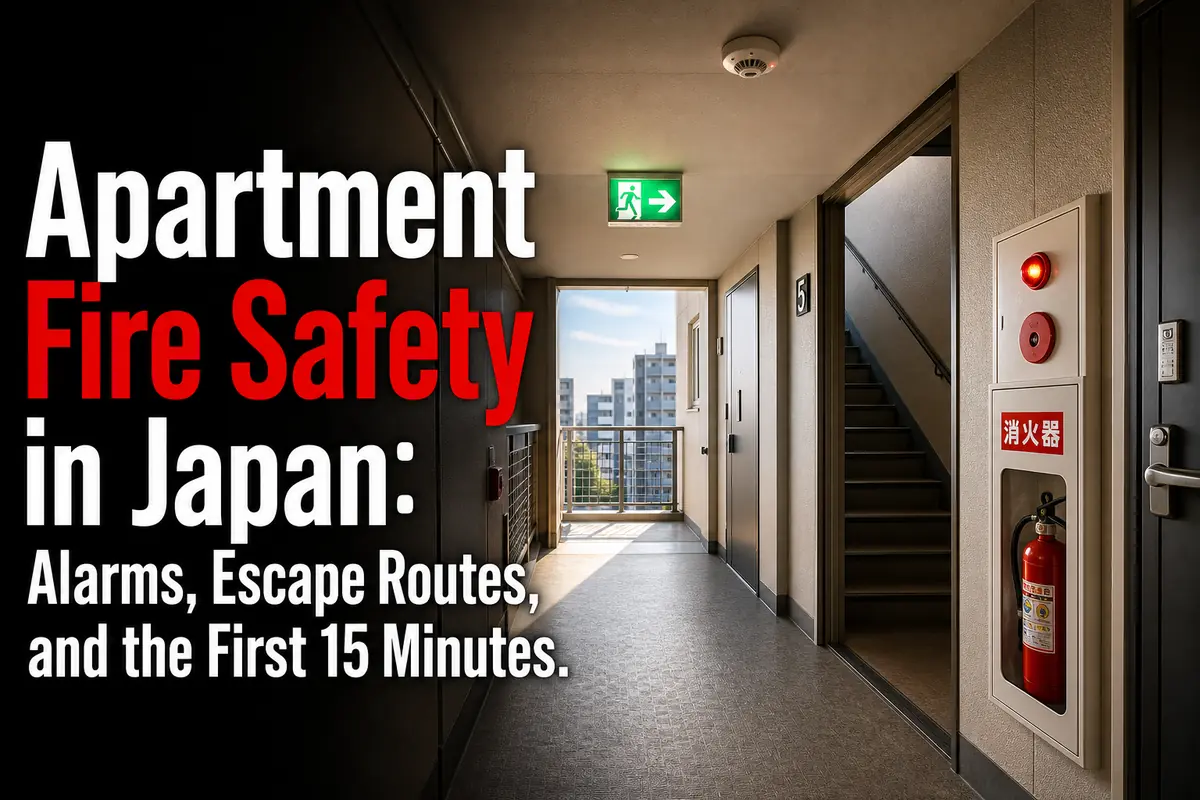
Apartment Fire Safety in Japan: What to Check Before an Emergency
The most important step is to identify two ways out of your apartment before a fire happens. Then test the alarm inside your unit, locate the building’s fire equipment, and make sure no luggage, bicycles, or storage boxes block an exit.
This guide is for foreign residents, students, workers, and families living in rented or owned apartments in Japan. The exact equipment and resident responsibilities depend on the building, municipality, lease, and local fire-prevention ordinance.
Quick safety check
- Find your normal exit and a possible second escape route.
- Test the alarm using its test button; never use smoke or flame to test it.
- Locate shared fire extinguishers without removing or using them for practice.
- Keep corridors, stairs, balcony partitions, and evacuation hatches clear.
- Save your full Japanese address so you can give it when calling 119.
Your escape route matters more than your belongings
Leave early if there is smoke, spreading fire, or any doubt that you can control the situation safely. Do not delay your escape to collect documents, valuables, or a prepared bag.
Start by walking from your front door to the outside of the building. Confirm which staircase reaches ground level and whether a second staircase or another designated route exists. Do this in daylight, then check whether emergency lighting and exit signs make the route understandable at night.
Never assume that an elevator is an escape route. A fire or power failure may stop it, open it onto a smoke-filled floor, or make it unavailable to residents. Tokyo Fire Department guidance tells people evacuating a fire to use the stairs rather than an elevator and not to return after leaving.
Check these places today
- Inside the apartment: Can everyone reach the front door without moving furniture?
- Common corridor: Are boxes, umbrellas, bicycles, or deliveries narrowing the route?
- Stairwell: Do you know which stairway reaches a safe outdoor area?
- Balcony: Is there a marked partition, floor hatch, ladder, or other evacuation device?
- Ground floor: Where does the route finally leave the building?
A balcony is not automatically a safe destination. Some apartment balconies form part of a designated emergency route, while others do not. Equipment may include a breakable partition between neighboring units, an evacuation hatch, or a ladder to a lower floor. Do not break, open, or operate this equipment merely to test it. Ask the building manager how your specific route works and whether residents receive evacuation training.
If smoke or fire blocks every route, move away from the fire, close doors where possible, call 119, state your exact location, and follow instructions from emergency personnel. Do not improvise by climbing over railings or jumping from a height.
ここがポイント: A balcony partition or hatch is useful only when residents know it is part of the building’s plan and keep access to it clear.
Know which alarm you are looking at
An alarm inside your apartment and the building-wide fire alarm may be different systems. Knowing that difference prevents two common errors: ignoring a local alarm because no building announcement follows, or assuming a detector in the corridor also protects every room.
Residential fire alarms
A residential fire alarm, called a jūtaku-yō kasai keihōki (住宅用火災警報器), detects smoke or heat and sounds an alarm. Japan requires residential fire alarms, but detailed installation locations are set through municipal ordinances. National guidance makes sleeping rooms and certain stairs central requirements; local rules may go further.
Tokyo illustrates why location matters. In most of the Tokyo Fire Department area, the local ordinance requires alarms in continuously used rooms, kitchens, and internal stairs. Other municipalities may publish different room-by-room rules.
Check the website of your municipal fire department instead of applying Tokyo’s layout to every home in Japan.
Automatic building fire-alarm systems
Larger or qualifying buildings may have an automatic fire-alarm system with detectors, manual call points, control equipment, bells, or announcements. Its components may be located both inside apartments and in common areas.
Where an approved automatic alarm or sprinkler system already covers a room, a separate residential alarm may not be required. However, a detector installed only in a common corridor does not necessarily cover the private apartment.
Ask the manager these precise questions:
- Is the device in my room a standalone residential alarm or part of the building system?
- Which rooms and common areas does the system cover?
- Who arranges inspection, battery replacement, and equipment replacement?
- What sound or announcement will residents hear during a real alarm?
- How should residents report a damaged, missing, or chirping device?
Do not paint over a detector, cover it while cooking, remove its battery, or disconnect it because of a nuisance alarm. Ventilate the room and follow the manufacturer’s instructions. If false alarms continue, contact the landlord or manager for a proper solution.
Test the alarm and check its age
A silent test is not proof that an alarm will work in a fire. Use the test button or pull cord according to the device’s instructions and confirm that everyone in the household can hear or otherwise perceive the warning.
The Fire and Disaster Management Agency recommends regular operation checks and replacement at about 10 years after installation. Aging affects the whole device, not only its battery, so replacing a battery may not solve an old sensor’s reliability problem.
A practical inspection takes only a few minutes:
- Read the label and identify the manufacturer and model.
- Look for an installation or manufacturing date.
- Press the test button or use the test cord as instructed.
- Listen for a normal confirmation sound or a low-battery warning.
- Check for dust, damage, paint, or an obstruction around the device.
- Record the result and report any problem to the manager promptly.
If you rent, do not assume either that every replacement is your expense or that you may replace connected equipment yourself. Responsibility can depend on the lease, the cause of damage, and whether the device belongs to a building-wide system. Send the manager a written report and keep a copy.
Accessibility needs
A standard audible alarm may not adequately warn a resident who is deaf, hard of hearing, a deep sleeper, or separated by closed doors. Official guidance identifies linked alarms and auxiliary warning devices using sound or light as possible improvements.
Families should also decide who will help children, older relatives, or residents with limited mobility. Tell the building manager in advance if a household member may need assistance during an evacuation, and ask what local support or registration systems are available.
Understand the fire extinguishers in your building
A fire extinguisher is for a small, early-stage fire only when you have a clear escape route. It is not a reason to remain in a room that is filling with smoke.
Japanese apartment buildings may have extinguishers in common corridors, near stairways, or in marked cabinets. Some homes also have a compact residential extinguisher. The label shows which kinds of fire the product is designed to handle.
Before an emergency, check:
- the nearest extinguisher’s location;
- whether the cabinet or equipment is visibly blocked or damaged;
- the illustrated operating instructions;
- the marked use or replacement date;
- whether your building conducts drills or demonstrations.
Report missing, discharged, corroded, or obstructed shared equipment. Do not take a common-area extinguisher into your apartment for storage.
When to attempt initial firefighting
Only consider using an extinguisher when all of the following are true:
- the fire is still small and has not spread;
- smoke is not making breathing or visibility difficult;
- someone has alerted others and called, or is calling, 119;
- you know how to operate the extinguisher;
- your exit remains behind you and unobstructed.
Tokyo Fire Department’s foreign-resident handbook gives a clear stopping point: if flames reach the ceiling, stop trying to extinguish the fire and escape.
For a typical portable extinguisher, the illustrated sequence is to pull the safety pin, aim the nozzle toward the base of the fire, and squeeze the lever. Follow the instructions printed on the actual unit because products differ.
Never fight a fire from a position that allows flames or smoke to cut off your exit. Smoke can become dangerous before flames appear large.
What to do when an alarm sounds
Treat an unexplained fire alarm as real until a responsible person or the fire department confirms otherwise. Waiting for visible flames can remove the safest opportunity to leave.
- Alert other people in your apartment.
- If there is smoke or fire, leave immediately by the safest usable route.
- Close doors behind you when you can do so without delaying escape.
- Use the stairs, not the elevator.
- Call 119 from a safe place.
- Follow firefighters, building staff, alarms, and emergency announcements.
- Do not re-enter for pets, documents, medicine, or valuables.
When calling 119, be ready to say whether there is a fire, give the address, identify a nearby landmark if needed, explain what happened, and give your name. Keep your building name, room number, postal code, and Japanese-format address in your phone and on paper near the entrance.
Multilingual handling varies among local fire departments. Tokyo provides English support and uses an interpretation service for several other languages. The national fire agency also promotes three-way telephone interpretation, but residents outside Tokyo should confirm the services offered by their local department.
Costs and responsibilities for renters
There is no single nationwide price or payment rule for every apartment. The practical question is whether the item belongs to your household, the landlord, or the building’s shared fire-safety system.
Tokyo Fire Department information gives a broad retail indication for residential alarms: from several thousand yen to more than ¥10,000 per unit, depending on the product and features. Linked alarms, light-based alerts, and other accessibility features may cost more. Actual prices change, so compare current products and confirm that they meet applicable Japanese standards.
Possible responsibilities include:
- Tenant: routine care, reporting problems, keeping evacuation routes clear, and avoiding damage or tampering.
- Landlord or management company: responsibilities stated in the lease, building maintenance, and management of shared equipment.
- Building association: maintenance decisions for common property in a condominium.
- Qualified contractor: inspection or work that residents should not perform themselves, particularly on connected systems or electrical wiring.
Before buying or installing anything, contact the manager. A private alarm placed in the wrong location does not repair a failed building system, and an unapproved modification could create another problem.
Regional and building differences
National law provides the framework, but municipal ordinances and building conditions determine many details. Construction, height, floor plan, use, and installed systems can all affect the required equipment.
Check three levels of information:
- Your apartment: the lease, move-in documents, equipment labels, and floor plan.
- Your building: instructions from the owner, manager, or condominium association.
- Your area: the municipal fire department’s alarm and evacuation guidance.
High-rise buildings, mixed-use buildings with shops, company housing, student dormitories, and short-term accommodation may have procedures that differ from a small residential block. Never assume that a route or alarm system works exactly like one in a previous home.
Common mistakes to avoid
Most failures are ordinary actions that seemed harmless at the time.
- Removing an alarm battery after a cooking alarm and forgetting to replace it.
- Assuming a corridor detector protects the entire apartment.
- Storing suitcases or boxes in front of a balcony partition or hatch.
- Leaving bicycles, strollers, or deliveries in a common escape route.
- Planning to use the elevator during a fire.
- Opening a smoke-filled door without first assessing conditions.
- Attempting to extinguish a fire after it has grown or blocked the exit.
- Returning inside for a passport, phone, pet, or other property.
- Buying equipment without checking the lease or building system.
- Applying Tokyo’s alarm-placement rules to another municipality without verification.
A 15-minute fire-safety check
The best next step is a household walk-through, not another purchase. Complete this check with every person who lives in the apartment.
- Walk the main route from each sleeping area to ground level.
- Identify a second route and ask the manager to explain any balcony equipment.
- Test residential alarms according to their instructions.
- Record their approximate installation dates.
- Find the nearest shared extinguisher and manual alarm point.
- Remove your belongings from exits and designated evacuation areas.
- Save the full address and building name in Japanese.
- Decide who will assist children or anyone with mobility, hearing, or vision needs.
- Ask the manager about the next fire drill and unresolved equipment problems.
Information in this guide was checked against official sources available on August 1, 2026. Fire-safety requirements can differ by municipality and building, so confirm the final details with your landlord, building manager, local fire department, or qualified fire-safety professional.
参照リンク
- Fire and Disaster Management Agency — Residential fire alarms and home fire prevention
- Fire and Disaster Management Agency — Residential fire extinguishers
- Fire and Disaster Management Agency — Japanese Fire Standards
- Tokyo Fire Department — Residential fire-alarm questions and installation rules
- Tokyo Fire Department — Evacuation guidance
- Tokyo Fire Department — Life Safety Handbook for Foreign Residents
- Tokyo Fire Department — How 119 emergency calls work