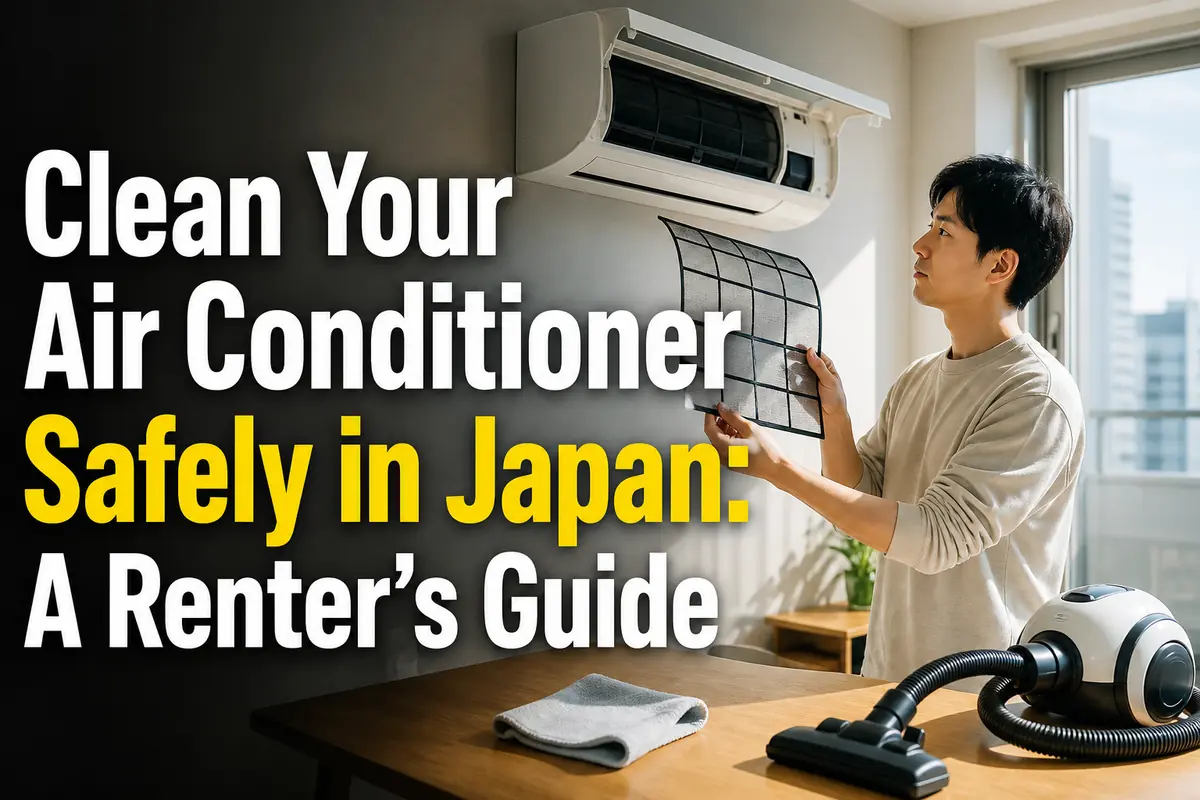
Clean Your Air Conditioner Safely in Japan: A Renter’s Guide
For most wall-mounted air conditioners in Japan, your safe DIY job is limited to the removable filters, exterior, and other parts named in the instruction manual. Leave the heat exchanger, fan, drain pan, wiring, and deep internal cleaning to a qualified service.
If the unit came with a rental home, contact the landlord or property manager before ordering professional cleaning. Who pays depends on the cause of the problem, the lease, and any cleaning clause—not simply on who makes the booking.
This guide is for renters, students, workers, and other residents preparing for Japan’s humid cooling season or dealing with weak airflow, odors, dust, or water leaks.
Quick guide
- Clean removable filters according to the manual; every two weeks is a common manufacturer guideline for units without automatic filter cleaning.
- Do not assume an ojidō sōji kinō (お自動掃除機能, automatic cleaning function) cleans the whole machine.
- Do not spray cleaner into the unit unless its manufacturer specifically permits it.
- In a rental, report faults and ask for written approval before arranging deep cleaning.
Start by identifying the unit and who owns it
The model number and lease determine what you should do next. Before opening the front panel or requesting a quote, identify the machine and establish whether it belongs to you or the property owner.
Look for a label on the bottom or side of the indoor unit. Common Japanese terms include:
- kataban (型番): model number
- seizō nen (製造年): year of manufacture
- torisetsu (取扱説明書): instruction manual
- fīrutā (フィルター): filter
- ojidō sōji or fīrutā ojidō sōji (お自動掃除 / フィルター自動掃除): automatic filter cleaning
- naibu kurīn (内部クリーン): internal-drying or internal-clean function
Search the manufacturer’s official website using the model number and the word “取扱説明書.” Controls, washable parts, drying instructions, and filter-removal methods vary by model.
Check whether the air conditioner is rental equipment
An air conditioner already installed when you moved in may be listed in the lease or move-in documents as one of two things:
- setsubi (設備): equipment supplied as part of the property
- zan置物 / zanchibutsu (残置物): an item left by a previous occupant and not necessarily covered as landlord-maintained equipment
The distinction can affect repair responsibility. Check the lease, the jūyō jikō setsumeisho (重要事項説明書, important matters explanation), the equipment list, and any special clauses.
If the documents are unclear, send the property manager the model number, photos, and a description of the problem. Ask whether the unit is covered equipment and whether you may hire a cleaner.
What you can normally clean yourself
Routine filter care is usually simple, but the manual—not a general online method—sets the limits for your model. Work only when the air conditioner is stopped and follow the manufacturer’s instructions for disconnecting power.
A safe filter-cleaning sequence
- Stop the unit and disconnect power as instructed. Turning it off with the remote may not be enough for maintenance. Use the plug or circuit breaker only as directed by the manual.
- Protect the floor. Place a dry towel or sheet below the indoor unit to catch loose dust.
- Open the front panel carefully. Do not force clips or hinges.
- Remove the filters in the shown direction. Take a photo first if you may forget their position.
- Vacuum loose dust gently. Cleaning from the dusty side helps avoid pushing debris further into the mesh.
- Wash only if the manual says the filter is washable. Use the permitted water temperature and cleaning product. Some special filters must not be washed.
- Dry the filters completely in the approved way. Avoid reinstalling wet filters. Direct heat or strong sunlight may deform some materials.
- Wipe the exterior and accessible louvers with an approved cloth. Do not push a cloth, brush, or tool deep inside.
- Reinstall every part securely. Restore power, then check for warning lights, unusual sounds, or loose panels.
Panasonic gives every two weeks as a basic filter-care guideline while advising users to shorten the interval when dirt builds up faster. This is a general starting point, not a rule for every machine. Homes with frequent use, pets, cooking smoke, or heavy dust may need more frequent checks.
Automatic cleaning does not mean maintenance-free
An ojidō sōji kinō generally removes dust from the filter. It does not necessarily wash the fan, heat exchanger, drain pan, or drain hose.
Some models collect filter dust in a small box that the user must empty. Others move it outside through a duct. The manual will explain which system you have and whether any filter or dust-box care remains necessary.
Similarly, naibu kurīn usually means a cycle intended to dry or manage moisture inside the unit. It is not the same as professional disassembly and washing.
Where DIY cleaning should stop
Do not turn filter maintenance into an internal wash. The electrical and drainage systems sit close to the parts people often try to spray.
Avoid these actions unless the manufacturer’s instructions explicitly authorize them:
- spraying cleaner, water, disinfectant, or alcohol into the heat exchanger or fan
- removing covers, electrical parts, fans, or drain components
- inserting a brush through the outlet
- bending the thin aluminum fins
- using a pressure washer, steam cleaner, or large amount of water
- standing on an unstable chair or furniture
Japan’s National Institute of Technology and Evaluation has documented fires associated with air-conditioner washing liquid reaching electrical components. Daikin also warns that residue and loosened dirt can enter the drain pan or hose and contribute to blockages.
Key point: A removable filter is designed for routine user care. The fan, heat exchanger, drain pan, wiring, and internal drainage route are not automatically safe DIY areas just because they are visible.
Stop using the unit and contact the appropriate party if you notice smoke, a burning smell, sparking, repeated breaker trips, or abnormal heat. Do not open the casing to investigate.
When professional cleaning makes sense
Book professional cleaning for internal contamination, not as a substitute for reporting a fault. Cleaning may help with dirt and odor, but it will not repair a failing motor, refrigerant problem, damaged control board, or incorrectly installed drain.
Professional assessment is reasonable when:
- dark deposits are visible beyond the filter
- a musty odor returns soon after filter cleaning
- airflow remains poor with clean filters
- the fan area is visibly dirty
- the manufacturer recommends professional service
- the unit has not received deep cleaning for a long time and its condition is unknown
Water dripping indoors requires special care. A blocked drain can be one cause, but leaks may also result from installation, damaged parts, icing, or other faults. In a rental, report the leak promptly instead of commissioning a cleaner first.
What professional cleaning costs in 2026
There is no national fixed price. Cost depends on the company, region, model, installation height, access, age, and optional work.
As a concrete reference, Osoji Honpo listed the following tax-inclusive prices in August 2026 after a price revision:
- Standard wall-mounted unit without automatic filter cleaning: ¥14,300 per unit
- Wall-mounted unit with automatic filter cleaning: ¥24,200 per unit
- Ceiling-mounted unit: ¥27,500 per unit
- Optional full disassembly: an additional ¥8,800 per unit
These are one provider’s published prices, not market-wide rates. Obtain a written quote and confirm whether parking, travel, tax, protective covering, reassembly, and optional coatings are included.
Questions to ask before booking
Send the service provider a photo of the indoor unit and model label. Then ask:
- Do you support this exact manufacturer, model, and year?
- Is it classified as an automatic-cleaning model?
- Which parts will be removed and washed?
- Is the drain pan or fan removed, or cleaned in place?
- What is excluded from the basic price?
- Is there an extra charge for height, difficult access, or parking?
- What happens if damage or a leak appears after the work?
- Do you accept older units for which replacement parts may no longer be available?
Some providers may refuse older models or limit their warranty because parts are difficult to obtain. That matters in a rental: if the landlord-owned unit is old, arranging unauthorized cleaning could create a dispute if a brittle part breaks.
Rental rules: ask before paying or authorizing work
Japan has no universal rule saying that every tenant must pay for professional air-conditioner cleaning at a fixed interval. Responsibility depends on the lease, the property’s rules, the condition of the unit, and why the work is needed.
The Ministry of Land, Infrastructure, Transport and Tourism’s restoration guidelines provide a general framework for disputes. Ordinary deterioration and normal use are generally treated differently from damage or deterioration caused by a tenant’s intentional act, negligence, or failure to provide reasonable care. However, the guidelines are not a replacement for reading the actual contract, and special cleaning clauses may affect the result.
A practical way to separate common situations
Routine care: Cleaning an accessible filter and following ordinary operating instructions will often be treated as everyday tenant maintenance.
Equipment failure or age-related trouble: If a supplied air conditioner stops cooling, leaks because of a defect, or fails through normal deterioration, report it to the landlord or management company. Do not assume you must pay for cleaning or repair.
Heavy dirt linked to neglected care: If filters were never cleaned and the unit was damaged or seriously contaminated, the property owner may argue that the tenant failed to take reasonable care. Keep simple records of maintenance and reports.
Optional cleaning for personal preference: If the unit works but you want deeper cleaning, the owner may approve the work while asking you to pay. Get that decision in writing before booking.
Move-out charges: A contract may contain a house-cleaning or air-conditioner-cleaning clause. Check the wording, amount or calculation method, and explanation given when you signed. Do not assume a general “cleaning fee” automatically covers—or excludes—air-conditioner cleaning.
The safest message to a property manager
A short written request reduces misunderstanding:
The air conditioner in [room] has [odor / weak airflow / visible dirt / a leak]. The model number is [number]. I cleaned the removable filter according to the manual, but the problem remains. Is this unit supplied equipment, and will you arrange an inspection or cleaning? If I must arrange it, please confirm in writing whether I have permission and who will pay.
Attach photos or a short video where useful. Keep the reply, quote, receipt, and completion report until after move-out.
Common mistakes that lead to expense or damage
Most avoidable problems come from cleaning beyond the manual or arranging work before confirming responsibility. Watch for these errors:
- Treating a bad smell as proof of mold. Odors can have several causes; describe what you notice without diagnosing the machine.
- Using an aerosol cleaner because the packaging looks universal. Compatibility and safe application depend on the unit.
- Confusing filter automation with complete internal cleaning. Automatic models still require model-specific care and cost more to service professionally.
- Booking the cheapest listing without checking the scope. “Air-conditioner cleaning” may describe different levels of disassembly.
- Paying first and requesting reimbursement later. A landlord may reject an unauthorized service or dispute whether it was necessary.
- Ignoring water leaks. Water can damage walls, flooring, furniture, or another unit. Stop operation when appropriate and report the issue promptly.
- Forgetting access requirements. A cleaner may need working space, water, electricity, and permission to use a bathroom or balcony area.
Timing your cleaning in Japan
The best time is before urgent summer demand, not after cooling performance collapses. Check filters before the main cooling season and before periods of heavy heating use if the same unit provides heat.
Professional companies may be busier when temperatures rise. Booking earlier gives you more time to obtain landlord approval, compare written quotes, and confirm that the provider supports your model.
Regional climate changes the maintenance pattern. Humid areas, rooms used for drying laundry, homes near busy roads, and kitchens connected to living spaces may collect moisture or particles differently. The correct response is not a universal cleaning schedule; it is more frequent inspection combined with the model’s manual.
A simple decision checklist
Use this order when the air conditioner needs attention:
- Find the model number and official manual.
- Confirm whether the machine is supplied equipment, a leftover item, or your own property.
- Stop operation immediately if there is smoke, burning, sparking, abnormal heat, or a serious leak.
- Clean only the user-serviceable filters and surfaces described in the manual.
- If the problem remains, document it with photos and a written description.
- In a rental, ask the landlord or manager who should inspect, approve, arrange, and pay.
- If professional cleaning is approved, obtain a model-specific written quote.
- Keep the permission, invoice, and service report with your rental records.
The most important next step is concrete: photograph the model label and check your lease before anyone removes the air conditioner’s casing. Those two records will tell the manufacturer how the unit should be maintained and help establish who can authorize deeper work.
参照リンク
- Panasonic: How to maintain air-conditioner filters
- Daikin: What users can and should not clean themselves
- NITE: Fire after internal air-conditioner washing
- Ministry of Land, Infrastructure, Transport and Tourism: Restoration guidelines for rental housing
- Ministry of Land, Infrastructure, Transport and Tourism: Rental guidance for foreign nationals
- Osoji Honpo: Air-conditioner cleaning price list
- Osoji Honpo: August 2026 price revision notice