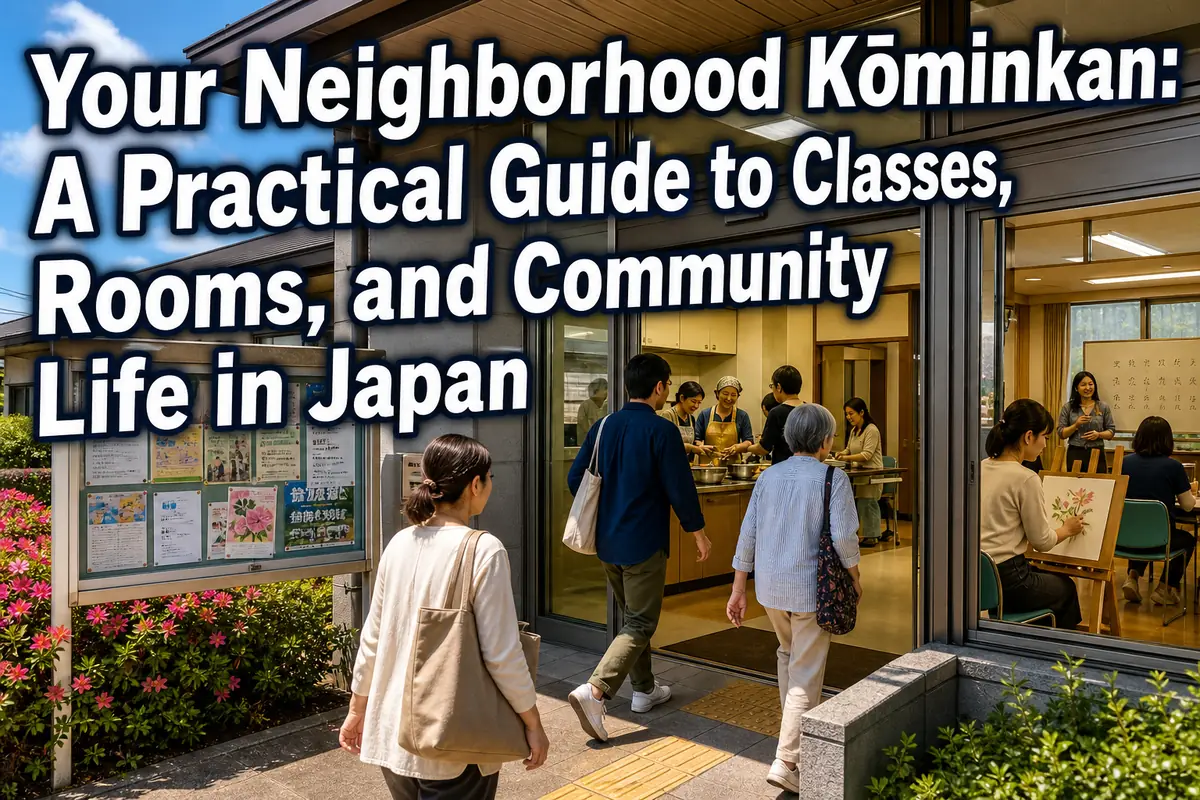
Your Neighborhood Kōminkan: A Practical Guide to Classes, Rooms, and Community Life in Japan
A kōminkan (公民館) is a public community learning center where local residents can join classes, meet activity groups, attend events, and sometimes reserve rooms. It can be one of the least expensive ways to learn a skill and meet people near your home.
However, there is no single nationwide booking system or price list. Your municipality and the individual facility decide who may reserve a room, how registration works, what activities are allowed, and whether a fee applies.
This guide is especially useful for new residents, students, workers, and families who want an affordable local activity or meeting space.
What to know first:
- You can often attend a class without becoming a registered room user.
- Reserving a room may require a group, a local representative, and advance registration.
- Free use is common, but it is not guaranteed; fees and exemptions vary by municipality.
- Rules for sales, paid lessons, political activity, food, music, and equipment must be checked locally.
What is a kōminkan?
A kōminkan is not simply a hall for rent. It is part of Japan’s social education (shakai kyōiku, 社会教育) system: organized learning outside the regular school curriculum, including cultural, recreational, and community activities.
The national Social Education Act describes kōminkan activities such as regular courses, lectures, workshops, exhibitions, recreation, coordination among local groups, and public community use. The Ministry of Education, Culture, Sports, Science and Technology, or MEXT, also describes them as legally based social education facilities established mainly by local governments.
In practical terms, one building may contain:
- Meeting and training rooms
- A washitsu (和室), or Japanese-style tatami room
- A cooking room called a chōrishitsu (調理室)
- An art, craft, or music room
- A hall, projector, microphones, or other shared equipment
- Noticeboards advertising clubs, volunteer work, and local events
Names differ. Depending on the city, a similar facility may be called a community center, civic center, lifelong learning center, district center, or community house. A building with “community center” in its English name is not necessarily a statutory kōminkan, so its rules may come from a different municipal system.
Three ways to use one
The easiest route depends on whether you want to participate, find a group, or organize your own activity.
1. Join a facility-run course or event
Look for kōza (講座), meaning a course or lecture, and ibento (イベント), meaning an event. Typical subjects include exercise, cooking, parenting, computers, crafts, local history, disaster preparedness, and cultural activities.
The notice should tell you:
- Who may apply
- Dates and times
- Capacity and age limits
- Participation or material costs
- Whether applications are first-come-first-served or selected by lottery
- How to apply and the deadline
A course described as free may still require payment for ingredients, textbooks, insurance, or craft materials. Ask what the quoted amount includes.
2. Join an independent group
Many regular users form a sākuru (サークル), or activity circle, and meet at the facility. The center may display recruitment notices or keep a list of registered groups.
Before joining, ask:
- Is the group accepting new members?
- Is a trial visit possible?
- Are meetings conducted only in Japanese?
- What are the membership, instructor, and material fees?
- Must members bring equipment or indoor shoes?
- Does the group expect help with setup, cleaning, or administration?
These groups are usually run by residents rather than by the municipality. A notice on a public board does not necessarily mean that the city operates or guarantees the activity.
3. Reserve a room for your group
Room booking is usually the most rule-heavy option. Some municipalities accept only registered groups, while others allow a broader range of users.
For example, Koganei City’s published guidance has required an eligible social-education group and limits registered groups to a set amount of reservable time. Saitama City’s community-center system requires free user registration before booking and says the registration procedure must be completed at a facility. These are local examples, not rules for all of Japan.
ここがポイント: Joining an advertised class and reserving a room are separate procedures. A person who may attend an event is not automatically eligible to book a room.
How to find your nearest facility
Start with the website of your city, ward, town, or village. Useful searches include:
[municipality name] 公民館[municipality name] 公民館 講座[municipality name] 公民館 施設予約[municipality name] community center English
If “kōminkan” produces few results, try shōgai gakushū (生涯学習), meaning lifelong learning, or chiku sentā (地区センター), meaning district center.
The local ward or city office can also direct you to the correct department. In larger cities, an international association or multilingual consultation desk may help explain the page or make a basic inquiry. Yokohama’s Naka Ward, for example, publishes an English list of community facilities and provides a multilingual city call center.
When comparing facilities, check more than distance. A nearby center may not have a soundproof room, kitchen, accessible route, evening hours, or parking.
How room registration and booking usually work
The exact order varies, but the following sequence is common.
Step 1: Describe the activity clearly
Prepare a short explanation covering:
- What the group will do
- Expected number of people
- Whether participants pay money
- Whether an instructor or business is involved
- Whether food, music, exercise, children, or special equipment are involved
Clear information helps staff identify the right room and rules. “Private lesson” and “resident study circle,” for example, may be treated differently even if both need the same-sized room.
Step 2: Check eligibility
Ask whether the facility accepts individuals or only groups. For group registration, the facility may check:
- A minimum number of members
- How many members live, work, or study in the municipality
- The address of the representative or contact person
- The group’s purpose and rules
- Whether the activity is commercial
Do not assume that foreign nationality is a barrier. The practical issue is usually whether you meet the published residence, group, and activity conditions. If a form is difficult to understand, ask whether staff can explain it in simple Japanese or whether multilingual support is available.
Step 3: Prepare the documents
Depending on the municipality, you may need:
- Riyōsha tōroku shinseisho (利用者登録申請書): user registration application
- Dantai meibo (団体名簿): group member list
- Daihōsha or daihyōsha (代表者): group representative details
- Identification for the representative
- Proof of local employment or enrollment if residence alone does not establish eligibility
- Group rules, an activity plan, or a budget for some registrations
Never submit a list of members’ personal details until you have confirmed what the facility actually requires and how the information should be provided.
Step 4: Register for the reservation system
You may receive a riyōsha ID (利用者ID) or registration card. Some municipalities offer online searches and bookings, but first-time identity checks may still require an in-person visit.
Popular rooms and weekend periods may be allocated through a chūsen (抽選), or lottery. Other bookings open later on a first-come-first-served basis.
Record three separate dates:
- Lottery or application opening date
- Payment or confirmation deadline
- Cancellation deadline
Missing the confirmation step can cancel a reservation. Saitama City, for instance, states that certain reservations require an in-person payment procedure within eight days, with a different deadline for lottery winners.
Step 5: Confirm the room and equipment
A room reservation may not include equipment. Ask separately about:
- Projectors, screens, microphones, and speakers
- Pianos or sound systems
- Cooking equipment and tableware
- Wi-Fi and electrical outlets
- Whiteboards, mirrors, mats, or sports equipment
- Setup time and the required restoration of furniture
Equipment may require advance booking, a separate charge, or staff instruction.
How much does it cost?
There is no reliable nationwide price. The correct amount is the fee shown by your municipality for that room, user category, date, and time block.
Possible cost patterns include:
- No room fee for eligible registered social-education groups
- A fixed fee for morning, afternoon, or evening use
- Different rates for local and non-local groups
- Additional charges for commercial use or events with admission fees
- Separate charges for equipment, heating, air conditioning, printing, or materials
- Reductions or exemptions that require an application
A useful current example of how quickly local policy can change is Koganei City. As of August 22, 2026, the city’s official kōminkan pages describe preparations for charges from September 2026 use while also providing a process under which registered groups may apply for free use. This change does not apply nationally; it shows why an older blog post or a group member’s memory may no longer be enough.
Before confirming a booking, ask for the total cost in writing or point to the relevant fee table. Also check whether a cancellation produces a refund.
Activities that need extra confirmation
The national Social Education Act sets the broad operating framework, while municipal ordinances and facility rules control actual permission and booking.
Article 23 says a kōminkan must not operate solely for profit or assist a particular commercial business. It also restricts support for a particular political party, candidate, or religion. This does not create a simple nationwide rule that every activity touching business, politics, or religion is automatically forbidden. MEXT has specifically discussed the need to interpret the commercial provision carefully.
Staff should therefore be given the real details of the proposed use. Ask before booking if the activity includes:
- Sales, product promotion, customer recruitment, or paid instruction
- Admission fees, instructor payments, or collection of donations
- Party-political, election-related, or religious content
- Food preparation or alcohol
- Loud music, dancing, martial arts, or heavy equipment
- Photography or video involving other users
- Childcare or an event mainly for unaccompanied children
The facility’s answer may depend on its ordinance, room type, safety rules, and the purpose of the group. If permission is important, request confirmation from the responsible municipal office instead of relying only on an informal interpretation from another user.
What to expect on the day
Public facilities usually expect groups to share responsibility for the room.
A practical arrival routine is:
- Check in at reception and follow the key procedure.
- Confirm the evacuation route and the room’s capacity.
- Use only the approved room, equipment, and time period.
- Keep doors, hallways, and emergency exits clear.
- Return tables, chairs, and equipment to their original positions.
- Clean the room and take rubbish home if required.
- Report damage immediately and complete the checkout process.
Your reserved period may include setup and cleanup. If the booking ends at 9:00 p.m., it may mean the room must already be restored and vacated by 9:00 p.m.
Food, outdoor shoes, rubbish, ventilation, and noise rules differ by room. A cooking room may permit food that is prohibited in an ordinary meeting room. A music room may have its own closing time or volume limit.
Common mistakes and how to avoid them
Assuming every public hall is a kōminkan
A civic hall, community center, school community room, and kōminkan may use different booking systems. Confirm the official facility type and managing department first.
Booking before checking commercial-use rules
Charging each participant only enough to cover materials is different from running a profit-making class, but local staff need the full facts to decide how the rule applies. State the fee, purpose, instructor payment, and expected income when you ask.
Treating “free” as “no procedure required”
A zero-yen room can still require registration, a reservation, permission, and a free-use exemption form.
Forgetting that applications may be Japanese-only
Do not wait until a popular booking window opens. Visit early, photograph or download the forms, and identify the fields you cannot read. Useful words include shiyō mokuteki (使用目的), purpose of use; shiyōryō (使用料), usage fee; and genmen (減免), reduction or exemption.
Inviting people before permission is final
An online request, lottery entry, provisional hold, payment, and final permission can be separate stages. Advertise the event only after you know which stage confirms the room.
Questions to ask the facility
You can show staff this compact checklist:
- Can an individual use this room, or must I register a group?
- Must members live, work, or study in this municipality?
- Is my activity permitted?
- Is there a room fee, equipment fee, or material charge?
- Can I apply for a reduction or exemption?
- When does booking open, and is there a lottery?
- When must I pay or confirm the reservation?
- What is the cancellation and refund rule?
- Is food, music, photography, or childcare allowed?
- Is language or accessibility assistance available?
A simple Japanese opening is: “Kono katsudō de heya o kariraremasu ka?” (この活動で部屋を借りられますか?) — “Can I rent a room for this activity?” Bring a written description if the details are complicated.
The practical takeaway
Start as a participant if you are new to the system. Joining one course or visiting an existing circle lets you see how the building works before you take responsibility for a group reservation.
If you need a room, verify these four items on the current municipal page or with facility staff:
- Eligibility: individual, group, and local-resident conditions
- Permission: whether your exact activity is allowed
- Money: room, equipment, material, and cancellation costs
- Timing: lottery, confirmation, payment, and cleanup deadlines
The most important watchpoint is local change. Fees, reservation systems, and exemption procedures can be revised even when the national role of the kōminkan stays the same. Check again each time your registration is renewed or your group changes its activity.
参照リンク
- Social Education Act — e-Gov Law Search
- Social Education in Japan — MEXT
- Providing Lifelong Learning Opportunities — MEXT
- Commercial Activities in Community Centers: Interpreting Article 23 — MEXT Social Education Specialist
- Koganei City Kōminkan Information
- About Koganei City Kōminkan
- Saitama City Community Centers
- Using Saitama City Community Centers
- Main Facilities in Naka Ward, Yokohama